


Quick Numbers
| Men in the phase 3 SCALP trials | 1,465 (US and Europe) |
|---|---|
| Concentration tested for hair loss | 5% topical solution |
| Relative hair count gain vs placebo | 539% (SCALP 1) and 168% (SCALP 2) |
| Longest controlled follow-up | 12 months |
| Planned US filing (NDA) | Early 2027 |
Key Takeaways
| Clascoterone blocks the androgen receptor in the scalp; it doesn't lower DHT in the blood. |
| Two large phase 3 trials in men beat placebo on hair counts, with side effects similar to placebo. |
| It isn't approved for hair loss anywhere yet, and absolute hair count data are still unpublished. |
| Like every hair loss drug, it can only protect follicles that still exist; it doesn't replace a transplant. |
A 31-year-old patient sent his scalp photos last month with a question attached: should he skip finasteride and wait for clascoterone instead? He'd read that a new hair loss drug was close, and that it worked on the scalp without touching his hormones. He's not alone. Since the phase 3 results appeared in December 2025, clascoterone for hair loss has become one of the most common topics in our consultation inbox.
The short version is that clascoterone is a real, well-tested molecule with a new mechanism, and the data so far are encouraging. It's also not on pharmacy shelves for this use, and the numbers making headlines need careful reading. Below is what the trials actually showed, how the drug compares with finasteride, dutasteride, and minoxidil, and where it might fit next to a hair transplant.
What is clascoterone and how does it work on the scalp?
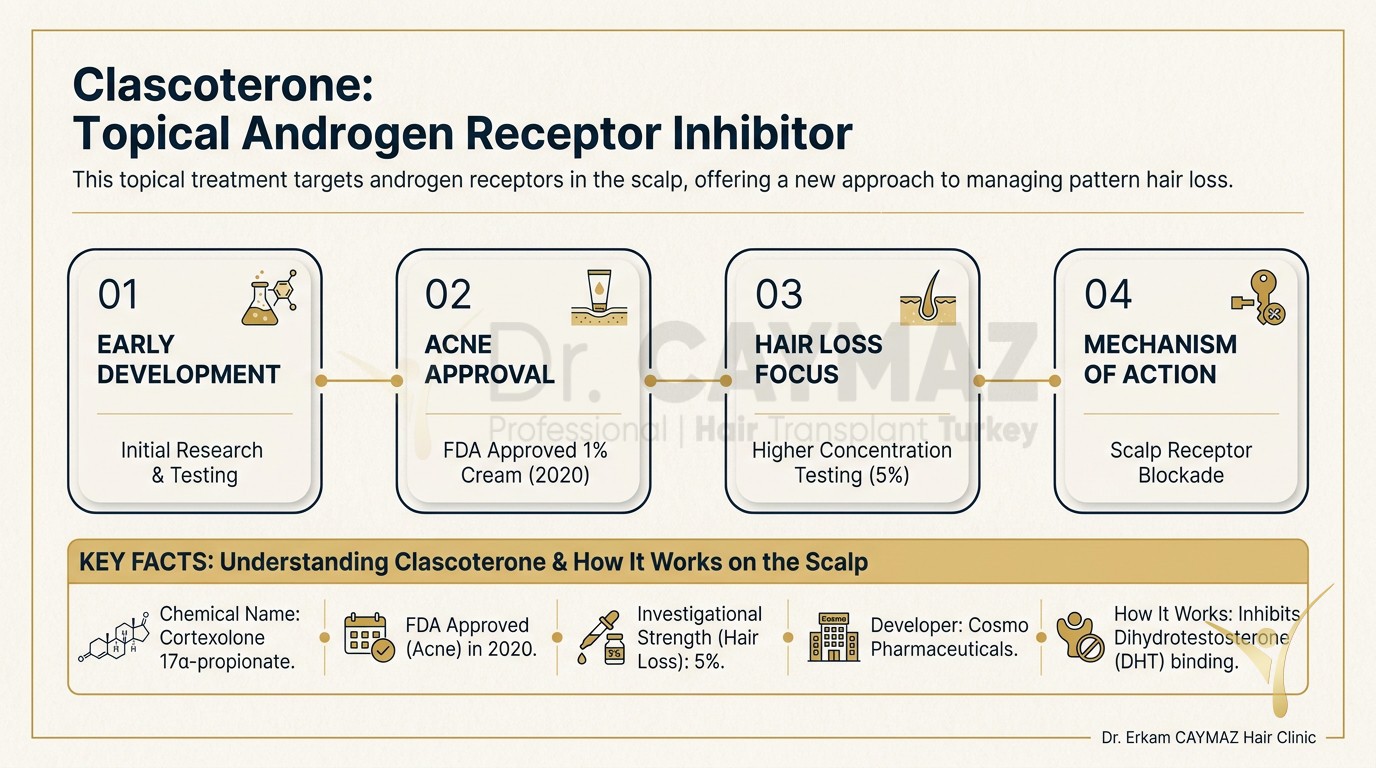
Clascoterone is a topical androgen receptor inhibitor, chemically known as cortexolone 17α-propionate. It isn't new to medicine. The US Food and Drug Administration approved it in August 2020 as a 1% cream for acne, sold as Winlevi. For pattern hair loss, the developer, Cosmo Pharmaceuticals, has tested a stronger 5% solution applied to the scalp.
To see why that matters, it helps to recall how pattern hair loss works. Testosterone is converted by the enzyme 5-alpha reductase into DHT (dihydrotestosterone). In genetically susceptible follicles, DHT attaches to the androgen receptor inside the dermal papilla cells at the base of the hair. That signal shortens the growth phase and shrinks the follicle with every cycle, a process called miniaturization.
Finasteride and dutasteride act one step earlier: they reduce how much DHT the body makes. Clascoterone acts at the end of the chain. It sits on the androgen receptor in the follicle and keeps DHT from switching it on, while blood DHT and testosterone levels stay where they were. A 2019 laboratory study in human scalp dermal papilla cells found it blocked androgen-driven signaling about as well as finasteride did in the same model.
The other half of the design is what happens after it's absorbed. Once clascoterone passes into the skin and bloodstream, it breaks down quickly into cortexolone, a compound with little hormonal activity. That's the reason researchers expect a local effect with limited spillover to the rest of the body.
What did the SCALP 1 and SCALP 2 trials show?
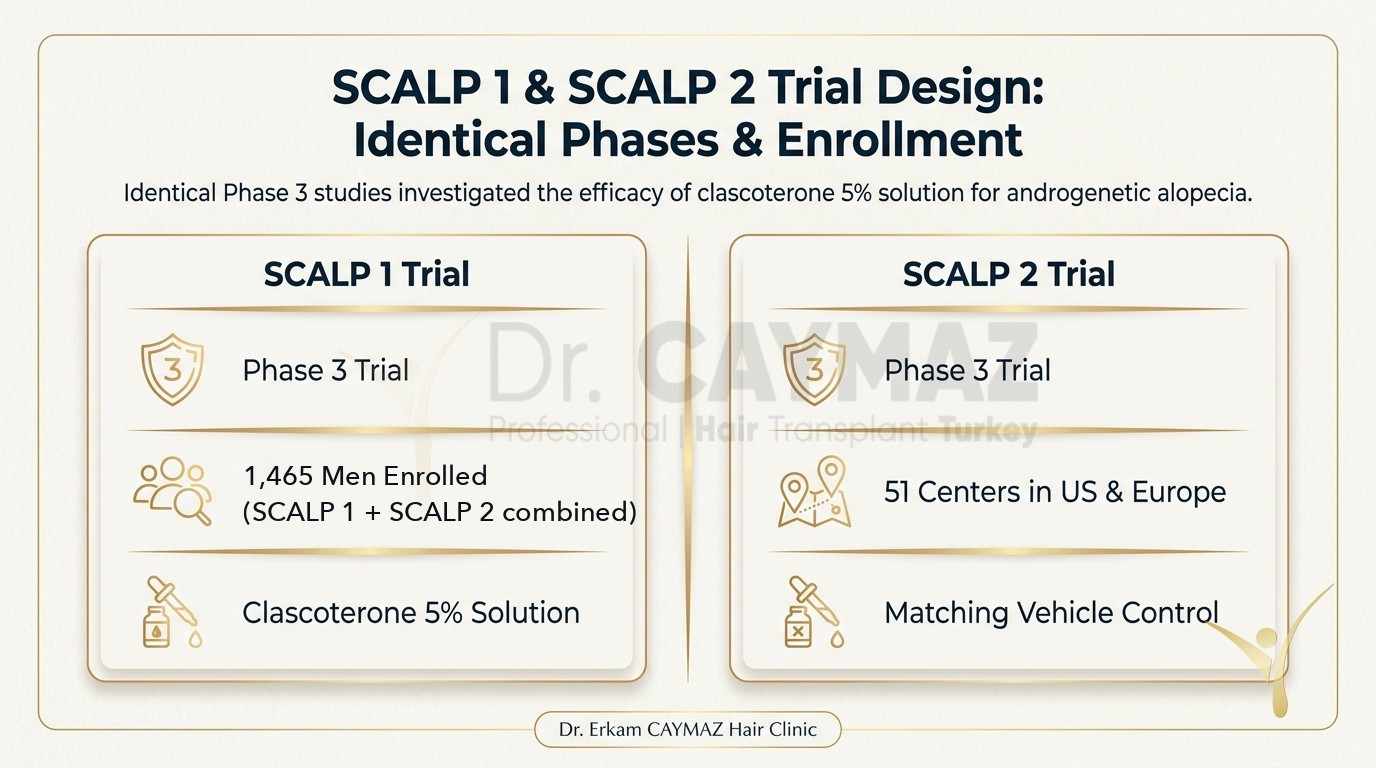
Two identical phase 3 trials, SCALP 1 and SCALP 2, enrolled 1,465 men with mild to moderate androgenetic alopecia at 51 centers in the United States and Europe. Participants applied either clascoterone 5% solution or a matching placebo (the same liquid without the active drug, which trial reports call the vehicle) for six months, double-blind. The main measure was target area hair count, the number of hairs in a marked patch of scalp counted on magnified photographs.
Topline results announced in December 2025 showed that both trials met that goal. Cosmo reported a 539% relative improvement over placebo in SCALP 1 and 168% in SCALP 2. Patient-reported hair growth and satisfaction improved significantly in SCALP 1, showed a positive trend in SCALP 2, and reached significance when both trials were pooled. Treatment-emergent side effects were similar to placebo, mostly mild, and no sexual side effects were reported.
The 12-month data followed in April 2026. Men who kept using clascoterone continued to gain hair between month 3 and month 12. Men who were switched to placebo after month 6 lost a measurable part of what they'd gained, and the continuous group ended with a 2.39-fold better hair count result than the switched group. Safety through 12 months stayed comparable to placebo.
Two cautions keep these figures in proportion. First, "relative improvement" isn't the same as the percentage of hair gained. If the placebo group added a handful of hairs and the clascoterone group added several times that, the relative figure can look dramatic while the absolute difference is moderate. As of October 2026, the absolute counts per square centimeter haven't appeared in a peer-reviewed journal. Second, the trials enrolled men only. An earlier phase 2 study in women didn't produce a statistically conclusive hair count gain, so female hair loss remains an open question.
The earlier phase 2 program in men supports the phase 3 picture. In a 12-month dose-ranging study of more than 400 men in Germany, every dose tested beat placebo on hair count, which is how the 5% twice-daily regimen was chosen.
How does clascoterone compare with finasteride, dutasteride, and minoxidil?
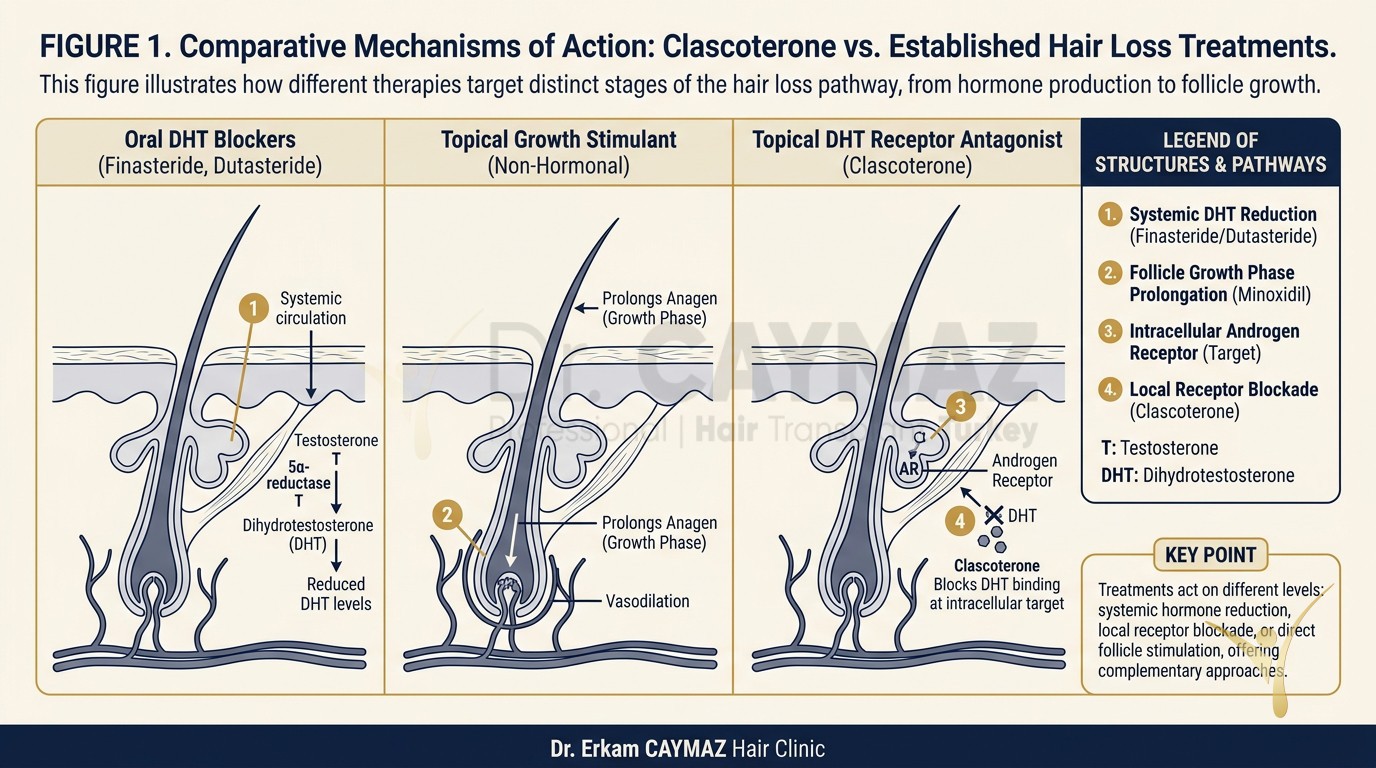
Each current treatment works on a different part of the problem, and that's the clearest way to place clascoterone. The two oral DHT blockers lower the hormone itself. Minoxidil doesn't touch hormones at all; it pushes follicles to stay in their growth phase longer. Clascoterone blocks the hormone's target inside the scalp. Surgery sits apart from all four, because it moves follicles rather than changing their biology.
| Treatment | Main role | How it acts |
|---|---|---|
| Finasteride 1 mg | DHT suppression | Oral tablet; blocks type II 5-alpha reductase and cuts blood DHT by about 70% |
| Dutasteride 0.5 mg | Stronger DHT suppression | Oral capsule; blocks type I and II enzymes and cuts blood DHT by about 90–95% |
| Minoxidil | Growth phase support | Topical, or oral off-label; works on follicle blood flow, not on hormones |
| Clascoterone 5% | Local androgen receptor blockade | Topical, still in trials; blocks DHT at the follicle while blood DHT stays the same |
| Hair transplant | Restores density in bald areas | Surgery; moves DHT-resistant donor follicles into thinning zones |
Clascoterone vs finasteride
Finasteride has been approved for male pattern hair loss in the United States since 1997 and has five-year and ten-year follow-up data behind it. It lowers blood DHT by about 70% and scalp DHT by around 60%. Clascoterone leaves DHT production alone and blocks the receptor locally. On paper, that should spare the whole-body effects that make some men stop finasteride, such as lower libido or erectile difficulty, which affect a small minority of users in trials.
What's missing is a head-to-head trial. Nobody can yet say whether clascoterone grows more, less, or about the same hair as finasteride, and the two have never been tested together in a phase 3 study.
Clascoterone vs dutasteride
Dutasteride is the strongest DHT blocker in common use, cutting blood DHT by roughly 90 to 95%. In a 2014 trial of 917 men, dutasteride 0.5 mg produced higher hair counts than finasteride 1 mg at 24 weeks. It's approved for hair loss in South Korea and Japan but used off-label in most other countries, and its five-week half-life means side effects can take months to fade. The trade-offs of moving from one oral drug to the other are covered in our comparison of finasteride vs dutasteride and when switching makes sense. Clascoterone offers a different trade-off: a weaker hormonal effect that stays in the area where it's applied.
Clascoterone vs minoxidil
These two aren't competitors so much as different tools. Minoxidil works through blood flow and growth-phase signaling, so it doesn't fight DHT at all, which is why it's often paired with a DHT blocker. The contrast between hormonal and non-hormonal pathways is explained in more detail in this overview of how finasteride and minoxidil work. In principle, clascoterone and minoxidil could be combined in the same way, since they don't overlap. That combination still needs trial data before anyone can recommend it.
Is topical clascoterone safer than oral DHT blockers?
The early safety record is good. In both SCALP trials, side effects were comparable to placebo through 12 months, with no significant systemic hormonal effects reported. That fits the drug's design: a topical medicine that's broken down quickly once it enters the bloodstream.
Still, a drug applied to the skin isn't completely free of absorption. The acne cream's US label offers a useful reference. In a study using the maximum amount of 1% cream on the face, chest, and back, a temporary dip in adrenal hormone output, called HPA axis suppression, appeared in 5% of adults and 9% of adolescents after two weeks. All of them returned to normal within four weeks of stopping. Mild rises in blood potassium were seen in 5% of cream users and 4% of placebo users.
The hair product uses a higher concentration on a different area, and so far the phase 3 trials haven't flagged these problems. Regulators will review the full laboratory data before approval, and that's exactly the detail patients should wait for.
One practical warning follows from this. Don't rub acne cream onto your scalp, or buy unregulated "clascoterone" solutions online, while the hair formulation is pending. The 1% cream wasn't designed or tested for hair loss, and products from unverified sellers carry unknown strength and purity.
Dr. Caymaz Insight
| I'm genuinely interested in clascoterone, mostly because of the patients it could help: men who stopped finasteride because of side effects, or who never wanted to take a hormonal tablet in the first place. What I don't do is put a working plan on hold for a drug that isn't available yet. Every month of untreated loss costs follicles that no medicine can bring back. When I plan a hairline, I'm designing for where your native hair will be in ten years, so I need it stable on something proven today. If clascoterone is approved and the full data hold up, I'll gladly add it to that conversation. |
When will clascoterone be available for hair loss?
Not yet, and not soon enough to build a plan around. Cosmo has said it plans to file a New Drug Application with the FDA in early 2027, with a European marketing application prepared in parallel. A standard FDA review usually takes about a year after submission, which points to 2028 at the earliest for US prescriptions, if the review goes smoothly. Europe and other markets would follow their own timelines.
Approval also wouldn't answer every question on day one. Price, insurance coverage, real-world use outside trials, results in women, and data beyond 12 months will all take time. The table below sets clascoterone's current position against treatments patients can use today.
| Treatment | Approved for hair loss? | Evidence so far |
|---|---|---|
| Finasteride 1 mg | Yes: US since 1997, Europe, and many other regions | Over 20 years, with 5- and 10-year data |
| Dutasteride 0.5 mg | South Korea and Japan; off-label elsewhere | Mostly 24-week to 1-year hair trials |
| Minoxidil | Topical form approved widely; oral use is off-label | Decades of use in men and women |
| Clascoterone 5% | Not yet; US filing planned for early 2027 | Two phase 3 trials, 12 months, men only |
| Hair transplant | Established surgical treatment | Long-term surgical outcome data |
Where would clascoterone fit next to a hair transplant?
A transplant and a medicine solve different problems. Grafts come from the back and sides of the scalp, where follicles are genetically resistant to DHT, a principle called donor dominance. Those follicles keep that resistance after they're moved. The native hair around them doesn't, and it keeps thinning unless something protects it. That's the reasoning behind continuing finasteride after a hair transplant, and it's where a topical receptor blocker could eventually earn a place.
The most likely candidates would be men who need native hair protection but can't or won't take an oral DHT blocker. For them, a scalp solution with placebo-like safety could make long-term maintenance more realistic. What clascoterone can't do is regrow hair on smooth, bald scalp. The trials enrolled men with mild to moderate loss, and like finasteride, it works on follicles that are still producing hair, however thin.
That's why stage matters more than the newest drug. Men in the early stages often do well with medication alone, while advanced loss needs grafts to restore coverage. The point at which medication stops being enough is laid out in this guide to medication versus surgery thresholds.
Before any graft count is planned at our clinic, Dr. Erkam Caymaz reviews each patient's medication history alongside the photos. A patient whose native hair is stable allows a more confident hairline and leaves donor reserve for the future.
Timing around surgery would need its own rules. Topical minoxidil is usually paused while the incisions close and restarted on a written date. Any future scalp solution, including clascoterone, would need the same kind of instruction, and no trial has yet studied it on freshly grafted skin.
Should you wait for clascoterone or start treatment now?
For most men with active thinning, waiting is the expensive option. Pattern hair loss progresses, and follicles that miniaturize completely during a two-year wait won't come back with any drug, old or new. Starting a proven treatment now keeps the most follicles alive for whatever comes next.
A sensible approach looks like this:
- Get a diagnosis first. Iron deficiency, thyroid problems, recent illness, and other forms of alopecia can mimic pattern loss.
- Start an evidence-based option with your physician. Finasteride, minoxidil, or both remain the standard first steps for men.
- Track results honestly. Take standardized photos every three to six months and give any treatment about 12 months before judging it.
- Revisit the plan if clascoterone is approved. Switching or adding a topical later is easy; recovering lost follicles isn't.
Women face a different set of choices, since finasteride and dutasteride aren't suitable for those who could become pregnant. Oral antiandrogens are one existing route, and the evidence behind spironolactone and minoxidil together is far more mature for women than clascoterone's is today.
Treatment order matters for men too. Some patients benefit from a year of stable medication before surgery, while others with advanced loss gain little by waiting, and that trade-off sits at the center of the hair transplant or medication first decision.
If you're thinking about a transplant in the next year or two, include your current medication, start dates, and dated photos when you send a hair transplant consultation request. A clear treatment history shapes the plan far more than any drug that's still under review.
Scientific Sources
- PubMed: clascoterone as an androgen receptor antagonist in scalp dermal papilla cells (J Drugs Dermatol, 2019)
- PubMed: emerging pharmacotherapies for androgenetic alopecia, including clascoterone (Expert Opin Pharmacother, 2026)
- FDA: clascoterone cream 1% (Winlevi) prescribing information, HPA axis and potassium safety data
- PubMed: dutasteride versus finasteride and placebo in male androgenetic alopecia (J Am Acad Dermatol, 2014)
FAQ
Clascoterone is a topical androgen receptor inhibitor, chemically cortexolone 17α-propionate. It's approved in the United States as a 1% cream for acne (Winlevi) and is being developed as a 5% scalp solution for male pattern hair loss. It blocks DHT at the follicle instead of lowering DHT in the blood.
No. As of October 2026, clascoterone isn't approved for hair loss in any country. The developer, Cosmo Pharmaceuticals, plans to file with the US FDA in early 2027 and to submit a European application in parallel. A standard review usually takes about a year, so US prescriptions are unlikely before 2028.
Nobody knows yet, because the two haven't been compared directly in a trial. Finasteride has more than 20 years of hair loss data. Clascoterone beat placebo in two phase 3 trials and is designed to avoid body-wide hormonal effects, but its absolute hair count results haven't been published in a peer-reviewed journal.
None were reported in the phase 3 SCALP trials, where side effects were similar to placebo through 12 months. Because clascoterone acts locally and breaks down quickly into an inactive compound, it's expected to spare most of the sexual side effects linked to oral DHT blockers. Full safety data will be reviewed by regulators before approval.
It isn't recommended. The 1% cream was designed and tested for acne on the face and body, not for hair loss, and using it over a large scalp area hasn't been studied. Unregulated clascoterone solutions sold online also carry unknown strength and purity. Wait for the approved hair formulation and a prescription.
In principle, yes, because the two work through different pathways: clascoterone blocks the androgen receptor, while minoxidil supports the growth phase and follicle size. However, the combination hasn't been tested in a phase 3 trial, so any future combined use should follow a physician's advice once the drug is approved.
That's still unclear. The phase 3 SCALP trials enrolled men only, and an earlier phase 2 study in women didn't produce a statistically conclusive hair count gain. Women with pattern hair loss currently have better-established options, such as minoxidil and, for suitable patients, oral antiandrogens prescribed by a physician.
No. Like finasteride and minoxidil, clascoterone works on follicles that are still producing hair. It can't regrow hair on smooth, bald scalp. A transplant moves DHT-resistant follicles into bald areas, while medication protects the native hair around them, so the two are complementary rather than interchangeable.
For most men with active thinning, waiting isn't a good trade. Follicles that miniaturize completely during a one- or two-year wait won't recover with any drug. Starting a proven treatment now with your physician, then reviewing the plan if clascoterone is approved, keeps the most hair available for the future.

When to Start Copper Peptide Serums After Hair Transplant
Copper peptide serums, typically containing GHK-Cu, can support scalp healing and hair follicle recovery after a hair…
Read More: When to Start Copper Peptide Serums After Hair Transplant
1 cm2 At least how many grafts should be planted?
Clinics and forums debate how many grafts per cm² should be implanted. The adult scalp naturally holds many follicular…
Read More: 1 cm2 At least how many grafts should be planted?
How should single grafts be used in the hairline?
Single-hair graft placement in the hairline is a precision design task. Natural framing depends on irregular transition…
Read More: How should single grafts be used in the hairline?
Return-to-Activity Calendar After Hair Transplant
Hair transplant recovery time varies by activity type. Most patients return to desk work within 3 to 5 days, light…
Read More: Return-to-Activity Calendar After Hair TransplantHair Loss — Frequently Asked Questions
Expert Answers by Dr. Erkam Caymaz, Istanbul