


Quick Numbers
| Blood DHT reduction, finasteride 1 mg | About 70% |
|---|---|
| Blood DHT reduction, dutasteride 0.5 mg | About 90–95% |
| Half-life | About 6 hours (finasteride) vs about 5 weeks (dutasteride) |
| Fair trial before judging finasteride | 12 months of daily use |
| Blood donation deferral after last dose | 1 month vs 6 months |
Key Takeaways
| Dutasteride blocks both type I and type II 5-alpha reductase, while finasteride blocks mainly type II. |
| Finasteride should be taken daily for about 12 months before anyone calls it a failure. |
| Side effect rates look broadly similar in trials, but dutasteride stays in the body for months after the last dose. |
| Transplanted grafts resist DHT; the medication protects the native hair around them. |
| A switch is a prescribing decision made with a physician, never a self-started upgrade before surgery. |
A 34-year-old man sends his photos 14 months into daily finasteride. His crown has held steady, but his temples are still retreating, and he asks a question that comes up in consultations almost every week: is it time to move to dutasteride? The finasteride vs dutasteride debate is usually framed as a strength contest, and on paper dutasteride wins. It lowers blood DHT by roughly 90 to 95%, while finasteride manages about 70%.
Suppression numbers don't settle the real decision, though. This article looks at a narrower question: what actually counts as finasteride failure, how the two drugs compare in trials and side effects, and what a switch means if you're also planning a hair transplant.
What exactly does each drug block?
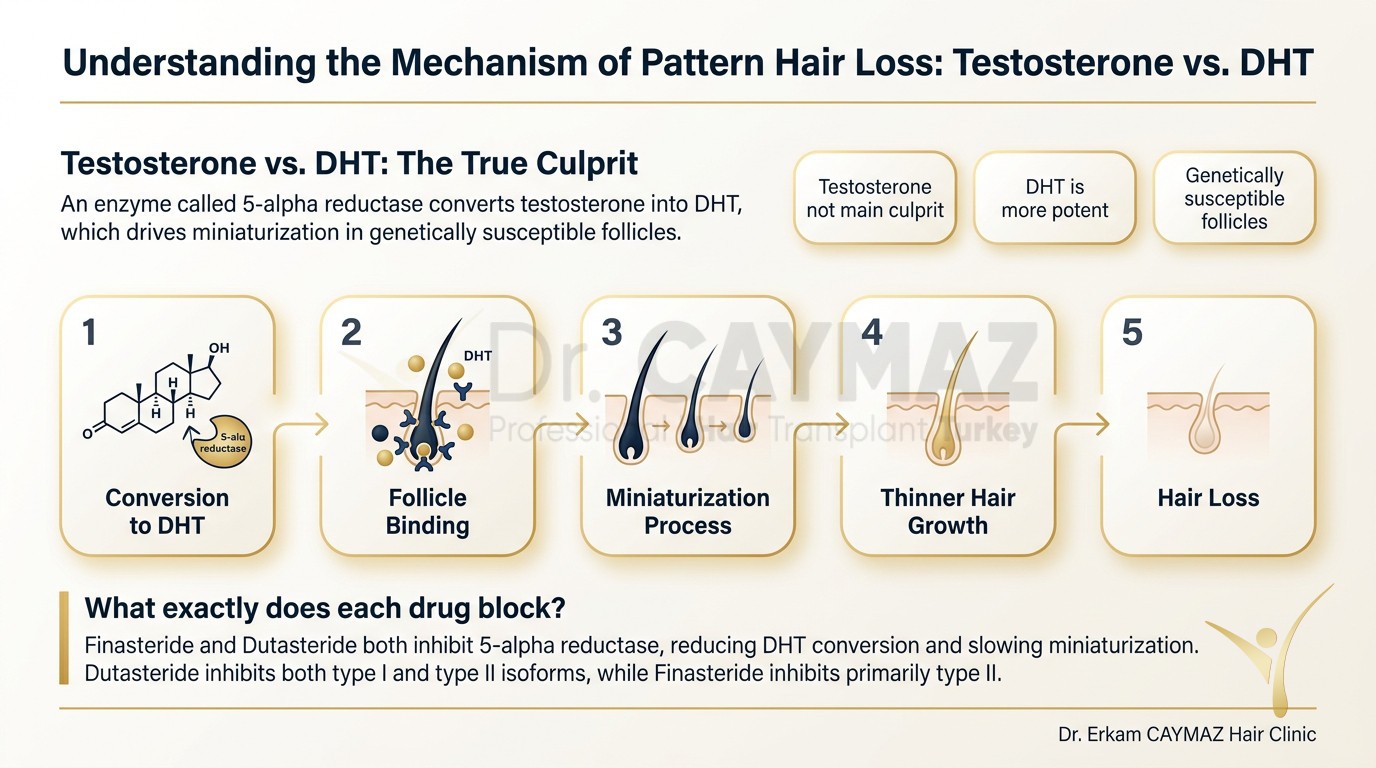
Testosterone isn't the main culprit in pattern hair loss. Its more potent derivative, DHT (dihydrotestosterone), is. An enzyme called 5-alpha reductase converts testosterone into DHT, and in genetically susceptible scalp follicles DHT drives miniaturization: with each growth cycle the follicle shrinks and produces a thinner, shorter, lighter hair, until it stops producing visible hair at all.
The enzyme comes in two main forms. Type I sits mostly in sebaceous glands, skin, and the liver. Type II dominates in hair follicles and the prostate. Finasteride blocks mainly type II, while dutasteride blocks both type I and type II and binds type II more tightly as well. That dual action explains the gap in blood DHT reduction.
Scalp tissue tells a similar story. Biopsy studies show that finasteride 1 mg lowers scalp DHT by around 60%, and dutasteride pushes it lower in a dose-dependent way. Minoxidil works through an entirely different route, acting on blood flow and growth-phase signaling rather than hormones, and the contrast is laid out in this overview of how finasteride and minoxidil work.
One limit applies to both drugs. Neither revives a follicle that has already disappeared. They protect and partly rescue hairs that are still miniaturizing, which is why they work best on thinning zones rather than on smooth, shiny scalp.
How much better does dutasteride perform in head-to-head trials?
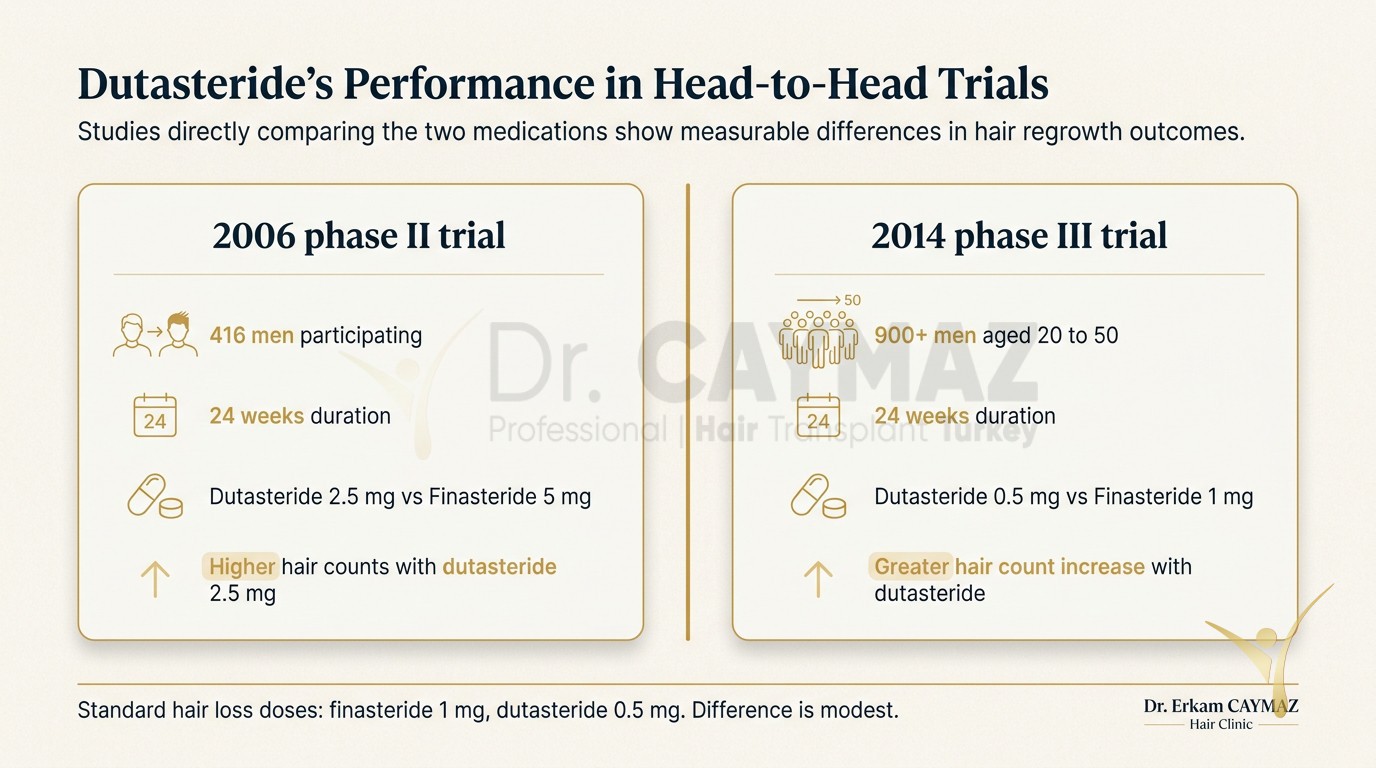
Two randomized trials carry most of the weight. A 2006 phase II study of 416 men compared several dutasteride doses with finasteride 5 mg over 24 weeks and found that dutasteride 2.5 mg produced higher hair counts. A larger phase III trial published in 2014 enrolled more than 900 men aged 20 to 50 and tested dutasteride 0.5 mg directly against finasteride 1 mg. After 24 weeks, the dutasteride group showed a significantly greater increase in hair count within a 2.54 cm diameter target area.
Network meta-analyses, which pool many trials to rank treatments against each other indirectly, also place dutasteride 0.5 mg above finasteride 1 mg for change in hair count. The pharmacology holds up in patients: dutasteride is the stronger DHT blocker, and in the short term it grows modestly more hair.
"Modestly" matters. The difference shows up more clearly in magnified hair counts than in everyday photographs, and most head-to-head data cover six months to a year. Finasteride has something dutasteride lacks for this use: more than two decades of hair loss data, including five-year and ten-year follow-up studies.
Regulatory status differs too. Finasteride 1 mg was approved for male pattern hair loss in the United States in 1997. Dutasteride is approved for hair loss in South Korea and Japan, but in the US and most of Europe it's licensed only for benign prostatic enlargement, so using it for hair is off-label prescribing. That's a legal and common practice, but it calls for an informed discussion with the prescriber. How the drug fits once grafts are in place is covered in a separate discussion of dutasteride use after surgery.
| Feature | Finasteride 1 mg | Dutasteride 0.5 mg |
|---|---|---|
| Enzyme target | Mainly type II 5-alpha reductase | Type I and type II |
| Blood DHT reduction | About 70% | About 90–95% |
| Half-life | About 6 hours | About 5 weeks |
| Time to clear after stopping | Days | Up to 6 months |
| Hair loss approval | US (1997), Europe, and many other regions | South Korea and Japan; off-label elsewhere |
| Hair loss evidence | Over 20 years, including 5- and 10-year data | Mostly 24-week to 1-year hair trials, plus long prostate safety data |
| Effect on PSA | About 50% lower after 6–12 months | About 50% lower after 6–12 months |
| Blood donation deferral | 1 month | 6 months |
| Typical role | First-line oral DHT blocker | Second-line after confirmed non-response |
When is finasteride really considered to have failed?
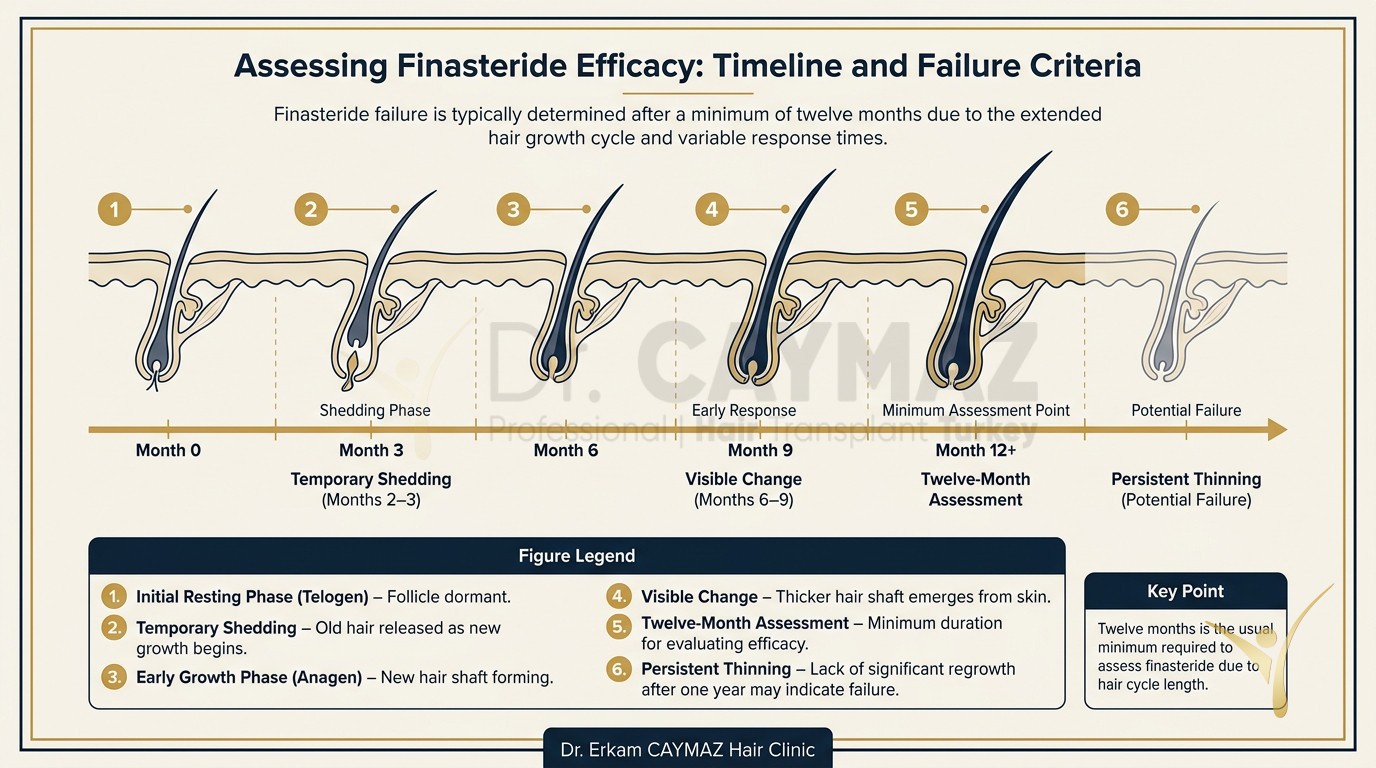
Twelve months is the usual minimum. Hair grows in cycles, and a responding follicle needs time to leave its resting phase and push a thicker hair through the skin. Visible change often starts around months 6 to 9, and some men shed more during the first 2 to 3 months as weak hairs are replaced by stronger ones. Judging finasteride at month four is like judging a new diet after a week.
Before anyone is labeled a non-responder, several checks come first:
- Adherence: finasteride clears within days, and DHT levels climb back soon after doses are missed. Frequent gaps quietly undo the effect.
- Standardized photos: same lighting, distance, and hair length, taken before starting and every 3 to 6 months. Memory is a poor measuring tool.
- Other causes: iron deficiency, thyroid disease, crash dieting, recent illness (telogen effluvium), alopecia areata, and scarring alopecias can mimic or overlap with pattern loss.
- Regional response: finasteride tends to do better on the crown and mid-scalp than on the temples, which are often the slowest area to respond to any medication.
Stabilization counts as success. In five-year finasteride data, roughly 9 in 10 treated men kept or improved their hair on photographic assessment, while most men on placebo lost ground. A patient whose hair looks the same after a year may be doing well, because the untreated alternative was continued thinning.
A true non-responder keeps losing density after 12 months of consistent daily use, with other causes ruled out. That patient has two main options: add minoxidil, which acts through a separate pathway, or move to dutasteride. Where surgery fits in that sequence depends on the stage of loss, as explained in this breakdown of medication versus surgery thresholds.
Do the side effects differ between finasteride and dutasteride?
Less than most people expect. In controlled trials, sexual side effects such as lower libido, erectile difficulty, and reduced ejaculate volume appear in roughly 1 to 4% of men on either drug, and placebo groups report similar complaints at rates not far below. Expectation plays a part. Men who are warned about sexual side effects report them more often than men who aren't, a pattern known as the nocebo effect.
That doesn't make side effects imaginary. Mood changes, including depression, are listed in finasteride's US prescribing information, and a small number of men describe sexual or psychological symptoms that persist after stopping, sometimes called post-finasteride syndrome. Its mechanism and true frequency are still debated. Breast tenderness or enlargement is uncommon with both drugs.
The biggest practical difference is how long each drug stays in your body. Finasteride is gone within days. Dutasteride has a half-life of about 5 weeks, reaches steady levels only after several months, and can remain detectable for up to 6 months after the last dose. If a side effect appears on dutasteride, stopping won't bring quick relief.
A few safety points apply to both drugs:
- PSA: both lower prostate-specific antigen, a blood marker used in prostate cancer screening, by about 50% after 6 to 12 months. Any doctor ordering the test needs to know, and men over about 45 benefit from a baseline PSA before starting.
- Blood donation: donors are typically deferred for 1 month after the last finasteride dose and 6 months after the last dutasteride dose.
- Pregnancy exposure: women who are or may become pregnant shouldn't handle crushed finasteride tablets or leaking dutasteride capsules, because DHT blockade can affect the development of a male fetus.
Dr. Caymaz Insight
| When a patient tells me finasteride has stopped working, my first step is to look at the calendar and the photographs, not the prescription pad. Most of the time he judged it before 12 months or took it inconsistently, and the answer is patience rather than a stronger drug. I don't treat dutasteride as an upgrade everyone should reach for; it's a reasonable second step for a confirmed non-responder who understands its long half-life and off-label status. For surgery, what matters most is that the native hair is stable, because I design the hairline and graft distribution around where your hair will be in ten years, not where it is today. A patient on steady, well-tolerated medication gives me a far more predictable plan to work with. |
Why does this choice matter for a hair transplant plan?
Transplanted hair and native hair behave differently. Grafts are taken from the back and sides of the scalp, where follicles are genetically resistant to DHT, a principle called donor dominance. Those follicles keep their resistance after they're moved. The hair around them doesn't, and it stays under the same hormonal pressure it faced before surgery.
So the DHT blocker question never ends at the operating room. Without medication, native hair behind or between the grafts can keep thinning, leaving a dense transplanted front with a widening gap behind it. The case for continuing finasteride after a transplant rests on exactly that pattern.
Medication status also affects shock loss, the temporary shedding of native hair near the recipient area in the weeks after surgery. Follicles that are already miniaturizing are the most vulnerable, and some never recover if they were near the end of their lifespan anyway. Patients who have been stable on a DHT blocker for 6 to 12 months before surgery tend to have less of this fragile hair at risk. The timing and recovery of shock loss around new grafts follow a predictable course in most cases.
Planning is where the drug decision becomes concrete. Dr. Caymaz designs each hairline and graft map personally from photos sent before travel, and a patient's response to medication shapes that map. A man whose loss has stabilized on finasteride can often have a more confident frontal design. A man still progressing needs a more conservative plan with donor reserve held back for later, whether or not he switches to dutasteride.
For Norwood 4 and above, the clinic recommends at least two sessions spaced a minimum of 6 months apart, rather than a single session of 5000 or 6000+ grafts. The donor area is finite, and overharvesting it to chase density in one day leaves nothing for future loss. How well medication holds the native hair in between sessions strongly influences the logic of planning a second session.
The medication choice doesn't change the surgical technique. Sapphire FUE, in which grafts are extracted with a 0.8–0.9 mm micromotor punch and recipient channels are opened with a V-shaped sapphire blade, remains the default. The method is fixed from the pre-operative photo assessment, never decided on the day of surgery.
Should you stop or switch medication around surgery?
For most patients, stable finasteride or dutasteride use doesn't need to stop for an FUE procedure. Neither drug is a blood thinner, and scalp bleeding during surgery is managed with epinephrine in the local anesthetic, firm gauze pressure, and careful pacing. Your full medication list is reviewed during planning, and any individual instruction is given in writing before you travel.
Switching is a different matter. Avoid starting dutasteride in the weeks just before or after surgery. Dutasteride takes months to reach steady levels, so a last-minute switch adds no protection on the day. And any new side effect becomes hard to interpret while your body is also recovering from a procedure. If a switch is on the table, it makes more sense at least 3 months before the operation or once healing is complete.
Topical minoxidil follows its own schedule. It's usually paused while the incisions close in the first couple of weeks, then restarted on the date given in your written aftercare instructions. Oral DHT blockers generally continue through this period unless your prescribing physician advises otherwise.
If you're weighing a switch and a transplant in the same year, include your medication history, start dates, and dated photos with your online consultation with photos. A clear timeline of what you took and when is often more useful for planning than the prescription itself.
How is a switch from finasteride to dutasteride done safely?
A switch should go through a physician who can prescribe, monitor, and document it, usually a dermatologist, urologist, or family doctor. Because dutasteride is off-label for hair loss in many countries, expect a conversation about evidence, alternatives, and the long wash-out period before you receive a prescription.
The usual sequence looks like this:
- Baseline record: dated photos, a symptom check, and a PSA test where age-appropriate.
- Direct substitution: finasteride is stopped and dutasteride 0.5 mg started, commonly the next day. Taking both together offers no benefit.
- Early review: a check at around 3 months for side effects.
- Efficacy review: photo comparison at 6 and 12 months, using the same standards applied to finasteride.
Some physicians use less frequent dutasteride dosing, such as several times a week, because of its long half-life. That's a prescriber's decision based on individual response, not something to improvise at home.
Certain groups need extra caution or a different plan. Women of childbearing potential shouldn't take either drug. Men actively trying to conceive should discuss timing, since both drugs can modestly reduce semen volume and sperm count. Both are processed by the liver, so abnormal liver tests deserve review before starting, in the same way that elevated liver enzymes before surgery prompt a closer look in transplant candidates. Regular blood donors should factor in the 6-month deferral.
Patients sometimes ask about dutasteride microinjections into the scalp as a way to avoid oral side effects. Small studies exist, but doses and schedules aren't standardized, and the approach doesn't replace a clear decision about oral therapy.
Scientific Sources
- PubMed: randomized trials comparing dutasteride and finasteride in male androgenetic alopecia
- PubMed: network meta-analyses ranking dutasteride, finasteride, and minoxidil
- PubMed: long-term (5-year) finasteride 1 mg outcomes in male pattern hair loss
- PubMed: effect of 5-alpha reductase inhibitors on serum PSA
FAQ
Yes, in terms of DHT suppression. Dutasteride 0.5 mg lowers blood DHT by about 90–95%, compared with about 70% for finasteride 1 mg, and a phase III trial of more than 900 men showed modestly higher hair counts at 24 weeks. The visible difference in everyday photos is usually smaller than the lab numbers suggest.
At least 12 months of consistent daily use. Visible change often begins around months 6 to 9, and early shedding in the first 2 to 3 months is common. Stabilization without regrowth still counts as a response, because untreated pattern hair loss usually keeps progressing.
Trial rates of sexual side effects are broadly similar for both drugs, roughly 1 to 4%. The key difference is duration: dutasteride has a half-life of about 5 weeks and can remain in the body for up to 6 months, so any side effect may take much longer to fade after stopping.
No. Both drugs block the same enzyme pathway, and combining them adds no meaningful benefit while complicating side effect assessment. When a switch is prescribed, finasteride is simply stopped and dutasteride started, commonly the next day.
For most patients, stable finasteride use does not need to stop for an FUE procedure, since it is not a blood thinner. Your medication list is reviewed during planning and any individual instruction is given in writing. Starting dutasteride in the weeks just before or after surgery is not advised.
Transplanted follicles come from the DHT-resistant donor zone and generally keep that resistance. The native hair around them does not, so stopping medication can allow surrounding hair to thin, leaving gaps behind or between the grafts over time.
Dutasteride is approved for male hair loss in South Korea and Japan. In the United States and most of Europe it is licensed only for benign prostatic enlargement, so prescribing it for hair loss is off-label and requires an informed discussion with your physician.
Dutasteride has a half-life of about 5 weeks and can remain detectable for up to 6 months after the last dose. That is why blood donors are deferred for 6 months, compared with 1 month after finasteride.
Women of childbearing potential should not take either drug, and pregnant women should not handle crushed tablets or leaking capsules because of risk to a male fetus. Some physicians prescribe these drugs off-label for selected postmenopausal women after individual assessment.

Hair Mill in Turkey: Avoiding Risky Clinics
A hair mill runs too many transplant cases with too little surgeon oversight. Warning signs include fixed graft quotes…
Read More: Hair Mill in Turkey: Avoiding Risky Clinics
Nicotine Pouches After Hair Transplant: Safe Timing
Nicotine pouches deliver nicotine without smoke, but they still trigger vasoconstriction that can reduce scalp blood…
Read More: Nicotine Pouches After Hair Transplant: Safe Timing
Minimum Grafts Per 1 cm² for Afro vs. Normal Hair Transplants
Afro-textured hair often needs fewer grafts per cm² for visible coverage because curl adds volume, yet extraction is…
Read More: Minimum Grafts Per 1 cm² for Afro vs. Normal Hair TransplantsHair Loss — Frequently Asked Questions
Expert Answers by Dr. Erkam Caymaz, Istanbul