


Quick Numbers
| Earliest safe application | 14 days post-op (recipient area) |
|---|---|
| Recommended concentration | 0.5–1% GHK-Cu |
| Typical use duration | 8–16 weeks |
| Collagen stimulation onset | 4–6 weeks of consistent use |
| Overall graft survival (clinic avg.) | Up to 98% |
Key Takeaways
| Copper peptide serums don't replace post-operative medications; they complement the healing process once incisions have closed. |
| Applying any active serum to open micro-incisions can irritate tissue and threaten newly placed grafts. |
| GHK-Cu works by promoting collagen synthesis and angiogenesis, both of which support a healthier scalp environment for new follicles. |
| Concentration matters: products above 2% GHK-Cu can cause contact dermatitis on freshly healed surgical skin. |
| Always confirm your serum choice with your surgeon before adding it to your aftercare routine. |
A patient reaches day 10 after a Sapphire FUE procedure, notices the scabs are almost gone, and wonders: "Can I start using my copper peptide serum now?" It's one of the most specific aftercare questions we receive, and the answer isn't a simple yes or no. Copper peptide serums after hair transplant can genuinely help scalp recovery, but only when introduced at the right time, in the right concentration, and with a clear understanding of what they actually do at the cellular level. This article breaks down the science of GHK-Cu, the safe introduction timeline, concentration guidelines, and the mistakes that can turn a helpful product into a source of irritation.
What Are Copper Peptides and How Do They Affect Scalp Tissue?

The term "copper peptide" almost always refers to GHK-Cu, a naturally occurring tripeptide (glycyl-L-histidyl-L-lysine) bound to a copper ion. Your body produces GHK-Cu on its own, but circulating levels decline with age. In dermatology research, GHK-Cu has been studied since the 1970s for its effects on wound remodeling, collagen synthesis, and anti-inflammatory signaling.
When applied topically to skin, GHK-Cu does three things that matter for a post-transplant scalp. First, it stimulates fibroblast proliferation, the cells responsible for producing collagen and elastin in the dermis. Second, it promotes angiogenesis, meaning it encourages the formation of new capillaries. More blood supply to the recipient area means more oxygen and nutrients reaching transplanted follicles during their critical anchoring phase. Third, GHK-Cu has documented anti-inflammatory properties: it downregulates pro-inflammatory cytokines like IL-6 and TNF-alpha, which can reduce post-surgical redness and swelling.
None of this means copper peptides are a magic ingredient. They don't override poor surgical technique, and they can't rescue a graft that was placed at the wrong angle or depth. What they can do is create a slightly more favorable biochemical environment for healing, once the scalp is ready to receive them.
Why Is Timing So Important After a Hair Transplant?

During a hair transplant procedure, thousands of micro-incisions are made in the recipient zone. Each incision is roughly 1.0 to 1.3 mm in diameter when using sapphire blades. These tiny channels need to close, form a fibrin seal around the graft, and begin epithelial migration before any topical active ingredient should touch them.
In the first 7 days, the grafts are held in place primarily by clotted blood and fibrin. The tissue hasn't yet formed a stable collagen matrix around the follicle. Applying a serum, even one with beneficial properties, introduces liquid that can soften the fibrin plug, loosen the graft, or carry bacteria into an open wound. This is why standard hair transplant aftercare protocols restrict topical products during the first week.
Between days 7 and 14, scabs shed and the surface epithelium closes over the incision sites. By day 14, most patients have fully closed micro-wounds with no visible crusting. This is the earliest safe window for introducing a copper peptide serum to the recipient area. Some surgeons prefer waiting until day 21 for patients with slower healing, particularly those with diabetes or who smoke.
The donor area heals faster because extraction sites are smaller (typically 0.7 to 0.9 mm punch diameter). You can usually apply a gentle serum to the donor zone a few days earlier, around day 10, but always confirm with your surgeon first. For a detailed look at what to expect during the post-transplant washing phase, that resource covers the scab-softening and rinsing steps that precede any serum use.
What Concentration of GHK-Cu Should You Use?
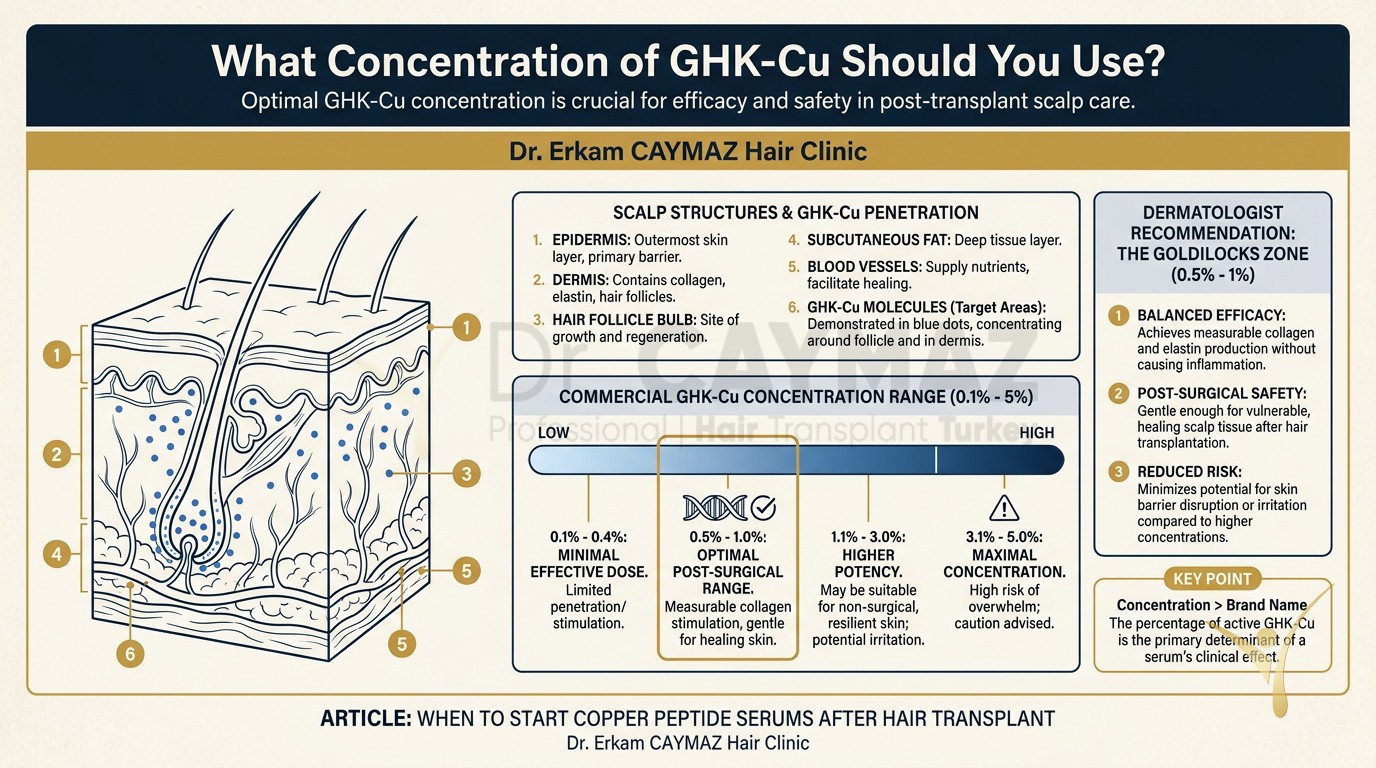
Commercial copper peptide serums range from 0.1% to 5% GHK-Cu. The concentration you choose matters more than the brand name on the bottle.
0.5% to 1% GHK-Cu is the range most dermatologists consider effective yet gentle enough for post-surgical skin. At this concentration, you get measurable collagen stimulation without overwhelming freshly healed tissue. A 2018 in vitro study showed that GHK-Cu at concentrations around 1 micromolar (roughly equivalent to a 0.5% topical formulation after dermal penetration) significantly increased type I and type III collagen gene expression in human fibroblasts.
Products above 2% can cause contact irritation on sensitized skin. Post-transplant scalp tissue is more reactive than normal skin for the first 3 to 4 months. Redness, itching, and even small papules can develop if you jump to a high-concentration formula too soon. If you've never used copper peptides before, start at 0.5% and observe your scalp's response for a full week before considering a higher concentration.
One practical note: some serums combine GHK-Cu with other actives like retinol, glycolic acid, or vitamin C at low pH. Avoid combination products with exfoliating acids during the first 3 months post-transplant. These acids can thin the stratum corneum and increase transepidermal water loss, which isn't ideal for a scalp still rebuilding its barrier function. A standalone copper peptide serum in a simple aqueous or hyaluronic acid base is the safest choice.
Dr. Caymaz Insight
| I tell my patients that copper peptide serums are a "phase two" product, not a "day one" product. In my 15+ years of practice, I've seen patients who applied active serums too early develop localized folliculitis that required antibiotic treatment and delayed their recovery by weeks. The grafts themselves weren't lost, but the inflammation created unnecessary anxiety. My recommendation is simple: complete your prescribed washing and moisturizing protocol first, wait until day 14 at minimum, then introduce a 0.5% GHK-Cu serum once daily in the evening. If your scalp tolerates it well for a week, you can move to twice daily. Patience in the first month protects the work we did in the operating room. |
How Should You Apply Copper Peptide Serum to a Healing Scalp?

Application technique matters almost as much as timing. A post-transplant scalp isn't like the skin on your face. The grafts are anchored but still maturing, and the surrounding tissue is in active remodeling for the first 90 days.
Use a dropper or spray nozzle to distribute the serum. Don't pour it from the bottle and spread it with your fingers, because that creates uneven coverage and excessive pressure on the grafts. Place 4 to 6 drops across the recipient zone, then use the pads of your fingertips (not your nails) to gently pat, not rub, the serum into the scalp. Patting distributes the product without creating lateral shear force on the follicles.
Apply the serum to a clean, dry scalp. The best time is after your evening hair wash, once the scalp has air-dried for about 15 minutes. Applying to damp skin dilutes the serum and can cause it to run down your forehead or neck, wasting product and potentially irritating your eyes.
During the first two weeks of serum use (days 14 to 28 post-op), apply once daily. After that, you can increase to twice daily if there's no redness, flaking, or itching. If you notice any of these signs, drop back to every other day and reassess. Patients who are also using minoxidil as part of their medication protocol should separate the two products by at least 30 minutes to avoid chemical interaction on the skin surface.
Copper Peptides vs. Other Post-Transplant Scalp Treatments
Patients often ask how copper peptide serums compare to other recovery aids. Here's a side-by-side look at the most common options discussed in post-transplant care.
| Treatment | Primary Mechanism | Earliest Start | Evidence Level | Potential Risks |
|---|---|---|---|---|
| GHK-Cu (Copper Peptide) | Collagen synthesis, angiogenesis, anti-inflammatory | Day 14 | Moderate (in vitro + small clinical studies) | Contact dermatitis at high concentrations |
| Minoxidil 5% | Vasodilation, prolonged anagen phase | Day 14–21 (surgeon-dependent) | Strong (FDA-approved for AGA) | Initial shedding, scalp dryness, systemic absorption |
| PRP Injections | Growth factor release from platelets | Day 0 (intraoperative) or month 1 | Moderate-to-strong (multiple RCTs) | Injection pain, bruising, cost |
| Low-Level Laser Therapy | Photobiomodulation at 650–670 nm | Day 7–14 | Moderate (FDA-cleared devices) | Minimal; rare scalp warmth |
| Scalp Care Oil (botanical) | Moisturization, barrier repair | Day 10–14 | Low (traditional use, limited RCTs) | Comedogenic risk if heavy formulation |
As the table shows, copper peptides occupy a middle ground. They don't have the regulatory backing of minoxidil or the procedural evidence base of PRP therapy, but they carry fewer side effects than either. Many patients use GHK-Cu as a complement to their primary medical therapy rather than a replacement.
If you're already following a long-term hair care protocol, a copper peptide serum slots in as an additional layer of support, not the foundation of your regimen.
For patients interested in low-level laser therapy timing, that modality can be used alongside copper peptides without interaction concerns, since one works through light energy and the other through topical biochemistry.
Can Copper Peptides Reduce Shock Loss or Speed Up New Growth?
Shock loss, the temporary shedding of transplanted and sometimes native hairs between weeks 2 and 8, is driven by the trauma of surgery and the follicle's shift from anagen (growth phase) into catagen and then telogen (resting phase). No topical product has been proven in a randomized controlled trial to prevent shock loss entirely. The follicle's response to surgical trauma is largely predetermined by its biology.
That said, there's a theoretical basis for copper peptides reducing the severity of shock loss. GHK-Cu's anti-inflammatory action may limit perifollicular inflammation, which is one of the triggers that push neighboring native hairs into telogen. A 2020 study on GHK-Cu and dermal papilla cells showed upregulation of Wnt/beta-catenin signaling, a pathway directly involved in hair follicle cycling. Whether this translates to clinically meaningful differences in shock loss outcomes remains unconfirmed by large-scale trials.
As for speeding up new growth: transplanted follicles typically enter a resting phase after surgery and don't produce visible new shafts until months 3 to 4. The full result takes 12 to 18 months. Some patients using copper peptides report subjectively earlier sprouting, around month 2.5 instead of month 3.5, but this is anecdotal. Without controlled data, it's honest to say that GHK-Cu may modestly support the follicle environment but shouldn't be expected to dramatically accelerate the growth timeline.
What Mistakes Should You Avoid with Copper Peptide Serums?
The most common errors fall into three categories: timing, formulation, and expectations.
Starting too early. Applying any active serum before day 14 risks disrupting the graft anchoring process. Even if the surface looks healed, the deeper dermal remodeling is still underway. One patient who applied a 2% copper peptide serum on day 8 developed widespread folliculitis across the transplant zone. The infection was treatable, but it added two weeks of antibiotic therapy and significant stress to the recovery period.
Using the wrong formulation. Some "copper peptide" products contain copper gluconate or copper sulfate instead of GHK-Cu. These are not the same molecule. Copper salts can be irritating and don't carry the same peptide-mediated signaling benefits. Check the ingredient list for "copper tripeptide-1" or "GHK-Cu." If neither appears, the product likely contains a less studied copper compound.
Expecting it to replace medical therapy. Copper peptides don't block DHT (dihydrotestosterone), the hormone responsible for androgenetic alopecia. If your surgeon has recommended finasteride or dutasteride to protect your native hair, a copper peptide serum is not a substitute. It addresses wound healing and tissue quality, not the hormonal mechanism of hair loss. For patients weighing whether to use finasteride after transplantation, that decision should be made independently of any topical peptide use.
A fourth, less obvious mistake: storing the serum improperly. GHK-Cu is sensitive to oxidation. If the serum turns from its typical blue-tinted color to green or brown, the copper ion has likely oxidized and the product has degraded. Store it in a cool, dark place, ideally in the refrigerator, and use it within the timeframe printed on the packaging.
How Long Should You Continue Using Copper Peptides?
Most dermatological protocols suggest an 8 to 16 week course of topical GHK-Cu for wound remodeling benefits. In the context of hair transplant recovery, this means starting around day 14 and continuing through approximately month 4 to 5 post-surgery.
By month 4, the transplanted follicles have re-entered anagen and are producing new hair shafts. The incision sites are fully remodeled, and the scalp's collagen architecture has stabilized. At this point, the acute wound-healing benefits of copper peptides have largely been realized. You can continue using the serum for its general skin-quality benefits, but the transplant-specific rationale diminishes.
Some patients choose to cycle copper peptides: 12 weeks on, 4 weeks off, then reassess. There's no strong clinical evidence for or against cycling, but it's a reasonable approach to avoid tachyphylaxis, a phenomenon where the skin becomes less responsive to a repeatedly applied active ingredient over time.
If you're building a complete post-operative regimen, consider how copper peptides fit alongside your oral supplementation protocol. Systemic nutrition supports healing from within.
Your surgeon may also recommend mesotherapy sessions for injectable growth factors. Each adjunct targets a different aspect of recovery: nutrition, injectable growth factors, and topical tissue support.
Does the Transplant Technique Affect When You Can Start?
The two most common techniques, Sapphire FUE and DHI, create slightly different wound profiles. Sapphire blades produce clean, narrow slit incisions that tend to heal with minimal scarring. The Choi implanter pen used in DHI procedures creates a puncture-type wound as it simultaneously opens the channel and places the graft.
In practice, the healing timeline for both techniques is similar enough that the day-14 guideline applies to either. Sapphire FUE incisions may close marginally faster due to the blade's smooth edge, but the difference is measured in hours, not days. What matters more is individual patient factors: age, skin type, smoking status, and whether the patient followed the graft care instructions during the first week.
Patients who had a large session (3,000+ grafts) may have more widespread micro-trauma and should lean toward the later end of the introduction window, around day 18 to 21. Smaller sessions with 1,500 to 2,000 grafts typically heal faster, and day 14 is usually appropriate.
Regardless of technique, the principle is the same: wait for full epithelial closure before applying any active topical. If you're unsure whether your scalp is ready, send a photo to your surgical team. At our clinic, patients can reach us directly for a visual assessment before adding new products to their routine.
Sources & clinical references
FAQ
No. The recipient area has thousands of open micro-incisions during the first week. Applying any active serum before the wounds close risks loosening grafts, introducing bacteria, and causing irritation. Wait at least 14 days post-surgery before applying a copper peptide serum to the transplant zone.
A concentration of 0.5% to 1% GHK-Cu is considered safe and effective for post-surgical scalp skin. Products above 2% can cause contact dermatitis on sensitized tissue. Always check the ingredient list for 'copper tripeptide-1' or 'GHK-Cu' rather than generic copper salts.
No topical product has been proven to fully prevent shock loss. GHK-Cu's anti-inflammatory properties may theoretically reduce the severity of shedding by limiting perifollicular inflammation, but large-scale clinical trials confirming this effect don't yet exist.
Yes, but separate the two applications by at least 30 minutes to avoid chemical interaction on the skin surface. Apply one product, let it absorb fully, then apply the other. Consult your surgeon about the specific timing for introducing each product after your procedure.
Most protocols recommend 8 to 16 weeks of use, starting from day 14 post-surgery. By month 4 to 5, the acute wound-healing benefits have been realized and the transplanted follicles are producing new growth. You can continue for general scalp health, but the transplant-specific rationale diminishes after this period.
Both Sapphire FUE and DHI create micro-wounds that follow a similar healing timeline. The day-14 guideline applies to either technique. Patients who had very large sessions of 3,000 or more grafts may benefit from waiting until day 18 to 21 to allow for more complete healing.

Minimum Grafts Per 1 cm² for Afro vs. Normal Hair Transplants
Afro-textured hair often needs fewer grafts per cm² for visible coverage because curl adds volume, yet extraction is…
Read More: Minimum Grafts Per 1 cm² for Afro vs. Normal Hair Transplants
Hair Transplant and Holiday in Turkey in one Journey
Nine out of ten balding men cite hair loss as their number one concern. If your hair loss is starting to make you…
Read More: Hair Transplant and Holiday in Turkey in one Journey
Breast operations: all information about breast correction
Breast operations include augmentation with implants or fat, mastopexy lift, reduction for comfort or aesthetics, and…
Read More: Breast operations: all information about breast correctionFrequently Asked Questions
Professional Hair Transplant Insights by Dr. Erkam Caymaz