


Quick Numbers
| Spironolactone onset | 3–6 months for visible shedding reduction |
|---|---|
| Minoxidil peak effect | 4–6 months (topical 2–5%) |
| Combined regrowth rate | Up to 30–40% density improvement in responders |
| Primary population | Women with androgenetic alopecia (off-label in men) |
| Typical spironolactone dose | 50–200 mg/day (physician-titrated) |
Key Takeaways
| Spironolactone is an anti-androgen that slows hormonal miniaturization; it doesn't directly regrow hair. |
| Minoxidil is a vasodilator that extends the anagen (growth) phase and works regardless of hormonal status. |
| Combining both drugs targets two separate mechanisms, often outperforming monotherapy in women. |
| Neither medication reverses advanced baldness where follicles are permanently lost; surgical transplantation fills those gaps. |
| Potassium monitoring and blood pressure checks are required while on spironolactone. |
A 34-year-old woman notices her part widening month after month. Her dermatologist prescribes spironolactone at 100 mg daily, and six months later the shedding slows, but the thin zone hasn't filled in. She starts asking: "Is spironolactone preventing hair loss, or is it pretending to fix it?" The answer is nuanced. Spironolactone does exactly what it's designed to do: block androgen receptors at the follicle. But blocking damage and reversing damage are two different things. That's where minoxidil enters the picture, stimulating regrowth through a completely separate pathway. Understanding how these two medications complement each other, and where they fall short, is the difference between realistic expectations and frustration.
How Does Spironolactone Actually Work Against Hair Loss?
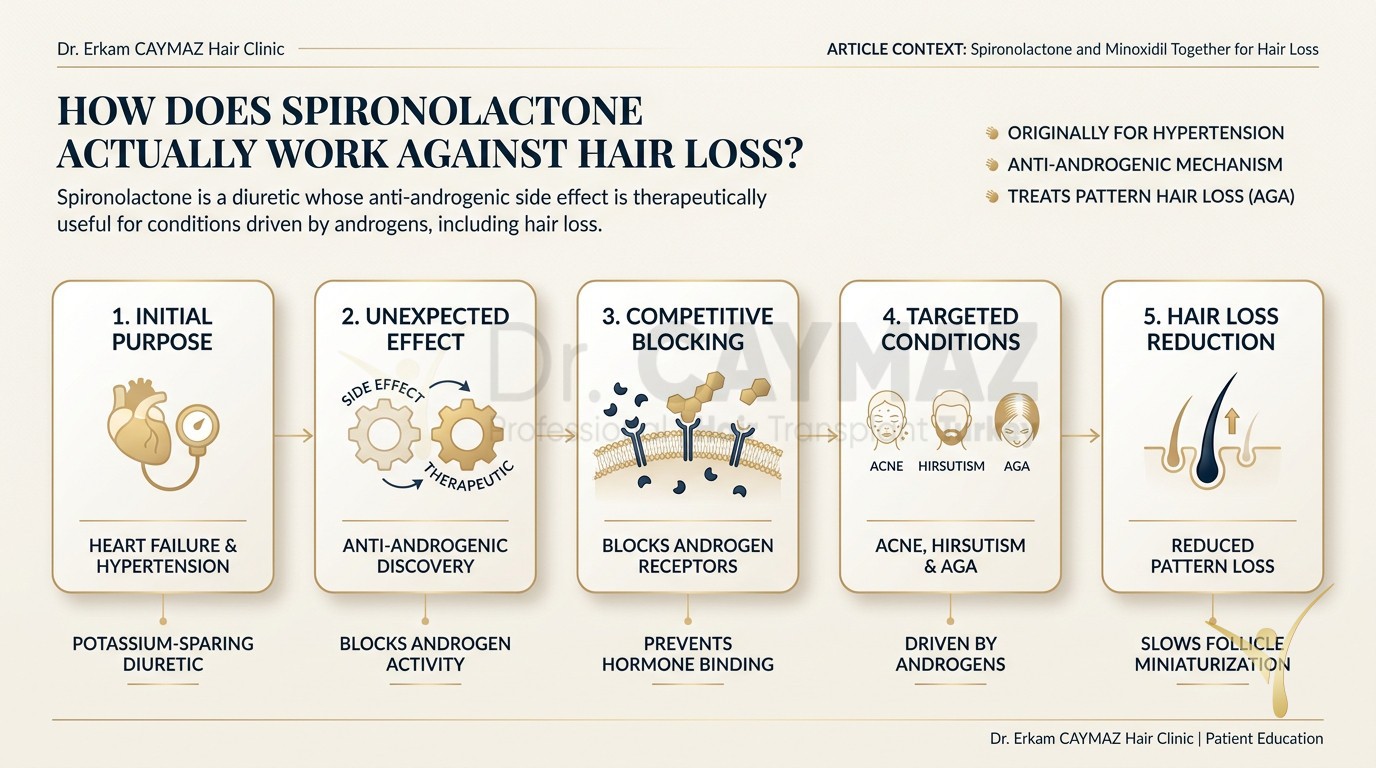
Spironolactone is a potassium-sparing diuretic originally developed for heart failure and hypertension. Its anti-androgenic side effect, once considered unwanted, turned out to be therapeutically useful for conditions driven by androgens: acne, hirsutism, and androgenetic alopecia (AGA), the most common pattern hair loss in both sexes. The drug works by competitively binding to androgen receptors in tissues, including hair follicles. When dihydrotestosterone (DHT) can't dock onto the receptor, the miniaturization signal weakens.
DHT is a potent androgen converted from testosterone by the enzyme 5-alpha reductase. In genetically susceptible follicles, DHT shortens the anagen phase, the active growth period, and shrinks the follicle diameter over successive cycles. Spironolactone doesn't lower circulating DHT levels the way finasteride does. Instead, it blocks the receptor itself, so even if DHT is present, its effect on the follicle is blunted. This distinction matters: spironolactone is a receptor-level blocker, not an enzyme inhibitor.
Clinically, spironolactone is most commonly prescribed for women. In men, its anti-androgenic effects can cause gynecomastia, decreased libido, and erectile dysfunction, which limits its practical use. Women with PCOS-related hair thinning or diffuse female-pattern loss often respond well, particularly when hormonal blood work confirms elevated androgens or clinical signs of hyperandrogenism.
What Does Minoxidil Do Differently?

While spironolactone addresses the hormonal trigger, minoxidil works through an entirely unrelated mechanism. It's a vasodilator. Applied topically (2% or 5% solution or foam) or taken orally at low doses (0.625–2.5 mg), minoxidil widens blood vessels around the follicle, increases local blood flow, and prolongs the anagen phase. The result is thicker individual hair shafts and a longer growth window before the follicle enters its resting (telogen) phase.
Minoxidil also opens potassium channels in vascular smooth muscle cells, which is thought to upregulate vascular endothelial growth factor (VEGF) around the dermal papilla. This molecular effect is independent of androgens. That's why minoxidil works in non-hormonal hair loss patterns too: telogen effluvium, medication-induced shedding, and even some cases of alopecia areata as adjunctive therapy. For a deeper look at how minoxidil and finasteride mechanisms differ, the pharmacology is worth reviewing.
One clinical reality patients should expect: minoxidil shedding. During the first 2–8 weeks of use, many patients experience a temporary increase in hair fall. This happens because minoxidil pushes resting telogen hairs out of the follicle to make room for new anagen hairs. It's a sign the drug is working, not failing. The shedding is self-limiting and typically resolves by week 8–12.
Why Combine Spironolactone and Minoxidil?

Each drug targets a different half of the problem. Spironolactone reduces ongoing follicle damage from androgens. Minoxidil stimulates dormant or miniaturized follicles to produce thicker, longer hairs. Used alone, spironolactone can stabilize loss but rarely produces dramatic regrowth. Used alone, minoxidil can regrow hair but doesn't address the hormonal cause, so new miniaturization continues in untreated follicles.
The combination makes pharmacological sense: block the damage while stimulating repair. Published case series in women with AGA show that dual therapy produces measurably higher hair counts at 12 months compared to either agent alone. One retrospective study of 100 women found that those on spironolactone plus topical minoxidil had a 30–40% improvement in hair density scores versus roughly 15–20% with minoxidil monotherapy.
Timing matters. Most dermatologists start spironolactone first, titrating from 50 mg to 100–200 mg over 4–8 weeks while monitoring potassium levels and blood pressure. Once the patient tolerates the dose, topical minoxidil 5% is added. Starting both simultaneously isn't dangerous, but it makes it harder to attribute side effects to the correct drug if they appear. Patients considering whether to try medication before surgery should understand that a 6–12 month medication trial is standard before evaluating surgical candidacy.
Dr. Caymaz Insight
| In my experience, the best medical outcomes for female pattern hair loss come from combining spironolactone with minoxidil rather than relying on one alone. Spironolactone slows the hormonal damage, and minoxidil pushes the follicles back into active growth. But I always tell patients: medication can thicken what's miniaturized, not resurrect what's gone. When I see a woman with a widened part and visible scalp despite 12 months of dual therapy, that's the point where I discuss surgical options honestly. Transplanted grafts from the donor area aren't androgen-sensitive, so they provide permanent density where medications have reached their ceiling. |
What Are the Side Effects of Each Drug?
Spironolactone's most clinically significant side effect is hyperkalemia, elevated potassium in the blood. The risk is low in healthy young women but increases with renal impairment, concurrent ACE inhibitor use, or potassium supplementation. Baseline and periodic potassium checks (every 3–6 months) are standard. Other side effects include breast tenderness, irregular menstruation, fatigue, and dizziness from blood pressure reduction. Spironolactone is teratogenic: it can feminize a male fetus, so reliable contraception is mandatory for women of childbearing age.
Minoxidil's topical side effects are usually local: scalp irritation, dryness, or flaking, especially with the alcohol-based liquid formulation. Foam versions tend to cause less irritation. Systemic absorption from topical use is minimal but can occasionally cause lightheadedness or mild tachycardia. Hypertrichosis, unwanted facial or body hair growth, affects roughly 3–5% of women using topical minoxidil 5%. Oral low-dose minoxidil carries a higher hypertrichosis rate (around 15–20%) but avoids the scalp irritation issue entirely.
Patients on both medications should be aware that stopping either drug leads to gradual reversal of its benefits. Spironolactone cessation allows androgen-mediated miniaturization to resume. Minoxidil cessation causes regrown hairs to shed over 3–6 months as follicles return to their pre-treatment cycle length. This is why some patients eventually consider surgical hair restoration as a more permanent solution for areas that have already lost significant density.
| Feature | Spironolactone | Minoxidil (topical 5%) |
|---|---|---|
| Mechanism | Androgen receptor blocker | Vasodilator / potassium channel opener |
| Primary target | Hormonal miniaturization (DHT) | Follicle stimulation (anagen prolongation) |
| Onset of effect | 3–6 months | 4–6 months |
| Best responders | Women with AGA, PCOS, hyperandrogenism | Both sexes, any pattern loss |
| Common side effects | Breast tenderness, irregular periods, hyperkalemia | Scalp irritation, initial shedding, hypertrichosis |
| Pregnancy safety | Contraindicated (teratogenic) | Contraindicated (category C) |
| Monitoring required | Potassium, blood pressure every 3–6 months | None routinely for topical |
| Reversal on stopping | Miniaturization resumes over months | Regrown hairs shed within 3–6 months |
When Does Medication Reach Its Limit?
Medications can thicken miniaturized hairs and slow progression, but they can't regenerate follicles that have already scarred shut or been replaced by smooth, shiny scalp skin. A follicle that has cycled through enough miniaturization rounds eventually loses its ability to produce any visible hair. At that point, no topical or oral medication will bring it back.
The clinical threshold is roughly this: if a patient has been on optimized dual therapy (spironolactone 100–200 mg plus minoxidil 5%) for 12 months and still has visible scalp through the hair, the remaining deficit is structural, not pharmacological. The follicles in those bare zones are gone. This is where hair transplant surgery becomes the logical next step, not as a replacement for medication, but as a complement to it.
Dr. Erkam Caymaz evaluates many patients who've already tried medication before seeking surgical consultation. In these cases, the medication history is valuable: it tells the surgeon which areas responded (and can be maintained medically) and which areas need grafts. Patients with advanced Norwood patterns, particularly Norwood 5 and above, almost always need surgical restoration because the frontal and vertex zones have lost too many follicles for medication alone to produce cosmetically satisfying density.
Can Men Use Spironolactone for Hair Loss?
Technically, yes. Practically, it's rarely prescribed. Spironolactone's anti-androgenic effects in men cause gynecomastia (breast tissue growth) in up to 10% of users at hair-loss doses, along with reduced libido and potential erectile dysfunction. Most male patients and their physicians prefer finasteride or dutasteride, which block the 5-alpha reductase enzyme rather than the androgen receptor, producing fewer feminizing side effects.
There are exceptions. Some men who can't tolerate finasteride (due to persistent sexual side effects or mood changes) may trial low-dose spironolactone under close supervision, accepting the trade-off. Topical spironolactone formulations (compounded at 2–5%) are being studied as a way to deliver the drug locally to the scalp while minimizing systemic anti-androgen exposure, but robust clinical trial data is still limited. For men weighing finasteride use after transplantation, the decision depends on ongoing native hair preservation goals.
How Does Combination Therapy Fit with Hair Transplant Surgery?
Medication and surgery aren't competing options. They serve different purposes. Medication protects and thickens existing native hair. Surgery adds permanent grafts to areas where native hair is gone. The best long-term outcomes happen when patients use both.
Before a Sapphire FUE procedure, patients on spironolactone and minoxidil are typically advised to continue spironolactone up to the day of surgery (it doesn't affect bleeding or anesthesia). Topical minoxidil is usually paused 5–7 days before the operation to reduce scalp irritation and allow the surgical team a clean field. It's restarted 2–4 weeks post-operatively, once the recipient area has healed enough to tolerate application.
After surgery, continuing both medications protects the non-transplanted native hairs surrounding the grafts. Transplanted follicles come from the donor area at the back and sides of the scalp, which is genetically resistant to DHT. Those grafts don't need spironolactone or minoxidil to survive. But the native hairs in the mid-scalp and crown do. Without ongoing medical therapy, native hair continues to miniaturize, and the patient may eventually see thinning around the transplanted zone, creating an unnatural "island" effect. Patients interested in long-term post-transplant hair care should plan for indefinite medication use if their loss pattern is progressive.
What Should You Expect from a Realistic Timeline?
Patience is non-negotiable with medical hair loss treatment. Neither spironolactone nor minoxidil produces overnight results. Here's what a realistic combined-therapy timeline looks like:
Weeks 1–4: Spironolactone titration begins (50 mg, increasing to target dose). Baseline blood work including potassium. Minoxidil may be started simultaneously or delayed until spironolactone is tolerated.
Weeks 4–8: Minoxidil shedding phase. Hair fall may temporarily increase. This is normal and expected. Spironolactone dose reaches 100–200 mg if tolerated.
Months 3–4: Shedding stabilizes. Some patients notice less hair in the drain or on the pillow. Visible regrowth is unlikely this early.
Months 6–8: First visible improvements. Finer vellus hairs begin appearing in thinning zones. Hair diameter measurements (trichoscopy) may show increased shaft thickness. Potassium recheck.
Months 10–12: Peak medication effect. This is the point to photograph and compare against baseline. If density is still insufficient, surgical consultation is appropriate.
Patients who respond well to dual therapy still need to continue both drugs indefinitely to maintain results. Stopping either one allows the respective mechanism of loss to resume. This indefinite commitment is one reason some patients prefer to evaluate the medication-versus-surgery threshold early rather than later.
Who Should Avoid This Combination?
Not every patient is a candidate for spironolactone-minoxidil dual therapy. Contraindications and cautions include:
Pregnant or planning pregnancy: Both drugs are contraindicated. Spironolactone is teratogenic, and minoxidil carries fetal risk. Women must use reliable contraception throughout treatment.
Renal insufficiency: Impaired kidney function increases hyperkalemia risk with spironolactone. Creatinine and GFR should be checked before starting.
Hypotension: Patients with baseline low blood pressure may not tolerate spironolactone's antihypertensive effect combined with minoxidil's vasodilation. Orthostatic dizziness can become disabling.
Non-androgenetic causes: If hair loss is driven by autoimmune disease (alopecia areata), thyroid dysfunction, iron deficiency, or scarring alopecia, spironolactone won't address the underlying cause. Correct diagnosis before treatment is essential. Minoxidil may still offer some benefit in non-hormonal patterns, but spironolactone adds nothing if androgens aren't the driver.
Men seeking first-line therapy: As discussed, finasteride or dutasteride is the standard anti-androgen approach for male pattern baldness. Spironolactone is a second-line or last-resort option in men due to its side-effect profile. Patients exploring finasteride and minoxidil dosing protocols will find that combination better studied and better tolerated in male populations.
The decision to combine medications, pursue surgery, or do both should always be guided by a physician who can interpret blood work, assess the Norwood or Ludwig classification, and set expectations based on the individual's follicle status, not marketing promises.
Hormonal hair loss plans work best when the blocker and the growth stimulus are reviewed together. Spironolactone can slow androgen-driven miniaturization, while topical or oral minoxidil supports thicker shafts in follicles that still have growth potential. Your clinician should set a monitoring interval for blood pressure, electrolytes when indicated, and a photo-based shedding review instead of changing doses after every short fluctuation.
Sources
FAQ
Spironolactone genuinely blocks androgen receptors at the follicle, reducing DHT-driven miniaturization. It doesn't mask the problem; it slows the hormonal mechanism causing thinning. However, it doesn't regrow lost follicles, which is why some patients feel it's 'pretending' to fix their hair loss when the real issue is that regrowth requires a different drug like minoxidil or surgical restoration.
Yes. The two drugs work through completely different mechanisms and don't interact pharmacologically. Most dermatologists start spironolactone first, titrate to the target dose over 4–8 weeks, then add topical minoxidil 5%. Starting both simultaneously is safe but makes it harder to identify which drug is causing any side effects.
Shedding typically stabilizes by month 3–4. Visible regrowth and improved density usually appear between months 6 and 8. Peak effect is around 10–12 months. Patience is essential because hair growth cycles are slow, and early shedding from minoxidil can be discouraging before improvement begins.
It can, but it's rarely prescribed for men because of feminizing side effects including gynecomastia, reduced libido, and erectile dysfunction. Finasteride or dutasteride are preferred anti-androgen options for male pattern baldness. Topical spironolactone formulations are being studied as a way to reduce systemic side effects in men, but data remains limited.
Stopping spironolactone allows androgen-mediated miniaturization to resume. Stopping minoxidil causes regrown hairs to shed over 3–6 months as follicles return to their pre-treatment cycle. Both drugs require indefinite use to maintain their benefits, which is one reason some patients eventually choose hair transplant surgery for permanent density.
Yes. Many patients use both medications before surgery to stabilize existing hair. Spironolactone is typically continued up to the day of surgery. Topical minoxidil is paused about 5–7 days before the procedure to reduce scalp irritation, then restarted 2–4 weeks after surgery once healing permits.

Per-Graft vs. Package Pricing for Hair Transplants in Turkey
Hair transplant cost in Turkey follows two pricing models: per-graft billing (€2–€4 per graft) and flat VIP packages…
Read More
Cannabis Before Hair Transplant: Risks to Graft Survival
Cannabis use before a hair transplant raises real clinical concerns. THC alters blood pressure, increases…
Read More
Hair Transplantation Technology: A Review of Recent Advances
Hair-transplant technology has evolved in tools, workflow precision, and planning support, but innovation claims should…
Read More
1 cm2 At least how many grafts should be planted?
Natural scalp may hold 60–70 follicular units per cm², but transplants typically target lower safe density to protect…
Read MoreHair Loss — Frequently Asked Questions
Expert Answers by Dr. Erkam Caymaz, Istanbul