


Quick Numbers
| Desk work return | 3–5 days post-op |
|---|---|
| Light cardio | Week 3 |
| Heavy weight training | Week 6 |
| Long-haul flights | 48–72 hours (short-haul sooner) |
| Swimming / sauna | Week 8–12 |
Key Takeaways
| Grafts anchor firmly into the scalp by day 10 to 14, which is why the first two weeks carry the strictest restrictions. |
| Sweat itself doesn't kill grafts, but the salt concentration, friction, and raised blood pressure from exercise can. |
| Social visibility of redness and scabbing fades significantly by week 2 to 3 for most patients. |
| Remote workers can often resume screen-based tasks the day after their first clinic wash on day 2. |
| Every activity restriction maps to a specific biological process: graft anchoring, neovascularization, or donor healing. |
You've booked your operation for a Friday and you're staring at your calendar wondering: can I take that Monday video call? Will anyone notice at the office barbecue in two weeks? When can I get back under the squat rack? These are the questions patients ask most often about turkey hair transplant recovery time, and the answers aren't one-size-fits-all. They depend on what the activity actually does to your scalp, your blood pressure, and the freshly placed grafts. This article breaks recovery into a week-by-week activity calendar, explains the biology behind each restriction, and gives you concrete dates you can plan around.
Why Do Activity Restrictions Exist After a Hair Transplant?
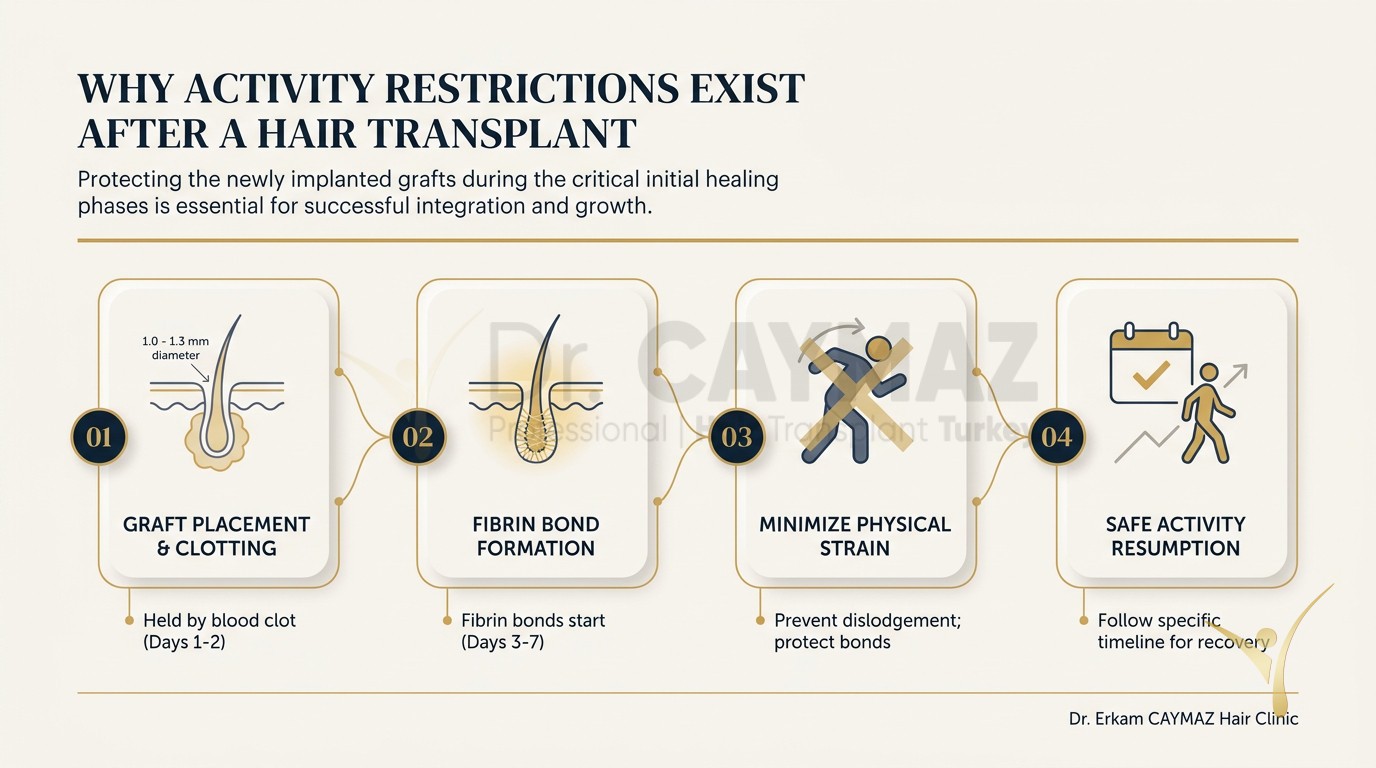
Every graft placed during a Sapphire FUE procedure sits inside a tiny recipient channel, roughly 1.0 to 1.3 mm in diameter. For the first 24 to 48 hours, the graft is held in place mostly by the clotted blood around it. Between days 3 and 7, early fibrin bonds form. True neovascularization, the growth of new capillaries that supply the graft with oxygen and nutrients, doesn't begin until around day 5 and isn't robust until day 10 to 14.
That timeline is the reason behind every restriction you'll read below. Anything that dislodges a graft before fibrin anchoring, disrupts clot formation, or raises scalp blood pressure enough to cause bleeding threatens graft survival. The donor area has its own healing arc: micro-punch wounds from FUE extraction close within 7 to 10 days, but the deeper dermal layer continues remodeling for several weeks. Knowing this biology lets you make smarter decisions about when to resume each activity rather than just following a list blindly.
When Can I Go Back to a Desk Job?
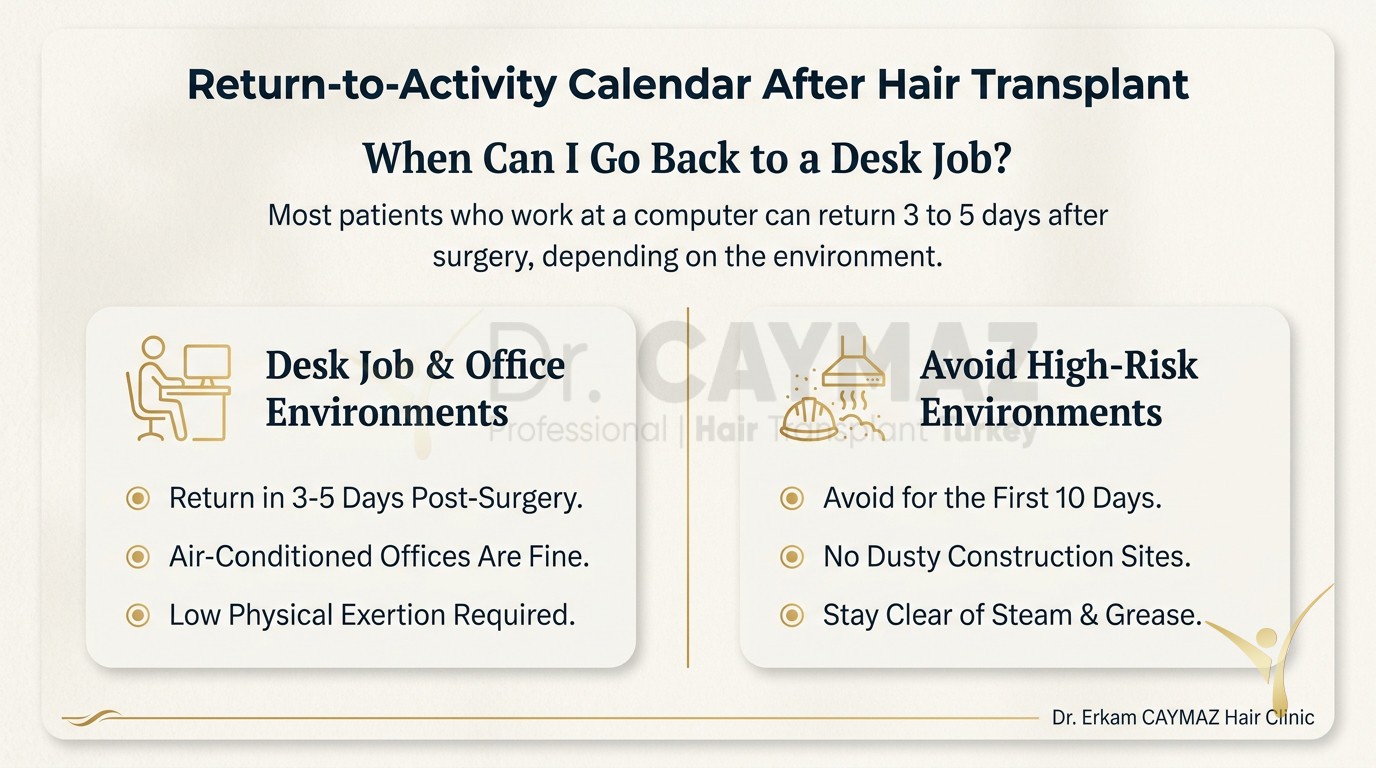
Most patients who work at a computer can return 3 to 5 days after surgery. The main concern isn't the work itself but the environment. Air-conditioned offices are fine. Dusty construction sites or kitchens with steam and grease are not, at least not for the first 10 days.
At our clinic, the operation typically happens on day 0. Day 1 is a rest day. On day 2 post-op, you return for your first clinic wash and donor bandage removal, which is our standard protocol for post-transplant washing. After that wash, many remote workers open their laptops the same evening. If you work in-person, days 3 through 5 are reasonable for a return, depending on how visible your recipient area is and how comfortable you feel in a loose hat or headband.
One practical note: avoid bending forward with your head below your heart for prolonged periods during the first week. This increases blood flow to the scalp and can cause swelling to migrate toward the forehead and eyes. If your desk setup forces you to lean over documents, prop them upright or use a monitor stand.
What About Physical Jobs and Manual Labor?
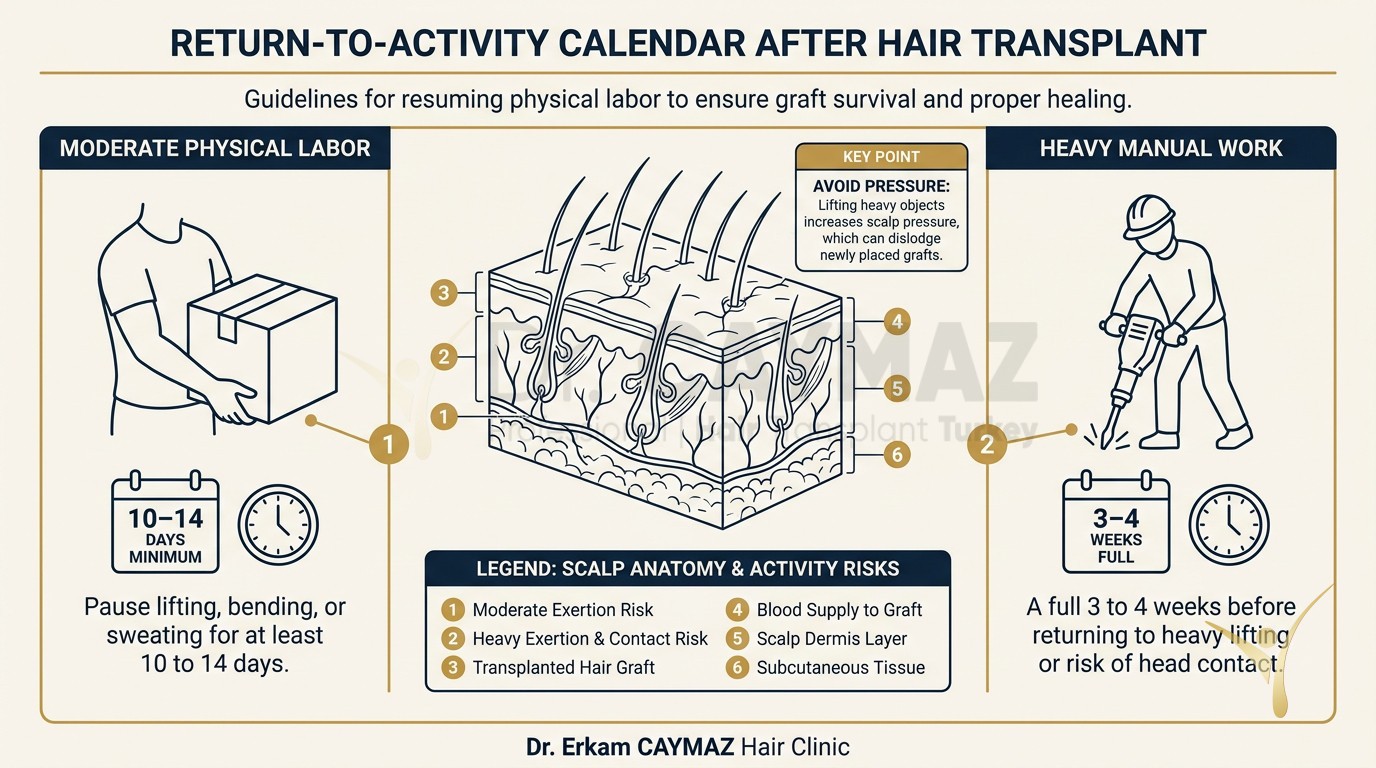
Physically demanding work, anything involving heavy lifting, bending, sweating, or risk of head contact, requires a longer pause. The general guideline is 10 to 14 days minimum before returning to moderate physical labor, and a full 3 to 4 weeks before heavy manual work.
The reasons are straightforward. Lifting heavy objects raises intracranial venous pressure. That pressure increase can reopen micro-wounds in the donor area and cause oozing in the recipient zone. Sweat running across the recipient area during the first 10 days introduces salt and bacteria to channels that haven't fully closed. Helmets, hard hats, or tight headgear can physically shear grafts from their channels if worn too early.
If your livelihood depends on physical work and you can't take two weeks off, discuss this during your pre-operative consultation. Scheduling surgery before a planned vacation or slow season is a strategy many patients use. Dr. Erkam Caymaz often reviews patients' work schedules during planning to set realistic expectations about downtime.
When Is It Safe to Exercise and Lift Weights?
Exercise is the single most common source of patient anxiety during recovery. Here's the clinical breakdown by intensity level.
Days 1 through 10: No exercise at all. Walking at a gentle pace is fine starting on day 1, and in fact it's encouraged to promote circulation in the legs and prevent stiffness. But your heart rate should stay below 100 bpm. No jogging, no yoga inversions, no stretching that puts your head below your waist.
Weeks 2 through 3: Light walking can increase in duration. Some patients begin stationary cycling at a low resistance around day 14, keeping the effort conversational. No upper-body resistance training yet, because exercises like bench press, overhead press, and rows all raise blood pressure in the head and neck.
Weeks 3 through 4: Light cardio, including brisk walking and easy cycling, is generally safe. Lower-body resistance training at moderate loads can resume if you avoid straining, breath-holding, or Valsalva maneuvers.
Week 6: Full weight training, including upper-body compound lifts, can typically resume. By this point, grafts are firmly anchored and the donor area is well healed. If you're a competitive athlete or bodybuilder, confirm with your surgeon before returning to maximal loads.
For a broader view of the healing phases that drive these timelines, the week-by-week recovery milestones covers each stage in detail.
Dr. Caymaz Insight
| I tell my patients that the gym isn't going anywhere, but their grafts only get one chance to anchor. The most common mistake I see is someone who "felt fine" at day 8 and decided to do a quick run. Feeling fine and being healed are two different things. Neovascularization is invisible to you, but it's the process keeping your grafts alive. I prefer patients to wait a full three weeks before any cardio that raises their heart rate above 120 bpm, and six weeks before heavy compound lifts. That patience pays off in graft survival rates that reach up to 98% in well-managed cases. |
How Soon Can I Attend Social Events?
Social readiness is partly medical and partly cosmetic. Medically, there's no reason you can't sit at a dinner table on day 3. The real question is how comfortable you are with how your scalp looks.
Here's what to expect visually at each stage:
- Days 1 through 5: Visible redness in the recipient area, small scabs around each graft site, possible mild swelling around the forehead. The donor area may show pinkish micro-dots. Most patients don't feel socially ready during this window.
- Days 6 through 10: Scabs begin to shed, especially after daily gentle washing. Redness is still present but less intense. A loose-fitting cap can cover the recipient zone if needed.
- Weeks 2 through 3: The majority of scabs have fallen off. Pinkness remains but can be concealed under a hat or even with careful hairstyling if existing hair provides some coverage. Many patients attend casual social events during this period.
- Week 4 onward: Redness fades to a light pink that's difficult to notice unless someone is staring at your scalp from inches away. Most patients feel fully comfortable in social settings by this point.
One thing to keep in mind: shock loss, the temporary shedding of transplanted and sometimes existing hairs, typically begins around weeks 2 to 4. This is a normal part of the growth cycle and doesn't mean grafts have failed. But it can make the transplanted area look thinner than it did immediately after surgery. Understanding this phase helps you manage expectations when you're around friends or colleagues. For a deeper explanation, the article on shock hair loss after transplantation covers the mechanism and timeline.
When Can I Travel or Fly After Surgery?
Short domestic flights are generally fine 48 hours after surgery, once your first clinic wash is complete and the donor bandage is removed. Cabin pressure in commercial aircraft is equivalent to an altitude of about 6,000 to 8,000 feet, which causes mild tissue expansion but doesn't pose a meaningful risk to anchored grafts after the initial 48-hour clotting window.
The bigger concerns with flying are practical, not atmospheric. Overhead bins require reaching above your head, which you should avoid in the first week. Seatback headrests press against the donor area. A travel neck pillow that keeps your occipital region off the seat is a simple fix. For long-haul flights, the risk of deep vein thrombosis is slightly elevated after any surgical procedure, so staying hydrated and moving your legs periodically matters.
We've written a dedicated article on flying after hair transplant and managing jet lag that covers cabin humidity, sleep position on the plane, and how time-zone shifts can affect your medication schedule.
For patients traveling internationally for their procedure, the practical sequence at our clinic looks like this: operation on day 0, rest on day 1, first clinic wash on day 2, and most patients fly home on day 3 or 4. If you're combining your trip with a few days of sightseeing, the Istanbul holiday and hair transplant planning guide offers a realistic itinerary.
Activity-by-Activity Recovery Calendar
The table below consolidates every major activity into a single reference. Timelines assume an uncomplicated Sapphire FUE procedure with standard graft counts (2,000 to 4,000 grafts). Larger sessions or combined procedures may require slightly longer restrictions.
| Activity | Earliest Safe Return | Clinical Reason for Restriction |
|---|---|---|
| Desk work / remote work | Day 3–5 | Low physical demand; avoid dusty or humid environments |
| Driving (short trips) | Day 3–4 | Seatbelt across chest is fine; avoid head contact with headrest pressure |
| Short-haul flight (< 4 hrs) | Day 2–3 | Cabin pressure is safe post-clotting; protect donor from headrest |
| Long-haul flight (> 6 hrs) | Day 3–5 | DVT risk, dehydration, prolonged headrest contact |
| Casual social events | Week 2 | Scabs mostly shed; redness manageable with hat |
| Formal events (no hat) | Week 3–4 | Pinkness fading; shock loss may begin |
| Walking (gentle pace) | Day 1 | Encouraged for circulation; keep heart rate below 100 bpm |
| Light cardio (cycling, brisk walk) | Week 3 | Grafts anchored; keep heart rate below 130 bpm |
| Lower-body weights (moderate) | Week 3–4 | Avoid Valsalva; no straining or breath-holding |
| Full weight training | Week 6 | Neovascularization complete; donor fully remodeled |
| Contact sports (boxing, basketball) | Week 8–12 | Risk of direct scalp trauma; full tissue maturation needed |
| Swimming (pool or ocean) | Week 8–12 | Chlorine and bacteria exposure; submersion pressure on healing skin |
| Sauna / steam room | Week 8 | Extreme heat dilates vessels; sweat and humidity risk |
| Helmet sports (cycling, motorcycling) | Week 4–6 | Helmet pressure on donor; friction on recipient if tight-fitting |
| Sexual activity | Week 1–2 | Elevated heart rate and blood pressure; risk of head contact |
What Happens If I Push Too Hard Too Soon?
Patients sometimes ask whether breaking a restriction once will ruin everything. The honest answer is: probably not, if it's minor. A single brisk walk on day 5 is unlikely to destroy your result. But the risks are cumulative and unpredictable.
The most common consequence of premature exercise is donor area bleeding. Micro-punch wounds that appeared sealed can reopen under elevated blood pressure, leading to spotting on your pillow or collar. This doesn't usually require medical intervention, but repeated episodes delay healing and can widen the punch scars.
In the recipient zone, the risk is graft dislodgement. A graft that's physically knocked out of its channel in the first 7 days is gone. It won't reimplant itself. You won't feel it happen, and you may not even see it. The result shows up months later as a small gap in density where that graft should have grown. Across hundreds of grafts, even a 2 to 3% dislodgement rate from premature activity translates to noticeable thinning in certain zones.
If you're concerned about potential side effects or complications from pushing recovery too fast, contact your clinic. A quick photo sent to your surgical team can usually clarify whether what you're seeing is normal or needs attention.
How Can I Speed Up Recovery Without Taking Risks?
You can't accelerate biology, but you can avoid slowing it down. A few evidence-based strategies help:
Sleep elevated for the first 5 nights. A 30 to 45 degree angle reduces forehead swelling by allowing fluid to drain away from the surgical site. Two or three pillows, or a wedge pillow, works well. This single habit is the most effective way to minimize visible swelling and get back to social or professional settings faster.
Follow the washing protocol precisely. At our clinic, the first wash happens on day 2 post-op. After that, daily gentle washing with the prescribed lotion and shampoo helps scabs soften and shed naturally by days 8 to 12. Patients who skip washes or scrub too aggressively tend to have longer visible scabbing. The full aftercare protocol covers each step.
Stay hydrated and eat protein-rich meals. Wound healing is metabolically expensive. Your body needs amino acids, zinc, and vitamin C to synthesize collagen and repair tissue. A standard balanced diet covers this for most people, but patients who are dieting or fasting should discuss supplementation with their surgeon.
Avoid alcohol for at least 7 days. Alcohol thins the blood and increases the risk of post-operative oozing. It also disrupts sleep quality, and sleep is when the majority of tissue repair occurs. Smoking carries even greater risks: nicotine constricts blood vessels and directly impairs the oxygen delivery that new grafts depend on during neovascularization.
For patients interested in adjunct therapies, PRP (platelet-rich plasma) treatment is sometimes used in the months following surgery to support follicle health, though it's a separate procedure from the transplant itself.
Planning Your Calendar Before Surgery
The best recovery is one you've planned for. Before your operation date, map out the two weeks that follow. Block off days 0 through 2 entirely. Mark day 2 as your clinic wash day. Pencil in a tentative return to desk work on day 4 or 5, and set a "light cardio" start date at week 3.
If you have a wedding, conference, or important social event within 4 weeks of your planned surgery date, consider rescheduling one or the other. The pinkness and early shock loss phase between weeks 2 and 4 is the most cosmetically awkward period. By week 6, most patients look entirely normal to casual observers.
Patients traveling to Istanbul for their procedure should factor in at least 3 nights in the city: one before surgery for the consultation and pre-operative planning session, the operation day itself, and at least one night after the day-2 wash. Many patients stay 4 to 5 nights for comfort.
The bottom line on hair transplant recovery time is that it's not a single number. It's a spectrum that depends on what you're recovering for. A desk worker and a CrossFit athlete have very different calendars. The biology is the same for both, but the demands they place on their healing scalp are not. Build your plan around the specific activities in your life, respect the graft-anchoring window of the first 14 days, and you'll give your transplant the best possible chance of reaching that 90 to 95% overall success rate that well-executed procedures achieve.
Sources & clinical references
FAQ
Most patients can do light screen-based work starting on day 2 or 3, after their first clinic wash. Avoid long periods of bending forward or looking down, as this increases swelling. Keep sessions short on day 2 and extend as you feel comfortable.
Light cardio such as brisk walking or easy stationary cycling can begin around week 3. Full weight training, including upper-body compound lifts, should wait until week 6. Contact sports and swimming require 8 to 12 weeks.
During the first 7 to 10 days, redness and small scabs are visible in the recipient area. By week 2 to 3, most scabs have shed and redness is fading. A loose hat can conceal the area during the early phase. By week 4, most patients feel comfortable without any head covering.
Short flights are generally safe 48 hours after surgery, once the first clinic wash and donor bandage removal are complete. Use a travel neck pillow to keep the donor area off the headrest, stay hydrated, and avoid placing heavy items in overhead bins during the first week.
Sweat itself doesn't destroy grafts, but the salt concentration can irritate open channels, and the physical activity causing the sweat raises blood pressure, which risks bleeding and graft dislodgement. Avoid activities that cause heavy sweating for at least 2 weeks.
Loose-fitting helmets may be worn around week 4 if there's no direct pressure on the recipient zone. Tight helmets for motorcycling or contact sports should wait until week 6 at minimum, as friction and compression can damage healing tissue.
Noticeable redness typically lasts 2 to 4 weeks in the recipient area. A faint pinkish tone may persist for up to 3 months in some patients, particularly those with fair skin. It's not harmful and fades gradually as the scalp heals.
Two weeks is borderline. Most scabs will have shed, but residual pinkness is common. A hat or strategic hairstyling can help. If the event is formal and hat-free, scheduling surgery at least 3 to 4 weeks before the event is safer for cosmetic comfort.
Premature exercise can cause donor area bleeding, increased swelling, and graft dislodgement in the recipient zone. A graft knocked from its channel in the first 7 to 10 days won't reimplant. The result appears months later as reduced density in that area.
For desk-based work, 3 to 5 days is usually sufficient. For physically demanding jobs involving lifting, bending, or outdoor exposure, plan for 10 to 14 days. Discuss your specific work requirements with your surgeon during the consultation.
Pool swimming should wait 8 to 12 weeks. Chlorine is an irritant to healing skin, and submersion creates pressure on the scalp. Ocean swimming carries additional bacterial risk. Both environments also involve sun exposure, which should be limited during early recovery.
Avoid alcohol for at least 7 days after surgery. Alcohol thins the blood, increasing the risk of post-operative oozing, and disrupts the quality of sleep needed for tissue repair. Most surgeons recommend abstaining for the full first week at minimum.

Do All Transplanted Hair Grow? Understanding Hair Growth after Hair Transplantation
Most transplanted hairs grow, but not every single graft. Graft survival reaches up to 98% in experienced hands and…
Read More: Do All Transplanted Hair Grow? Understanding Hair Growth after Hair Transplantation
Stem Cell and Exosome Hair Transplantation: Revolutionary Methods or Unproven Trials?
Stem cell and exosome treatments are widely marketed in hair restoration, but evidence strength remains uneven across…
Read More: Stem Cell and Exosome Hair Transplantation: Revolutionary Methods or Unproven Trials?
Hair Transplant Quote Checklist: Turkey vs USA Costs
Turkey VIP hair transplant packages typically run €5,000–€7,500 all-inclusive (Sapphire FUE) or €5,000–€6,000 (DHI)…
Read More: Hair Transplant Quote Checklist: Turkey vs USA CostsFrequently Asked Questions
Professional Hair Transplant Insights by Dr. Erkam Caymaz