


Quick answer
FUT (follicular unit transplantation) harvests a strip of scalp from the donor area, then dissects follicular units under microscopy before implantation. It leaves a linear scar and longer recovery versus FUE dot scarring. Most modern cases use FUE; FUT is rare except specific donor situations.
Quick Numbers
| Harvest | Strip excision + sutures |
|---|---|
| Scar type | Linear ~15–20 cm |
| Recovery | Longer than FUE |
| Modern use | Exceptional cases |
Key Takeaways
| FUT is not our default at this clinic for new cases. |
| Linear scar limits short hairstyles at the back. |
| FUE remains standard for beard, brow, and scalp. |
| Scar revision may combine FUE into old FUT lines. |
We Do Not Use This Method! We are renewing FUT Scar, You have a 50% chance!
FUT Method in Hair Transplantation
Follicular Unit Transplantation, also known as the FUT word, which is made up of the initials of the technique, has lost its popularity with the progress of technology in hair transplantation operations but it is still applied in some exceptional cases.
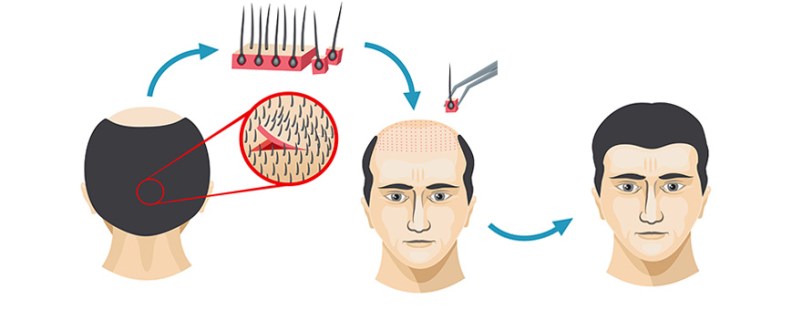
How to apply the FUT Method?
Dr. Caymaz Insight
| When patients ask about FUT, I explain the trade-off honestly: you may avoid a full donor shave once, but you inherit a lifelong linear scar. Most men who want flexibility at the back choose FUE despite longer surgery time. |
There are 2 methods for hair transplant operations currently in use. The FUE (Follicular Unit Extraction) method and the FUT (Follicular Unit Transplantation) method. These methods differ in the way hair follicles are extracted from the donor area.
The steps other than this issue are almost the same. In the FUT method, hair follicles are extracted by removing a strip of the scalp in about 15-20 cm to 2 cm from the back of the head between two ears. Then, hair follicles are harvested from the strip and individually transplanted to the recipient areas. The area where the strip of the scalp was removed is closed with stitches.
The FUT hair transplant results in an incision scar of about 15-20 centimeters in size. FUT hair transplant recovery time is long since an incision is performed on the scalp. Depending on the strain, rate of wound healing, and quality of the surgical procedure performed, this scar may expand and there may be hair loss around the scar.
The only advantage of FUT hair transplant – which is not a significant advantage – is that scalp is removed in a strip by an incision so that it is not necessary to shave this area. Therefore, this method is preferred by women or men with long hair. In a FUE hair transplant, the duration of operation can be several hours longer.
Advantages of FUT hair transplant
- Operation is completed in a shorter time.
- Hair shaving is not required for the operation.
- It is a more suitable method for graft removal for patients with curly hair, especially in African hair types. However, the incision scar on the nape might be remarkable in these patients using short hair.
Disadvantages of FUT hair transplant
Approximately, a maximum of 2000 grafts can be extracted but, that number can range from 4500 to 5000 in FUE.
The scar remains on the nape area after the operation. The surgical procedure and suture must be performed by a plastic surgeon.
Since the area of the removed scalp is damaged, numbness might occur after the operation.
More bleeding occurs during the operation compared to the FUE method.
The nape area is more painful after the operation.
FUT vs FUE Hair Transplant |
|
FUT Hair Transplant |
FUE Hair Transplant |
| Hair follicles are extracted by removing a strip of scalp with an incision | Hair follicles are extracted with a sub-millimeter punch without an incision |
| Recovery time is more | Recovery time is less |
| 2000 grafts can be extracted at maximum | Graft number can be increased up to 4500-6000 |
| Leaves scars after the operation | Does not leave any scars |
| The surgery lasts for a shorter time | The surgery lasts for a longer time |
| More bleeding occurs during the operation | Less bleeding occurs during operation |
| Hair shaving is not required | Complete hair shave is required |
| FUT hair transplant costs are much higher | Hair transplant costs are less compared to FUT |
SCAR RESTORATION AFTER FUT PROCEDURE
Scar revision may be necessary for those who have undergone FUT hair transplant surgery. The scar area on the scalp can be thinned again by a surgical procedure, hair follicles can be transplanted to the scar area. Sometimes, scars might be concealed only by micropigmentation, also referred to as semi-permanent make-up or dermal-pigmentation.
| Factor | FUT strip | FUE |
|---|---|---|
| Donor scar | Linear | Diffuse dots |
| Shave need | Often partial at strip | Typically short donor trim |
| Recovery | Suture line healing | Usually faster return |
| Clinic default | Not offered new | Standard |
Sources & clinical references
New patients are typically planned with FUE; FUT strip harvest is not the clinic default for routine cases.
A linear scar where the strip was removed, visible with short hair at the back.
Historically for maximal graft yield in one session or specific donor anatomy, most cases now use FUE.
FUE into scar tissue or revision planning may soften appearance, requires individual exam.
FUE with curl-aware technique is standard; FUT strip risks a prominent scar with short Afro styles.
FUT Hair Transplant — Frequently Asked Questions
Expert Answers by Dr. Erkam Caymaz, Istanbul