


Quick answer
Neither DHI nor Sapphire FUE is universally superior. The right choice depends on the patient's hair loss pattern, required density, and graft count. Sapphire FUE excels in large-area coverage with high graft numbers, while DHI offers precision in tight zones. A skilled surgeon selects the technique after evaluating each individual case.
Quick Numbers
| Extraction (both) | Motorized micro-punch — identical step |
|---|---|
| Sapphire channel tip | 1.4–1.6 mm (pre-made incisions) |
| Choi pen diameter | 0.6–1.0 mm (DHI simultaneous) |
| Graft survival | Up to 98% with proper handling |
Key Takeaways
| No single technique is universally best; surgeon planning and team training drive outcomes. |
| Sapphire FUE maps large recipient areas with pre-made V-shaped channels before implantation. |
| DHI suits tight zones, partial unshaven cases, and implantation among native hair. |
| Sapphire FUE is the default for broad coverage; DHI is selected when the clinical scenario calls for it. |
"Should I ask for DHI or Sapphire FUE?" That question appears in nearly every online hair transplant forum, and it's the most common concern patients raise during a pre-operative consultation. The short answer: the technique itself doesn't guarantee a perfect result. What determines your outcome is the surgeon's ability to evaluate your scalp, design a natural hairline, and match the right method to your specific hair loss pattern. Both DHI (Direct Hair Implantation) and Sapphire FUE (Follicular Unit Extraction with sapphire-tipped blades) are modern, state-of-the-art approaches. Neither is obsolete, and neither is magic. This guide breaks down exactly when each technique works best, what the real clinical differences are, and why the surgeon behind the instrument matters more than the instrument itself.
What actually separates DHI from Sapphire FUE?
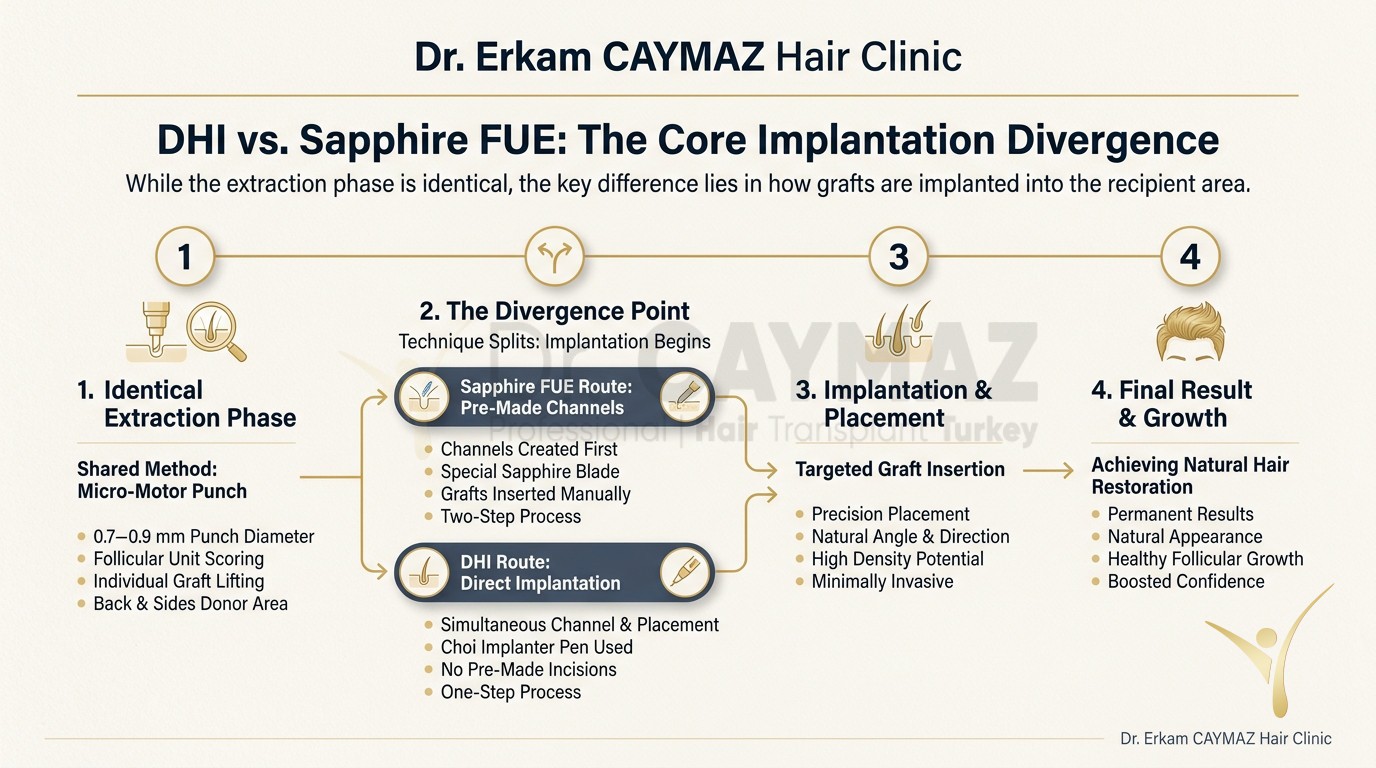
The extraction phase is identical in both methods. A micro-motor punch, typically 0.7–0.9 mm in diameter, scores around each follicular unit in the donor area at the back and sides of the head. The grafts are then lifted out one by one. Where the two techniques diverge is the implantation phase, the step that places each graft into the recipient scalp.
In Sapphire FUE, the surgeon first creates recipient channels, tiny slit incisions, using blades made from synthetic corundum (the same mineral family as sapphire). These blades hold their edge longer than steel, produce a V-shaped micro-incision of about 1.4–1.6 mm, and cause less lateral tissue trauma. After all channels are made, the surgical team places grafts into those pre-made slits using fine-tipped forceps. This two-step workflow, channel creation followed by graft placement, is sometimes called the "open technique" because the channels are visible and mapped before any graft goes in.
DHI collapses those two steps into one. A Choi implanter pen, a hollow needle loaded with a single graft, punctures the scalp and deposits the follicle simultaneously. There's no separate channel-creation phase. The pen's diameter ranges from 0.6 to 1.0 mm, chosen to match the graft caliber. You can read a detailed comparison of sapphire and Choi pen nibs for the mechanical specifics.
When does Sapphire FUE have a clinical advantage?
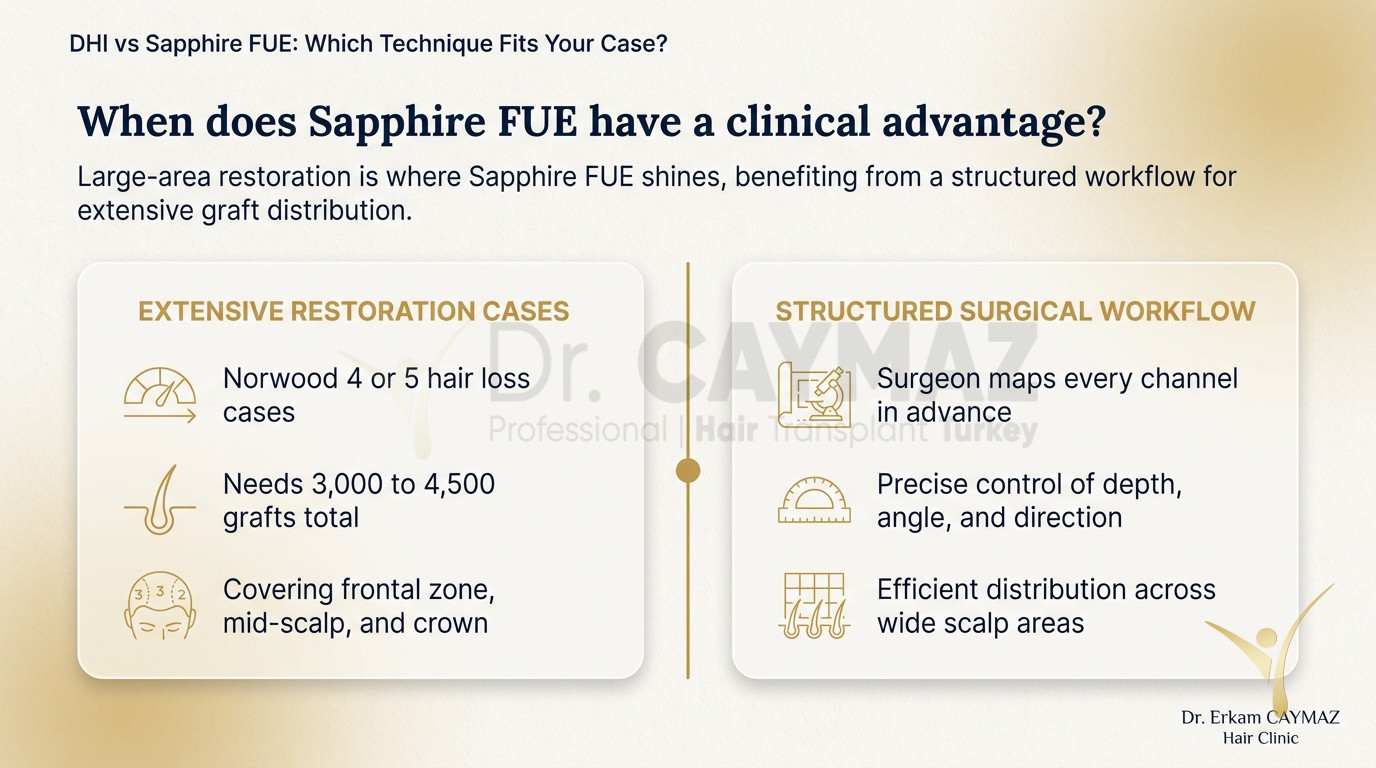
Large-area restoration is where Sapphire FUE shines. A patient with Norwood 4 or 5 hair loss who needs 3,000 to 5,500 grafts distributed across the frontal zone, mid-scalp, and crown benefits from the structured workflow. The surgeon maps every channel in advance, controlling depth, angle, and direction across a wide surface before a single graft is placed. That pre-mapping step gives the team a visual blueprint of the entire recipient area.
Sapphire blades also allow lateral slit incisions, which mimic the natural exit angle of hair from the scalp. Lateral slits let the surgeon pack grafts closer together, achieving densities of 40–55 follicular units per cm² in the frontal zone. For patients who need broad coverage and high density in one session, this efficiency is hard to match. the operating surgeon generally prefers Sapphire FUE for exactly this reason: it allows precise, large-scale planning with consistent channel geometry across thousands of incisions.
Healing is another practical consideration. Because sapphire blades create a clean V-shaped incision rather than a round punch hole, the surrounding tissue closes more neatly. Patients typically report less crusting and a slightly faster resolution of redness in the first 10–14 days. You can review the full aftercare protocol for post-operative timelines.
When might DHI be the better fit?
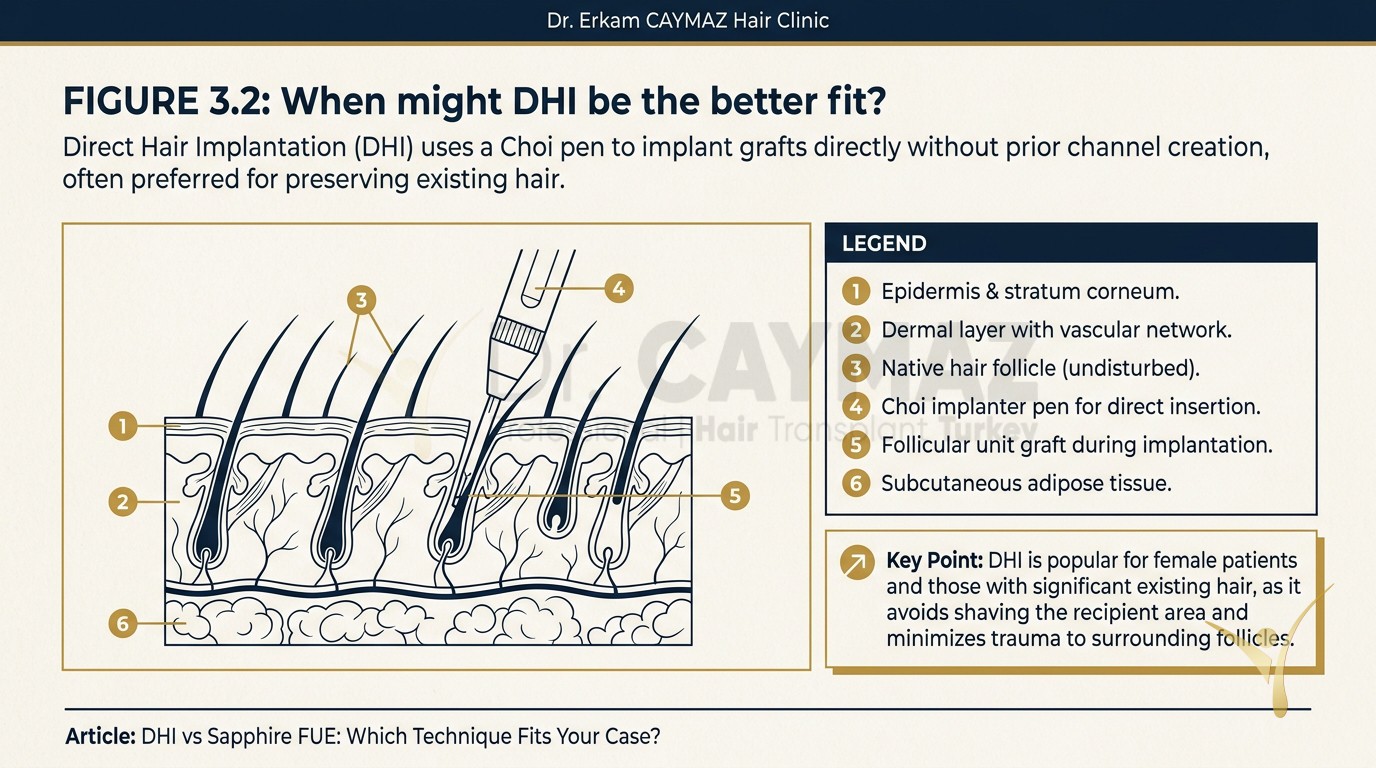
DHI earns its place in specific clinical scenarios. If a patient has existing native hair that shouldn't be disturbed, the Choi pen can implant grafts between those hairs without shaving the recipient area or creating channels that might damage surrounding follicles. This makes DHI popular for female patients who want to thicken a diffusely thinning area without a visible shaved zone.
Both techniques share the same extraction step, follicles removed with a motorized micro-punch, before their implantation workflows diverge. Small, high-precision zones also favor DHI. Temple point reconstruction, a narrow strip of 200–400 grafts along the temporal hairline, benefits from the pen's ability to control angle and depth in a confined space. The same applies to hairline reinforcement in patients who had a previous transplant and need added density in a 1–2 cm strip along the frontal border.
However, DHI has practical limits. Loading each graft into a Choi pen takes time. When graft counts exceed 3,000, the total out-of-body time for the follicles increases, which can reduce graft survival if the team isn't highly experienced. The technique also requires more implanter pens, each pen's needle dulls after repeated use, so a high-graft DHI session may go through 8–12 pens. None of this makes DHI inferior; it simply means the technique is optimized for different case profiles.
Does the technique affect graft survival rates?
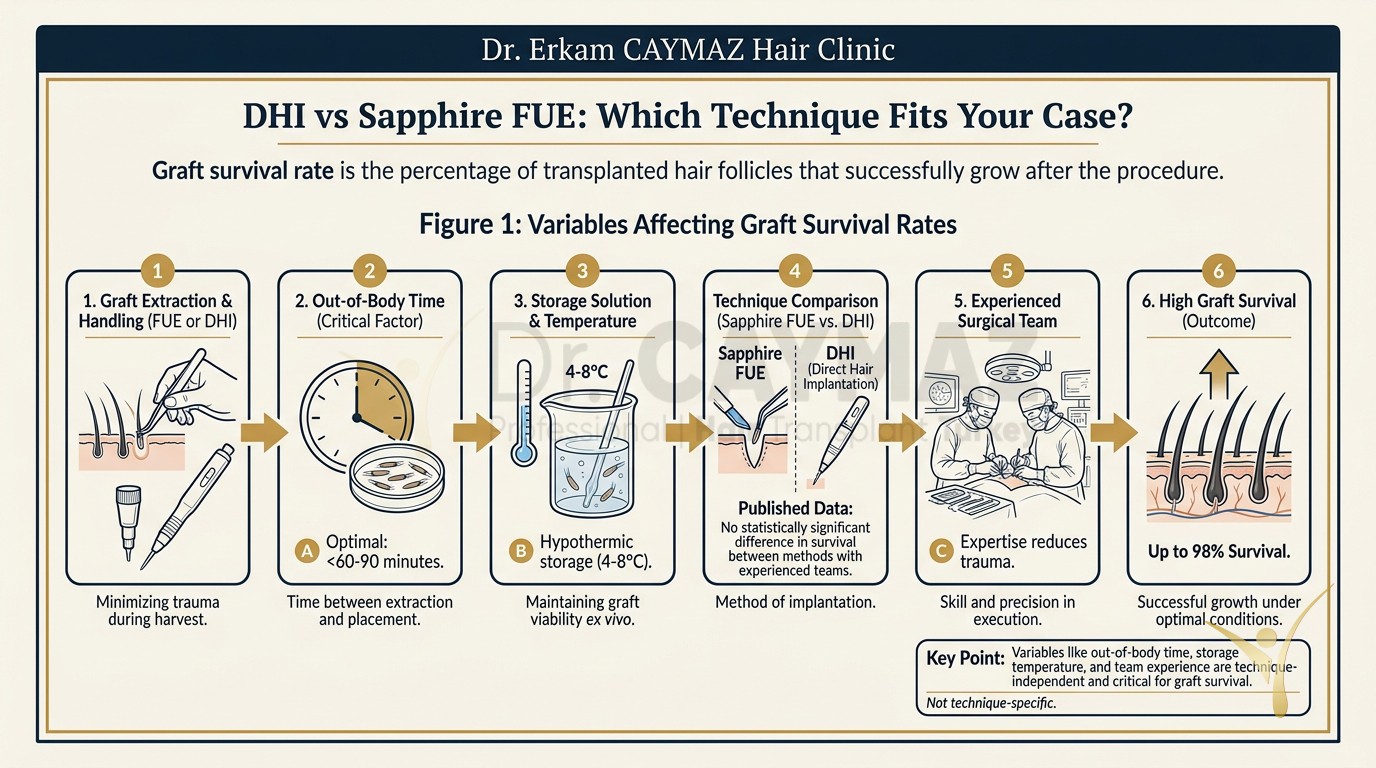
Published data don't show a statistically significant difference in graft survival between the two methods when performed by experienced teams. Both can achieve graft survival rates up to 98% under optimal conditions. The variables that actually threaten graft survival are technique-independent: out-of-body time (ideally under 60–90 minutes), storage solution temperature (4–8 °C is standard), mechanical trauma during handling, and desiccation.
A 2021 review in the Journal of Cosmetic Dermatology found that follicular unit survival correlated more strongly with graft handling protocols than with the implantation instrument used. In other words, a well-organized Sapphire FUE team that keeps grafts hydrated and implants them quickly will match or exceed a poorly organized DHI team, and vice versa. The graft care principles are the same regardless of technique.
Overall success rates for hair transplantation, combining graft survival with patient satisfaction and aesthetic outcome, sit at 90–95% across the literature. That range reflects the reality that no method guarantees 100% perfection. Patient compliance with aftercare, underlying health conditions, and the quality of the donor area all influence the final result.
How do incision quality and healing compare?
Incision quality is where the sapphire blade has a measurable edge, literally. Synthetic corundum rates 9 on the Mohs hardness scale (diamond is 10). That hardness means the blade retains its sharpness through hundreds of incisions without deforming. A sharper blade produces a cleaner cut, less surrounding tissue disruption, and a tighter wound margin. Clinical observations show that sapphire incisions tend to produce less post-operative edema compared to steel-slit incisions, though individual healing varies.
The Choi pen creates a round puncture rather than a slit. Because the pen simultaneously inserts the graft, the wound is immediately filled, which can reduce initial bleeding. Hemostasis during any hair transplant relies on epinephrine in the local anesthetic, firm gauze pressure, and careful pacing of the procedure, not on the implantation tool itself. Both techniques produce pinpoint scabs that shed within 7–12 days when patients follow proper post-transplant washing steps.
By the 3-month mark, the recipient area looks essentially the same regardless of which method was used. Redness fades, transplanted hairs enter the growth phase, and the tiny incision marks become invisible to the naked eye. Long-term scarring in the recipient zone is negligible with both approaches.
Side-by-side comparison: DHI vs Sapphire FUE
Dr. Caymaz Insight
| There is no superior technique, only a skilled surgeon. I generally prefer Sapphire FUE because pre-mapped channels let me control angle and density across large areas; I switch to DHI when a case needs precision between existing hairs. On VIP packages I design the hairline and open recipient channels; my surgical technicians perform extraction and implantation under my direct supervision. |
Why does the surgeon matter more than the technique name?
A common marketing trap in the hair transplant industry is branding one technique as "superior" to attract patients. The clinical reality is different. A 2019 survey by the International Society of Hair Restoration Surgery found that surgeon experience and case planning were the top two predictors of patient satisfaction, ahead of any specific instrument or method. The technique is a tool. The surgeon is the decision-maker.
Consider two scenarios. In the first, a highly experienced surgeon uses Sapphire FUE with meticulous hairline design, proper graft sorting (singles at the hairline, doubles and triples behind), and careful channel angulation. In the second, an inexperienced operator uses DHI but places grafts at inconsistent angles, ignores natural hair direction, and overharvests the donor zone. The first patient will have a natural, dense result. The second will not, despite using a "newer" tool.
Planning is among the most critical steps in any transplant. Before a single punch touches the scalp, the surgeon must assess donor density (ideally 60–80 FU/cm² in the safe zone), calculate how many grafts the donor can safely yield without visible thinning, and map the recipient area for angle, direction, and density gradients. For patients at Norwood 4 or above, Dr. Caymaz recommends at least two sessions spaced a minimum of 6 months apart to protect donor health and avoid overharvesting.
Can both techniques be used in the same session?
Yes, and some surgeons do exactly that. A hybrid approach might use Sapphire FUE for the bulk of the mid-scalp and crown, where 2,500+ channels need to be mapped across a wide area, and then switch to DHI for the frontal hairline, where 300–500 grafts need to be placed at very acute angles between existing hairs. This isn't common practice everywhere, but it's technically sound when the surgical team is trained in both methods.
The decision to combine techniques is made during the surgical planning phase, not on the fly. It requires two separate instrument setups and a team comfortable transitioning between workflows. At our clinic, where we perform only 1–2 VIP operations per day, there's enough time and focus to execute a hybrid plan if the case calls for it. High-volume clinics running 5–10 operations daily rarely have that flexibility.
Clinical Intelligence. DHI vs Sapphire FUE
Clinical Context
DHI and Sapphire FUE are implant workflows, not competing brands. Choice depends on shave tolerance, zone size, density goals, and who controls direction, not a universal winner.
Candidate Profile
Patients comparing techniques before surgery: Norwood stage known, donor assessed, and realistic about session scope, whether they need broad coverage or targeted zones.
Key Risk
Choosing technique from marketing charts instead of indication, e.g. DHI for a full scalp rebuild or sapphire slits for a small unshaven temple without planning time.
Expected Outcome
Either method in surgeon-led, limited-intake care delivers about 90–95% success and up to 98% graft survival when case, handling, and aftercare align.
Start with shave tolerance or zone size?
How does session scope change the choice?
Does either method guarantee higher density?
Who should make the final technique call?
What happens first in Sapphire FUE?
What happens first in DHI?
Which heals faster on paper?
Can one patient combine both?
Why do comparison tables mislead?
What is the hair-mill failure mode?
When does technique choice not matter?
Do survival rates differ between methods?
What graft ranges fit each workflow?
Is there a best technique?
Questions to ask any clinic?
What photos should you send?
How do you avoid regret?
Key Takeaway
Pick workflow by indication, shave plan, zone size, and density target, then verify surgeon involvement; the tool follows the plan.
Clinical Pearl
There is no best technique, only the best surgeon: sapphire and DHI both succeed when case selection and direction mapping come first.
Red Flag
A clinic that insists one method always wins, refuses staged planning, or will not document who performs incisions and implantation.
Monitoring Point
Revisit technique choice at consultation if donor assessment lowers graft estimates, flexibility beats locking a method before exam.
What should you ask during your consultation?
Instead of walking into a clinic and requesting a specific technique by name, ask these questions:
- "Based on my hair loss pattern and donor density, which technique do you recommend, and why?"
- "How many grafts do I need, and can my donor area supply them safely in one session?"
- "Who makes the incisions, and who places the grafts?"
- "What is your graft survival rate, and how do you keep grafts viable during the procedure?"
These questions shift the conversation from marketing labels to clinical substance. A confident surgeon will explain the reasoning behind their technique choice without dismissing the alternative. If a clinic tells you one method is always better than the other, that's a red flag, not a sign of expertise. You can explore more about factors behind poor results to understand what really goes wrong when planning is skipped.
Both DHI and Sapphire FUE are proven, effective, modern techniques. The difference in your result won't come from the name printed on the blade or pen. It will come from the surgeon who evaluates your scalp, designs your hairline, and ensures every graft is handled with precision from extraction to final placement. That's the variable worth researching.
Technique choice follows consultation at our clinic. Surgeon-led VIP planning generally favours sapphire FUE for broad coverage; Dr. Caymaz reserves DHI when precision between native hairs matters more than pre-made slit geometry.
| Parameter | Sapphire FUE | DHI (Choi Pen) |
|---|---|---|
| Implantation method | Pre-made channels, then graft placement | Simultaneous channel + graft insertion |
| Blade / pen tip | Sapphire crystal, 1.4–1.6 mm | Hollow needle, 0.6–1.0 mm |
| Ideal graft range per session | 2,000–5,500 grafts | 500–3,000 grafts |
| Best for | Large-area coverage, high-density frontal + crown | Small zones, unshaved areas, hairline reinforcement |
| Shaving required? | Usually full or partial shave | Can be done without shaving recipient zone |
| Graft out-of-body time | Moderate (channels first, then rapid placement) | Can be longer at high graft counts |
| Density achievable | 40–55 FU/cm² (lateral slits) | 40–50 FU/cm² (pen angle dependent) |
| Healing timeline | Crusts shed 7–12 days; redness fades 4–8 weeks | Similar: 7–12 days crusting; 4–8 weeks redness |
| Graft survival | Up to 98% | Up to 98% |
Sources & clinical references
Neither technique is universally better. DHI works well for small, high-precision zones and unshaved recipient areas. Sapphire FUE is preferred for large-area coverage with high graft counts. The surgeon's skill and planning determine the outcome far more than the instrument used.
It's technically possible but challenging. DHI requires loading each graft into a Choi pen individually, which increases total procedure time and graft out-of-body duration at high counts. Most experienced surgeons prefer Sapphire FUE for sessions above 3,000 grafts to keep graft survival rates optimal.
Both techniques produce minimal scarring in the recipient area. Sapphire FUE creates V-shaped micro-slits that heal cleanly, while DHI creates small round punctures that close quickly. By 3 months, the incision marks from either method are typically invisible to the naked eye.
Dr. Caymaz prefers Sapphire FUE because the pre-mapped channel system gives him full control over density distribution, angle, and direction across large recipient areas. He uses DHI selectively when a case requires precision work in a small zone, such as temple point reconstruction or hairline reinforcement between existing hairs.
Published studies show no significant difference in graft survival between the two methods when performed by experienced teams. Both can achieve graft survival rates up to 98%. The factors that most affect survival are graft handling, storage temperature, out-of-body time, and hydration, not the implantation tool.
Yes. Some surgeons use a hybrid approach: Sapphire FUE for the bulk of the mid-scalp and crown, and DHI for the frontal hairline where acute-angle placement between existing hairs is needed. This requires a team trained in both methods and adequate time, which is why it's more feasible in clinics that limit daily operations.
FUE vs DHI — Frequently Asked Questions
Expert Answers by Dr. Erkam Caymaz, Istanbul