


Quick Numbers
| FUE extraction punch | 0.8–0.9 mm |
|---|---|
| FUT strip scar | About 15–20 cm long |
| FUE donor scabs | Gone in about 7–10 days |
| FUT stitches | Removed at about 10–14 days |
| Our standard technique | Sapphire FUE |
Key Takeaways
| FUE and FUT move the same thing, follicular units from the back of the head. They differ in how those units are taken out. |
| FUE leaves small dot scars spread across the donor area. FUT leaves one long linear scar that shows if you wear your hair very short. |
| FUT avoids shaving the donor area, which is its main practical advantage. |
| The donor area usually heals faster and with less tightness after FUE. |
| We use Sapphire FUE as our standard. FUE grafts can also be placed into an old FUT scar to make it less visible. |
Most people researching a hair transplant meet the same two abbreviations within minutes: FUE and FUT. Clinic websites tend to describe their own method as the obvious choice, which doesn't help much when you're trying to compare them. This guide explains what actually differs between the two, what each one leaves behind on the back of your head, and why most patients today are planned with FUE.
The short version: both methods take hair from the same donor area and place it the same way. The difference is in the harvest. FUE removes follicular units one at a time with a tiny punch. FUT removes a strip of scalp and divides it into grafts under the microscope. That one step decides the scar, the recovery and how your donor area can be used in the future.
What is the difference between FUE and FUT?
Hair grows in small natural groups of one to four hairs called follicular units. A graft is one of those units moved from the donor area, the back and sides of the head, to the thinning area. Donor hair is the right source because it's naturally resistant to the hormone DHT, which drives pattern hair loss.
In FUE (follicular unit excision), the team extracts each unit individually with a motorized punch about 0.8–0.9 mm across. Extraction is spread over the donor area so that no single spot is thinned out. In our clinic, the recipient channels are then opened with sapphire blades, which is why we call the technique Sapphire FUE. The sapphire blade is used for the channels, not for the extraction.
In FUT (follicular unit transplantation, also called the strip method), the surgeon removes a long, narrow strip of scalp from the back of the head and closes the wound with stitches. Technicians then cut the strip into individual grafts under microscopes. The implantation that follows is similar to FUE. Our FUT page describes the strip technique in more detail.
How do the scars compare?
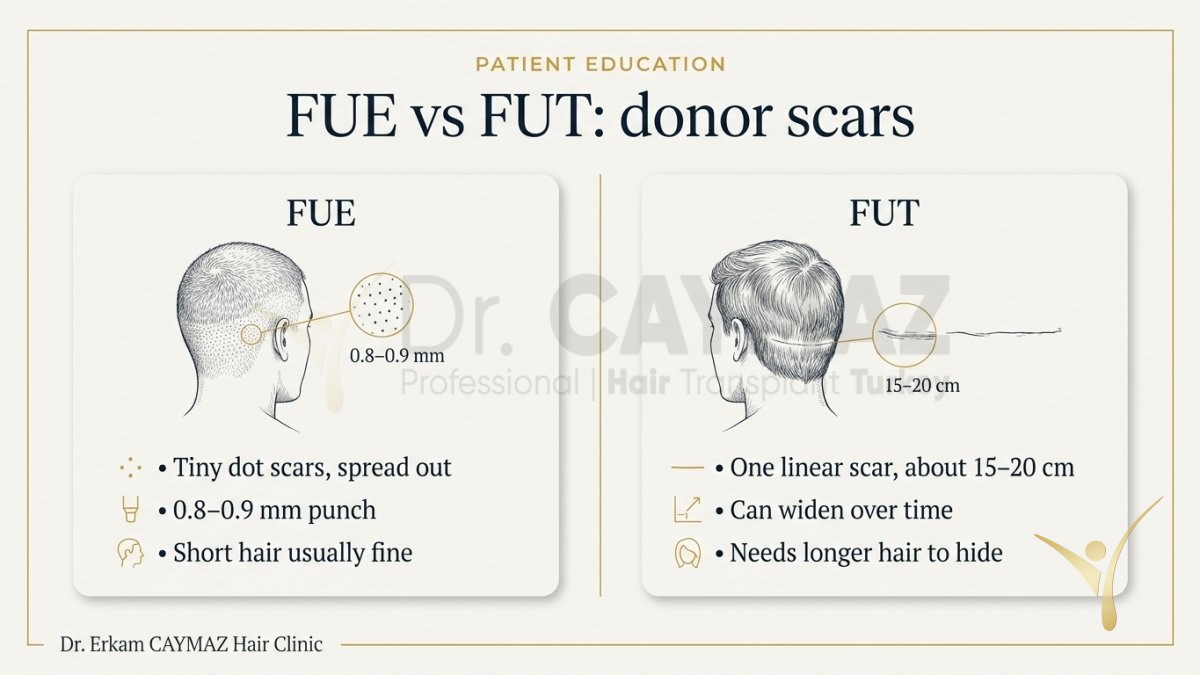
Every hair transplant leaves some scarring in the donor area. The question is what kind and where.
FUE leaves many tiny round scars, each roughly the size of the punch, scattered between the remaining hairs. Once the donor hair has grown back, they're very hard to see. Most patients can wear the back and sides short, with hair a few millimeters long, without anyone noticing. A completely shaved head can show small pale dots in bright light, especially if a lot of grafts were taken.
FUT leaves a single linear scar across the back of the head, typically about 15–20 cm long, running from ear to ear in larger sessions. When it heals well it's a thin line hidden by hair a couple of centimeters long. It can also stretch and widen, especially if the scalp was tight or the closure was under tension, and hair around the scar can thin. Either way, it limits very short haircuts for life.
For many men this is the deciding factor. Hairstyles change over the years, and a clipper fade isn't possible over a strip scar without it showing.
Which method gives you more grafts?
This is the argument most often made for FUT, so it deserves a careful answer. A strip is taken from the densest central part of the donor area, and in the past this allowed large sessions in a single day. Each further strip operation, however, makes the scalp tighter and adds to the scar, so the total number of grafts available over a lifetime doesn't increase.
FUE draws from a wider area of the back and sides, and it can be combined with beard or body hair when the scalp donor is limited. In our clinic, a single Sapphire FUE session can reach about 5,000–5,500 grafts when the donor area allows it, and our usual packages range from 2,500 to 4,500 grafts. We don't perform mega-sessions of 6,000–7,000 grafts in one day, because the health of the donor area matters more than the number on the day.
What really limits graft numbers is your donor density and how much of it can be taken without visible thinning. That applies to both methods. For a closer look at how many grafts different stages need, see how many grafts do I need.
FUE vs FUT at a glance
| Factor | FUE | FUT (strip) |
|---|---|---|
| Harvest | Individual follicular units with a 0.8–0.9 mm punch | A strip of scalp, divided into grafts under the microscope |
| Donor scar | Small dot scars spread out | One linear scar, about 15–20 cm |
| Short hair at the back | Usually fine once healed | The scar can show |
| Shaving the donor area | Needed | Not needed |
| Stitches | None | Yes, removed at about 10–14 days |
| Donor discomfort | Mild, mostly the first few days | Tightness and numbness for weeks, sometimes longer |
| Body or beard hair as extra donor | Possible | Not possible |
| Our approach | Standard technique (Sapphire FUE) | Not used for new cases |
How does recovery compare?
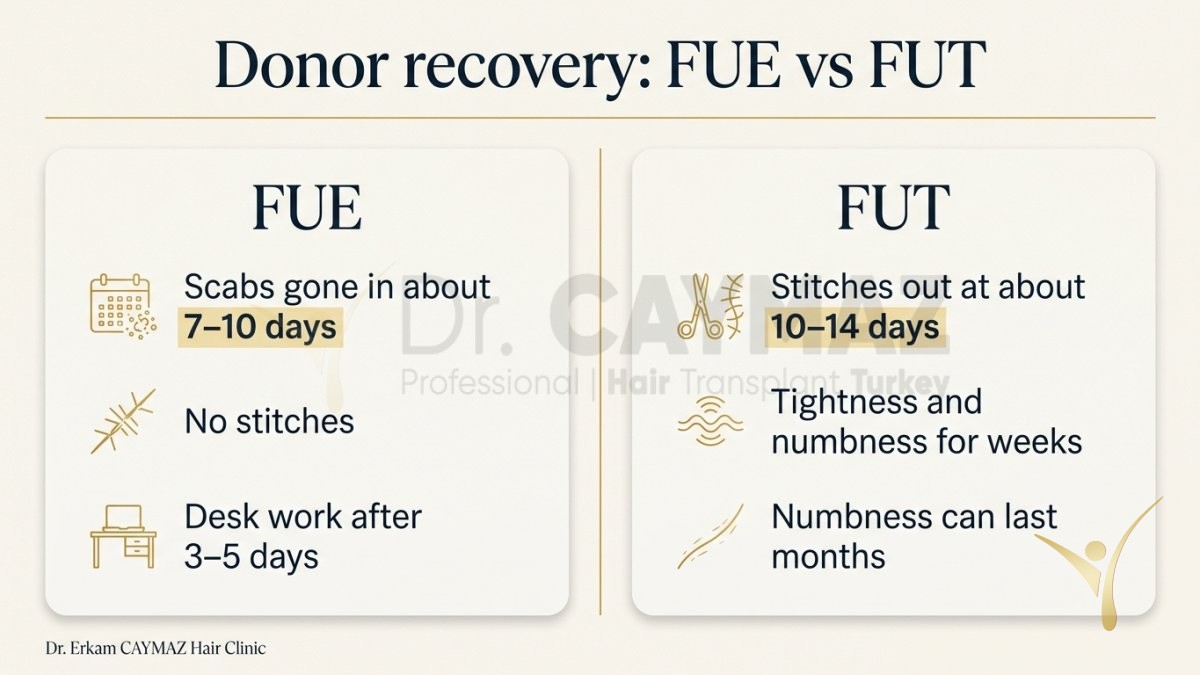
The recipient area heals the same way with both methods: small crusts form, the grafts anchor by about day 10 to 14, and the transplanted hairs shed in the following weeks before new growth begins around the third month. The difference is in the donor area.
After FUE, the extraction sites form tiny scabs that fall off within about 7–10 days. The donor hair starts growing back immediately and covers the area within a few weeks. Most patients who work at a computer go back after 3 to 5 days. In our clinic, the donor bandage comes off on day 2, together with the first wash. The day-by-day course is covered in FUE recovery from the first days to the final result.
After FUT, the donor wound is a stitched incision. Stitches or staples come out at about 10–14 days. Many patients feel tightness at the back of the head for several weeks, and numbness above the scar can last for months. Sleeping on the back and bending the neck forward are uncomfortable at first, and heavy training has to wait longer because strain on the wound can widen the scar.
Is one method more painful?
Both procedures are done under local anesthesia, and the patient stays awake throughout. In our clinic, the local anesthetic is given with a needle-free delivery method, administered by an assisting nurse under Dr. Caymaz's supervision. Once the area is numb, neither harvest should hurt.
The difference comes afterwards. A stitched strip wound pulls whenever you move your neck, so FUT patients usually need painkillers for longer. FUE donor sites feel more like a mild graze for the first few days. Our article on pain during a hair transplant covers what to expect on the day itself.
Dr. Caymaz Insight
| When patients ask me about FUT, I explain the trade-off plainly. You avoid shaving the back once, but you carry a linear scar for the rest of your life. I see many patients who had strip surgery years ago and now want to wear their hair short. We can place FUE grafts into the scar to soften it, but we can't make it disappear. That's why I plan new patients with Sapphire FUE. The technique alone doesn't guarantee a good result, though. Planning, donor protection and careful work over the whole operation matter more than the name of the method. |
Who might still consider FUT?
FUT isn't wrong for everyone, and some surgeons still use it. Its practical advantage is that the donor area doesn't need to be shaved, because the hair above the strip falls over the stitched line. People who always wear their hair long and can't take time off with a shaved head sometimes prefer it for that reason.
For most patients, though, the drawbacks weigh more: a permanent linear scar, a longer and tighter donor recovery and less freedom to use the donor area in future sessions. Hair loss often continues for years, and a large share of men with Norwood 4 or higher stages need at least two sessions, spaced at least six months apart. Keeping the donor area flexible for that second session is one more reason we favor FUE. If you're weighing a transplant against medication first, read hair transplant or medication first.
Can FUE fix an old FUT scar?
Yes, in many cases. Grafts taken with FUE can be placed directly into the scar tissue of an old strip line. Scar tissue has a poorer blood supply than normal scalp, so growth is usually lower than in a standard recipient area, and some patients need a second pass. The goal is realistic: a scar that blends in with hair a little longer than before, not a scar that's gone.
Before any repair, we look at how much healthy donor hair remains, because earlier strip surgery and any previous FUE both reduce what's available. If you're considering a correction after an earlier operation, our article on revision surgery explains how we assess it.
Which method is right for you?
There's no universally better technique, only better planning for each patient. Still, the comparison points clearly in one direction for most people today. If you want the option of short hair, a quicker donor recovery and a donor area you can return to in a few years, FUE is the more flexible choice. FUT remains a valid technique in some hands, mainly for patients who must avoid shaving.
The best way to decide is to have your donor area assessed. Send clear photos of the front, top, crown and back of your head, and Dr. Caymaz will review your density, your likely future loss and the number of grafts you need. The technique is planned before the operation day, based on those photos, and isn't changed in the operating room.
Scientific Sources
FAQ
Both move follicular units from the back of the head to the thinning area. FUE extracts each unit individually with a 0.8–0.9 mm punch, while FUT removes a strip of scalp that is then divided into grafts under the microscope. That difference decides the scar and the donor recovery.
Yes, but the scars are tiny round dots spread across the donor area. Once the hair has grown back they are very hard to see, and most patients can wear the back and sides short. A fully shaved head can show small pale dots in bright light.
FUT leaves one linear scar across the back of the head, typically about 15–20 cm long. When it heals well it is a thin line hidden by hair a couple of centimeters long, but it can stretch and widen, and it limits very short haircuts for life.
A strip can yield a large number of grafts in one day, but each further strip makes the scalp tighter, so the lifetime total doesn't increase. FUE uses a wider donor area and can add beard or body hair. In our clinic a single Sapphire FUE session can reach about 5,000–5,500 grafts when the donor area allows.
The donor area usually recovers faster after FUE. The small scabs fall off in about 7–10 days and there are no stitches. After FUT, stitches come out at about 10–14 days and tightness or numbness at the back of the head can last for weeks or months.
The donor area at the back and sides needs to be shaved for FUE so that each follicular unit can be extracted. FUT doesn't require shaving the donor area, which is its main practical advantage for people who always wear their hair long.
In many cases, yes. FUE grafts can be placed into the scar tissue of an old strip line. Growth in scar tissue is usually lower than in normal scalp, so the realistic goal is a scar that blends in, not one that disappears.
Sapphire FUE is our standard technique, and DHI is planned only in selected cases. We don't use FUT for new cases. The technique is planned in advance from your photos and isn't changed on the operation day.

Hair Transplant Surgery in The Summer
Hair transplant can be performed in summer when aftercare rules are followed. The season itself is not the main risk…
Read More: Hair Transplant Surgery in The Summer
When Can You Swim After a Hair Transplant?
Patients should avoid ocean, pool, and lake swimming for at least 30 days after a hair transplant. Saltwater, chlorine…
Read More: When Can You Swim After a Hair Transplant?
What does it mean Overharvest : Hair Transplantation?
In hair transplant surgery, overharvest means removing more follicles from the donor area than the scalp can afford to…
Read More: What does it mean Overharvest : Hair Transplantation?
Hair Transplant or Medication First: How to Choose
For most patients with androgenetic hair loss, medication first is best if you still have miniaturizing hair to…
Read More: Hair Transplant or Medication First: How to ChooseFUT Hair Transplant — Frequently Asked Questions
Expert Answers by Dr. Erkam Caymaz, Istanbul