


Quick Numbers
| Days 1–14 focus | Protect grafts, scabs, donor comfort |
|---|---|
| Micro-scab shedding | Days 10–14 |
| First visible growth | Months 3–4 |
| Clear density shift | Months 6–7 |
| Final density | Months 10–12 |
Key Takeaways
| Treat days 1–14 as a protection window: gentle washing, no picking of scabs, elevated sleep, and limited exercise. |
| Donor soreness usually peaks on days 2–3 and settles within a week; mild numbness can last longer without signaling failure. |
| Shock loss in weeks 2–6 is expected biology, not a failed transplant. |
| Months 3–12 are a growth and maturation arc; cosmetic patience matters more than daily mirror checks. |
| Graft survival can reach up to 98% when aftercare is followed; overall success commonly sits at 90–95% for well-planned FUE. |
FUE hair transplant recovery is easiest to understand as two linked calendars. Days 1–14 are tissue healing: micro-scabs, donor tightness, swelling, and graft anchoring. Months 3–12 are growth: early strands, rising density, and final cosmetic maturity. This FUE-specific map complements our first 30 days guide.
For week-by-week milestones, use the recovery timeline. Activity limits live in a separate calendar article.
Days 1–3: Rest, First Wash, and Early Swelling
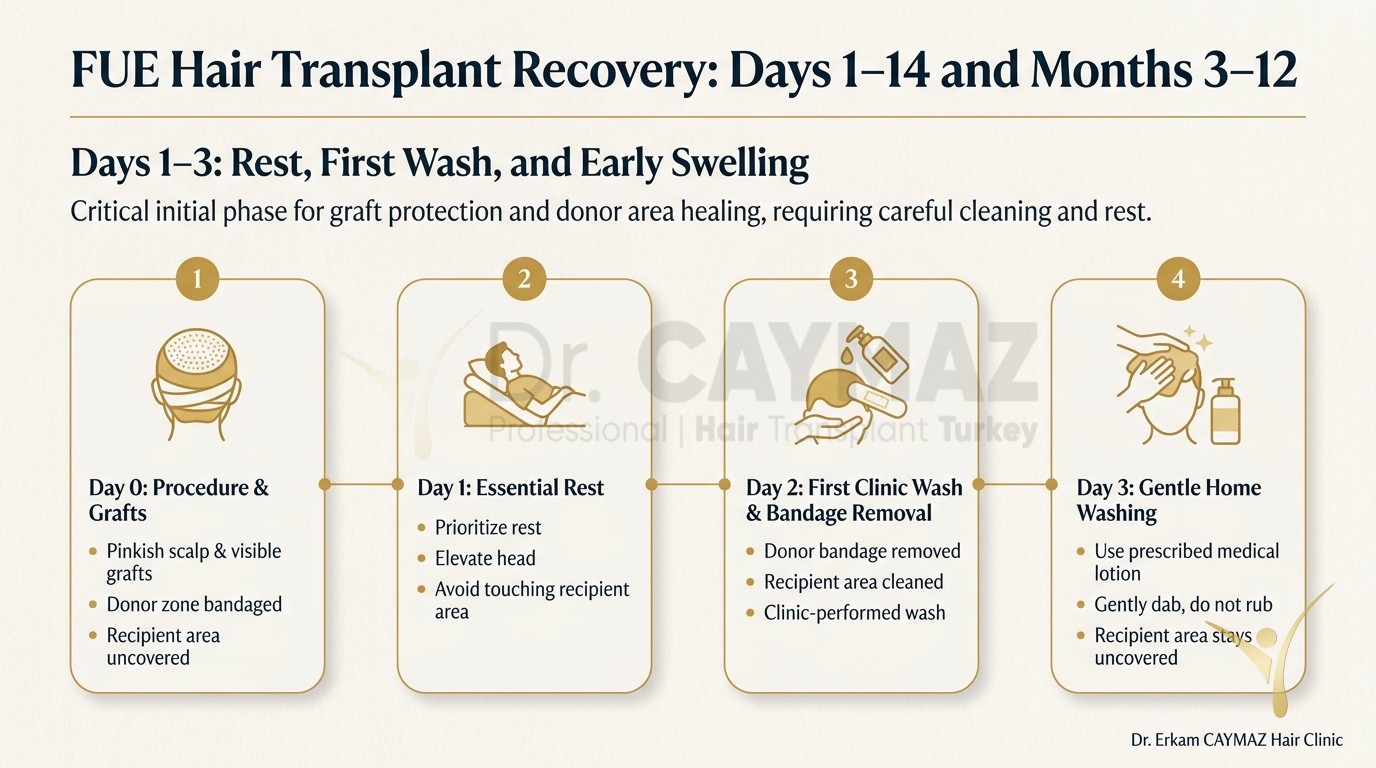
Day 0 leaves pinkish scalp, visible grafts, and a bandaged donor zone. Day 1 is rest. At our practice the first clinic wash is on day 2, when the donor bandage comes off. The recipient area stays uncovered from the operating room onward.
Washing uses a gentle medical lotion with an open palm, never nails. The goal on day 2 is softening, not stripping crusts. Some clinics wash on day 1; we prefer day 2 so the fibrin seal has another 24 hours to stabilize. From day 2 onward, patients wash daily at home. The post-transplant washing steps spell out the exact technique.
Forehead swelling appears in roughly 30–40% of patients, especially after frontal work. Tumescent fluid migrates with gravity over 48–72 hours and can reach the brow. It looks dramatic and usually settles in 2–3 days. Sleep with the head elevated about 45 degrees and cool the forehead carefully, never pressing ice on grafts. Standard analgesics cover most early discomfort; see the perioperative medication list if you need the full schedule.
After the first clinic wash, home care stays deliberate: soft lotion, low water pressure, and no nails on crusts. The full aftercare protocol keeps those daily steps in one place so you are not improvising from memory.
Days 4–14: Micro-Scabs, Donor Healing, and the Two-Week Visual Map

Each FUE graft sits in a sapphire-blade channel roughly 1.0–1.3 mm long. Within 24–48 hours plasma seals the slit into a micro-scab. That crust is a biological dressing while neovascularization begins. Disturbing scabs before about day 7 can lift a graft still seating in its channel.
Donor extraction uses a 0.8–0.9 mm micromotor punch. Soreness peaks around days 2–3 as sunburn-like tightness, then fades by days 5–7 for most patients. Mild tingling or numbness can linger 2–4 weeks as sensory branches recover. Conservative harvesting matters: for Norwood 4 and above, Dr. Caymaz plans staged sessions at least 6 months apart rather than a single mega-session of 5,000+ grafts. See donor area management for planning detail.
Around days 7–8, gentle fingertip circular washing can begin because anchoring is stronger. Most scabs shed by days 10–14 during washes; stubborn ones usually clear by day 16–17 with continued soaking.
| Timeframe | Appearance | What Is Happening |
|---|---|---|
| Day 0 | Pink-red scalp, visible grafts | Fibrin clot forming in channels |
| Days 1–2 | Dark crusts; mild swelling possible | Micro-scabs harden; first clinic wash day 2 |
| Days 3–5 | Forehead swelling may peak; scabs darken | Early anchoring and neovascularization |
| Days 6–8 | Swelling down; scabs brown or yellow | Fingertip washing may start; grafts more secure |
| Days 9–14 | Scabs shed; short shafts visible; pink skin | Epithelial closure nearly complete |
Redness alone is inflammation, it isn't failure by itself. Most fades between weeks 4 and 8. Spreading warmth, pus, or fever after week one needs prompt review. Strong sterilization protocols plus aftercare keep infection risk low.
Dr. Caymaz Insight
| I ask patients to treat days 1–14 as a protection calendar and months 3–12 as a growth calendar. The scabs and redness test patience, not graft quality. Skipping washes or picking crusts is the mistake I see most often. By day 7, gentle consistent washing is what clears scabs safely. Donor soreness is temporary; in more than 15 years of practice I rarely need anything stronger than a basic anti-inflammatory for early post-op pain. |
Weeks 3–6: Shock Loss Before the Growth Phase
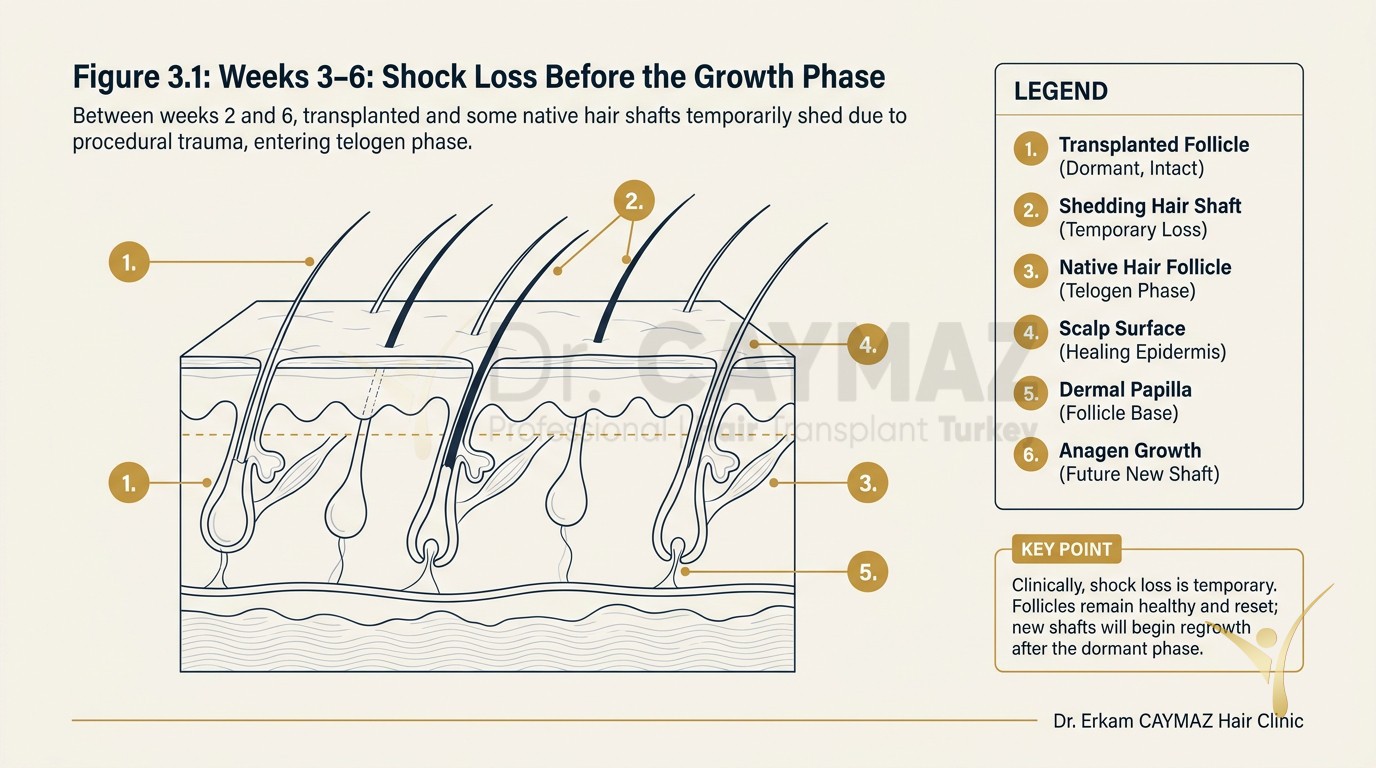
Between weeks 2 and 6, many transplanted shafts shed. This shock loss sends follicles into telogen after extraction and reimplantation trauma. Native hairs near the zone can shed too. Both patterns are temporary. Follicles remain; shafts reset. A deeper mechanism note is in our shock hair loss article. Clinically, shock loss isn't graft failure.
Patients often feel this phase contradicts the careful days 1–14 work. In reality it's the bridge into months 3–12. The shafts you see fall aren't the permanent grafts leaving; they are early shafts cycling while the follicle stays in place. Expect uneven thinning for a few weeks, then quiet scalp before month-3 sprouts appear.
Video summary: A short explainer on why the final result takes about 12 months: inflammation in the first days, shedding in weeks 2 to 6, a resting phase in months 1 to 3 while the grafts build a new blood supply, then the growth phase. A scalp that still looks bare in month 3 is normal.
Months 3–6: First Growth and Early Density
Month 3: Early hairs emerge, often thin or temporarily curly. Months 4–5: About 30–40% of follicles typically produce visible hair; density still looks incomplete. Months 6–7: Roughly 50–60% of grafts show hair, shaft diameter increases, and many patients finally see a clear cosmetic shift. Mirror impatience is common here; the calendar's still early.
Compare photos in consistent light every 4–6 weeks rather than daily. FUE recovery in months 3–6 rewards pattern recognition: fringe growth along the hairline first, then filling behind it. If growth is absent past month 5 in a whole zone that had healthy scab healing in days 1–14, schedule a review rather than assuming failure overnight.
Months 6–12: Maturation and Final Results
Months 8–10: About 70–85% of final density is often present as texture normalizes. Long-term care guidance in the post-operative hair care protocol becomes practical. Months 10–12: Most patients reach final density. Some slower follicles thicken into months 14–15, but month-12 changes are usually subtle. Well-performed FUE commonly delivers 90–95% success, with graft survival up to 98% when aftercare is followed.
Sleep, Work, and Exercise Across the Full Timeline
For 7–10 nights, sleep on your back with the head elevated. Desk work often resumes in 3–5 days. Physical or dusty jobs may need 10–14 days. Walking starts day 1. Light gym work without heavy loading often returns around days 10–14. Full intensity and contact sports wait until days 28–30. Swimming waits at least 4 weeks. The return-to-activity calendar breaks restrictions down week by week.
You'll want to avoid alcohol for at least 72 hours post-op. Itching around weeks 2–3 is usually healing; it doesn't mean infection; see the side effects overview.
When Poor Recovery Harms Results, and When to Call
Suboptimal density more often traces to technique or planning than to one missed wash, but patient choices still matter. Picking scabs before day 7, untreated infection, early heavy sun, and nicotine that constricts blood flow can all reduce survival. For failure patterns see FUE transplant failure causes.
Contact the clinic for worsening pain after day 5 with warmth or focal swelling, fever above 38°C (100.4°F), pus or foul discharge, bleeding that ignores 10 minutes of firm gauze pressure, or a medication rash. In a surgeon-led practice with conservative graft planning, these events stay uncommon.
Keep the two calendars separate in your mind. Days 1–14 protect what was placed. Months 3–12 reveal what those follicles grow. The grafts that clear the first 10 days carefully are, for the vast majority of patients, permanent.
Sources
Sources & clinical references
FAQ
Days 1–14 are about wound protection. Micro-scabs form within 24–48 hours and usually shed by days 10–14. Donor soreness peaks around days 2–3. The first clinic wash is typically on day 2. Swelling, if present, often peaks by days 3–5 and settles soon after.
Most micro-scabs soften and shed during gentle washing between days 10 and 14. A few may linger until day 16–17. Do not pick them earlier than about day 7, when grafts are usually anchored enough for careful fingertip washing.
Donor soreness usually peaks on days 2–3 and feels like sunburn tightness rather than sharp pain. Most patients manage with standard analgesics. Discomfort typically settles by days 5–7, though mild numbness can linger for 2–4 weeks.
Shock loss often appears between weeks 2 and 6. Transplanted shafts shed while follicles rest under the skin. This is not graft failure. New growth usually begins around month 3 as follicles re-enter anagen.
First visible growth commonly starts in months 3–4. By months 6–7 many patients notice a clearer cosmetic change. Roughly 70–85% of final density is often present by months 8–10, with most final density by months 10–12.
Month 3 brings early thin strands. Months 4–5 show more visible growth, often around 30–40% of follicles producing hair. Month 6 is when many patients see a meaningful density shift as shaft diameter matures.
Most patients reach final density around months 10–12. A minority of slower follicles may thicken into months 14–15. Well-performed FUE with careful aftercare commonly achieves 90–95% success, with graft survival up to 98%.
Walking is fine from day 1. Light gym work without heavy lifting often resumes around days 10–14. Full-intensity training and contact sports usually wait until days 28–30. Swimming is typically deferred at least 4 weeks.
At our practice the first clinic wash is on day 2 post-op, with day 1 reserved for rest. Daily gentle washing continues at home. Slightly firmer fingertip washing can begin around days 7–8 once grafts have anchored.
Redness alone is usually a normal inflammatory response. It often fades between weeks 4 and 8. Seek care if redness comes with rising pain, warmth, pus, or fever after the first week.
This guide is FUE-specific and covers both the acute days 1–14 window and the months 3–12 growth arc. For a day-by-day first-month checklist see our first 30 days guide; for week-by-week milestones see the recovery timeline article.
Call if pain worsens after day 5 with warmth or focal swelling, if fever exceeds 38°C (100.4°F), if there is pus or foul discharge, if bleeding does not stop with 10 minutes of firm gauze pressure, or if a medication rash appears.

1 cm2 At least how many grafts should be planted?
Clinics and forums debate how many grafts per cm² should be implanted. The adult scalp naturally holds many follicular…
Read More: 1 cm2 At least how many grafts should be planted?
Good Hair Transplant Candidates: Eligibility and Success Factors
Good Hair Transplant Candidates and What Must Be True Featured Snippet A good hair transplant candidate must have a…
Read More: Good Hair Transplant Candidates: Eligibility and Success Factors
DHI vs FUE: How the Implantation Method Is Chosen Before Surgery
The DHI hair transplant vs FUE choice is set before surgery day from remote photos sent over WhatsApp or email. Dr…
Read More: DHI vs FUE: How the Implantation Method Is Chosen Before Surgery
Red Light Therapy After Hair Transplant: Timing and Protocols
Red light therapy (LLLT) at 630â670 nm wavelengths may support scalp healing and reduce inflammation after hair…
Read More: Red Light Therapy After Hair Transplant: Timing and ProtocolsFrequently Asked Questions
Professional Hair Transplant Insights by Dr. Erkam Caymaz