


Before graft planning, Dr. Caymaz documents Ludwig stage with standardized part-line photos every three to six months.
Quick Numbers
| Common pattern | Ludwig I–III diffuse thinning |
|---|---|
| Medical first-line | Often topical minoxidil |
| Surgery selectivity | Localized deficits only |
| Workup | Rule out scarring alopecia |
Key Takeaways
| Female loss is not always male-pattern recession. |
| Scarring alopecia must be excluded before surgery. |
| Diffuse unpatterned loss may limit donor reliability. |
| Photos every 3–6 months clarify progression. |
The Silent Struggle: Decoding Female Pattern Hair Loss

Female hair loss is under-discussed, under-diagnosed, and often misunderstood by clinics that primarily treat men. In our practice, we see women whose hair has been thinning for years before they find a surgeon who takes it seriously. The progression in women is rarely the clean Norwood scale used for men, it's more diffuse, more emotionally complex, and requires a genuinely different treatment framework. This article reflects what we've learned from working with female patients across a wide spectrum of hair loss patterns.
Hair loss is frequently discussed as a male issue, but for millions of women, it is a daily, often silent struggle. Unlike male pattern baldness, which is characterized by a receding hairline, woman hairloss typically manifests as a gradual thinning across the top of the scalp.
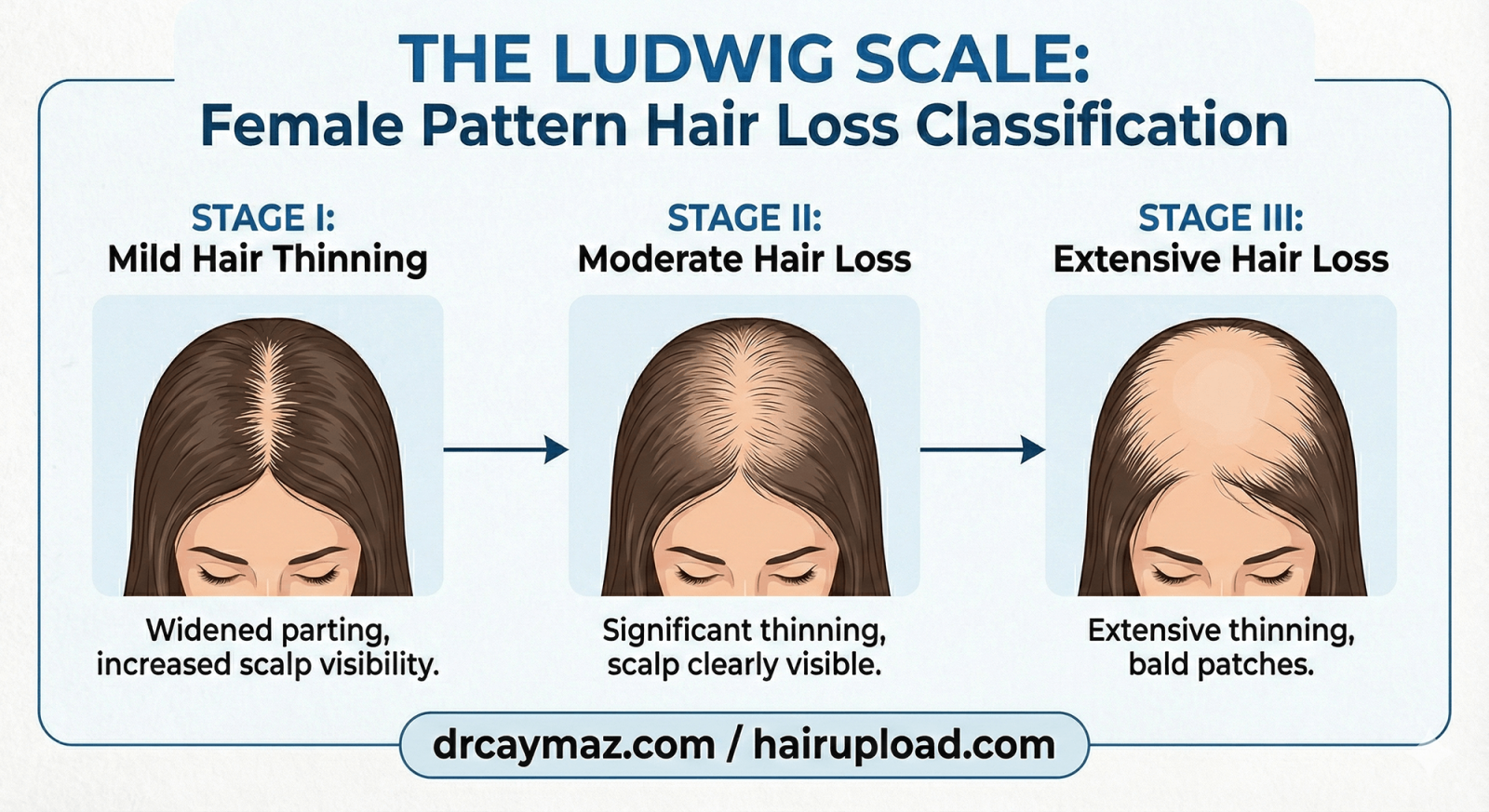
To achieve the best results in treatment, we must first understand the severity of the condition using the Ludwig Scale.
What is the Ludwig Scale?
Dermatologists and hair restoration experts use the Ludwig Scale to classify the stages of female pattern baldness:
Type I: Minimal thinning that can be camouflaged with styling. The frontal hairline remains intact.
Type II: Moderate decrease in volume and a noticeable widening of the part line.
Type III: Significant diffuse thinning across the crown. The scalp becomes clearly visible.
Identifying your stage on this scale is the first step toward determining if you are a candidate for a best hair transplant procedure.
Why Does It Happen?
| Pattern | Typical feature | First step |
|---|---|---|
| Ludwig diffuse | Central widening part | Minoxidil ± antiandrogen if indicated |
| Telogen effluvium | Acute diffuse shed after trigger | Treat trigger; delay surgery |
| FFA/scarring | Frontal band loss, eyebrow loss | Dermatology; avoid transplant in active phase |
| Localized post-trauma | Stable scar or traction patch | Selected transplant after stability |
The causes are often multifactorial:
1. Genetics: If your mother or grandmother experienced thinning, you are at higher risk.
2. Hormones: Events like menopause, pregnancy, or thyroid imbalances can trigger shedding.
3. Stress & Diet: Telogen effluvium can cause temporary but alarming hair loss.
Dr. Caymaz Insight
| When a woman shows rapid widening of the central part with fringe intact, I slow down and ask about eyebrows and arm hair loss before discussing graft counts. Pattern recognition prevents the wrong surgery on the right patient. |
The Gold Standard: Sapphire FUE & DHI for Women
For women seeking cosmetic density improvement, the "shaved head" look often associated with transplants is a major barrier. Fortunately, advanced techniques now allow for unshaven or partially shaven options.
Sapphire FUE Technique
The Sapphire FUE technique utilizes blades made from precious sapphire gemstone rather than steel. This allows for:
Micro-incisions: Smaller channels mean faster healing and less trauma to the scalp.
Higher Density: The precision allows surgeons to pack follicles closer together, critical for restoring volume in thinning areas.
Natural Angles: The V-shaped sapphire blade mimics the natural direction of hair growth.
DHI (Direct Hair Implantation)
For many women, DHI is the preferred choice because it often requires no shaving of the recipient area. The surgeon uses a "Choi Pen" to implant follicles directly between existing hairs, increasing density without damaging neighboring strands.
Why Choose a Hair Transplant in Turkey?
Istanbul has earned its reputation as the capital of hair restoration. A hair transplant in Turkey offers a unique combination of affordability and world-class expertise.
Cost-Effectiveness: Packages often include accommodation and VIP transfers. You can check our specific Hair Transplant Price & Packages to see how competitive these rates are compared to the US or UK.
High Volume Experience: Turkish surgeons perform thousands of cases annually, giving them unparalleled experience with complex female cases.
Comprehensive Care: From the moment you land to your final wash, the process is managed smoothly.
What to Expect: The Journey to Restoration
1. Consultation & Planning
Your donor area (usually the back of the head) is evaluated. We map out the recipient area based on your Ludwig Scale classification.
2. The Procedure
Under local anesthesia, healthy follicles are extracted and implanted. The use of Sapphire blades ensures minimal scarring.
3. Aftercare & Recovery
Post-op care is vital for graft survival. You must follow specific washing and protection protocols. For a detailed guide on what happens next, read our Hair Transplant Aftercare page.
4. The Results
Patience is required. New hair typically begins to grow at 3-4 months, with best results visible around the 12-month mark.
FAQ: Common Questions About Female Hair Transplants
Women often prioritize frontal framing, temple softening, and density in the part line rather than full scalp reconstruction. Design must respect future styling preferences and potential ongoing diffuse loss behind the transplanted band. Single-session mega counts are rarely appropriate. Surgical options for women are outlined in our female hair transplant article.
Not every thinning pattern benefits from surgery on the first visit. Stable donor reserve, realistic zone priorities, and controlled medical comorbidities matter as much as graft totals. A candid conversation about what today’s session can safely achieve prevents regret later. Start with structured candidate eligibility screening before booking travel or deposits.
Medical therapy can stabilize miniaturizing native hair while surgery redistributes resistant follicles; the order depends on age, pattern, and donor reserve. Starting finasteride or minoxidil before surgery may change what zones need grafts at all. Rushing to operate on unstable patterns can consume inventory prematurely. Compare pathways in hair transplant or medication first.
Sources & clinical references
FAQ
Many women develop diffuse central thinning with relative frontal preservation rather than deep temporal recession. Scarring and inflammatory conditions are more common and must be excluded.
Topical minoxidil is widely used for female pattern hair loss when diagnosis supports androgenetic miniaturization without active scarring inflammation.
Use is off-label in many regions and contraindicated in pregnancy. Decisions require endocrine evaluation, contraception counseling, and specialist oversight.
Selected cases with stable donor, localized deficit, and no active diffuse unpatterned alopecia may qualify. Most diffuse patterns are managed medically first.
Iron, thyroid, androgen indices, and history for telogen triggers are common starting points. Biopsy may be needed for scarring alopecia suspicion.
Not always. Density may change with hormonal shifts, yet miniaturization can continue and should be monitored with photos and dermoscopy.

Breast operations: all information about breast correction
Breast operations include augmentation with implants or fat, mastopexy lift, reduction for comfort or aesthetics, and…
Read More: Breast operations: all information about breast correction
Hair Transplant and Holiday in Turkey in one Journey
Nine out of ten balding men cite hair loss as their number one concern. If your hair loss is starting to make you…
Read More: Hair Transplant and Holiday in Turkey in one Journey
Compliance To Hair Transplantation Criteria
Before booking grafts, clinics assess whether you meet compliance criteria for hair transplantation, medical safety…
Read More: Compliance To Hair Transplantation Criteria
DHI Hair Transplant: Indications, Limits, and Healing
DHI (Direct Hair Implantation) uses a Choi pen to place grafts without pre-made incisions, offering precise angle…
Read More: DHI Hair Transplant: Indications, Limits, and HealingHair Loss — Frequently Asked Questions
Expert Answers by Dr. Erkam Caymaz, Istanbul