


Quick Numbers
| Typical onset | Early weeks post-op |
|---|---|
| Common window | Weeks 2-8 |
| Frequent recovery band | Months 3-6+ |
| Permanent-risk driver | Miniaturization or trauma |
Key Takeaways
| Shock loss is a known postoperative pattern, not always failure. |
| Weeks 2-8 is a common shedding window in donor and recipient transitions. |
| Recovery often needs months, not days, to become visible. |
| Persistent loss requires diagnosis, not forum guesswork. |
One of the most worrying issues after getting a hair transplant is losing the existing natural hair around the operational site. Although not always encountered, this is a normal and expected situation named shock hair loss. This article answers frequently asked questions about this unpleasant but mostly temporary situation.
Why Does Shock Loss Occur?
Like every surgical operation, hair transplantation can cause trauma in the operational site. This surgical trauma leads to a phenomenon which is known as shock hair loss. The native hair follicles can become shocked from this trauma and hair can fall out. Surgical trauma can be both physical or chemical. Losing the hair can start as early as the few days after the operation to a couple of months. Shock hair loss can both occur at the donor or recipient site but mostly occurs at the site where the grafts are implanted between and around existing native hair.
Video summary: Why transplanted hairs fall out between weeks 2 and 6: the surgery pushes the follicles into a resting phase, but only the hair shaft is lost. The follicle itself stays in the skin, the same response can affect nearby native hair, and new growth usually starts around months 3 to 4.
How Long Does Shock Loss Last After Hair Transplant?
| Pattern | Typical implication |
|---|---|
| Diffuse early shed | Often cycle disruption after surgery |
| Localized persistent gap | Evaluate technical or biologic risk |
| Improving by month 3-6 | Compatible with temporary shock phase |
| No recovery trend | Needs deeper trichologic review |
Before answering this question, it is important to know there are two types of shock loss, which are temporary and permanent. The most commonly seen one is temporary shock loss and it can take about 3 or 4 months for the hair to grow back. This type of shock loss is not preventable and therefore impossible to know beforehand. There is also no scientific evidence to explain why it occurs at some people but does not at others. Temporary shock loss is likely to occur when the hair follicles are not strong enough to endure the surgical trauma that is going near itself. After healing themselves, they start to grow new hair.
The other type of shock hair loss is permanent shock loss. Physician-related or unrelated factors can cause permanent shock hair loss. If the native hair follicles are transected by the physician, they will not be coming out ever. This happens when the hair transplantation procedure is carried out by an inexperienced physician. Also, it is important the devices that the surgeon uses have new technological advances. For example, it is known that sapphire blades are made from durable crystal which has a smooth surface that does not lose its sharpness. They are known to cause less trauma in the incision site. However, there is no experiment conducted yet to prove if they cause less shock loss in a clinical environment.
Another reason for permanent shock loss is if the existing natural hair follicles are already gone into the miniaturization process. In other words, these hairs would have fallen out sooner or later even there was not any surgical procedure.
Dr. Caymaz Insight
| The biggest mistake is treating all post-op shedding as one diagnosis. I separate temporary cycle shock from structural risk before deciding whether to observe, medicate, or revise the plan. |
How to Prevent Shock Loss After Hair Transplant?
Although there is no scientific data on the prevention of shock loss, our hair transplant recovery timeline explains when shedding peaks, and there are things both patient and surgeon can do to minimize the risk.
What can you do to prevent shock loss?
It is very important to make detailed research before choosing a center. You should ask the experience of the medical staff and you should question which technology they are using for their procedures. These two factors are important to ensure there is no permanent hair loss as explained above.
What can the surgeon do to prevent shock loss?
Surgeons may discuss finasteride or minoxidil when native miniaturization continues after surgery. Benefits and risks should be reviewed individually with your prescribing physician, not as a one-size post-op default.
Would you suggest I start taking a low dose (1mg) of Finasteride?
Firstly you can read sir after than decide for using. We think that topical use has fewer side effects, but there is no guarantee that it will not have any side effects as in systemic use. Systemic use has very dangerous side effects.But this does not mean that these side effects will appear in everyone.
Also, a well-experienced surgeon will keep the recipient sites parallel to the hair follicles, not create too dense transplantation near a site that has natural hair, and uses a chemical that is known to cause a chemical trauma like epinephrine (adrenaline – 1mg max.) in the anesthetic very carefully and minimally. Minoxidil forte spray. Biotin, saw palmetto tablet also take a day. Cocunut oil helping also too.
You can see one patient 4 months process
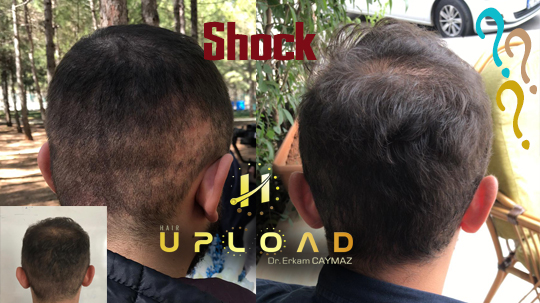
As Dr.Erkam CAYMAZ Hair Upload Hair Clinic we are delighted to answer any further questions about shock loss or all your questions about hair transplantation. Feel free to contact us.
Clinical timeline: what usually happens first
Most shock-loss conversations are easier when patients understand timing. In many cases, visible shedding starts in early weeks and can peak around the weeks 2 to 8 interval. This phase can involve native hairs near implantation zones, donor-adjacent hairs, or both. The visual impact may be significant even when follicles remain viable.
Because mirror-based perception is inconsistent, timeline photography under fixed lighting is essential for accurate interpretation.
Why temporary shedding can still look severe
Post-surgical inflammatory signaling, vascular stress, and abrupt cycle shifts can move vulnerable follicles into resting phases. The result is dramatic shedding that appears worse before it improves. This does not automatically indicate graft death.
Recovery typically requires biological patience. Early panic often leads to unnecessary changes in care that do not improve outcomes.
When permanence becomes a realistic concern
Persistent non-recovery may reflect underlying miniaturization that was already near threshold before surgery. It may also reflect avoidable technical factors such as traumatic angle transitions or density jumps in weak native zones. Differentiating these causes is central to honest counseling.
The right response depends on pattern, timeline, and trichologic context. There is no single protocol for every shedding profile.
Practical prevention strategy
Before surgery
Set realistic density targets, map vulnerable native regions, and discuss medical stabilization when indicated.
During surgery
Use careful recipient-site creation, controlled trauma, and spacing transitions that respect existing follicle orientation.
After surgery
Follow structured aftercare, avoid self-directed product stacking, and monitor recovery with objective photos rather than day-to-day mirror checks.
How to discuss low-dose medical support responsibly
Medication questions should be handled through risk-benefit counseling, not copy-pasted media links. Patients need individualized discussion about expected benefit, side-effect profile, contraindications, and monitoring. Fear-based dumps of unrelated URLs do not replace medical decision-making.
A clear physician-supervised plan is safer than fragmented internet experimentation.
Follow-up milestones that reduce uncertainty
A practical schedule includes early wound review, shedding-phase check-ins, and growth-phase reassessment through months 3 to 6 and beyond. If no trend toward recovery appears after expected windows, reassessment should include donor and recipient together, not isolated snapshots.
Shock loss is manageable when expectations, timing, and diagnostics are aligned from the start.
Itch after surgery usually reflects healing crusts, mild inflammation, or early regrowth rather than infection, but timing still matters. Scratching can dislodge grafts or widen donor scabs. Clinics typically provide a wash protocol and approved moisturizers rather than ad hoc remedies. Our protocol for itchy scalp timing explains when symptoms are expected versus urgent.
Low-level laser therapy is sometimes added after FUE to support recovery, but start windows and device quality vary. Caps should not replace medical follow-up or compress approved aftercare steps. Most teams delay adjunct devices until initial healing milestones are met. See when we typically authorize laser cap use after FUE.
Sources & clinical references
FAQ
It is temporary or persistent shedding triggered by surgical stress in surrounding follicles, most often seen near recipient and donor manipulation zones.
Many patients notice changes from the first weeks up to around the second month, depending on individual healing and follicle vulnerability.
No. Many cases recover, but pre-existing miniaturized follicles or direct follicular trauma can lead to incomplete return.
Careful channel planning, conservative density transitions, and medically guided postoperative support can reduce avoidable injury risks.
If shedding is progressive, asymmetrical, or unchanged beyond expected recovery windows, structured follow-up with photos is recommended.
Shock shedding is a normal phase within the broader hair transplant recovery arc, typically weeks two through eight, before new growth becomes visible near months three to four.

Hair Transplantation and the Effect of Scalp Tissue
Scalp tissue quality influences extraction safety, implantation response, and cosmetic durability. Temporary donor…
Read More: Hair Transplantation and the Effect of Scalp Tissue
Do All Transplanted Hair Grow? Understanding Hair Growth after Hair Transplantation
Most transplanted hairs grow, but not every single graft. Graft survival reaches up to 98% in experienced hands and…
Read More: Do All Transplanted Hair Grow? Understanding Hair Growth after Hair Transplantation
Hair Transplantation with Selenium, Zinc
Selenium and zinc support general hair follicle metabolism and immune function, but they are not substitutes for…
Read More: Hair Transplantation with Selenium, Zinc
Am I a Good Candidate for Hair Transplantation?
Hair thinning affects both men and women, but not every person with visible loss is ready for surgery today. Candidacy…
Read More: Am I a Good Candidate for Hair Transplantation?Shock Loss After Hair Transplant — Frequently Asked Questions
Expert Answers by Dr. Erkam Caymaz, Istanbul