


Quick Numbers
| Minimum | Adults only |
|---|---|
| Most predictable pattern | Late 20s onwards |
| Gap between sessions | At least 6 months |
| Final result | 12–18 months |
| Upper age limit | None, if healthy with a good donor area |
Key Takeaways
| There's no single best age. What matters is how predictable your hair loss has become and how much donor hair you have. |
| In the early 20s, hair loss is hard to predict, so medication and careful planning usually come first. |
| From the late 20s into the 40s, the pattern is clearer and most patients are good candidates if the donor area allows. |
| Older patients can have excellent results when they're healthy and their donor area is strong enough. |
| Hair loss continues after surgery at any age, so every plan should leave room for the future. |
Patients often ask whether they're too young or too old for a hair transplant. It's a fair question, but age on its own doesn't decide it. A 24-year-old and a 54-year-old can both be good candidates, and both can be poor ones. What age really tells us is how much your hair loss is likely to change after the operation.
This guide explains how we think about age at each stage of adult life, why young patients need the most careful planning, and what decides whether someone in their fifties or sixties can expect a good result.
Is there a best age for a hair transplant?
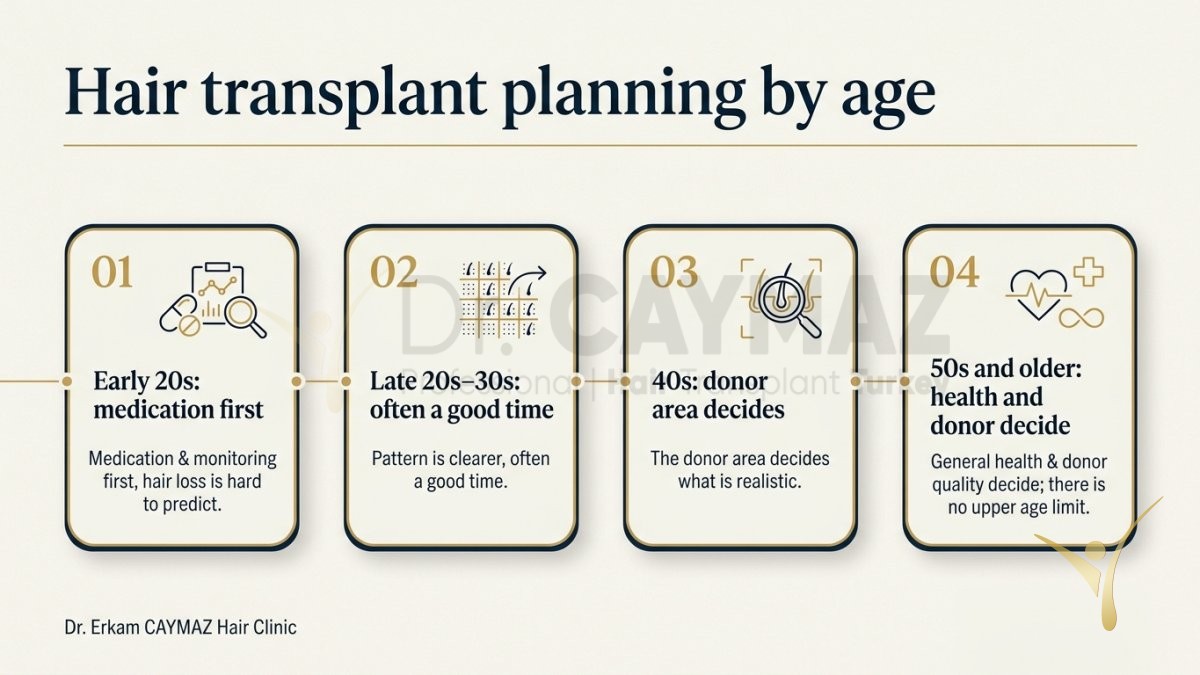
There's no ideal birthday for surgery. There is, however, a best moment for each patient: when the pattern of hair loss is predictable enough to plan around, and when the donor area at the back and sides of the head can supply what's needed now and later.
Pattern hair loss is progressive. Transplanted hair comes from the donor area, which is naturally resistant to the hormone DHT, so it usually keeps growing for life. The native hair around it doesn't have that protection and may keep thinning. A transplant that looks perfect at 25 can look out of place at 40 if the surrounding hair has receded and the plan didn't account for it.
That's why age matters mainly as a measure of predictability, not as a limit. The younger the patient, the more of the future we have to estimate, and the more conservative the plan needs to be.
Why does age change the plan?
When we plan a transplant, we look at three things alongside age: the current stage on the Norwood scale, how fast the loss has progressed, and the family history. Someone whose father and grandfather reached an advanced stage by 40 is likely to follow a similar path. Someone whose loss has been stable for ten years is far easier to plan for.
Age then shapes how we use the donor area. A donor area holds a limited number of grafts over a lifetime. If too many are used early on a low, dense hairline, there may not be enough left for the crown or mid-scalp when loss progresses. Dr. Caymaz builds a projection of likely future loss into every plan, so that the hair placed today still makes sense years later. How the medication-or-surgery decision shifts with each stage is set out in male pattern baldness stages and treatment thresholds.
Hair transplant in your early 20s
This is the age group that needs the most caution. Hair loss that starts early is often more aggressive, and at 21 or 22 it's very hard to tell where it will stop. Many young men also want their teenage hairline back, which isn't a good long-term goal.
For most patients in this age group, we recommend starting with medical treatment and monitoring the pattern for a while. Medication can slow or stop the miniaturization of native hair, and the response tells us a lot about how the pattern will behave. Our article on hair transplant or medication first explains how that decision is made.
Surgery isn't ruled out in the early twenties. A young patient with a stable pattern, limited loss and a strong donor area can be a reasonable candidate. The plan, though, will be conservative: a mature hairline rather than a very low one, and enough donor reserve kept back for later sessions.
Hair transplant in your late 20s and 30s
For many men, this is when hair transplants make the most sense. The pattern has usually declared itself, the family history is easier to read, and there's often a few years of photos showing how fast the loss is moving. Most of our patients are in this age range.
A patient in their thirties at Norwood 3 with a slow, stable pattern can often be treated in one session. Someone at Norwood 4 or higher usually needs at least two sessions, spaced at least six months apart. That's not a limitation of the technique. It protects the donor area and allows the second session to be planned around how the first one grew. Medication is still worth considering at this age to protect the native hair around the transplant.
Hair transplant in your 40s
By the forties, most patients know their pattern well. Loss that has been slow for years is unlikely to suddenly speed up, which makes planning easier. The hairline design also changes: a natural hairline at 45 sits a little higher and has gentler temple angles than one at 25, and that's what makes the result look like your own hair.
The main question at this age is donor quality. Some men have dense, strong donor hair well into their forties. Others have started to thin at the back and sides too, which limits how many grafts can be taken safely. A careful assessment of donor density decides what's realistic.
Hair transplant in your 50s and older
There's no upper age limit for a hair transplant. Healthy patients in their fifties and sixties can have very natural results, often with less uncertainty about future loss than younger patients. Many choose a plan focused on framing the face, restoring the front and leaving a lighter crown.
Two things matter more at this age. The first is general health: conditions such as high blood pressure or diabetes need to be well controlled, and blood thinners have to be reviewed with your doctor before surgery. The second is the donor area, which can thin with age. Some older patients also have finer or greyer hair, which affects how dense the result looks. These points are reviewed in the consultation, and a list of contraindications is worth reading in advance.
Age-by-age at a glance
| Age | Main question | Typical approach |
|---|---|---|
| Early 20s | Where will the loss stop? | Medication and monitoring first; if surgery, a conservative plan with donor reserve |
| Late 20s–30s | How far will the pattern go? | Often a good time; Norwood 4+ planned as at least two sessions |
| 40s | How strong is the donor area? | Stable pattern, mature hairline design |
| 50s and older | Is general health and donor quality good? | Health review; plan focused on framing the face |
Dr. Caymaz Insight
| The patients I worry about most are young men who want a low, straight hairline and haven't seen where their hair loss is going. I'd rather plan a hairline that looks natural at 45 than one that only looks good for the next few years. With older patients, the conversation is different. If they're healthy and the donor area is good, age itself isn't the obstacle. In every age group I plan for the hair that will be lost later, not only for the hair that's missing today. |
How do you know if you're ready?
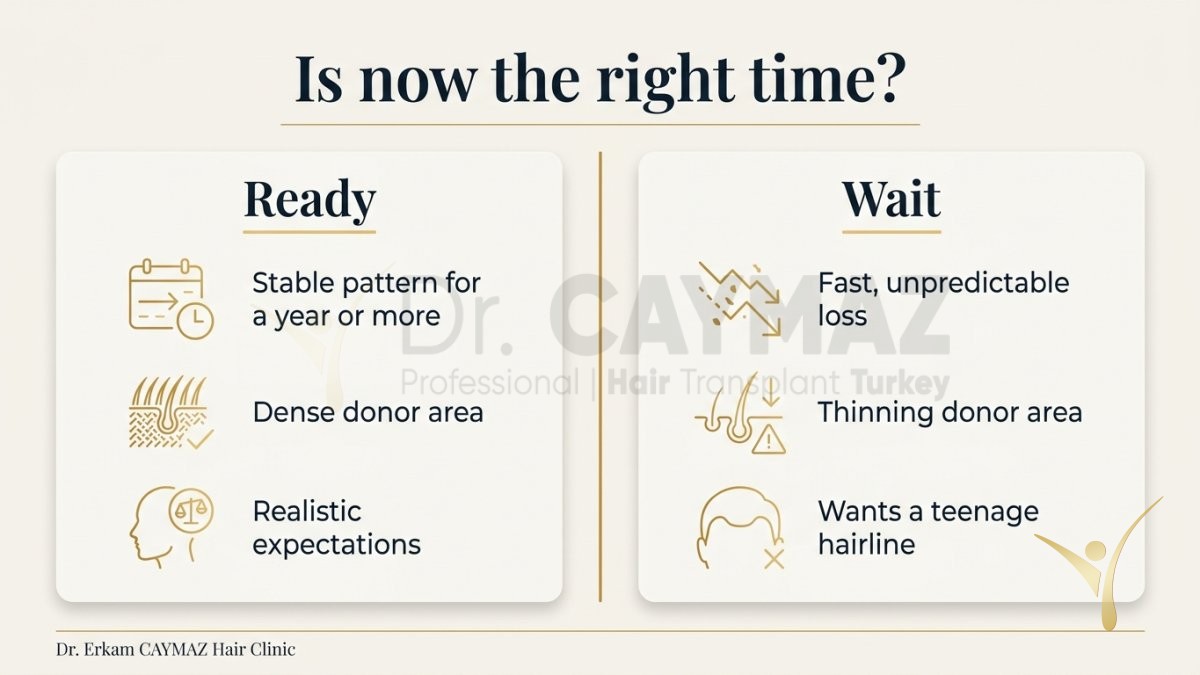
A few signs suggest the timing is right, whatever your age:
- Your pattern has been fairly stable for a year or more, or it's responding to medication.
- Your donor area is dense and shows no thinning at the back and sides.
- Your expectations are realistic. You want a natural, age-appropriate result rather than your teenage hairline.
- You accept that the plan may involve medication or a second session in the future.
- You're in good general health and can stop smoking, alcohol and blood thinners before surgery as advised.
The final result takes 12 to 18 months, and no surgeon can honestly promise a perfect outcome. In our clinic we name the overall success rate as 90–95%, and part of what decides the rest is choosing the right moment. To see how graft numbers change with each stage, read how many grafts do I need.
If you'd like to know where you stand, send clear photos of the front, top, crown and back of your head. Dr. Caymaz reviews every case personally and will tell you honestly whether now is the right time or whether waiting would give you a better long-term result.
Scientific Sources
FAQ
There's no single best age. The right moment is when your hair loss pattern is predictable enough to plan around and your donor area can supply what you need now and later. For many men that's from the late 20s onwards, but it depends on the individual case.
It's possible, but it needs the most caution. Hair loss that starts early is often aggressive and hard to predict, so we usually recommend medication and monitoring first. If surgery is right, the plan is conservative, with a mature hairline and donor reserve kept for later sessions.
No. Healthy patients in their fifties and sixties can have very natural results. General health and the quality of the donor area matter more than age itself, and conditions such as high blood pressure or diabetes need to be well controlled.
Because the donor area holds a limited number of grafts over a lifetime. If too many are used early on a low hairline and hair loss keeps progressing, there may not be enough left for the crown or mid-scalp later. A plan for a young patient has to account for future loss.
Transplanted hair comes from the DHT-resistant donor area and usually keeps growing. The native hair around it can keep thinning, which is why medication is often recommended and why the plan should leave room for the future.
It depends on your stage and donor area. Patients at Norwood 4 or higher usually need at least two sessions, spaced at least six months apart, to protect the donor area and plan the second session around how the first one grew.
Yes. A natural hairline at 45 sits a little higher and has gentler temple angles than one at 25. Dr. Caymaz designs every hairline personally and plans it to look natural as you age, not only today.

Red Light Therapy After Hair Transplant: Timing and Protocols
Red light therapy (LLLT) at 630â670 nm wavelengths may support scalp healing and reduce inflammation after hair…
Read More: Red Light Therapy After Hair Transplant: Timing and Protocols
How should single grafts be used in the hairline?
Single-hair graft placement in the hairline is a precision design task. Natural framing depends on irregular transition…
Read More: How should single grafts be used in the hairline?
Sapphire FUE Hair Transplant Recipient Sites: Blade, Depth, Density
In a sapphire fue hair transplant, the main technical change is how the recipient sites (channels) are created…
Read More: Sapphire FUE Hair Transplant Recipient Sites: Blade, Depth, Density
Compliance To Hair Transplantation Criteria
Before booking grafts, clinics assess whether you meet compliance criteria for hair transplantation, medical safety…
Read More: Compliance To Hair Transplantation CriteriaFrequently Asked Questions
Professional Hair Transplant Insights by Dr. Erkam Caymaz