


Quick Numbers
| Overall success (clinic metric) | 90–95% (typical range) |
|---|---|
| Graft survival (upper-end) | Up to 98% (case-dependent) |
| FUE punch size (extraction) | 0.8–0.9 mm (micromotor punch) |
| First clinic wash (our standard) | Day 2 post-op (day 1 rest) |
| Typical “growth restart” window | 3–4 months (visible change often begins) |
Key Takeaways
| A sapphire fue hair transplant changes the recipient-site incision tool, not the biology of healing. |
| Naturalness comes from angle, direction, and depth control, not from chasing the highest graft count. |
| “Higher density” is limited by blood supply and spacing, even with very sharp blades. |
| Most early problems, like bumps or pitting, trace back to site sizing and placement, not the grafts themselves. |
| Protecting sites for the first 72 hours, especially during washing, supports stable graft anchoring. |
If you searched “sapphire fue hair transplant recipient sites,” you’re probably trying to understand one very specific moment in surgery: the creation of thousands of tiny openings that will hold each graft. Patients often hear “sapphire” and assume it changes everything. In real clinical terms, it changes one step, the instrument used to make the recipient channels. The rest still depends on planning, scalp anatomy, blood supply, and how carefully the sites are spaced and oriented. This article narrows in on what actually changes in the recipient area, what does not, and what you can reasonably expect in healing and appearance.
What is a “recipient site,” and why does the blade matter?
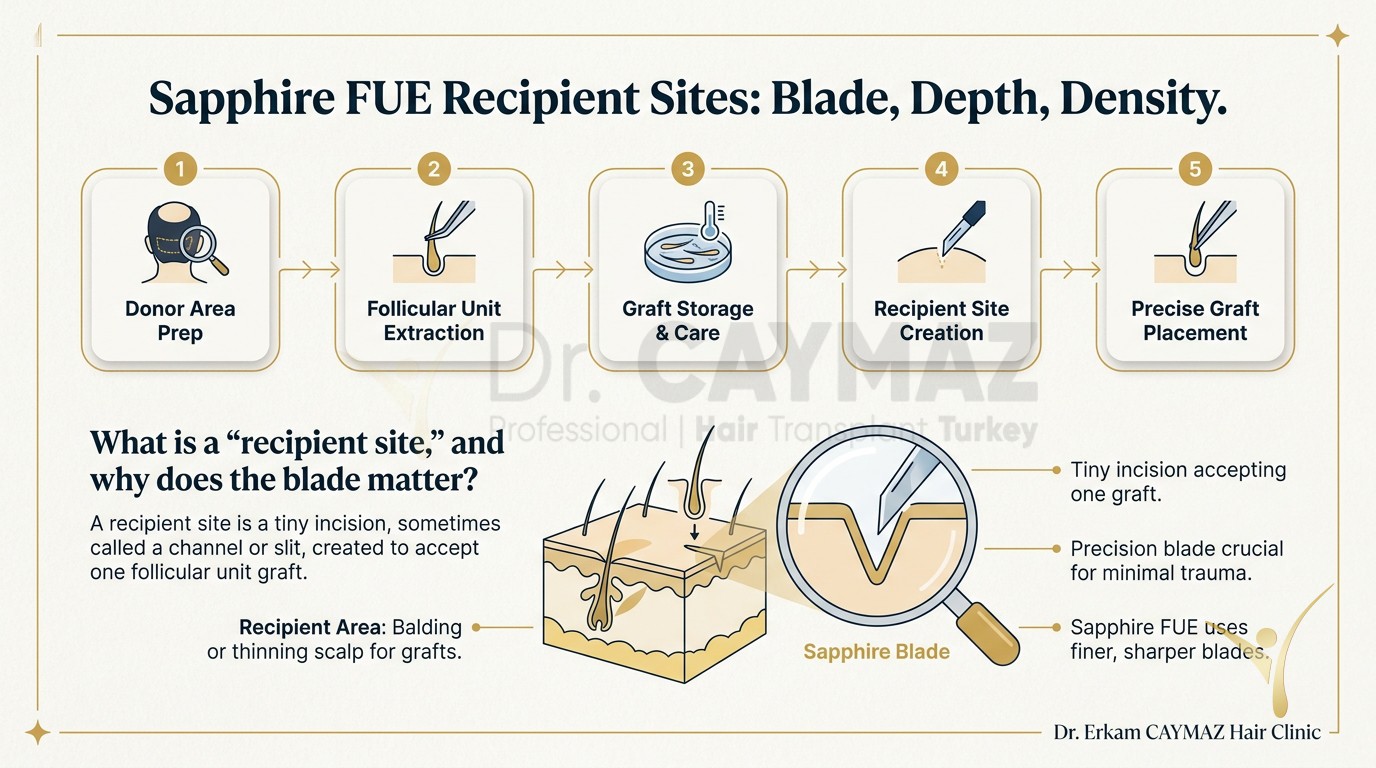
The recipient area is the balding or thinning scalp where grafts will be placed. A recipient site is a tiny incision, sometimes called a channel or slit, created to accept one follicular unit graft. In FUE (follicular unit extraction), grafts are removed one by one from the donor area, then placed into these recipient sites. If you’d like a high-level view of the full surgical flow, the step-by-step order is summarized on the procedure steps page.
The blade matters because it affects the geometry of the opening: how wide it is at the surface, how it tapers, and how it interacts with the tissue as it enters. That geometry influences three practical outcomes: (1) how tightly the graft fits, (2) how much trauma occurs to surrounding skin and small vessels, and (3) how predictable the surgeon can be when repeating the same motion thousands of times.
In a sapphire technique, “sapphire” refers to the material of the recipient-site blade, not the extraction punch. Extraction still uses a micromotor punch, typically 0.8–0.9 mm in our standard setup. The sapphire component is used to create the channels where grafts will be implanted, which is why the discussion belongs to recipient-site design rather than donor harvesting.
What exactly changes in a sapphire-blade recipient incision?
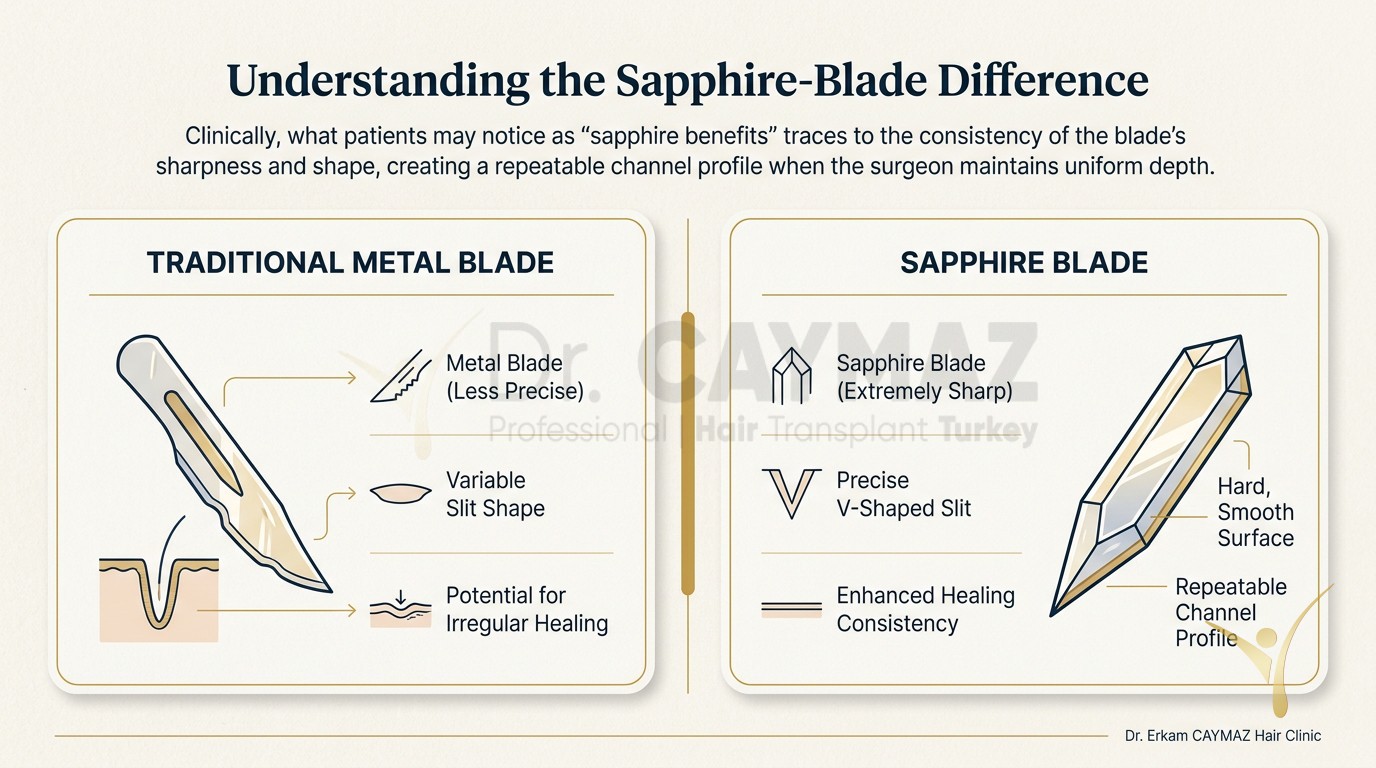
A sapphire blade is a very hard, smooth, and precisely manufactured cutting surface used to make V-shaped recipient slits. Clinically, what patients may notice as “sapphire benefits” usually traces to consistency: the blade’s sharpness and shape can create a repeatable channel profile when the surgeon keeps the same depth and angle. For an overview of where sapphire fits among modern methods, see the clinic’s sapphire technique overview.
Most steel blades used for sites can also work well in skilled hands. The difference is not a guarantee of better growth. It’s about how the instrument interacts with tissue during incision. A sapphire V-shaped blade tends to separate tissue cleanly. A dull or damaged blade, regardless of material, can tear or crush tissue, which increases inflammation and can make early healing look rougher.
From a patient education standpoint, the key “change” is not magical healing. It’s a mechanical change in how the channel is cut. A cleaner cut may reduce the amount of collateral trauma around the opening, which can translate into less oozing and more uniform scab formation, but those effects are modest and highly dependent on scalp thickness, sebaceous activity, and bleeding tendency.
How do angle, direction, and depth get decided in the recipient area?
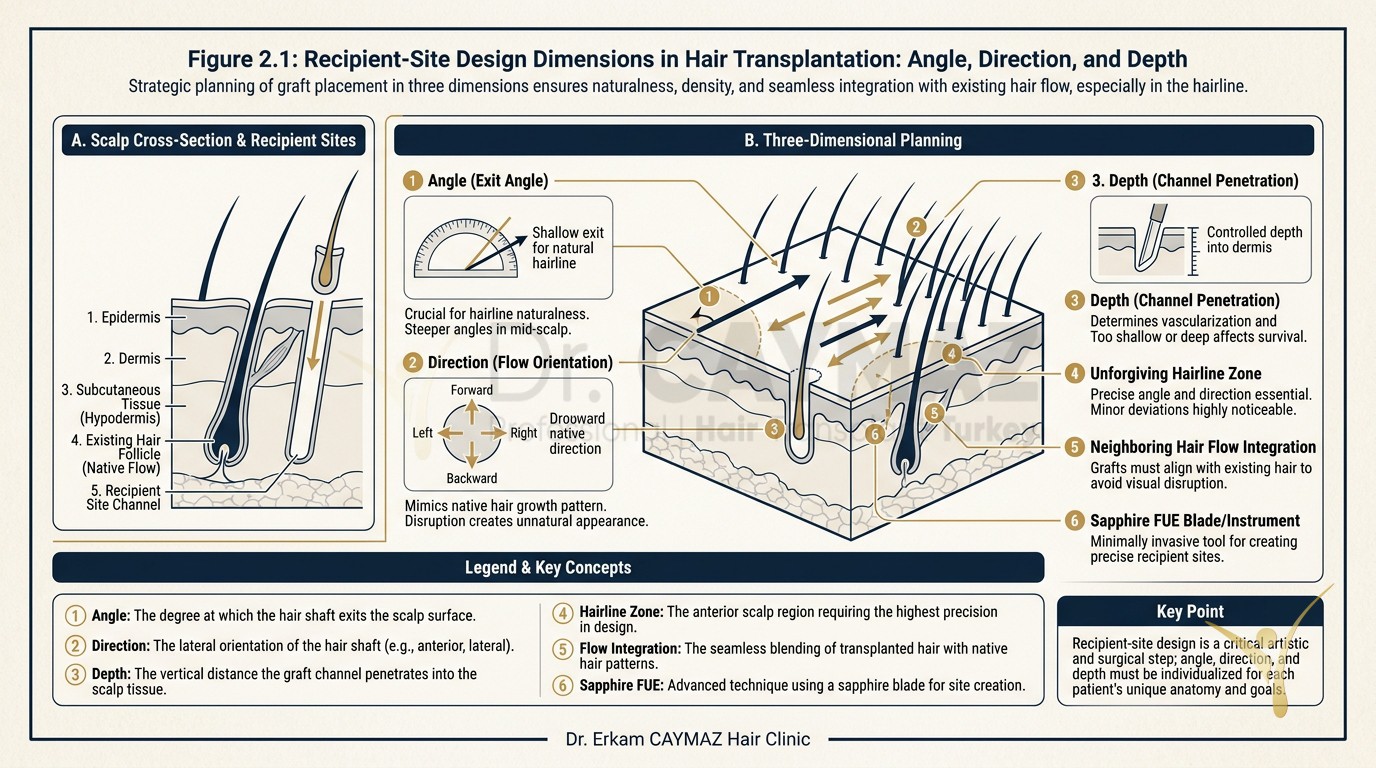
The hairline and front third of the scalp are unforgiving. One graft that points the wrong way can be noticeable because it disrupts the “flow” of neighboring hairs. Recipient-site design has three dimensions: angle (how shallow the graft exits), direction (left, right, forward, backward), and depth (how far the channel goes into the scalp). These are set during planning, then executed consistently during incisions. The micro-anatomy of the front edge is discussed in frontal hairline anatomy.
Depth control is where many aesthetic complications begin. If a site is too shallow, the graft may sit proud and heal with visible elevation. If it is too deep, the graft can sink, increasing the risk of pitting and making the exit angle less predictable. A correct depth is not one fixed number for all patients. It depends on scalp thickness, the size of the follicular unit, and the target zone (hairline vs midscalp vs crown).
Direction planning is also case-specific. The crown has a whirl pattern that often requires changing direction every few millimeters. The temple points and the transition zone behind the hairline require more acute angles and careful use of single-hair grafts. This is why “same density everywhere” can look unnatural even if growth is strong. A well-designed recipient pattern tries to imitate natural variation.
Dr. Caymaz Insight
| I treat recipient-site creation as the moment where the result becomes “locked in,” because angle, direction, and depth can’t be corrected later without revision. With sapphire blades, I’m aiming for consistent channel geometry, but I still limit density to what the scalp can safely perfuse. If the tissue looks tight, bleeds more than expected, or shows early congestion, I space more and prioritize survival over numbers. A natural result comes from thousands of small correct choices, not a single tool. |
Does sapphire recipient-site work mean you can safely implant at higher density?
Some patients are told that sapphire automatically allows “maximum density.” The more accurate statement is: a sharp, consistent blade may help create controlled, narrow slits, which can support dense placement in selected areas. The limiting factor remains biology, mainly scalp blood supply and the space needed for each graft to survive without compression. If the grafts are packed too tightly, local circulation can be compromised, and survival can drop even if the sites are beautifully made.
Density also depends on what you already have. Implanting between existing miniaturized hairs (common in diffuse thinning) is harder than implanting into a bald area. The surgeon must avoid transection of native follicles, and the team must place grafts without “bulldozing” adjacent units. This is one reason the implantation method (classic slit-and-place vs pen-based placement) is decided from preoperative photos and planning, not changed on the day of surgery. For a method comparison, see implantation method comparison.
The safest patient takeaway is simple: the best-looking density is not always the highest numeric density. In the first 1–2 cm behind the hairline, the goal is often a soft, irregular transition using singles. The midscalp may accept higher density because it is less scrutinized at close range and can be layered with multi-hair grafts. The crown often needs conservative planning because swirl patterns require larger surface area coverage per graft.
| Factor | Sapphire-blade slit (V-shaped) | Typical steel slit |
|---|---|---|
| Channel shape | Often a consistent V-profile with a sharp edge when the blade is intact | Can be highly precise as well, but depends on blade type, sharpness, and wear |
| Tissue interaction | May separate tissue cleanly, potentially reducing crush injury | Can also be clean, but a dull blade can increase tearing and inflammation |
| Density tolerance | May support tight spacing in selected zones, but still limited by perfusion | Same biologic limits; safe density still depends on spacing and scalp quality |
| Risk of raised healing | Usually related to depth mismatch or graft size mismatch, not the material alone | Similar; “cobblestoning” risk is mostly a planning and technique issue |
| Bottom line | There’s no “good technique,” only a good surgeon and team, matched to your scalp and goals. | |
What happens to bleeding control and swelling when the sites are created?
Recipient-site creation triggers small-vessel bleeding. Most scalp bleeding is controlled with local anesthetic that contains epinephrine (which temporarily constricts vessels), firm gauze pressure, and pacing the work so the tissue can respond. In our practice, bleeding control relies on tumescent technique, firm gauze pressure, and pacing, not heat-based tools, for routine recipient-site hemostasis. Heat injury is avoidable damage in a field where graft survival depends on gentle handling.
Swelling is common after hair transplantation, especially in frontal work where fluid can migrate downward with gravity. Swelling is influenced by how much local anesthetic is used, how reactive your scalp is, and how long the head stays flat after surgery. Recipient-site density can contribute: more sites in a tight area often means more inflammatory signaling and more temporary edema.
If you’re comparing how clinics organize surgical time, it helps to understand the workflow in a surgeon-led setting. At Dr. Caymaz’s clinic, all packages are VIP: he performs consultation, planning, hairline design, and the recipient incisions. Donor and recipient local anesthesia is given by an assisting nurse under his supervision, and extraction plus implantation are performed by expert surgical technicians under supervision. This team structure is described on the clinic structure page.
How do recipient sites heal, and what should you expect in the first 10 days?
Recipient-site healing is a sequence: immediate clotting, early scab formation, then surface re-epithelialization (skin sealing), followed by deeper remodeling. The earliest “anchoring” of grafts happens quickly, but the surface still looks fragile for several days. Many patients confuse scabs with grafts. Scabs are dried blood and serum at the surface, while the graft sits deeper in the channel.
Most clinics keep the recipient area uncovered at discharge. In our standard protocol, the donor area is bandaged when you leave, while the recipient area remains uncovered to avoid friction. Our first clinic wash and donor bandage removal are scheduled on day 2 post-op (day 1 is rest). Example: Monday surgery, Tuesday rest, Wednesday wash. Some clinics wash on day 1, and we have not seen that as inherently harmful, but we prefer day 2 for a calmer first night and less manipulation of fresh sites. If you want the exact washing technique, the steps are outlined under post-transplant washing steps.
By days 7–10, most scabs can be removed with correct soaking and gentle washing. Pulling or scratching scabs early can traumatize the sites and increase redness. Persistent redness can happen in fair skin and does not automatically mean infection. Pain that increases after day 3, new pus, or a bad smell should trigger a medical message to your clinic.
Which recipient-site mistakes cause cobblestoning, pitting, or an unnatural look?
Many “bad results” are not because the grafts failed to grow. They are because the grafts healed in the wrong position or direction. The recipient sites determine that position. Cobblestoning (a bumpy, pebbled surface) is usually linked to grafts sitting too high, oversized grafts in undersized slits, or shallow site depth. Pitting can occur when sites are too deep, when the graft is pushed below the intended level, or when the skin heals with surface contraction.
Unnaturalness is also about distribution. A hairline built with too many multi-hair grafts can look pluggy, even if survival is excellent. A hairline that is too straight, too low, or too dense for age can look surgically “stamped.” Recipient sites must be varied in micro-irregularity and orientation to mimic natural hair emergence. If you’re looking for a detailed discussion of bumps and corrective options, there’s a focused resource on cobblestone side effects.
There are also rare but serious vascular complications when density and trauma exceed what the scalp can tolerate, especially in smokers or patients with vascular disease. In those cases, the goal of recipient-site planning is prevention: conservative density, careful spacing, and avoiding prolonged pressure or tight bandaging over the recipient area.
How does aftercare protect the recipient sites during the “high-risk” first 72 hours?
The first 72 hours are less about growth and more about stability. During this window, the grafts are settling into their sites, and the surface is vulnerable to shear forces. Common risks are rubbing during sleep, helmet or hat friction, and aggressive washing. The simplest protective rule is: avoid any motion that drags across the recipient zone.
Correct washing is a mechanical skill, not a cosmetic routine. You’ll usually soften the crusts with foam or lotion, rinse with low pressure, and pat dry. Hot water, strong shower jets, and fingernails increase the chance of dislodging scabs and irritating sites. General activity limits, sleeping posture, and when to resume exercise are covered on the aftercare basics page.
Be careful about “helpful” products during this phase. Strong alcohol-based tonics, unapproved essential oils, and heavy occlusive gels can irritate healing sites. If you’re using standard hair-loss medications like topical minoxidil, timing should be individualized, because starting too early can increase irritation and shedding. If you have a history of dermatitis or psoriasis, your recipient sites can stay red longer, and you may need a calmer wash routine.
Who is a poor candidate for aggressive recipient-site density, even with sapphire?
Blade quality can’t override patient factors. If the scalp is tight, shiny, or heavily sun-damaged, it may not tolerate dense packing well. If there is diffuse thinning, the surgeon must protect the existing hairs, and that often means lower density per session with more strategic distribution. Crown work also tends to be less efficient per graft because the swirl pattern spreads coverage demands over a larger area.
Patients with high Norwood patterns (Norwood 4 and above) often need at least two sessions, separated by a minimum of 6 months, to protect the donor area and avoid overharvesting. A single-session 5,000+ graft plan is not our standard approach, because donor management is part of long-term success. If you want to understand donor limits and the concept of a “safe donor zone,” start with donor area basics.
Medical and lifestyle factors matter, too. Smoking and nicotine use impair microcirculation and can increase risk of delayed healing. Poorly controlled diabetes, clotting disorders, or immunosuppression require individualized planning. Patients prone to keloids or hypertrophic scarring should disclose this, even though scalp keloids are uncommon. If you’re unsure whether your health profile changes recipient-site risk, a formal evaluation can be scheduled through pre-op consultation.
For transparency: Dr. Caymaz has been in hair restoration practice since 2012, and his surgical role focuses on planning and recipient-site creation because those steps drive naturalness and consistency. His professional background is summarized under surgeon credentials.
What should you ask a clinic specifically about recipient sites in sapphire FUE?
Patients often ask, “Do you do sapphire?” A better question is, “How do you decide the size, depth, and spacing of the sites for my scalp and my graft sizes?” Ask how the hairline is designed, who performs the incisions, and how the clinic prevents overpacking in vascularly sensitive zones. These answers tell you more about safety than the blade material alone.
You can also ask how the plan is made before you arrive. A reliable clinic should be able to estimate a graft range, outline target zones (hairline vs midscalp vs crown), and explain the trade-off between density today and donor preservation for tomorrow. The technique choice should be planned from photos and consultation, not negotiated at the operating chair. If you want broader background on surgical decision-making, the educational hub under hair transplant information is a good place to orient.
Finally, ask about measurable expectations. Any clinic promising 100% growth is not speaking clinically. In real-world practice, overall success is commonly described in ranges, such as 90–95%, and graft survival can reach up to 98% in favorable cases with correct handling and aftercare. What matters is how the clinic manages risk, documents outcomes, and supports you through the first months when shedding and redness can cause understandable anxiety.
Sources
FAQ
Recipient sites are the tiny incisions (channels or slits) made in the balding area to hold each graft. In sapphire FUE, sapphire blades are used to create these sites, while extraction still uses a separate punch instrument.
No. Sapphire refers to the blade material used for recipient-site incisions. Extraction in FUE is typically done with a micromotor punch, commonly around 0.8–0.9 mm, depending on graft characteristics and surgeon preference.
No. A sharp, consistent blade can help create controlled slits, but safe density is limited by scalp blood supply, spacing, and tissue characteristics. Overpacking can reduce graft survival and increase healing problems.
Cobblestoning is most often linked to recipient-site depth and sizing mismatches, such as shallow sites or grafts sitting too high, rather than the blade material itself. Distribution and graft selection at the hairline also matter.
No. Either method can produce high-quality results when the surgeon and team are skilled. DHI is used for selected indications; sapphire FUE is a common standard approach. The method should be planned before surgery, not switched on the day.
Our standard is a clinic wash and donor bandage removal on day 2 post-op, with day 1 reserved for rest. The recipient area is usually left uncovered at discharge to reduce friction.

Who Is the Right Candidate for DHI Hair Transplant?
DHI (Direct Hair Implantation) uses a Choi pen to place grafts without pre-made incisions, making it ideal for hairline…
Read More: Who Is the Right Candidate for DHI Hair Transplant?
How Many Graft Hair Transplants Do I Need?
Patients ask how many grafts they need before booking travel or comparing clinic quotes. The honest answer blends…
Read More: How Many Graft Hair Transplants Do I Need?
Do All Transplanted Hair Grow? Understanding Hair Growth after Hair Transplantation
Not every transplanted follicle matures into identical visible growth at the same time. Hair caliber, healing…
Read More: Do All Transplanted Hair Grow? Understanding Hair Growth after Hair Transplantation
Best Hair Transplant in the World? How to Evaluate Surgeons Objectively
Type "best hair transplant in the world" into any search engine and you'll find ranked lists, paid ads, and influencer…
Read More: Best Hair Transplant in the World? How to Evaluate Surgeons ObjectivelySapphire FUE Hair Transplant — Frequently Asked Questions
Expert Answers by Dr. Erkam Caymaz, Istanbul