


Quick Numbers
| Typical female graft range | 800 , 2,500 grafts per session |
|---|---|
| Turkey VIP cost range | $2,500 , $10,000 (surgeon-led) |
| Pre-op blood work | Ferritin, TSH, free T4, DHEA-S, testosterone |
| Graft survival (VIP) | Up to 98 % |
| Final density visible | 12 , 18 months post-op |
Key Takeaways
| Women usually need fewer grafts than men, so the total cost of hair transplant surgery for women is often lower per session. |
| Hormonal screening before surgery is non-negotiable; operating on unstabilized hair loss wastes grafts and donor supply. |
| Ethical donor harvesting means no visible thinning in the back of the head, even when the hair is worn up. |
| Female hairline design follows different anatomical rules than male hairline design, requiring a surgeon's direct involvement. |
| A no-shave or partial-shave extraction protocol lets most women return to daily life within 7 to 10 days. |
A 38-year-old woman notices her part line widening every year. She's tried minoxidil, PRP injections, and biotin supplements. Nothing has reversed the thinning. She types "hair transplant surgery women cost" into a search bar and finds prices ranging from $1,800 to $25,000. That spread is confusing, and it hides the real question she should be asking: how many grafts does she actually need, and can her donor area supply them without visible damage? This article breaks down the clinical factors that determine cost, explains why donor ethics matter more for female patients than for most men, and clarifies what a surgeon-designed female hairline actually involves.
Why Does Hair Transplant Surgery for Women Cost Less Than Most Expect?
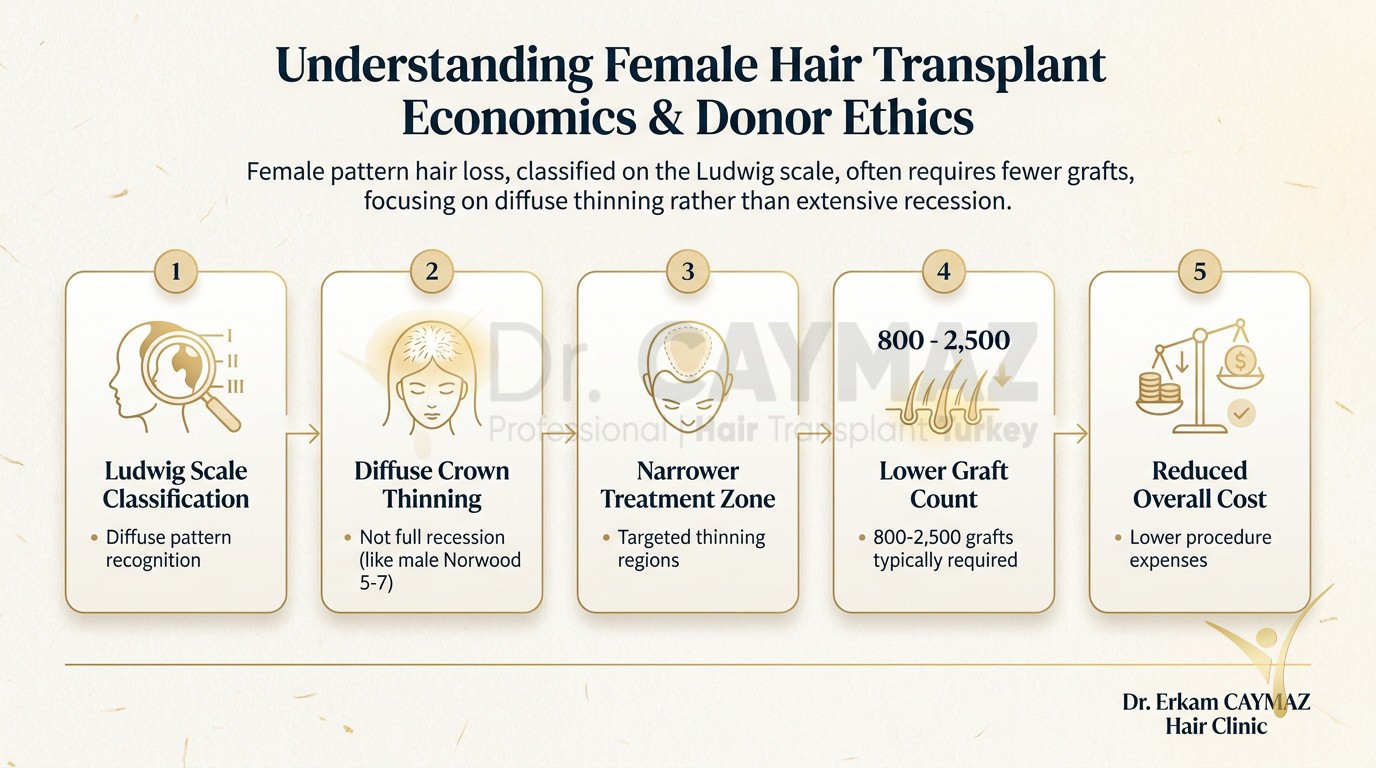
Female pattern hair loss, classified on the Ludwig scale, typically presents as diffuse thinning across the top of the scalp rather than the full recession seen in male Norwood 5, 6, or 7 patterns. Because the thinning zone is narrower, most women need between 800 and 2,500 grafts in a single session. Compare that to a Norwood 5 male case that might require 3,500 to 4,500 grafts across two sessions, and the math becomes clear: fewer grafts means a shorter procedure, less donor extraction, and a lower total price.
In Turkey, a VIP surgeon-led session for a female patient generally falls between $2,500 and $10,000. That figure includes the surgeon's personal consultation, hairline design, and incision work, along with extraction and implantation performed by expert surgical technicians under direct supervision. Clinics that quote per-graft pricing can obscure the real total, so it's worth understanding per-graft versus package pricing structures before comparing quotes.
In the US or UK, the same 1,500-graft female case can run $8,000 to $15,000. The clinical technique is often identical, specifically Sapphire FUE, but overhead costs, surgeon fees, and facility charges inflate the number. That price gap is the main reason women from North America and Europe travel to Istanbul for the procedure.
What Hormonal Tests Should Women Complete Before Surgery?

Operating on a woman whose hair loss hasn't been hormonally stabilized is one of the most common mistakes in the field. If the underlying cause is still active, transplanted grafts survive but the native hair around them keeps falling out, creating an uneven, patchy look within two years. That's why pre-operative blood work isn't optional for female candidates.
The standard panel includes:
- Ferritin (iron stores): levels below 40 ng/mL correlate with increased shedding in women.
- TSH and free T4: thyroid dysfunction is a reversible cause of diffuse hair loss.
- DHEA-S and total testosterone: elevated androgens point toward androgenetic alopecia or PCOS-related thinning.
- Complete blood count: rules out anemia and flags clotting concerns before any surgical procedure.
Women with PCOS-related hair loss can still be candidates, but only after hormonal management has slowed the shedding rate. You can read more about PCOS candidacy and surgical timing in a separate clinical discussion. The point here is simple: a responsible clinic won't book your surgery date until your labs confirm stability.
How Is the Female Hairline Different From a Male Hairline?

Most women don't need a new hairline drawn from scratch. Their frontal hairline is usually intact; the loss happens behind it, along the part line and the mid-scalp. But when a woman does present with frontal recession, often from traction alopecia or a naturally high forehead, the design rules change dramatically compared to male cases.
A female frontal hairline sits lower and rounder than a male one. It lacks the defined temporal recession points that look natural on men. The transition zone, that soft, irregular border of single-hair grafts that prevents a "wall of hair" appearance, needs to be wider in women because female hairstyles expose the hairline from more angles. Parting the hair to the side, pulling it into a ponytail, or wearing it swept back all reveal the first centimeter of transplanted hair.
Dr. Erkam Caymaz personally designs every female hairline during the pre-operative consultation, mapping the transition zone with single-graft placements before any extraction begins. For a deeper look at the anatomical principles behind this process, the discussion on female hairline and facial enhancement covers the topic in clinical detail. The design phase is where artistry meets anatomy, and it can't be delegated to a template.
Why Is Donor Ethics a Bigger Concern for Women?

The donor area is the strip of scalp between the ears, running across the back of the head. In men, this zone is often buzz-cut short after surgery, which hides extraction marks within days. Women rarely shave the donor zone. Most female patients request a no-shave or partial-shave protocol, where only a narrow band of hair is trimmed short enough for the punch tool, and the longer hair above it falls over the trimmed section like a curtain.
This constraint has a direct impact on how many grafts can be safely extracted in one session. Overharvesting, taking too many follicular units from a small area, leaves visible thinning in the back of the head. For a woman who wears her hair up regularly, that thinning is socially devastating. It trades one cosmetic problem for another.
Ethical donor management means extracting at a density that allows the remaining hair to cover the donor zone completely once it grows back. A safe extraction ratio removes no more than 25 to 30% of follicular units from any given square centimeter. The clinical reasoning behind this limit is explained in the discussion on balancing density without damaging the donor area.
For women with Ludwig II or III thinning who need more than 2,500 grafts total, the responsible approach is to split the work into two sessions spaced at least six months apart. This gives the donor zone time to heal and lets the surgeon verify that the first session's grafts are growing before committing more donor supply to the second round.
Dr. Caymaz Insight
| I turn away roughly one in three female consultations, not because the patient isn't a candidate, but because her hair loss hasn't stabilized yet. Transplanting into an actively thinning scalp is like planting seeds in shifting sand. I also insist on conservative donor extraction for every woman I operate on. I'd rather plan a second session six months later than overharvest in one sitting and leave her with a thin donor zone she can't hide. When I design a female hairline, I spend 20 to 30 minutes drawing, erasing, and redrawing before I'm satisfied, because a woman's hairline is visible from every angle and there's no margin for a geometric mistake. |
What Does the Procedure Day Look Like for a Female Patient?
The morning begins with a final consultation where the surgeon reviews the hairline design with the patient in a seated, upright position. Gravity changes how hair falls, so the design must be confirmed while the patient is sitting, not lying flat. Once approved, the local anesthetic is administered. The anesthetic solution contains epinephrine, which constricts blood vessels and reduces bleeding throughout the procedure. If any minor bleeding occurs during extraction, it's managed with firm gauze pressure and careful pacing of the punch work.
For women choosing the partial-shave approach, the surgical team trims a narrow horizontal band in the occipital region, typically 1 to 2 cm wide. The hair above and below this band remains at full length. Extraction uses a 0.7 to 0.8 mm micro-punch, smaller than the standard 1.0 mm punch used in some male cases, because female occipital hair tends to be finer. You can review the full sequence of hair transplant procedure steps for a broader overview of the surgical day.
Implantation follows the pre-drawn map. Single-hair grafts go into the hairline transition zone. Double and triple-hair grafts fill the mid-scalp and part line for density. The entire session for a 1,200 to 1,800 graft female case typically lasts 5 to 7 hours, including breaks.
How Does Recovery Differ for Women Compared to Men?
The biggest practical difference is hair length. Women with longer hair can camouflage the recipient area crusting within the first week by gently draping surrounding hair over the transplanted zone. Men with short buzz cuts have no such option. That said, the biological healing timeline is identical regardless of sex.
Days 1 to 3: mild swelling around the forehead, managed with a headband and sleeping at a 45-degree angle. The transplanted grafts form small crusts.
Days 7 to 10: crusts shed during gentle washing. Most women feel comfortable returning to office work by day 7 if they can style their hair to cover the recipient area. The specific washing technique matters; the protocol for post-transplant hair washing protects grafts during this fragile window.
Weeks 3 to 6: shock loss occurs. This is the temporary shedding of transplanted hair shafts while the follicle root remains alive beneath the skin. It alarms patients who don't expect it, but it's a normal phase. The native hair surrounding the transplant zone can also shed temporarily, which is more noticeable in women because their existing hair is longer. Detailed information on shock hair loss mechanisms can help set realistic expectations.
Months 4 to 6: new growth begins. Fine, wispy hairs emerge and gradually thicken.
Months 12 to 18: final density is visible. The transplanted hair now matches the caliber and growth cycle of the surrounding native hair.
Women's Hair Transplant: Cost Comparison by Country
| Country | Price range (USD) | Typically includes | Surgeon involvement |
|---|---|---|---|
| Turkey (VIP surgeon-led) | $2,500 , $10,000 | Hotel, transfers, meds, PRP | Consultation, design, incisions by surgeon |
| Turkey (high-volume clinic) | $1,200 , $2,000 | Hotel, transfers | Often technician-only; surgeon may not be present |
| United Kingdom | $6,000 , $12,000 | Procedure only | Varies by clinic |
| United States | $8,000 , $15,000 | Procedure only | Varies; some per-graft, some flat fee |
| Germany | $5,000 , $10,000 | Procedure only | Varies by clinic |
The price gap between a VIP surgeon-led clinic and a high-volume hair mill in Turkey reflects daily patient volume and who holds the blade, not spa amenities. A clinic performing 8 to 12 operations daily can't provide individual hairline design or supervise each case closely. At our clinic, Dr. Caymaz operates on 1 to 2 VIP patients per day, which allows the kind of focused attention that female cases demand. For a full breakdown of what drives pricing, the hair transplant cost overview explains each variable.
Who Should Not Have Hair Transplant Surgery?
Not every woman with thinning hair is a surgical candidate. The following conditions either disqualify a patient or require treatment before surgery can be considered:
- Active alopecia areata: an autoimmune condition that causes patchy, unpredictable hair loss. Transplanted grafts can be attacked by the same immune response.
- Diffuse unpatterned alopecia (DUPA): thinning that affects the donor zone as well as the recipient area. If the donor hair itself is miniaturizing, it won't produce lasting results after transplantation.
- Uncontrolled thyroid disease or severe iron deficiency: these must be corrected first. Surgery on a metabolically unstable patient wastes grafts.
- Unrealistic graft expectations: a woman with Ludwig III thinning who insists on full coverage in one session may need 4,000+ grafts, which risks overharvesting. The ethical answer is two sessions or, in some cases, a combination of transplantation and medical therapy.
A thorough candidacy evaluation, including scalp examination, blood work, and an honest conversation about expectations, is the first step. You can explore the general eligibility and success factors that apply to both male and female patients. For women specifically, the candidacy discussion also needs to address whether ongoing minoxidil or spironolactone therapy will be needed after surgery to protect native hair that wasn't transplanted.
What Questions Should Women Ask During a Consultation?
Walking into a consultation with the right questions protects you from both overtreatment and undertreatment. Here are the clinical questions that matter most:
- Has my hair loss stabilized? Ask to see your blood work results and have the surgeon explain what each value means for your candidacy.
- How many grafts do I actually need? Be skeptical of any clinic that quotes a number before examining your scalp in person or via high-resolution photos.
- Will you use a no-shave or partial-shave protocol? Confirm this before booking, because some clinics only offer full-shave extraction.
- Who performs the extraction and implantation? In a surgeon-led model, the doctor handles consultation, hairline design, and incisions while trained technicians perform extraction and graft placement under supervision. Clinics where the surgeon is absent from the operating room entirely carry higher risk.
- What is your plan if I need more grafts than one session can safely provide? The answer should involve a staged approach, not a promise to extract 4,000 grafts in a single sitting.
- Do you have before-and-after photos of female patients specifically? Female results look different from male results. Ask to see cases with a similar loss pattern to yours.
If you're ready to start that conversation, you can request a consultation with photos of your scalp from multiple angles. A preliminary assessment can often be done remotely before you commit to travel.
The cost of hair transplant surgery for women is shaped by graft count, technique, and the ethical limits of donor extraction. It's not a one-size-fits-all number. Women who invest time in the right pre-operative screening, choose a surgeon who personally designs the hairline, and accept a staged plan when necessary tend to get the most natural, lasting results. The price you pay should reflect the quality of that planning, not just the number of grafts moved from one part of your scalp to another.
Sources
- PubMed , Female pattern hair loss classification and Ludwig scale studies
- PubMed , Follicular unit extraction: donor area density and safe harvesting limits
- PubMed , Hair transplantation in women: outcomes and graft survival rates
- PubMed , Ferritin, thyroid, and androgen screening in female alopecia
FAQ
Most female patients need between 800 and 2,500 grafts per session. The exact number depends on the Ludwig classification stage, the width of the part line thinning, and whether frontal recession is also present. Women rarely need the 3,500 to 5,000 graft counts common in advanced male cases.
Per session, it's usually less expensive because fewer grafts are needed. A 1,500-graft female Sapphire FUE session in Turkey costs roughly $2,500 to $10,000 at a surgeon-led clinic. The same graft count in the US or UK can cost $8,000 to $15,000. However, if a woman needs two sessions for full coverage, the cumulative cost approaches male case totals.
No. Most clinics experienced with female patients offer a partial-shave or no-shave protocol. In a partial-shave approach, only a narrow band in the donor area is trimmed, and the surrounding longer hair covers it. This allows most women to return to social activities within 7 to 10 days.
A standard pre-operative panel includes ferritin (iron stores), TSH and free T4 (thyroid function), DHEA-S and total testosterone (androgen levels), and a complete blood count. These tests confirm that the hair loss has a treatable or stabilized cause and that the patient is safe for surgery.
Yes, but only after hormonal management has slowed or stopped the active shedding. Operating on a woman with uncontrolled PCOS-related hair loss risks poor long-term results because native hair continues to thin around the transplanted grafts. Stabilization with medication typically takes 6 to 12 months before surgery is appropriate.
Donor ethics refers to extracting only as many grafts as the donor zone can lose without visible thinning. For women, this is especially critical because they rarely wear their hair short enough to hide extraction marks. Safe extraction removes no more than 25 to 30% of follicular units per square centimeter, preserving full coverage in the back of the head.

Donor Area in Hair Transplant Surgery
The donor area is finite, and every extraction decision affects current density and future options. In most FUE plans…
Read More: Donor Area in Hair Transplant Surgery
Hair Transplant Contraindications: When Is It Not Advised?
A hair transplant is not advised with active scalp infection or scarring alopecia, widespread alopecia areata, bleeding…
Read More: Hair Transplant Contraindications: When Is It Not Advised?
Sedated Hair Transplant vs Staying Awake: What to Expect
No sedation is needed for a hair transplant. At our clinic, every operation uses local anesthesia alone: needle-free…
Read More: Sedated Hair Transplant vs Staying Awake: What to Expect
Hair Mill in Turkey: Avoiding Risky Clinics
A hair mill runs too many transplant cases with too little surgeon oversight. Warning signs include fixed graft quotes…
Read More: Hair Mill in Turkey: Avoiding Risky ClinicsFemale Hair Transplant — Frequently Asked Questions
Expert Answers by Dr. Erkam Caymaz, Istanbul