


Quick Numbers
| Awake procedure day | 6–8 hours |
|---|---|
| Operations using sedation or general anesthesia | 0 (none) |
| Daily operating capacity | 1–2 VIP operations |
| Extraction punch size | 0.8–0.9 mm micromotor |
| Graft survival | Up to 98% |
Key Takeaways
| Our clinic does not use oral sedatives, IV sedation, or general anesthesia for hair transplants. Local anesthesia is enough. |
| Sedation changes awareness, not scalp sensation. A sedated patient still needs the same local anesthetic. |
| Graft survival depends on handling, time outside the body, and planning. It does not depend on whether the patient is asleep. |
| Most patients say the first few minutes of numbing are the only uncomfortable part of the day. |
| Heart conditions, blood thinners, past anesthetic reactions, and severe anxiety should be raised at consultation, before travel. |
Do they put you to sleep for a hair transplant? Patients type that question into search engines every day, often alongside “sedated hair transplant” and “are you awake during a hair transplant.” At our clinic, the honest answer is no. Every operation is done under local anesthesia alone. You stay awake, alert, and able to talk with the team for the full 6 to 8 hours.
That surprises some people, especially if they've seen clinics advertising “sleep packages” or IV sedation. This article explains what sedation actually involves and why it doesn't numb the scalp by itself. It also covers the risks sedation adds and what an awake procedure day feels like from the chair. You'll also find drug-free ways to handle nerves, plus a list of situations worth raising before you book.
What does a “sedated hair transplant” mean at other clinics?
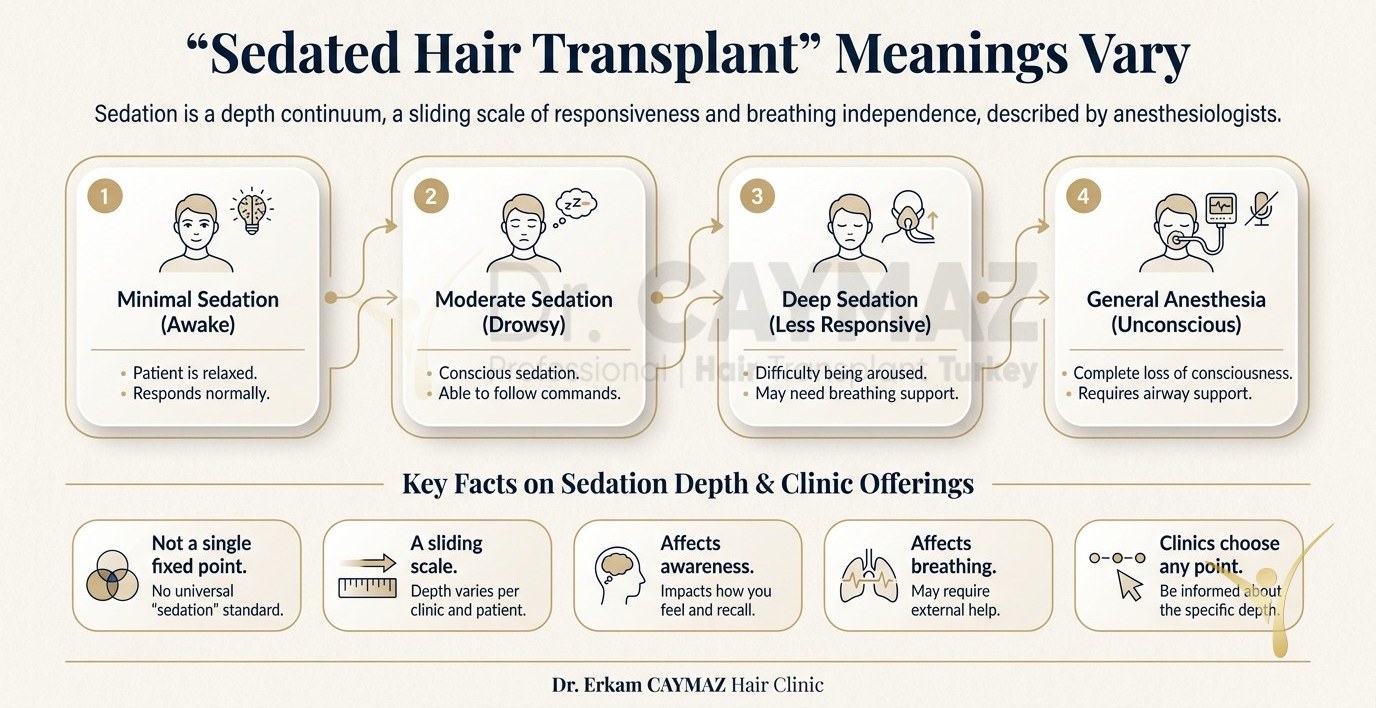
Sedation isn't a single thing. Anesthesiologists describe it as a continuum of depth, a sliding scale based on how well you respond and whether you can keep breathing on your own. A clinic that advertises a comfort or sleep option could be using any point on that scale, and the marketing rarely says which one.
- Minimal sedation (anxiolysis): usually an oral tablet, often a benzodiazepine. You feel relaxed, you respond normally to speech, and your breathing is unaffected.
- Moderate sedation, often called “conscious sedation”: usually intravenous drugs given through a cannula in the arm. You're drowsy, you respond to your name or a light touch, and you often remember little afterward.
- Deep sedation: you're hard to wake and may need help keeping your airway open.
- General anesthesia: full unconsciousness, with breathing and airway managed by an anesthesia team.
In hair restoration advertising, a sedated hair transplant usually means the moderate level. Sometimes propofol is used, a fast-acting IV drug that induces sleep. Propofol can slip into deep sedation with small changes in dose. For that reason, many countries require a dedicated person whose only job is to watch the patient's breathing and oxygen levels.
Our clinic sits outside that scale entirely. We don't use oral sedatives, IV sedation, or general anesthesia for hair transplants. Local anesthesia is the standard for every patient and every graft count.
Why doesn't sedation make the scalp numb?
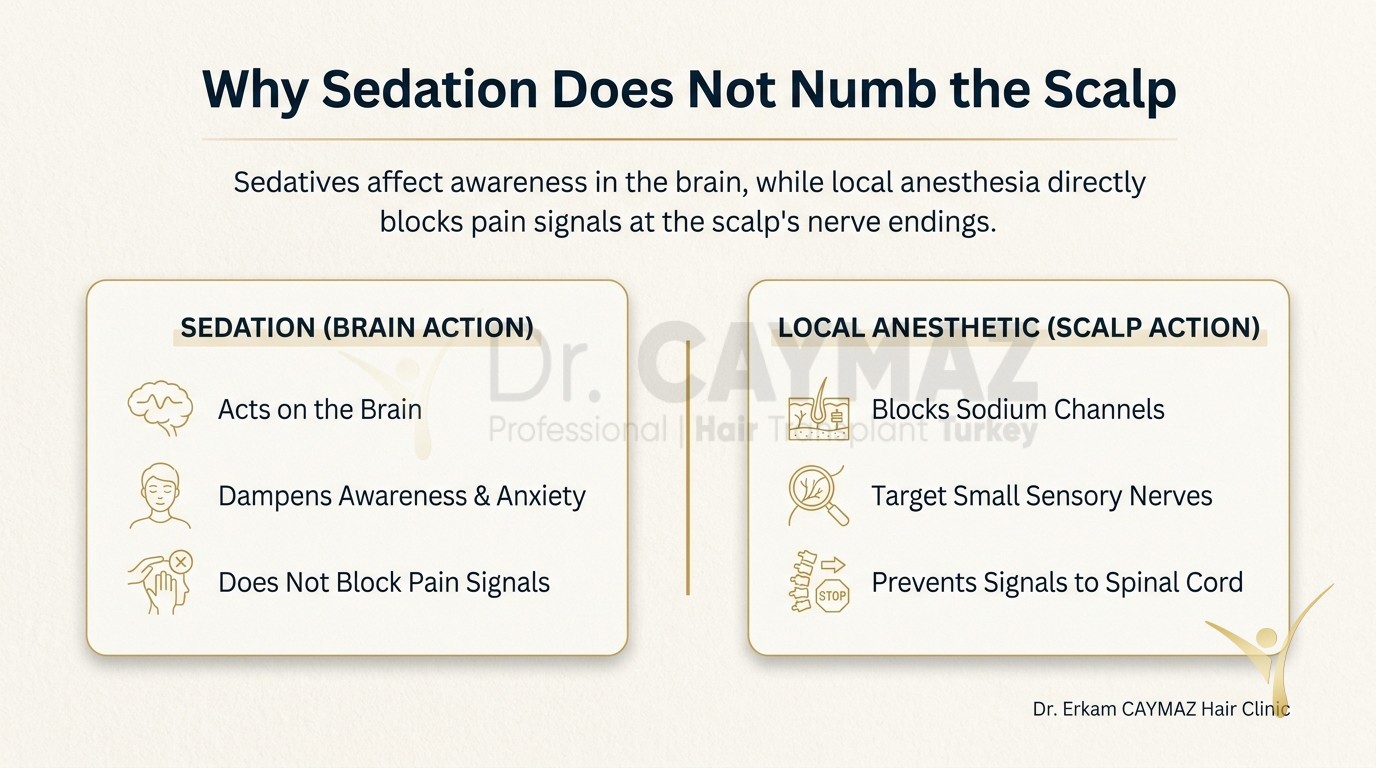
Sedatives act on the brain. They dampen awareness, anxiety, and memory, but they don't stop pain signals at the scalp. That job belongs to local anesthetic, a drug that temporarily blocks sodium channels in small sensory nerves. While the block lasts, signals from the skin never reach the spinal cord.
So a sedated patient still gets local anesthetic injections, in the same places and often in similar amounts. The difference is that they may not remember those injections clearly. In both cases, the real pain control comes from the local block. That block is what makes hours of extraction and implantation comfortable.
This has a practical downside that marketing rarely mentions. Under deeper sedation, the brain is less able to interpret sensation calmly. If an area isn't fully numb, a patient may startle, groan, or move their head without being able to explain what's wrong. During FUE (follicular unit extraction, where grafts are removed one at a time from the donor area), even small head movements interrupt precise work. An awake patient who says “the left side is getting sharp” gives the team a clearer signal than a sedated patient who flinches.
If your main worry is pain rather than being aware, it helps to know how much discomfort patients actually feel at each stage. For most people, the honest answer is a few minutes of stinging at the start, then pressure rather than pain for the rest of the day.
How does local anesthesia work without sedation at our clinic?
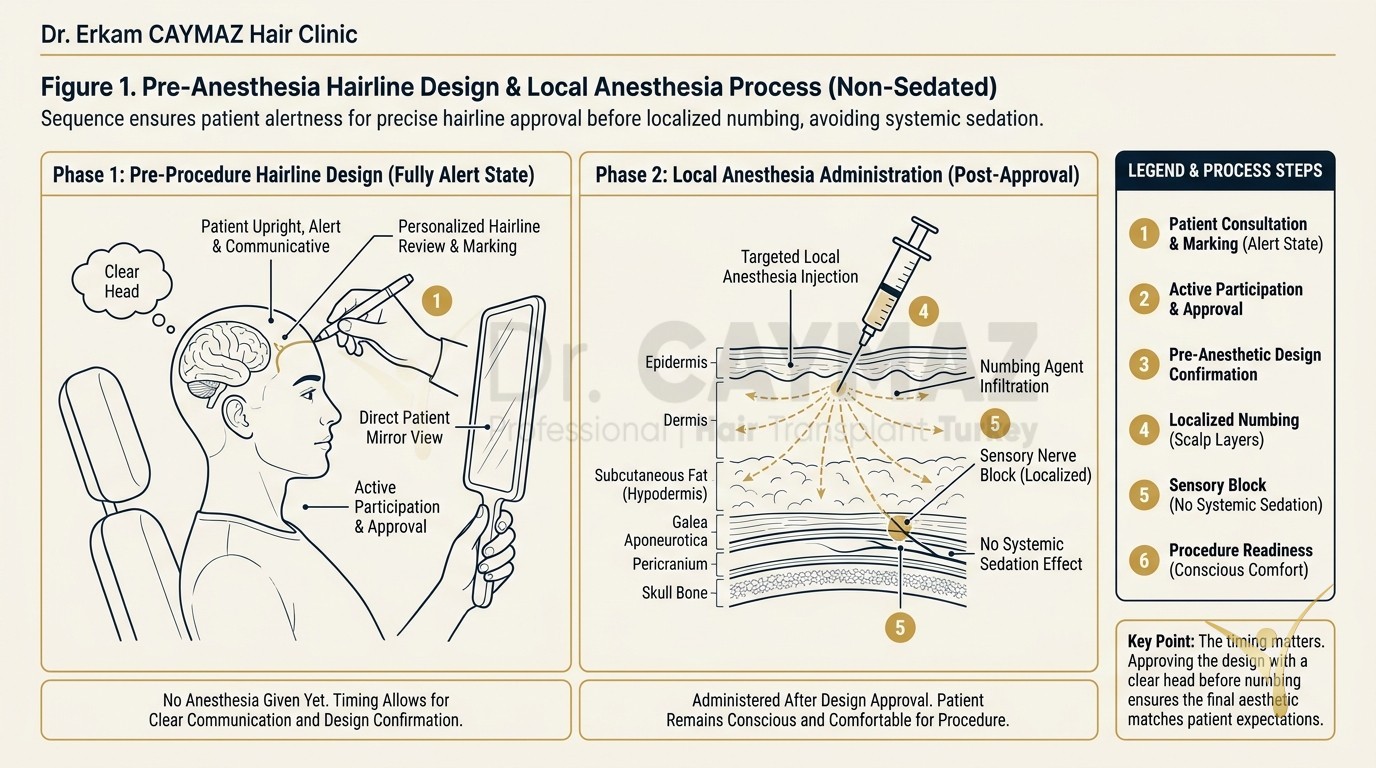
The day starts before any anesthetic is given. Dr. Caymaz personally reviews and marks your hairline while you sit upright and fully alert, with a mirror in front of you. The timing matters. You approve the design with a clear head, and any changes can be discussed openly.
Numbing then begins in the donor area at the back and sides of the scalp. The assisting nurse delivers the anesthetic in two layers, working under the surgeon's direct supervision:
- Needle-free delivery comes first. A pressure-based device pushes a small amount of anesthetic through the skin surface without a needle. Most patients describe it as a firm tap or a quick flick against the scalp.
- Fine local blocks come second. Once the surface is numb, a very thin needle places anesthetic in a ring around the working zone. Because the skin is already numb, these injections feel like pressure rather than sharp stings.
The anesthetic mixture contains a small amount of epinephrine (adrenaline), which narrows local blood vessels. This keeps the surgical field drier, slows absorption of the drug, and makes the numbness last longer. Bleeding is controlled with this mixture, firm gauze pressure, and steady pacing. Nothing else is needed.
Total doses are calculated against your body weight and kept within established safety limits. Numbness is topped up before it wears off, not after you start feeling things. The recipient area at the front or crown is numbed separately later in the day, just before the channels are opened. You can follow each stage in our step-by-step local anesthesia method.
Once both areas are numb, the sensations change. You'll notice vibration from the micromotor punch, light tugging, and the sound of instruments, but not pain. If a small spot feels sharp, it simply needs a top-up. You say so, and it's handled within a minute or two.
Why don't we add sedation, even when patients ask?
Sedation brings real risks and no measurable benefit to the result. A hair transplant is long, but it's superficial surgery. No muscle needs to relax, no body cavity is opened, and there's no medical reason for the patient to be unconscious.
Respiratory depression is the main concern. Sedatives slow the brain's drive to breathe and relax the muscles that keep the upper airway open. Oxygen levels can fall gradually. The risk rises with longer procedures, higher body weight, sleep apnea, and alcohol the night before. Donor harvesting is often done with the patient lying face-down or on one side, and those positions make airway rescue harder.
Neurological side effects are the second concern. They include confusion, dizziness, nausea, slowed reactions, and paradoxical agitation, where a patient becomes restless or even combative instead of calm. Memory loss is sometimes sold as a perk, but many patients find it unsettling to lose hours of a day they planned carefully.
Recovery is the third. Sedated patients need observation before discharge, can't leave alone, and often feel foggy well into the next day. After an awake procedure, you walk out clear-headed, eat normally, and rest at your hotel the same evening.
None of these trade-offs improves graft survival. Grafts survive because they're handled gently, kept hydrated and cool, spend as little time outside the body as possible, and go into well-planned channels. Our graft survival of up to 98% and overall success rate of 90–95% come from those factors, not from whether the patient was asleep. A calm, unhurried team matters as well, which is one reason behind limiting the clinic to one or two operations a day.
Dr. Caymaz Insight
| Since 2012, every hair transplant in my practice has been performed under local anesthesia, and I have not seen a case where sedation would have improved the result. The scalp is one of the easiest regions of the body to numb well. Once it's numb, comfort depends far more on a quiet room and an unhurried team than on a drug that clouds the mind. I want my patients awake when we confirm the hairline, when we change position, and when they tell us a small area needs a top-up. An awake patient is a safer patient, and a safe day is the foundation for the graft survival we aim for. |
Local anesthesia vs sedation vs general anesthesia
The table below compares the three approaches patients ask about most often. The sedation and general anesthesia columns reflect general clinical principles for scalp surgery. The first column describes our own standard.
| Factor | Local anesthesia, awake (our standard) | Moderate IV sedation | General anesthesia |
|---|---|---|---|
| Consciousness | Fully awake and alert | Drowsy, responds to voice | Unconscious |
| What numbs the scalp | Local anesthetic | Local anesthetic (still required) | Local anesthetic often added for bleeding control |
| Breathing | Unaffected | Can slow; oxygen monitoring needed | Controlled by the anesthesia team |
| Extra staff and equipment | Standard surgical monitoring | Dedicated sedation monitor and rescue equipment | Anesthesiologist, airway devices, recovery area |
| Confirm hairline, change position, report sensations | Yes, throughout the day | Limited | Not possible |
| Meals and restroom breaks | Normal lunch and breaks | Usually fasting beforehand; limited breaks | Fasting required |
| Discharge | Walk out clear-headed the same day | After observation; escort needed | After a recovery period; escort needed |
| Effect on graft survival | None; depends on handling | None | None |
| Used at our clinic | Yes, every operation | No | No |
The second row surprises patients the most. Every column relies on local anesthetic for the scalp itself. Sedation and general anesthesia add more drugs on top, and each brings its own monitoring requirements. Fasting is another hidden cost. Sedated patients are usually told not to eat for hours beforehand, which makes a long day harder rather than easier.
What does an awake 6–8 hour procedure day feel like?
Most patients expect the day to feel like an ordeal. In practice, it feels closer to a long dental appointment with a lunch break in the middle. Here's the typical order:
- Arrival and preparation: consent forms, photographs, a blood pressure check, and a final review of the plan. The technique, Sapphire FUE in most cases, was already chosen from your photos weeks earlier and isn't changed on the day.
- Hairline marking: done while you sit upright, and approved by you before any anesthetic is given.
- Donor numbing: about 10–15 minutes. This is the part most people remember as mildly uncomfortable.
- Extraction: expert surgical technicians remove grafts under the surgeon's supervision, using a 0.8–0.9 mm micromotor punch. You lie face-down on a padded table with a face cushion. Depending on the graft count, this phase usually takes a few hours.
- Lunch break: you sit up, eat, use the restroom, and check your phone.
- Recipient numbing and channel opening: the surgeon opens the recipient channels with V-shaped sapphire blades. This step sets the angle, direction, and density of the future hair.
- Implantation: technicians place the grafts while you recline in a semi-upright position.
During extraction, many patients watch a series on a tablet, listen to podcasts, or chat with the team. Some fall asleep on their own, and that's perfectly fine. Natural sleep is not sedation: you can wake instantly, your breathing reflexes stay normal, and you can answer when someone speaks to you. If you'd like to see each stage in order, the sequence of a standard procedure day walks through it with explanations.
At discharge, the donor area is covered with a bandage and the recipient area is left uncovered. Because no sedative needs to wear off, the evening is simple: a light meal, your medications, and sleep with your head slightly raised. Day 1 is a rest day at the hotel. Our standard is the first clinic wash and donor bandage removal on day 2 after surgery. For example, if you're operated on Monday, you rest Tuesday and come in for your wash on Wednesday. Some clinics wash on day 1, and we haven't seen problems with that approach, but we prefer day 2. The post-transplant washing steps explain what happens at that visit and afterward.
How can you manage anxiety without a sedative?
Feeling nervous before surgery is normal, and it doesn't make you a poor candidate. Much of that nervousness comes from uncertainty: not knowing what the next hour will feel like. Practical preparation reduces that uncertainty better than a tablet does.
- Know the sequence. Read through the day's stages beforehand, and ask the team to tell you before each new step begins.
- Sleep and eat normally. Have a regular breakfast, avoid alcohol for several days beforehand, and keep coffee moderate. Too much caffeine can raise your heart rate and leave you jittery.
- Use slow breathing. Breathe in for about 4 counts and out for about 6. A longer exhale activates the nervous system's calming branch and steadies your heart rate within a minute or two.
- Bring entertainment. Headphones, a charged tablet, and something to watch make the extraction hours pass quickly.
- Speak up early. You can ask for a short break, a position change, or a top-up of anesthetic at any point.
For patients afraid of needles, the needle-free first layer makes a real difference. By the time a fine needle is used, the skin surface is already numb.
A small number of patients feel lightheaded, sweaty, or queasy during the first injections. This is a vasovagal reaction, a reflex drop in heart rate and blood pressure triggered by anxiety or the sensation of the needle. It usually passes within minutes if you lie flat, raise your legs, and sip water. Being awake is an advantage here. You can tell the nurse the moment you feel off, long before it turns into a faint.
Anxiety before and after surgery is a recognized part of the process, and the emotional side of hair restoration surgery is discussed in more depth elsewhere. If you take regular medication for an anxiety disorder, tell us at consultation, and don't stop or change it on your own before travel.
Who should raise anesthesia concerns at consultation?
Local anesthesia is safe for the great majority of healthy adults. A few situations, though, need a conversation before you travel rather than on the morning of surgery:
- A previous reaction to dental or local anesthetic. True allergy to amide-type local anesthetics is rare. Most reported reactions turn out to be vasovagal episodes or palpitations from epinephrine. Even so, details help us plan.
- Heart rhythm disorders, coronary disease, or beta-blocker use, because epinephrine affects heart rate and blood pressure.
- High blood pressure or diabetes. Both are usually manageable with good control, and having a hair transplant with diabetes or hypertension is common.
- Blood thinners or supplements that affect clotting, such as aspirin, fish oil, ginkgo, or high-dose vitamin E.
- Diagnosed panic disorder, severe needle phobia, or claustrophobia.
- Neck, back, or shoulder problems that make lying face-down for long periods difficult.
- Obstructive sleep apnea. It isn't a problem under local anesthesia, but it's one more reason to avoid sedation if another clinic has suggested it.
Bring a complete list of your medications and supplements, along with any recent blood test results. These details shape how anesthesia is dosed and how the day is paced. They're easiest to review during your pre-surgery consultation, which usually happens over WhatsApp or email with photos well before you book flights.
Occasionally, after an open discussion, someone remains certain they couldn't tolerate an awake procedure. In that case we would rather tell them honestly than lower a safety standard. That conversation is rare. Far more often, patients who arrive worried about being awake say by lunchtime that the numbing was the only hard part, and that they were glad to watch their hairline being confirmed with a clear head.
Scientific Sources
FAQ
Not at our clinic. Every hair transplant is performed under local anesthesia alone. You stay awake and can talk with the team for the full 6–8 hour day. We don't use oral sedatives, IV sedation, or general anesthesia.
No. We don't use sedation in any form for hair transplants. Anxiety is managed with clear explanations before each step, needle-free numbing, slow-breathing techniques, entertainment during extraction, and breaks whenever you need them. If you have a diagnosed anxiety disorder, discuss it at consultation before you travel.
The first layer is given with a needle-free device that most patients describe as a firm tap. Fine needle blocks follow in skin that is already numb, so they feel like pressure rather than sharp stings. Most patients say these first 10–15 minutes are the only uncomfortable part of the day.
Epinephrine in the anesthetic mixture extends how long the numbness lasts. Top-ups are given before it wears off, and the recipient area is numbed separately later in the day. Total doses stay within weight-based safety limits. If any spot feels sharp, tell the team and it will be topped up.
Yes. Many patients doze off naturally during extraction. Natural sleep is not sedation: your breathing reflexes stay normal and you can wake instantly when someone speaks to you.
No. Graft survival depends on gentle handling, hydration, short time outside the body, and well-planned recipient channels. Our graft survival of up to 98% comes from those factors. Whether the patient is awake or asleep doesn't change it.
Yes. Because no sedation is involved, you don't need to fast beforehand. There's a lunch break at midday, and you can take restroom breaks as needed throughout the procedure.
Usually, yes, but share the details at consultation. True allergy to amide-type local anesthetics is rare. Most past reactions turn out to be fainting episodes or palpitations from epinephrine, and knowing what happened helps the team plan your dosing and pacing.
Our clinic standard is the first wash and donor bandage removal on day 2 after surgery, with day 1 as a rest day. For example, after a Monday operation you rest on Tuesday and come in for the wash on Wednesday.

Hair Mill in Turkey: Avoiding Risky Clinics
A hair mill runs too many transplant cases with too little surgeon oversight. Warning signs include fixed graft quotes…
Read More: Hair Mill in Turkey: Avoiding Risky Clinics
Compliance To Hair Transplantation Criteria
Before booking grafts, clinics assess whether you meet compliance criteria for hair transplantation, medical safety…
Read More: Compliance To Hair Transplantation Criteria
Why am I in needs of a Second Session for Hair Transplantation?
A second session is not a failure by default. It can be a planned stage when donor reserve and progression patterns…
Read More: Why am I in needs of a Second Session for Hair Transplantation?Frequently Asked Questions
Professional Hair Transplant Insights by Dr. Erkam Caymaz