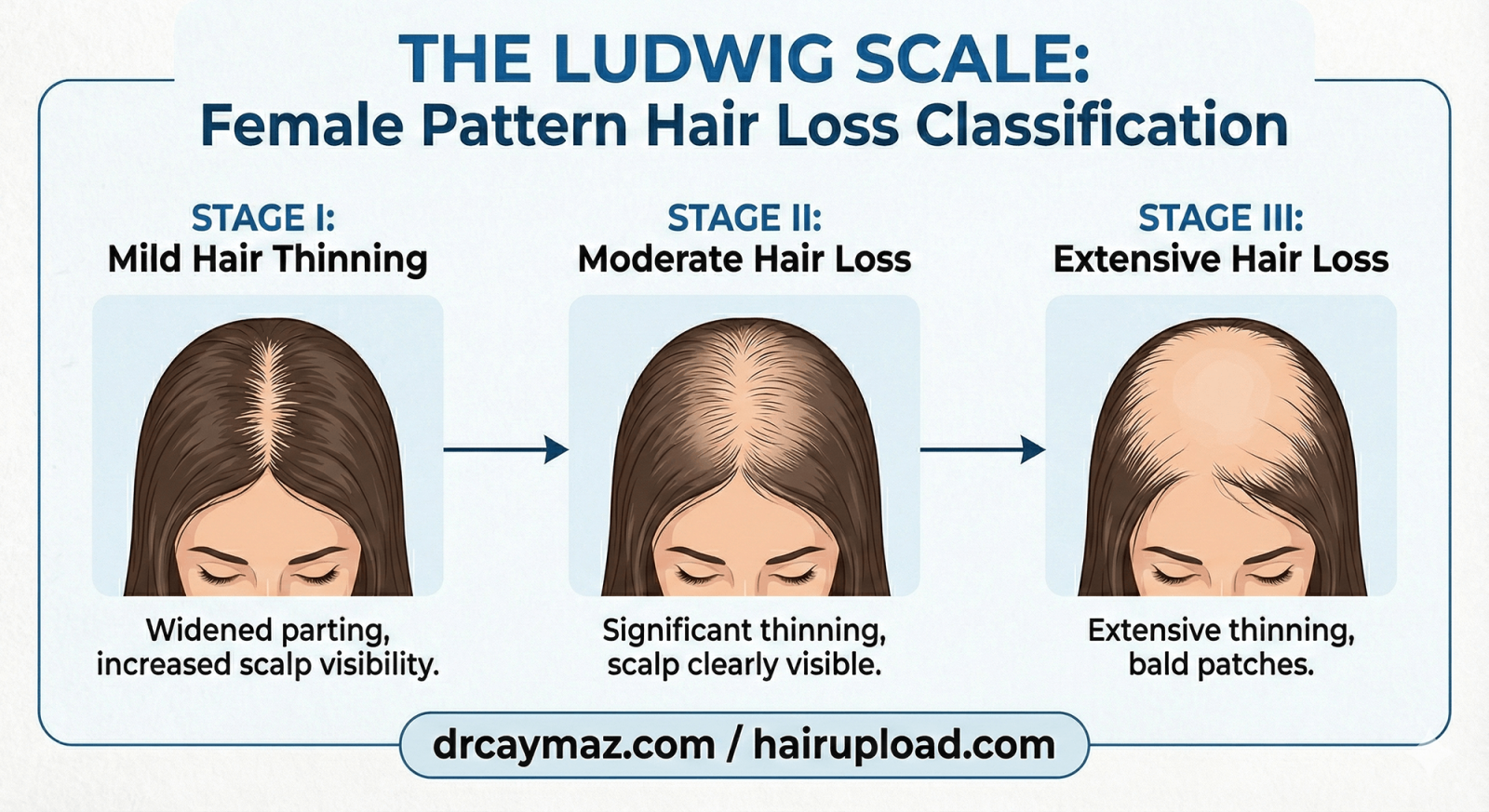
Understanding Female Hair Loss Progression


Summary


Female hair loss often follows a diffuse pattern known as the Ludwig Scale, unlike the receding hairline seen in men. While hormonal shifts and genetics play a huge role, modern solutions like Sapphire FUE and DHI are revolutionizing restoration. Turkey has become a global hub for these procedures, offering high-density results. If you are noticing widening parts or thinning crowns, early intervention is key.

Ludwig Scale Woman


The Silent Struggle: Decoding Female Pattern Hair Loss


Hair loss is frequently discussed as a male issue, but for millions of women, it is a daily, often silent struggle. Unlike male pattern baldness, which is characterized by a receding hairline, woman hairloss typically manifests as a gradual thinning across the top of the scalp.

To achieve the best results in treatment, we must first understand the severity of the condition using the Ludwig Scale.

What is the Ludwig Scale?

Dermatologists and hair restoration experts use the Ludwig Scale to classify the stages of female pattern baldness:

Type I: Minimal thinning that can be camouflaged with styling. The frontal hairline remains intact.

Type II: Moderate decrease in volume and a noticeable widening of the part line.

Type III: Significant diffuse thinning across the crown. The scalp becomes clearly visible.

Identifying your stage on this scale is the first step toward determining if you are a candidate for a best hair transplant procedure.

Why Does It Happen?


The causes are often multifactorial:

1. Genetics: If your mother or grandmother experienced thinning, you are at higher risk.

2. Hormones: Events like menopause, pregnancy, or thyroid imbalances can trigger shedding.

3. Stress & Diet: Telogen effluvium can cause temporary but alarming hair loss.

The Gold Standard: Sapphire FUE & DHI for Women


For women seeking cosmetic density improvement, the "shaved head" look often associated with transplants is a major barrier. Fortunately, advanced techniques now allow for unshaven or partially shaven options.

Sapphire FUE Technique

The Sapphire FUE technique utilizes blades made from precious sapphire gemstone rather than steel. This allows for:

Micro-incisions: Smaller channels mean faster healing and less trauma to the scalp.

Higher Density: The precision allows surgeons to pack follicles closer together, critical for restoring volume in thinning areas.

Natural Angles: The V-shaped sapphire blade mimics the natural direction of hair growth.

DHI (Direct Hair Implantation)

For many women, DHI is the preferred choice because it often requires no shaving of the recipient area. The surgeon uses a "Choi Pen" to implant follicles directly between existing hairs, increasing density without damaging neighboring strands.

Why Choose a Hair Transplant in Turkey?


Istanbul has earned its reputation as the capital of hair restoration. A hair transplant Turkey offers a unique combination of affordability and world-class expertise.

Cost-Effectiveness: Packages often include accommodation and VIP transfers. You can check our specific Hair Transplant Price & Packages to see how competitive these rates are compared to the US or UK.

High Volume Experience: Turkish surgeons perform thousands of cases annually, giving them unparalleled experience with complex female cases.

Comprehensive Care: From the moment you land to your final wash, the process is managed seamlessly.

What to Expect: The Journey to Restoration


1. Consultation & Planning

Your donor area (usually the back of the head) is evaluated. We map out the recipient area based on your Ludwig Scale classification.

2. The Procedure

Under local anesthesia, healthy follicles are extracted and implanted. The use of Sapphire blades ensures minimal scarring.

3. Aftercare & Recovery

Post-op care is vital for graft survival. You must follow specific washing and protection protocols. For a detailed guide on what happens next, read our Hair Transplant Aftercare page.

4. The Results

Patience is required. New hair typically begins to grow at 3-4 months, with best results visible around the 12-month mark.

FAQ: Common Questions About Female Hair Transplants


Q: Will I have to shave my head?

A: Not necessarily. Techniques like DHI and specific FUE methods allow for "unshaven" transplants where only a small window in the donor area is shaved, which is easily hidden by your remaining hair.

Q: Is the result permanent?

A: Yes. The transplanted hair is taken from the "safe zone" at the back of the head, which is genetically resistant to hair loss.

Q: How do I book a consultation?

A: You can reach out directly to our team to discuss your specific case. Visit our Contact Us page to get started.

Conclusion


Hair loss doesn't have to be permanent. With advancements in the Sapphire FUE technique* and the expertise available for a hair transplant Istanbul, restoring your density and confidence is more achievable than ever. Whether you are at Ludwig Stage I or II, early action yields the best outcomes.

If you are ready to take the next step, explore the expertise of Dr. Caymaz Hair Transplant and reclaim your hair.

References (Scientific Sources)


International Society of Hair Restoration Surgery (ISHRS). (2025). 2025 Practice Census Results: Trends in Female Hair Restoration. ISHRS Publications.

Smith, J., et al. (2024). Efficacy of Sapphire Blade Incisions in Follicular Unit Extraction: A Comparative Study. Journal of Cutaneous and Aesthetic Surgery.

Gupta, A. K., & Bamimore, M. A. (2023). Female Pattern Hair Loss: Current Treatment Landscape and Future Directions. Journal of Cosmetic Dermatology.


Dr. Caymaz Insight


"In my clinical experience, the emotional impact of hair loss on women is profound. The key to a successful female hair transplant is not just density, but the artistic preservation of the natural hair whorl patterns. Using Sapphire blades allows us to enter the scalp with such precision that we can protect the existing healthy hair while adding the necessary volume."

---"

 
>


常见问题

许多女性出现弥漫性中央变薄,但额叶相对保留,而不是深度颞叶后退。疤痕和炎症更为常见,必须排除。

当诊断支持雄激素小型化且无活动性疤痕炎症时,外用米诺地尔广泛用于女性型脱发。

在许多地区,该药属于超说明书使用,并且在怀孕期间是禁忌的。决策需要内分泌评估、避孕咨询和专家监督。

具有稳定供体、局部缺陷且无活动性弥漫性无图案脱发的选定病例可能符合资格。大多数弥漫性模式首先要进行医学治疗。

铁、甲状腺、雄激素指数和休止期触发史是常见的起点。怀疑疤痕性脱发可能需要进行活检。

并非总是如此。密度可能会随着荷尔蒙的变化而变化,但小型化可以继续,并且应该通过照片和皮肤镜检查进行监测。

脱发 — 常见问题解答

Dr. Erkam Caymaz(伊斯坦布尔)的专家解答

最常见的脱发原因有哪些?
男性约 95% 的病例归因于雄激素性脱发 — 即对 DHT(二氢睾酮)的遗传性敏感。其他原因包括压力性休止期脱发、自体免疫的 斑秃、甲状腺失衡、缺铁性贫血、产后脱发以及某些药物副作用。Caymaz 医生会在面诊中确定您的具体类型。
非那雄胺和米诺地尔究竟是如何起作用的?
非那雄胺通过抑制 5α-还原酶降低头皮 DHT,减缓毛囊微缩化。米诺地尔是一种局部血管扩张剂,可延长生长期(anagen)并改善血液灌注。二者均有循证医学支持且互为补充。机制详情:Minoxidil and Finasteride Mechanism
不做植发能阻止脱发吗?
在早期到中度的雄激素性脱发中 — 通常可以。非那雄胺、米诺地尔、美塑疗法以及生活方式调整组合通常能稳定脱发并部分恢复密度。当毛囊微缩化已无法被药物逆转时,植发才是合适的下一步。延伸阅读:Ways to Stop Hair Loss
女性脱发与男性有何不同?
女性型脱发通常表现为头顶弥漫性变薄,而前发际线得到保留,与男性的「后退式」脱发不同。激素、产后期、铁、甲状腺、多囊卵巢综合征都扮演更大角色。我们的诊断流程和 女性植发方案 都根据这些差异定制。
什么时候应该考虑植发?
当男性脱发达到 Norwood 3 级(女性出现明显弥漫性变薄)、单靠药物已无法逆转脱发、供体区仍然致密、患者至少 25-26 岁且脱发模式稳定时,可以考虑植发。Caymaz 医生在批准手术前会综合考量所有因素 — 患者适应性是临床判断,而非商业判断。