


Quick Numbers
| Swelling peak | Days 3–5 post-op |
|---|---|
| First clinic wash | Day 2 (our protocol) |
| Scab separation | Days 10–14 |
| Shock loss onset | Weeks 2–4 |
| Graft survival (up to) | 98% |
Key Takeaways
| Sleep at a 45-degree angle for the first 5 nights to reduce forehead and periorbital swelling. |
| Shock loss is a normal shedding phase, not graft failure; the follicle root stays alive beneath the skin. |
| Scabs should never be picked or scratched off; gentle washing loosens them naturally by day 10–14. |
| Most patients return to desk work within 3–5 days, but heavy exercise waits until week 4 or later. |
| The scalp may look thinner at day 30 than on surgery day; visible regrowth begins around months 3–4. |
You're two days out from your procedure, your forehead is starting to puff, and you're wondering whether every itch, every tiny scab, and every hair that falls onto your pillow is normal. That single question, "what happens after hair transplant in the first month," is the most common message Dr. Erkam Caymaz's team receives on follow-up WhatsApp chats. About 80 percent of patient anxiety during recovery comes from not knowing the daily sequence of events. The calendar below maps each phase of the first 30 days so you can tell the difference between expected healing and a genuine concern worth reporting.
What Happens on Days 0 to 2 After Hair Transplant?
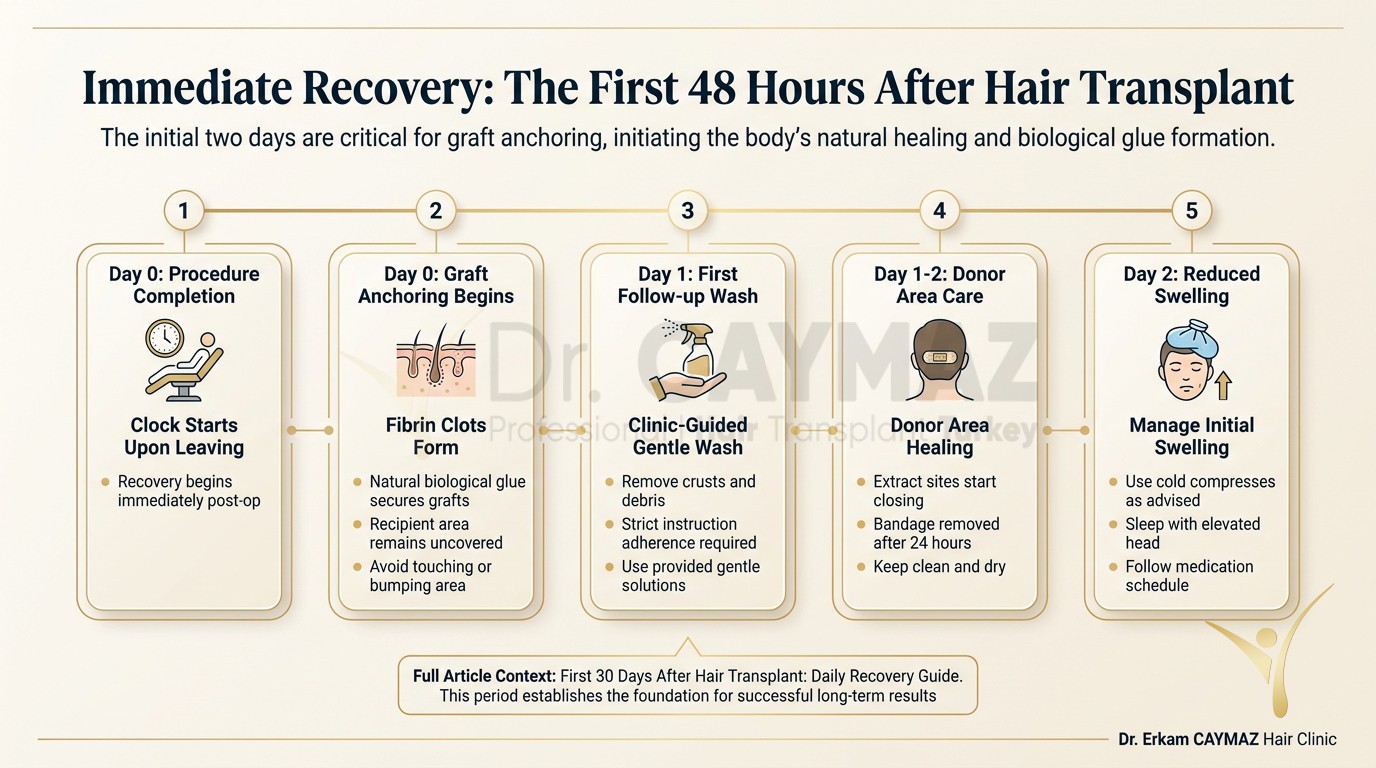
The clock starts the moment you leave the operating chair. Your recipient area is left uncovered so the tiny channel openings can begin forming initial fibrin clots, the body's natural biological glue that anchors each graft in place. The donor area, where grafts were extracted using a 0.8–0.9 mm micromotor punch, is wrapped in a light bandage to absorb any minor oozing overnight.
Day 0 itself is a rest day. You'll feel numbness from the local anesthetic wearing off over 4 to 8 hours, followed by a mild tightness across the scalp. Some patients describe it as a sunburn sensation. Pain is usually manageable with the prescribed medications given during and after the operation, which typically include an analgesic, an antibiotic, and an anti-edema corticosteroid.
On day 1, you rest at your hotel. No washing, no touching the grafts, no bending forward. Gravity matters: keep your head above your heart as much as possible. At our clinic, the first wash and donor bandage removal happen on day 2. A trained nurse performs this wash in the clinic using a gentle foam solution, softening the dried blood and demonstrating the exact patting motion you'll replicate at home for the next 10 days. Some clinics perform this wash on day 1; we haven't observed problems with that timing, but we prefer day 2 to give the fibrin seal an extra 24 hours of undisturbed consolidation. You can read the full first-wash protocol after surgery for step-by-step instructions.
Why Does Swelling Peak Around Days 3 to 5?
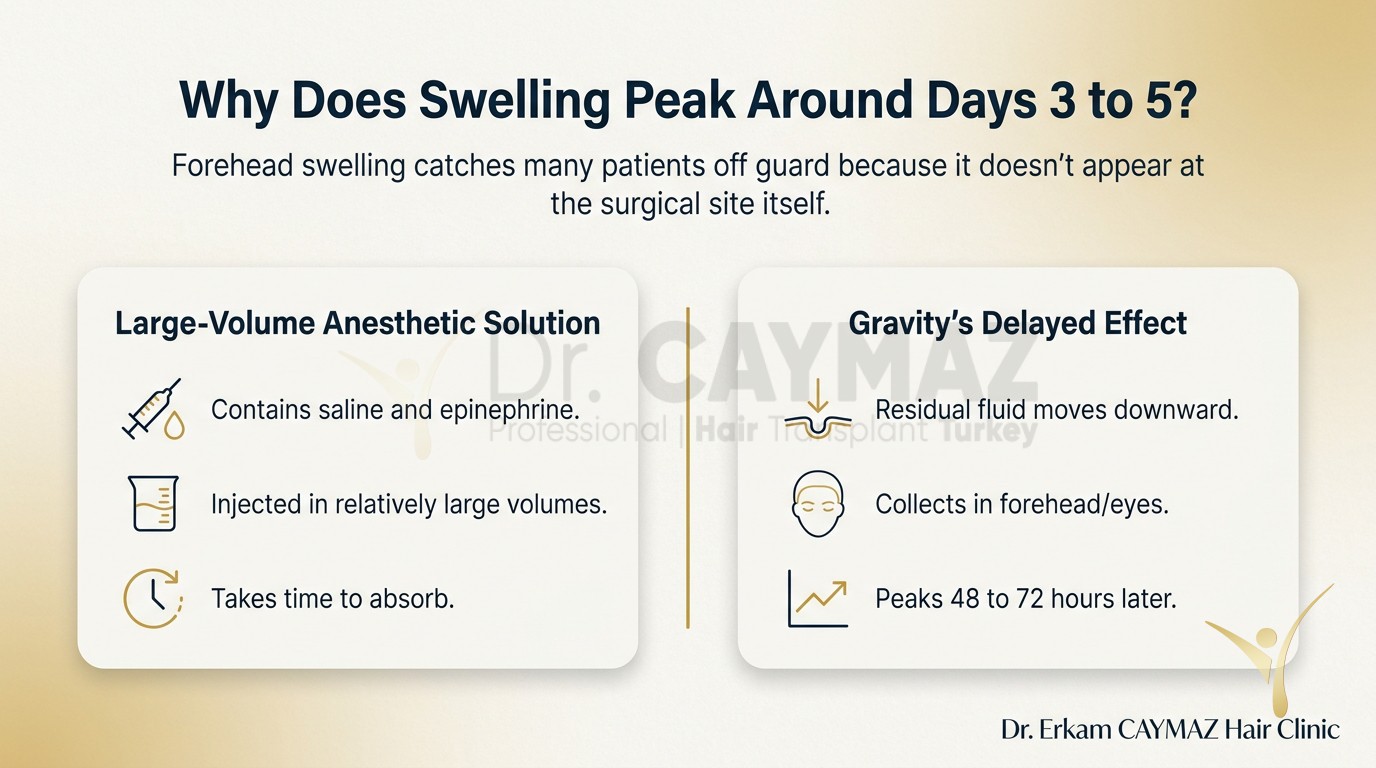
Forehead swelling catches many patients off guard because it doesn't appear at the surgical site itself. The local anesthetic solution, which contains saline and epinephrine, is injected in relatively large volumes during the procedure. Over the next 48 to 72 hours, gravity pulls residual fluid downward from the scalp into the loose connective tissue of the forehead and upper eyelids. The result: a puffy forehead, sometimes bruised-looking periorbital skin, and occasionally swollen eyelids that make it hard to open your eyes fully on day 4.
This is not an allergic reaction and not an infection. It's a predictable fluid migration. Sleeping at a 45-degree incline, using a travel neck pillow to prevent rolling, and applying a cold compress to the forehead (never directly on the grafts) can reduce the peak intensity. The corticosteroid prescribed on surgery day also helps. By day 6 or 7, swelling resolves in the vast majority of patients. If it persists past day 8 or is accompanied by fever, that warrants a call to your surgical team. For a broader look at what to expect during healing, the recovery overview covers each milestone.
How Should You Sleep in the First Two Weeks?
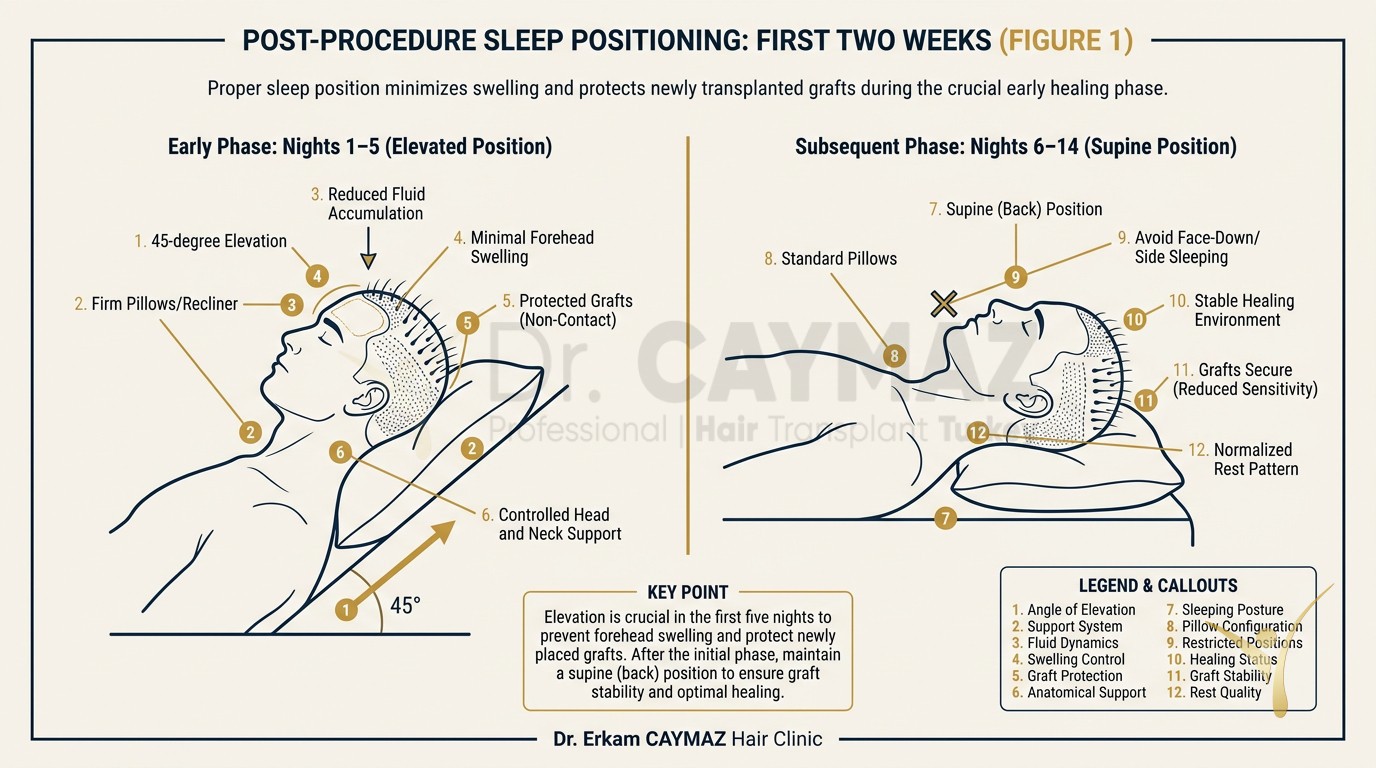
Sleep position is one of the simplest variables you can control, and one of the most frequently ignored. For the first 5 nights, sleep on your back at roughly 45 degrees. Two firm pillows or a recliner chair work well. This elevation limits fluid accumulation in the forehead and reduces the risk of accidentally pressing grafts against a pillowcase.
After day 5, you can lower the angle to about 30 degrees. Side sleeping becomes possible around day 10 for most patients, provided the recipient zone doesn't contact the pillow. If your transplant was limited to the frontal hairline, sleeping on your side with a satin pillowcase is usually safe by day 10. Crown transplants require a bit more caution because the recipient area sits where the pillow naturally presses.
By day 14, most patients can return to their normal sleeping position. The grafts are well anchored by this point; the epithelial layer has closed over each channel, and the risk of mechanical dislodgement is minimal. If you're a restless sleeper, wearing a loose headband around the forehead (not over the grafts) can act as a tactile reminder to avoid face-down positions during the first week.
Dr. Caymaz Insight
| I tell every patient the same thing on discharge day: the first month will test your patience more than anything else. Swelling looks alarming but resolves on its own. Shock loss feels devastating but it's the follicle resetting, not dying. The patients who follow the washing schedule, sleep elevated, and resist the urge to pick at scabs are the ones whose 12-month photos look the best. I've seen this pattern across 15 years and thousands of cases. Trust the biology, follow the protocol, and don't judge your result at day 30. |
When Do Scabs Form and How Should They Come Off?
Small, dark scabs begin forming within hours of surgery. Each scab sits at the opening of a recipient channel, essentially a tiny crust of dried blood and plasma around the base of the implanted graft. By day 3, the recipient area looks like it's covered in hundreds of small dots. This is completely normal.
The washing routine you learned at the day-2 clinic wash is your primary tool for scab removal. You'll apply a moisturizing foam or lotion, let it sit for 15 to 20 minutes to soften the crusts, then rinse with lukewarm, low-pressure water while gently patting (never rubbing) with your fingertips. Over the course of days 3 through 10, each wash session loosens more scabs. By day 10 to 14, most scabs have separated naturally.
Resist the temptation to scratch or pick. A scab pulled off prematurely can take the graft with it, especially in the first 7 days when the follicle hasn't yet established a blood supply in its new location. If a few stubborn scabs remain past day 14, slightly more pressure during washing is acceptable, but aggressive scrubbing is not. Detailed aftercare steps are outlined in the aftercare protocol.
What Is Shock Loss and When Does It Start?
Somewhere between week 2 and week 4, you'll notice transplanted hairs falling out. This is called shock loss, sometimes referred to as shedding phase or catagen shift. It happens because the trauma of extraction and reimplantation pushes the hair shaft into a premature resting phase. The shaft falls out, but the follicle root, the living part, remains anchored beneath the skin surface.
Shock loss affects roughly 80 to 90 percent of transplanted hairs. Some patients lose nearly all visible transplanted hairs by week 4 to 6. This is the most psychologically difficult phase of recovery because the scalp can look thinner than it did before surgery. Understanding the mechanism helps: the follicle is alive, dormant, and will re-enter the growth (anagen) phase over the coming months. Visible regrowth typically starts around month 3 to 4, with meaningful density appearing by month 6 to 8. For a deeper explanation of the biology behind this shedding, the article on shock hair loss covers the cellular mechanisms.
Shock loss can also affect existing native hairs near the recipient zone. The surgical trauma, specifically the creation of recipient channels, can temporarily disrupt blood flow to neighboring follicles. These native hairs usually regrow within 3 to 4 months. If you're concerned about native hair thinning, your surgeon may recommend starting or continuing finasteride or minoxidil to support those follicles during the vulnerable period.
Day-by-Day Recovery Calendar: What Changes Each Week?
| Timeframe | What You'll See | What to Do | What to Avoid |
|---|---|---|---|
| Days 0–2 | Redness, tiny blood dots on recipient area, donor bandage in place | Rest, sleep elevated at 45°, take prescribed medications | Touching grafts, bending forward, alcohol |
| Days 3–5 | Forehead swelling peaks, scabs darken, mild itching begins | Continue daily foam washes (after day-2 clinic wash), cold compress on forehead | Scratching, direct sun, hats pressing on grafts |
| Days 6–9 | Swelling subsides, scabs start loosening, donor area pinkness fading | Gentle patting during washes, lower sleep angle to 30° | Swimming, sauna, heavy lifting |
| Days 10–14 | Most scabs gone, recipient area looks pink or slightly red, side sleeping possible | Normal shampoo (gentle, pH-balanced), resume light desk work if not already | Picking remaining scabs, hair dryer on hot setting |
| Weeks 3–4 | Shock loss begins, transplanted hairs shed, mild flaking | Continue gentle washing, moisturize if dry, follow up with clinic photos | Panicking about shedding, intense cardio, contact sports |
This table represents a typical timeline. Individual variation exists based on graft count, skin type, and how closely the aftercare protocol is followed. The week-by-week recovery timeline provides a longer-range view extending through month 12.
Can You Work, Exercise, and Travel During the First Month?
Desk work is usually possible by day 3 to 5 for patients who work remotely. If your job requires in-person meetings, most patients feel comfortable returning by day 7 to 10, once swelling has resolved and scabs are less visible. A loose cap can be worn after day 10 if needed for cosmetic coverage, but it shouldn't press tightly against the recipient zone.
Exercise follows a stricter timeline. Light walking is fine from day 1. Anything that raises blood pressure or heart rate significantly, including jogging, weight training, and cycling, should wait until at least day 14, and ideally until week 4. Elevated blood pressure can cause delayed bleeding from donor extraction sites and increase swelling. Contact sports, swimming in chlorinated or salt water, and steam rooms are off-limits for the full 30 days. The return-to-activity calendar breaks this down by sport and intensity level.
Flying is safe as early as day 2 or 3 for most patients. Cabin pressure changes don't affect graft survival. The main concern is the dry cabin air, which can dehydrate the scalp, and the risk of bumping your head on overhead bins or seat backs. A travel pillow and a small spray bottle of saline can help. Many international patients fly home within 3 days of surgery without complications.
What Signs Should Prompt You to Contact Your Clinic?
Most of what you experience in the first 30 days is normal. But certain signs warrant a message or call to your surgical team:
- Fever above 38.5°C (101.3°F) lasting more than 24 hours, which could indicate infection
- Pus or yellow-green discharge from the donor or recipient area, distinct from the normal clear or slightly pink oozing of the first 48 hours
- Sudden, significant bleeding from the donor area after day 3, especially if it doesn't stop with 10 minutes of firm gauze pressure
- Severe pain that worsens rather than improves after day 2, or pain unresponsive to prescribed analgesics
- Widespread rash or hives that could signal a medication reaction
Itching, mild redness, flaking skin, and the shedding of transplanted hairs are all expected. They don't require emergency contact. When in doubt, sending a photo to your clinic's follow-up channel is the fastest way to get reassurance. For a full list of normal versus abnormal post-operative findings, the side effects overview is a useful reference.
How Does the Scalp Look at Day 30 Compared to Surgery Day?
This is the question that causes the most anxiety. At day 30, your scalp will likely look worse than it did immediately after surgery. On the operating table, every graft was visible as a tiny hair emerging from a fresh channel. Four weeks later, most of those hairs have shed due to shock loss. The recipient area may appear pink, slightly bumpy in texture, and, frankly, not much different from your pre-surgery appearance.
This is entirely expected. The follicles are alive beneath the surface, entering a dormant phase before cycling back into active growth. Think of it as a reset period. The first fine, wispy hairs usually appear around month 3. By month 6, you'll see noticeable coverage. Final density, the result you'll live with, takes 12 to 15 months to fully mature.
Patients who understand this timeline in advance handle the emotional dip of month 1 far better than those who expect immediate results. Dr. Caymaz's team sends follow-up photo requests at months 1, 3, 6, and 12 to track progress and provide reassurance at each stage.
Protecting follicles during this dormant window follows the same graft care rules used in the first 10 days: no mechanical pressure, gentle washing, and patience while the follicle sits in telogen.
Does What You Do in Month 1 Actually Affect Final Results?
Yes, measurably. Published data on FUE outcomes show that graft survival rates reach up to 98 percent when aftercare protocols are followed correctly. The first 10 days carry the highest risk of mechanical graft loss, meaning a graft physically dislodged from its channel before neovascularization (new blood vessel formation) secures it. After day 10, the risk drops sharply.
The behaviors that protect grafts during this critical window are straightforward:
- Don't touch, rub, or scratch the recipient area
- Wash exactly as instructed, with the correct foam, water temperature, and patting technique
- Sleep elevated and on your back
- Avoid blood-thinning substances including alcohol, aspirin, and nicotine for the recommended period
- Keep the scalp out of direct sunlight for at least 3 weeks
Nicotine deserves special mention. Smoking and nicotine products constrict blood vessels in the scalp, reducing oxygen delivery to newly transplanted follicles during the exact period when they're establishing a blood supply. Even nicotine pouches and vaping carry this risk. The recommendation is to stop all nicotine products at least 1 week before surgery and avoid them for at least 4 weeks after. The smoking and hair transplant explains the vascular mechanism in detail.
Overall success rates for FUE procedures sit at 90 to 95 percent across the literature, with the gap between 90 and 95 often attributable to patient compliance with aftercare. The surgical team controls technique, graft handling, and channel design. You control what happens in the 30 days that follow.
Sources
FAQ
Forehead and periorbital swelling typically peaks between days 3 and 5 post-op and resolves by day 6 to 7. Sleeping at a 45-degree angle and applying cold compresses to the forehead (not the grafts) can reduce the intensity. If swelling persists beyond day 8 or is accompanied by fever, contact your clinic.
Sleep on your back at a 45-degree angle for the first 5 nights, then lower to 30 degrees. Side sleeping is usually safe by day 10 for frontal transplants. Most patients return to their normal sleeping position by day 14, once the grafts are well anchored.
Yes. This is called shock loss and affects 80 to 90 percent of transplanted hairs between weeks 2 and 4. The hair shaft sheds, but the follicle root remains alive beneath the skin. New growth typically begins around month 3 to 4.
At our clinic, the first wash is performed in the clinic on day 2 post-op, which is also when the donor bandage is removed. Some clinics wash on day 1; we prefer day 2 to allow the fibrin seal an extra day of consolidation. The nurse demonstrates the gentle patting technique you'll use at home.
Remote desk work is possible by day 3 to 5. In-person work is comfortable for most patients by day 7 to 10, once swelling has resolved and scabs are less noticeable. A loose cap can provide cosmetic coverage after day 10.
Light walking is fine from day 1. Moderate exercise like jogging or weight training should wait until at least day 14, ideally week 4. Contact sports, swimming, and steam rooms are off-limits for the full 30 days to protect grafts and prevent infection.
Apply the prescribed moisturizing foam, let it sit for 15 to 20 minutes, then rinse with lukewarm low-pressure water while gently patting with your fingertips. Never scratch or pick at scabs. Most scabs separate naturally between days 10 and 14 through this daily washing routine.
At day 30, the scalp typically looks worse than on surgery day because shock loss has shed most transplanted hairs. The recipient area may appear pink and similar to its pre-surgery state. This is normal. Visible regrowth starts around month 3, with final density maturing at 12 to 15 months.
Flying is safe as early as day 2 or 3. Cabin pressure changes don't affect graft survival. Use a travel pillow to avoid bumping your head, and keep a saline spray handy to counteract dry cabin air.
Avoid touching or scratching the recipient area, direct sunlight for at least 3 weeks, alcohol and nicotine for at least 4 weeks, heavy exercise for 2 to 4 weeks, swimming pools, saunas, and tight hats that press on grafts. These precautions protect graft survival during the critical anchoring period.
Yes. Nicotine constricts scalp blood vessels, reducing oxygen delivery to newly transplanted follicles during the period when they're establishing a blood supply. Stop all nicotine products at least 1 week before surgery and avoid them for at least 4 weeks after.
Contact your clinic if you develop a fever above 38.5°C lasting more than 24 hours, pus or yellow-green discharge, significant bleeding that doesn't stop with 10 minutes of gauze pressure, severe worsening pain after day 2, or a widespread rash. Itching, mild redness, flaking, and shock loss shedding are normal and don't require emergency contact.

Do All Transplanted Hair Grow? Understanding Hair Growth after Hair Transplantation
Most transplanted hairs grow, but not every single graft. Graft survival reaches up to 98% in experienced hands and…
Read More: Do All Transplanted Hair Grow? Understanding Hair Growth after Hair Transplantation
What is the Success Rate of Hair Transplantation in Skin Diseases such as Eczema, Psoriasis, Liken Planus and Seborrheic Dermatitis?
Patients with eczema, psoriasis, lichen planus, or seborrheic dermatitis ask about hair transplant success rates. Skin…
Read More: What is the Success Rate of Hair Transplantation in Skin Diseases such as Eczema, Psoriasis, Liken Planus and Seborrheic Dermatitis?
Places to visit in Istanbul during Hair Transplant Procedure
Istanbul is a living history with city walls, mosques, palaces, museums and lots of historical places. You don’t need…
Read More: Places to visit in Istanbul during Hair Transplant ProcedureFrequently Asked Questions
Professional Hair Transplant Insights by Dr. Erkam Caymaz