


Quick Numbers
| Minimum wait before flying | 3 days post-op (short haul); 5–7 days preferred for 8 h+ flights |
|---|---|
| Cabin humidity | 10–20 %, vs. 40–60 % at ground level |
| Jet lag recovery rate | ~1 day per time zone crossed |
| Deep-sleep healing peak | Growth hormone surge during first 90 min of slow-wave sleep |
| Peak forehead swelling window | Days 3–5 post-transplant |
Key Takeaways
| Cabin pressure at cruising altitude can intensify post-operative scalp and forehead swelling during the first five days. |
| Jet lag disrupts slow-wave sleep, the phase when growth hormone peaks and tissue repair is most active. |
| Drinking at least 250 mL of water per hour of flight helps counteract the extreme dryness of pressurized cabins. |
| Patients crossing six or more time zones should pre-shift their sleep schedule by 30–60 minutes per night for three nights before departure. |
| A travel pillow that keeps the head elevated at 35–45 degrees protects grafts from contact and reduces fluid pooling. |
A patient from Los Angeles books a Sapphire FUE procedure in Istanbul, spends two nights recovering at the hotel, then boards a 13-hour return flight that crosses 10 time zones. By the time he lands at LAX, his forehead is noticeably more swollen than when he left, he hasn't slept properly in 36 hours, and he's wondering whether the long flight after his hair transplant just ruined everything. This scenario is common. Roughly 60 % of international hair transplant patients fly home within 72 hours of surgery, and many of them cross enough time zones to trigger significant jet lag.
Patients who traveled to Turkey for a hair transplant make up a significant share of this group, given the transatlantic or intercontinental journey typically required. The combination of cabin-pressure changes, dehydration, sleep deprivation, and circadian disruption creates a specific set of recovery challenges that deserve a clear, evidence-based discussion.
Why Does Cabin Pressure Affect a Freshly Transplanted Scalp?
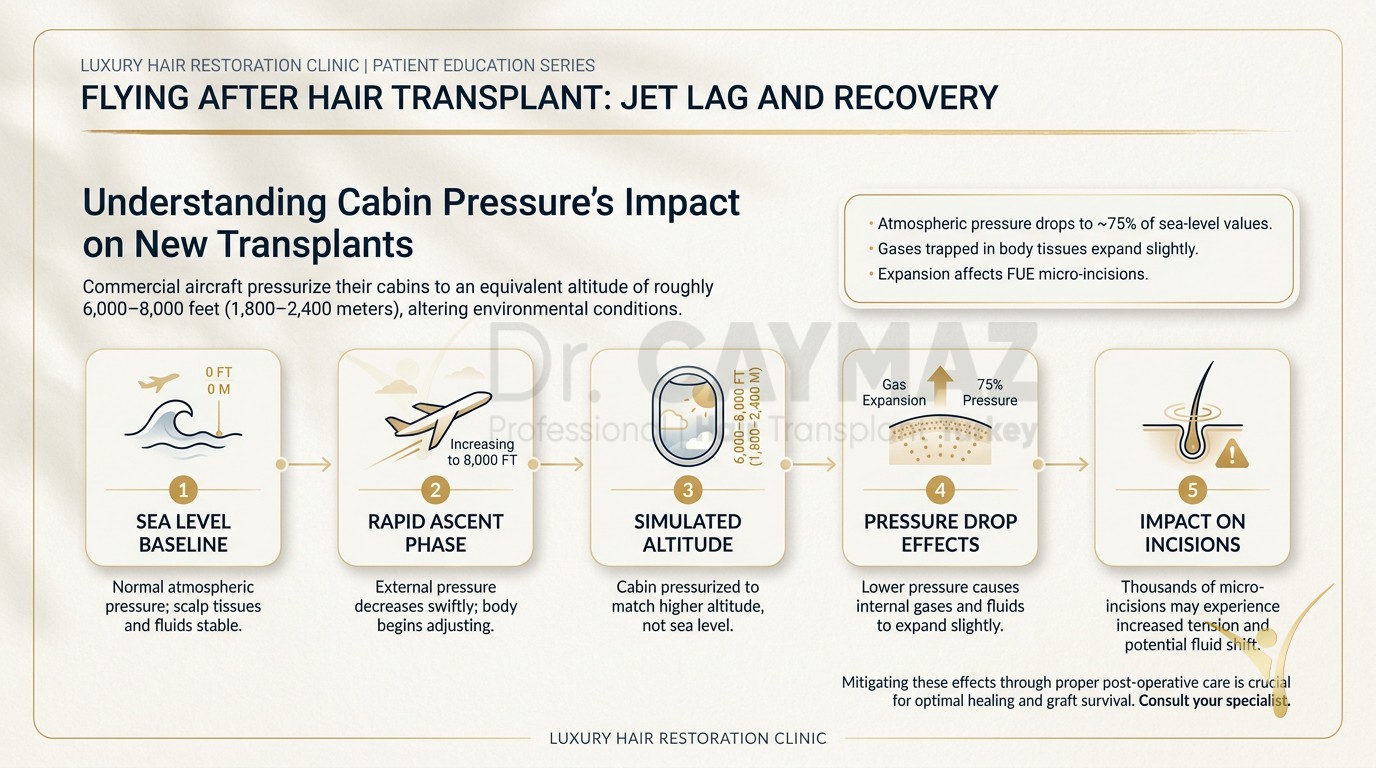
Commercial aircraft pressurize their cabins to an equivalent altitude of roughly 6,000–8,000 feet (1,800–2,400 meters). At that simulated elevation, atmospheric pressure drops to about 75 % of sea-level values. Gases trapped in body tissues expand slightly. For a patient whose scalp has thousands of micro-incisions from an FUE extraction, this mild expansion can worsen the interstitial edema, the fluid that collects between tissue layers, that is already forming as part of normal wound healing.
Patients who had DHI implantation notice the same pattern, because both techniques leave open micro-wounds in the recipient zone during the first post-operative week.
The effect is most pronounced between days 2 and 5 post-surgery, when swelling typically migrates from the scalp down toward the forehead and periorbital area. If you board a long flight on day 2 or 3, the reduced cabin pressure can accelerate that fluid shift. Patients sometimes report landing with puffy eyelids or a tight, heavy feeling across the brow. This swelling is temporary and doesn't damage grafts, but it can be uncomfortable and alarming if you aren't expecting it.
Keeping your head elevated during the flight is the single most effective countermeasure. A U-shaped neck pillow combined with a reclined seat angle of about 35–45 degrees helps gravity pull fluid away from the forehead. Lying flat in a business-class bed, while tempting on a long flight, can make swelling worse during the first five days. If your clinic prescribed a short course of oral corticosteroids to manage swelling, take them on schedule regardless of time zone shifts. You can read more about medications given during and after the operation for context on why these prescriptions matter.
How Does Jet Lag Interfere with Graft Healing?
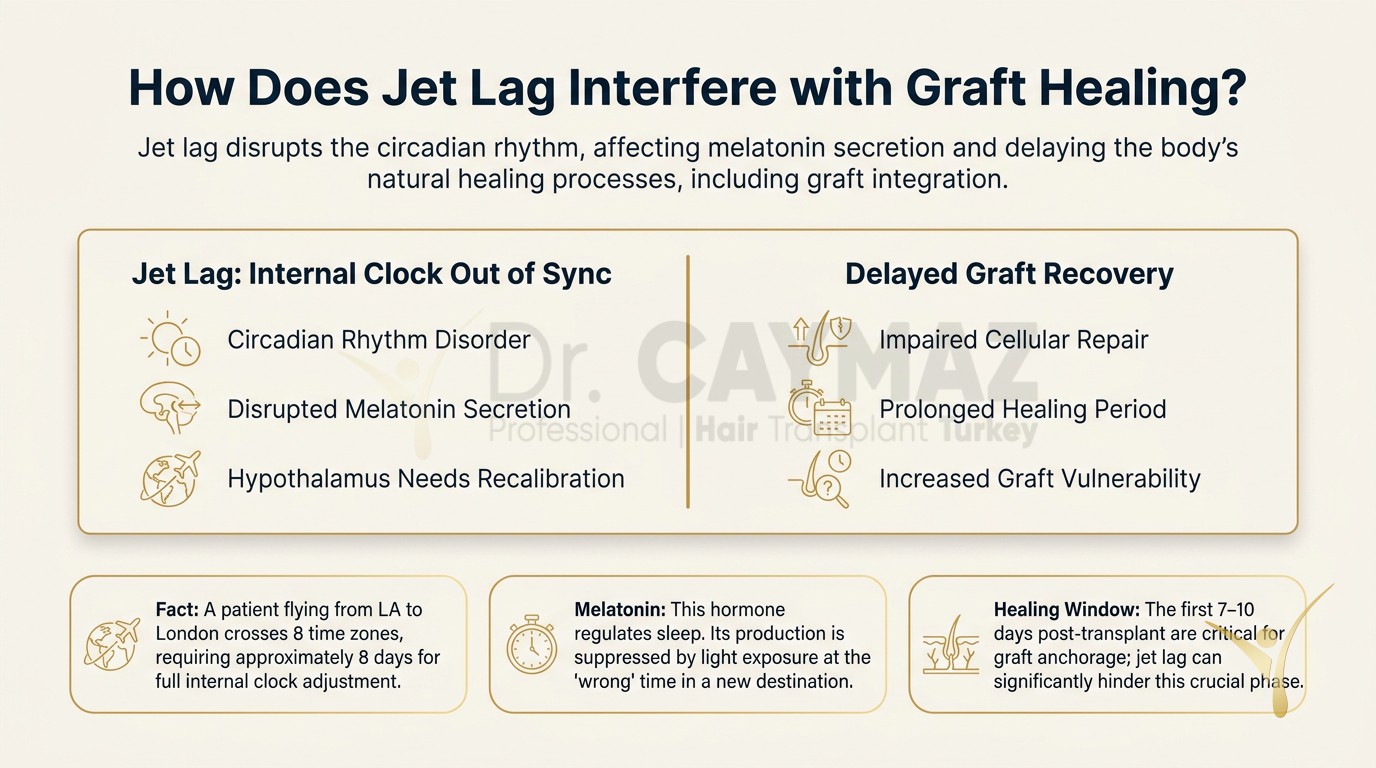
Jet lag is a circadian rhythm disorder. When you cross multiple time zones rapidly, your internal body clock falls out of sync with local daylight. The hypothalamus, which regulates your sleep-wake cycle through melatonin secretion, needs roughly one full day per time zone crossed to recalibrate. A patient flying from London to Istanbul (2-hour difference) barely notices. A patient flying from Sydney to Istanbul (7–8 hours difference) may need a full week to normalize.
Why does this matter for hair transplant recovery? Tissue repair is not a 24-hour constant process. It peaks during slow-wave sleep, the deepest stage of non-REM sleep that occurs primarily in the first half of the night. During slow-wave sleep, the pituitary gland releases its largest pulse of growth hormone, a peptide that stimulates fibroblast proliferation, collagen synthesis, and angiogenesis (new blood vessel formation) in healing wounds. When jet lag fragments your sleep architecture, you spend less total time in slow-wave sleep, and the growth hormone pulse is blunted.
A single night of poor sleep won't destroy your grafts. But three to five consecutive nights of disrupted, shallow sleep during the most active wound-healing window (days 3–10) can slow the stabilization of newly placed follicular units in their recipient channels. The grafts aren't going to fall out, but the micro-environment around each graft, oxygen delivery, nutrient supply, inflammatory cell clearance, benefits from uninterrupted deep sleep.
What Happens to Your Scalp in Dry Cabin Air?
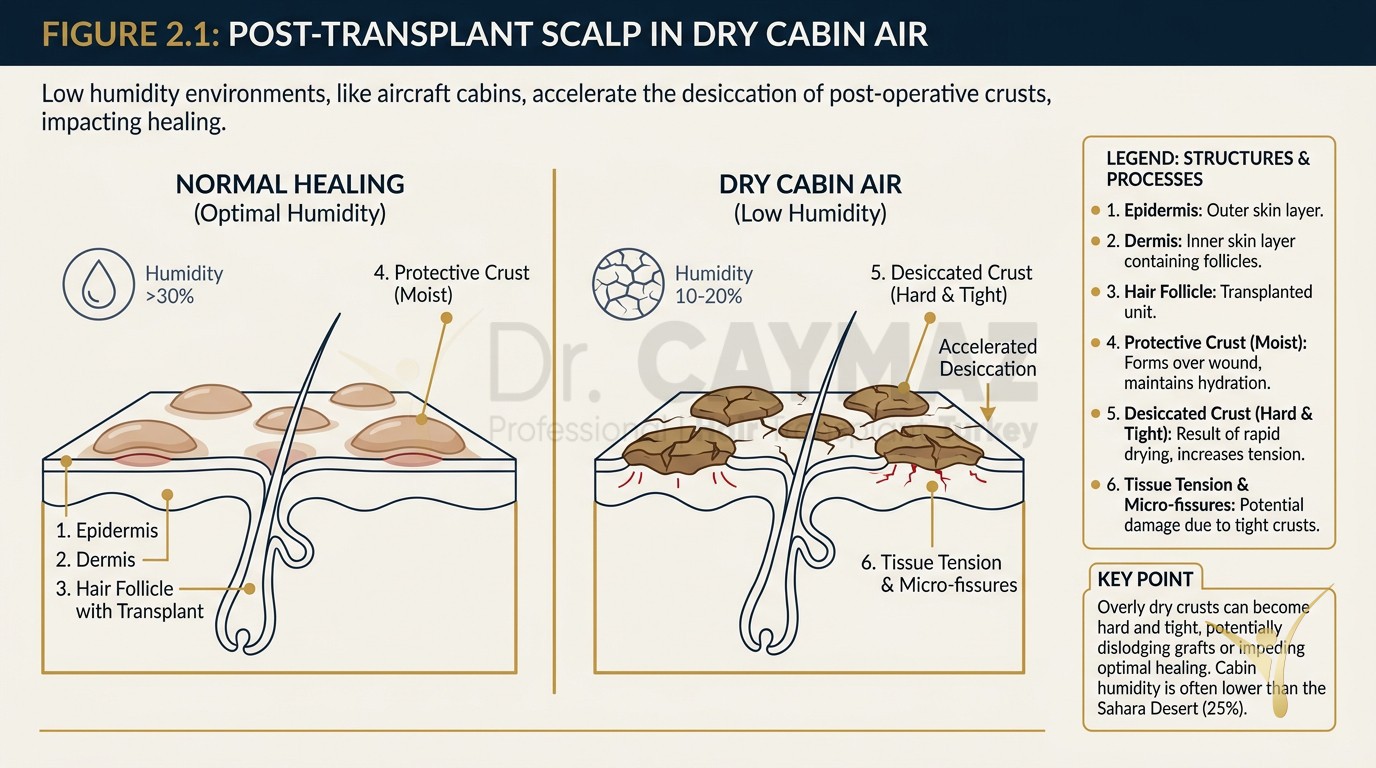
Aircraft cabin humidity sits between 10 and 20 %. For comparison, the Sahara Desert averages about 25 %. A freshly transplanted scalp has open micro-wounds that are forming protective crusts. In extremely dry air, those crusts can desiccate faster than normal, becoming hard and tight. Overly dry crusts are more likely to crack or catch on fabric, which raises the theoretical risk of disturbing a graft during the first 48–72 hours when anchorage is still weak.
The solution is straightforward. Carry a small spray bottle of sterile saline (0.9 % NaCl) and mist the recipient area lightly every 60–90 minutes during the flight. Don't soak the scalp; a fine mist is enough to keep crusts pliable. Avoid touching the grafts with your fingers or pressing a damp cloth directly onto the transplanted zone. Your clinic's aftercare instructions will specify when and how to begin gentle washing, usually 48–72 hours post-op. On the plane, saline mist is the safest interim measure.
Systemic dehydration compounds the problem. Cabin air pulls moisture from your respiratory tract and skin at a rate that can cause a net fluid loss of about 1.5 liters on an 8-hour flight if you don't actively drink water. Dehydrated blood is slightly more viscous, which can reduce microcirculation to the scalp. Aim for at least 250 mL of water per hour of flight. Skip alcohol entirely: it's a diuretic, and it also impairs sleep quality, doubling the negative effects during recovery.
When Is the Safest Time to Fly After a Hair Transplant?

| Flight duration | Time zones crossed | Minimum wait post-op | Preferred wait | Key concern |
|---|---|---|---|---|
| Under 3 hours | 0–2 | 24 hours | 48 hours | Mild pressure change; minimal jet lag |
| 3–6 hours | 2–4 | 48 hours | 3 days | Moderate swelling risk; manageable circadian shift |
| 6–10 hours | 4–7 | 3 days | 5 days | Significant jet lag; peak swelling window overlap |
| 10+ hours | 7–12 | 5 days | 7 days | Severe circadian disruption; prolonged cabin exposure; dehydration risk |
These windows aren't arbitrary. They're based on the biological timeline of graft stabilization. Within the first 24 hours, grafts sit in their channels held mainly by a fibrin clot, a fragile protein mesh. By 72 hours, early collagen fibers begin anchoring the graft more firmly. By day 5–7, the graft is embedded well enough that normal daily activities, including air travel, pose very little mechanical risk. Patients who need to understand the full step-by-step procedure can see how channel depth and graft placement affect this timeline.
If your travel schedule forces you to fly within 48 hours, it's not a disaster. Thousands of patients do it safely every year. But if you have the flexibility to stay an extra day or two, especially when facing a 10-hour-plus flight, the benefit to your comfort and healing is real.
Dr. Caymaz Insight
| I tell my international patients to plan at least two full nights in Istanbul after their procedure before boarding a long return flight. The reason is simple: the first post-operative wash, which I supervise personally, happens around 48 hours after surgery, and I want to inspect every graft under proper lighting before a patient spends 10 hours in a pressurized cabin. Patients who fly on day 3 or later consistently report less forehead swelling upon landing than those who leave on day 2. I also prescribe a specific hydration and head-elevation protocol for the flight itself, because I've seen too many patients arrive home with unnecessary edema simply because they slept flat on the plane. When a patient truly cannot extend their stay and must fly sooner than I would prefer, I am direct about the compromise: drink at least 3 liters of water per day from surgery day through landing, keep the head elevated whenever they sit or sleep, and mist the recipient zone with sterile saline during the flight. Extra hydration will not replace an additional recovery day, but for travelers with no flexibility on timing, it is the most practical step I can give them. |
Can You Reduce Jet Lag Before You Even Leave?
Sleep researchers have studied circadian pre-adaptation for decades, and the data is consistent: gradually shifting your sleep schedule before departure reduces the severity and duration of jet lag after arrival. The protocol is simple. For eastward travel (e.g., flying from the U.S. to Turkey), go to bed 30–60 minutes earlier each night for three nights before your flight. For westward travel, shift bedtime later by the same increment.
Light exposure is the strongest zeitgeber, the environmental cue that resets your circadian clock. On the morning before an eastward flight, get bright light exposure (sunlight or a 10,000-lux light box) as early as possible. This advances your melatonin onset, making it easier to fall asleep at the earlier local time when you arrive. On the evening before a westward flight, extend your light exposure later into the night.
Melatonin supplements (0.5–3 mg) taken 30 minutes before the target bedtime at your destination can accelerate re-entrainment by about half a day per dose. However, if your clinic has prescribed any post-operative medications, check for interactions first. The pre-operational instructions page covers medication timing in detail, and the same principles apply to the post-op period.
Caffeine is a double-edged tool. A single cup of coffee timed correctly (early morning at your destination's local time) can sharpen alertness and help anchor your new schedule. But caffeine consumed within 6 hours of your target bedtime will fragment sleep and worsen the very problem you're trying to solve.
What Should You Pack for the Flight Home?
Packing for a post-transplant flight is different from packing for a normal trip. Your carry-on should include a few specific items that protect your grafts and support recovery during the hours you'll spend in a pressurized, dry, cramped environment.
Travel neck pillow (U-shaped or donut style): This keeps your head upright and prevents your scalp from pressing against the headrest. Direct pressure on the recipient area during the first week can dislodge grafts or flatten channel angles.
Sterile saline spray: A 100 mL bottle fits within carry-on liquid limits for most airlines. Mist the recipient area every 60–90 minutes. Don't use tap water or mineral water sprays; the mineral content can leave residue on crusts.
Prescribed medications in original packaging: Anti-inflammatory tablets, antibiotics, and any prescribed pain relief should be in your hand luggage, not checked baggage. Lost luggage is an inconvenience; missing your antibiotic dose during the critical first week is a clinical concern. Keep every tablet in the original packaging your clinic gave you at discharge so customs and flight staff can identify them quickly.
A loose-fitting hat or headband: Some patients feel self-conscious about visible crusting or redness. A soft, clean hat that doesn't press on the grafts (baseball caps are too tight in the first week) can provide coverage without mechanical risk. A loose beanie or a wide surgical headband works well.
Electrolyte packets: Plain water is good. Water with a balanced electrolyte mix is better for maintaining hydration over a 10-hour flight, especially if you're also taking a mild diuretic like caffeine.
Does Altitude Affect Shock Loss Risk?
Shock loss, the temporary shedding of transplanted and sometimes native hairs that occurs 2–6 weeks post-surgery, is driven primarily by the trauma of graft extraction and implantation, not by environmental factors like altitude. There is no published evidence linking commercial flight altitude to an increased rate of shock loss. The follicle's decision to enter a temporary telogen (resting) phase is set in motion during the procedure itself, when the hair bulb experiences brief ischemia (reduced blood supply) during the time it spends outside the body.
That said, the cumulative stress of a long flight, including sleep deprivation, dehydration, and physical discomfort, can elevate cortisol levels. Chronically elevated cortisol is associated with telogen effluvium, a diffuse shedding pattern, in the general population. A single stressful flight won't trigger this. But if jet lag keeps you sleeping poorly for a full week after you get home, and you're also dealing with work stress and skipping meals, the aggregate physiological burden could theoretically nudge more native hairs into telogen. Patients concerned about shock loss mechanisms can review the detailed explanation for reassurance.
The practical takeaway: fly when your surgeon says it's safe, manage your jet lag aggressively once you land, and prioritize sleep during the first two weeks of hair transplant recovery. These steps won't eliminate shock loss (it's a normal part of the process for many patients), but they remove unnecessary stressors from the equation.
How Should You Handle the First Week at Home After a Long Flight?
Landing after a 10-hour flight with a 7-hour time zone shift means your body thinks it's 3 a.m. when your local clock says 10 p.m., or vice versa. The temptation is to crash into bed and sleep for 14 hours. Resist it. Oversleeping on arrival anchors your circadian clock at the wrong phase and prolongs jet lag by days.
Instead, follow a structured re-entry plan:
Day of arrival: Stay awake until at least 9 p.m. local time, even if you're exhausted. Get outdoor light exposure during the afternoon. Eat a protein-rich meal at your normal local dinner time. Take melatonin (if cleared by your surgeon) 30 minutes before your target bedtime. Sleep with your head elevated at 30–45 degrees, which you should be doing anyway during the first week post-transplant.
Days 2–4 at home: Wake at a consistent time each morning, ideally with bright light exposure within 15 minutes of waking. Perform your post-transplant hair washing routine at the same time each day to build a predictable schedule. Avoid naps longer than 20 minutes. Short naps can restore alertness without disrupting nighttime sleep; long naps reset your adenosine clock and make it harder to fall asleep at night.
Days 5–7 at home: Most patients find their sleep normalizes by this point if they've been disciplined about light exposure and meal timing. This also coincides with the period when post-operative swelling has fully resolved and crusts are beginning to shed naturally. Your scalp is entering a more stable phase of healing, and consistent sleep supports that transition. For a broader view of what to expect during this period, the long-term hair care guide covers the weeks and months ahead.
Are There Patients Who Should Avoid Long Flights Entirely?
Most healthy adults can fly safely within 3–5 days of a hair transplant. However, certain patient profiles warrant extra caution or a longer ground stay:
Patients with a history of deep vein thrombosis (DVT): Prolonged immobility during long flights increases DVT risk in the general population. Post-surgical patients have a mildly elevated baseline clotting tendency due to the inflammatory response. If you have a personal or family history of DVT, discuss compression stockings and in-flight movement protocols with your surgeon before booking your return flight.
Patients on blood-thinning medications: Some patients take aspirin or other anticoagulants for cardiovascular reasons. These medications are typically paused before surgery (as outlined in the pre-operative preparation guidelines) and resumed afterward. The timing of resumption relative to your flight matters, because anticoagulants can increase post-operative oozing, and the dry cabin air can cause dried blood to crack and flake visibly.
Patients with severe anxiety or claustrophobia: Stress and anxiety elevate cortisol and adrenaline, both of which constrict peripheral blood vessels and can impair microcirculation to the scalp. If flying triggers significant anxiety for you, consider a mild anxiolytic prescribed by your physician, or choose a seat with extra legroom to reduce the feeling of confinement.
Patients who had very large sessions (4,000+ grafts) may experience more pronounced swelling than those who had smaller procedures. The greater the number of recipient-site incisions, the more interstitial fluid accumulates. For these patients, waiting a full 5–7 days before a long flight is a reasonable precaution. You can explore how graft count is determined and why session size affects recovery intensity.
The bottom line is that flying after a hair transplant is safe for the vast majority of patients, provided they respect the minimum waiting period, stay hydrated, keep their head elevated, and take jet lag seriously as a recoverable but real physiological disruption. Your grafts are resilient. Your job is to give them the best possible environment to anchor, heal, and eventually grow.
Sources & clinical references
FAQ
Flying on the same day is not recommended. Grafts are held in place only by a fragile fibrin clot during the first 24 hours, and cabin pressure changes can worsen scalp swelling. A minimum of 24–48 hours on the ground is advised even for short flights under 3 hours.
Jet lag alone won't cause graft failure. However, the sleep disruption it causes can reduce growth hormone release during deep sleep, which supports tissue repair. Managing jet lag with light exposure, melatonin, and consistent sleep schedules helps optimize the healing environment.
Use a U-shaped neck pillow and keep your seat reclined at about 35–45 degrees. Avoid lying flat, even in business class, during the first five days post-surgery, as this can increase forehead and periorbital swelling.
Yes. Aircraft cabin humidity is only 10–20%, which can cause post-operative crusts to dry and harden prematurely. Misting the recipient area with sterile saline spray every 60–90 minutes during the flight keeps crusts pliable and protects the grafts.
The general rule is about one day of adjustment per time zone crossed. A patient flying from the U.S. East Coast to Istanbul (7-hour difference) may need 5–7 days to fully normalize sleep. Pre-shifting your bedtime by 30–60 minutes per night for a few days before departure can shorten this.
No. Alcohol is a diuretic that worsens dehydration in an already dry cabin environment. It also impairs sleep quality by suppressing deep slow-wave sleep, the phase most important for post-surgical tissue repair. Stick to water and electrolyte drinks.

Artas Robot System For Hair Transplantation
Robotic hair transplant marketing often leads patients to ask about the ARTAS robot system. ARTAS is a US-developed…
Read More: Artas Robot System For Hair Transplantation
Hair Transplantation Technology: A Review of Recent Advances
Hair-transplant technology has evolved in tools, workflow precision, and planning support, but innovation claims should…
Read More: Hair Transplantation Technology: A Review of Recent Advances
Hair Transplantation with Selenium, Zinc
Selenium and zinc support general hair follicle metabolism and immune function, but they are not substitutes for…
Read More: Hair Transplantation with Selenium, ZincFrequently Asked Questions
Professional Hair Transplant Insights by Dr. Erkam Caymaz