


Quick Numbers
| Implantation tool | DHI (Choi) pen |
|---|---|
| Donor area | Still shaved, as a window |
| Typical graft count | About 1,000–1,500 |
| Technique decided | Before the operation day |
| Final result | 12–18 months |
Key Takeaways
| "Unshaven" usually refers to the recipient area. The grafts are placed between your existing hairs with a DHI pen. |
| The donor area still has to be shaved for extraction, as a window sized to the number of grafts that the longer hair above can cover. |
| It works best for smaller areas: refining a hairline, adding density to early thinning, or treating women. |
| An unshaven session usually yields only about 1,000–1,500 grafts. Dr. Caymaz doesn't generally recommend it, but it can be done for a suitable patient who specifically asks for it. |
| Whether your case suits an unshaven plan is decided from your photos before the operation day. |
For many patients the hardest part of a hair transplant isn't the surgery, it's the shaved head afterwards. A short buzz cut tells colleagues, clients and family exactly what happened, and it can take weeks to grow out. That's why "unshaven hair transplant" has become such a common search.
The idea is real, but it's often oversold. This guide explains what can stay unshaven and what can't, who is a good candidate, and where the limits are. Knowing them in advance avoids disappointment on the operation day.
What is an unshaven hair transplant?
An unshaven hair transplant is a procedure in which the area receiving the grafts isn't shaved. The new grafts are placed between your existing hairs, which stay at their normal length and cover the treated area while it heals.
This is possible because of the DHI technique. With DHI, each graft is loaded into a fine implanter pen, known as a Choi pen, which creates the channel and places the graft in one movement. The narrow tip can be guided between standing hairs at the right angle without cutting them.
The word "unshaven" is used loosely in marketing, though. In almost every case it describes the recipient area only. Our article on DHI indications and limits explains when the pen is the right tool.
What still has to be shaved?
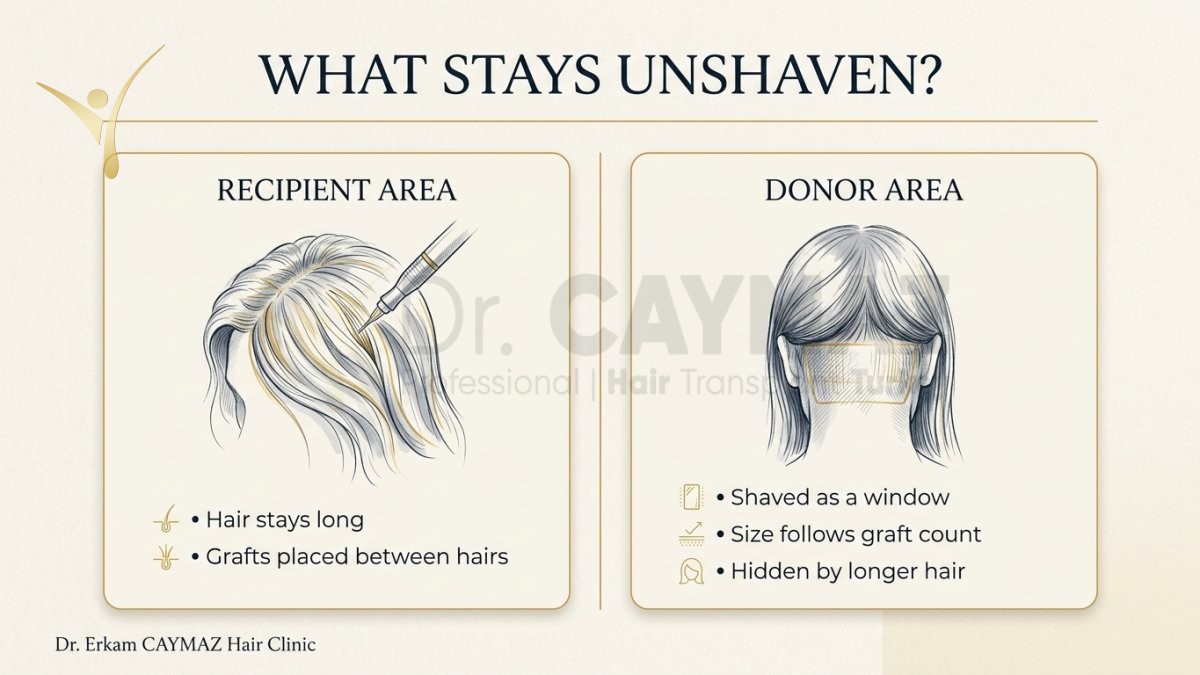
Grafts are taken from the donor area at the back and sides of the head, and each follicular unit is extracted individually with a fine punch. To do that accurately, the team needs to see the skin and the exit angle of every hair. Extracting through long hair is slow, less precise and risks damaging grafts.
For that reason the donor area is still shaved. We shave it as a window at the back of the head: a small, minimal window when only a few grafts are needed, and a wider one when the plan needs more. The longer hair above falls over it, so it isn't visible once you comb your hair down.
When you see a clinic advertise a completely unshaven procedure, ask exactly how the donor area will be handled. A plan that hides the donor work well is realistic. A plan that promises a large session with no shaving anywhere usually isn't.
How does unshaven implantation work?
Once the grafts have been extracted, they're loaded one by one into the DHI pens. The team places them between your existing hairs, following the natural direction and angle of the surrounding hair so the new hair blends in as it grows.
Working between long hairs takes more care and more time per graft than working on a shaved area. The team has to keep existing hair out of the way, avoid cutting it and keep each graft at the planned depth. That's one reason unshaven sessions are usually smaller than shaved ones.
In our clinic, Sapphire FUE is the standard technique for most patients, and DHI is planned for selected indications such as unshaven recipient work. DHI isn't a premium upgrade. It's a different tool that suits particular cases.
Who is a good candidate?
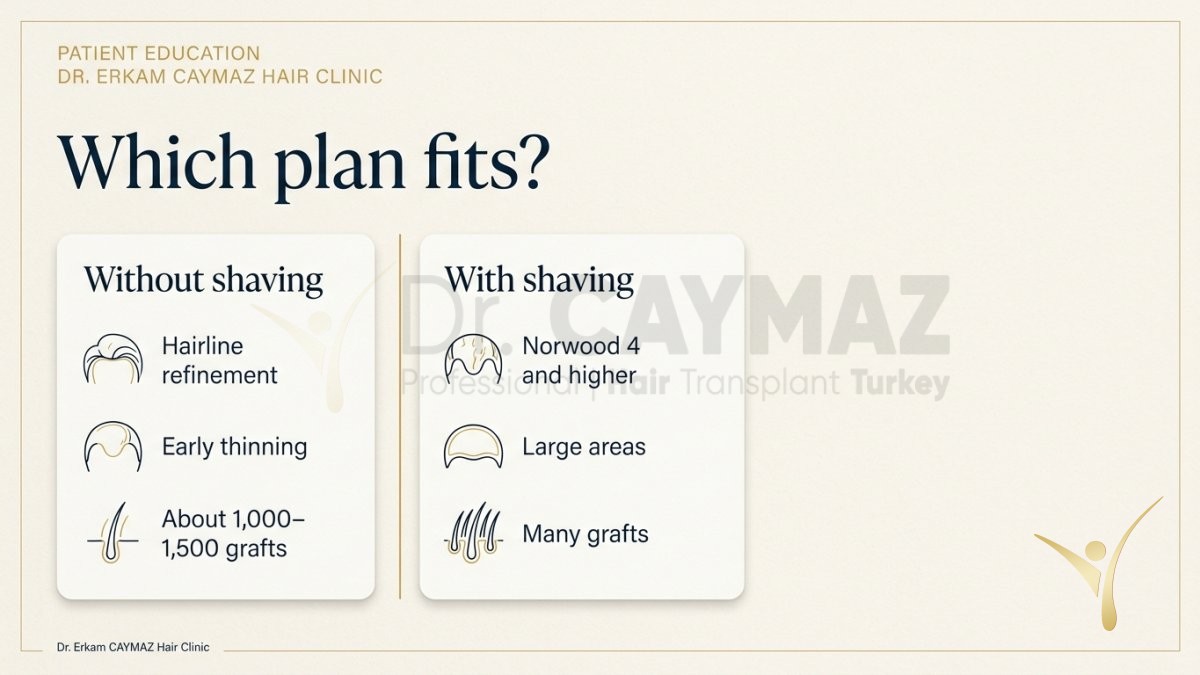
An unshaven plan tends to work well for:
- Hairline refinement. Adding a few hundred grafts to soften or slightly lower an existing hairline.
- Early thinning. Adding density between existing hairs at Norwood 2 or 3, where there's still plenty of native hair to cover the area.
- Women. Female hair loss is usually diffuse thinning along the part line, and most women don't want to shave. Our article on hair transplants for women covers this in detail.
- Patients who can't take visible time off. People with client-facing jobs who need the change to stay discreet.
- Small corrections. Filling a gap or refining an earlier result.
Your hair also needs to be long enough to cover the treated area and the shaved donor window. A few centimeters on top and at the back usually makes a big difference.
Shaven vs unshaven at a glance
| Factor | Shaven | Unshaven |
|---|---|---|
| Recipient area | Shaved short | Existing hair stays long |
| Donor area | Shaved | Shaved as a window sized to the graft count, hidden by longer hair |
| Session size | Suitable for large sessions | Best for smaller, selected zones |
| Visibility in the first weeks | Obvious | Discreet if hair is long enough |
| Main technique | Sapphire FUE | DHI pen |
| Best for | Norwood 4 and higher, large areas | Hairline refinement, early thinning, women |
What are the limits and risks?
The main limit is size. Because the donor window has to stay hidden under longer hair, an unshaven session usually yields only about 1,000 to 1,500 grafts. A large area needs a large number of grafts, and treating it without shaving makes it harder to place them evenly and densely. Patients at Norwood 4 or higher usually need at least two sessions, spaced at least six months apart, and those sessions are usually best done shaved.
The second point is the native hair. Working between existing hairs can cause temporary shock loss of some native hair around the grafts. It usually grows back over the following months, but in the first weeks the area may look a little thinner before it improves.
Finally, the result takes the same time as any transplant. The transplanted hairs shed in the weeks after surgery, new growth starts around the third month, and the final result takes 12 to 18 months.
Dr. Caymaz Insight
| I don't generally recommend an unshaven transplant. Keeping the donor window hidden under longer hair limits the session to about 1,000 to 1,500 grafts, which is rarely enough for real coverage. If a patient specifically asks for it and the case suits it, for example a hairline refinement or early thinning, we can do it. For a large bald area, shaving lets my technicians implant each graft at the planned angle and depth, and that matters more than a few weeks of short hair. We make this decision together before the operation day, and it doesn't change in the operating room. |
What will people notice after an unshaven transplant?
When the hair is long enough and the session is small, most people won't notice much. The existing hair covers the small crusts that form over each graft in the first week, and the donor window is hidden under the hair above.
The aftercare is the same as for any transplant. The donor bandage is removed and the first wash is done at the clinic on day 2, then you wash gently at home every day. Long hair needs a little extra care when washing and drying so it doesn't tug on the grafts. Avoid styling products, hats that press on the area and hair dryers on a hot setting until the grafts are anchored, at about day 10 to 14.
How is the decision made?
The technique isn't chosen on the operation day. Dr. Caymaz reviews your photos in advance and decides whether an unshaven plan fits your goals, your hair length and the number of grafts you need. If it does, the plan is fixed before you travel. If a shaved session would give you a clearly better result, he'll tell you why.
To find out whether you're a candidate, send clear photos of the front, top, crown and back of your head with your hair at its usual length, and mention that you'd prefer not to shave. You'll get an honest answer about what's possible in your case.
Scientific Sources
FAQ
Yes, for the recipient area. With the DHI technique, grafts are placed between your existing hairs, which stay at their normal length. The donor area at the back is still shaved, as a window sized to the number of grafts, so they can be extracted accurately.
Yes. The donor area is shaved so the team can see each hair's exit angle during extraction. We shave it as a window: minimal when only a few grafts are needed, wider when more are needed. The longer hair above covers it once you comb it down.
It suits smaller areas: refining a hairline, adding density to early thinning at Norwood 2 or 3, women with thinning along the part, and patients who need the change to stay discreet. Your hair also needs to be long enough to cover the treated area. An unshaven session usually yields about 1,000–1,500 grafts, so Dr. Caymaz recommends it mainly when a suitable patient specifically asks for it.
Usually not well. Large areas need many grafts, and placing them evenly between long hairs is harder. Patients at Norwood 4 or higher usually need at least two sessions spaced at least six months apart, and these are best done shaved.
Some native hair around the grafts can go through temporary shock loss. It usually grows back over the following months, but the area may look a little thinner for a few weeks before it improves.
No. DHI isn't a premium upgrade; it's a different tool that suits particular cases such as unshaven recipient work. Sapphire FUE remains our standard technique for most patients.
Before the operation day. Dr. Caymaz reviews your photos and decides whether an unshaven plan fits your goals, hair length and graft needs. The plan is fixed before you travel and isn't changed in the operating room.

Hair Transplantation and the Effect of Scalp Tissue
Scalp tissue quality influences extraction safety, implantation response, and cosmetic durability. Temporary donor…
Read More: Hair Transplantation and the Effect of Scalp Tissue
Why a 7000 Graft Hair Transplant Needs Two Sessions
A patient who needs roughly 7,000 grafts for full coverage is usually Norwood 7. That total cannot safely be done in…
Read More: Why a 7000 Graft Hair Transplant Needs Two Sessions
FUE Hair Transplant Recovery: Days 1–14 and Months 3–12
FUE hair transplant recovery has two clear phases. Days 1–14 focus on protecting grafts while micro-scabs form and…
Read More: FUE Hair Transplant Recovery: Days 1–14 and Months 3–12
How to Correct Failed or Unsuccessful Hair Transplants?
Correcting a failed hair transplant starts with diagnosis: poor growth, harsh angles, overharvested donor, or untreated…
Read More: How to Correct Failed or Unsuccessful Hair Transplants?Frequently Asked Questions
Professional Hair Transplant Insights by Dr. Erkam Caymaz