


Quick Numbers
| Standard lab panels | 6–8 tests (CBC, PT/INR, hepatitis, HIV, TSH, glucose) |
|---|---|
| Labs valid window | Within 30 days of surgery |
| Medication pause (blood thinners) | 7–10 days pre-op (physician approval) |
| VIP operations per day | 1–2 patients maximum |
| Overall success rate | 90–95 % |
Key Takeaways
| Every hair transplant consultation should include a structured blood panel, not just scalp photos. |
| Abnormal coagulation or uncontrolled blood sugar can postpone surgery until values normalize. |
| Thyroid dysfunction is a treatable cause of hair loss that must be ruled out before grafting. |
| Stopping aspirin, ibuprofen, and herbal supplements at least 7 days before surgery reduces intraoperative bleeding risk. |
| A thorough medical workup protects both graft survival and patient safety on the operating table. |
A 38-year-old patient sends scalp photos to a clinic, receives a graft count by WhatsApp, and books a flight the same week. No blood work. No medication review. No discussion of his daily aspirin for a cardiac stent. Scenarios like this happen more often than you'd think, and they put both the patient and the surgical outcome at risk. A proper hair transplant consultation goes beyond counting follicles and drawing a hairline. It's a medical workup: lab panels, a careful drug history, scalp examination, and an honest conversation about what surgery can and can't deliver. This article walks you through every test and checkpoint that should happen before you sit in the operating chair.
Why Does a Blood Test Before Hair Transplant Surgery Matter?

Hair transplant surgery is an outpatient procedure, but it still involves local anesthesia, thousands of micro-incisions, and a session that can last 6 to 8 hours. The scalp is one of the most vascular regions of the body. Even a minor coagulation abnormality can turn a routine extraction into a procedure complicated by persistent oozing, poor visibility, and compromised graft placement. Blood tests exist to catch these problems before the first punch touches skin.
Pre-operative labs also screen for infectious diseases that affect sterilization protocols and staff safety. Hepatitis B surface antigen (HBsAg), hepatitis C antibody (anti-HCV), and HIV antibody testing are standard in accredited surgical settings worldwide. A positive result doesn't automatically disqualify a patient, but it changes instrument handling, waste disposal, and post-operative monitoring. Clinics that skip this panel are cutting corners on safety, not streamlining your experience.
There's a clinical reason behind every tube of blood drawn. If you're evaluating hair transplant candidacy and eligibility factors, understand that candidacy goes beyond donor density. It's about whether your body can safely tolerate the procedure and heal properly afterward.
Which Blood Tests Are Ordered Before Surgery?
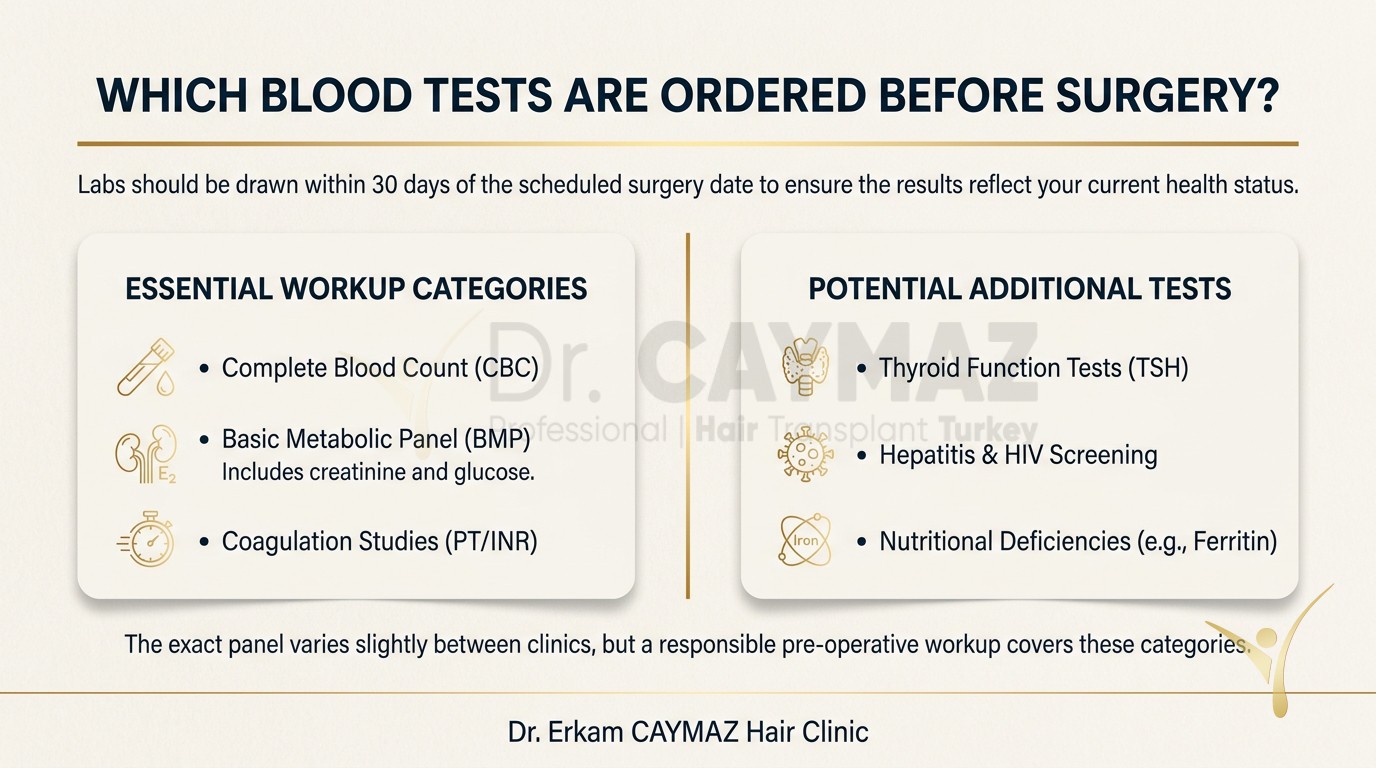
The exact panel varies slightly between clinics, but a responsible pre-operative workup covers the following categories. Labs should be drawn within 30 days of the scheduled surgery date to ensure the results reflect your current health status.
| Test | What It Measures | Why It Matters |
|---|---|---|
| CBC (Complete Blood Count) | Hemoglobin, hematocrit, WBC, platelets | Detects anemia, infection, clotting risk |
| PT / INR | Prothrombin time, international normalized ratio | Identifies coagulation disorders or anticoagulant effects |
| HBsAg | Hepatitis B surface antigen | Infection control and sterilization protocol |
| Anti-HCV | Hepatitis C antibody | Infection control |
| HIV Ab | HIV 1/2 antibody | Infection control, wound healing assessment |
| Fasting glucose | Blood sugar level | Uncontrolled diabetes impairs wound healing |
| TSH (Thyroid-Stimulating Hormone) | Thyroid function | Hypothyroidism causes diffuse hair loss |
| Ferritin (when indicated) | Iron stores | Low ferritin worsens hair shedding, especially in women |
Some surgeons also request a basic metabolic panel (BMP) that includes creatinine and electrolytes, particularly for patients over 50 or those with known kidney issues. If you're taking finasteride or dutasteride, liver function tests (ALT, AST) may be added. Patients with elevated hemoglobin or hematocrit need further evaluation because polycythemia increases clotting risk during any surgical procedure.
Thyroid screening deserves special attention. A TSH level outside the normal range of roughly 0.4 to 4.0 mIU/L can indicate hypothyroidism or hyperthyroidism, both of which cause diffuse thinning that mimics androgenetic alopecia. Transplanting grafts into a scalp where the underlying cause of loss is hormonal and untreated leads to continued shedding around the transplanted hairs, producing an unnatural, patchy look. The right move is to treat the thyroid condition first, stabilize the hair loss, and then reassess surgical candidacy.
What Medications Need to Be Stopped or Adjusted?

The medication review is one of the most overlooked parts of a hair transplant consultation. Patients often forget to mention over-the-counter supplements, assuming they don't count. They do. Here's a breakdown of what typically needs to change before surgery.
Blood thinners and anti-platelet agents. Aspirin, clopidogrel (Plavix), and warfarin all increase bleeding during extraction and incision-making. Aspirin should be stopped 7 to 10 days before surgery, but only with clearance from the prescribing physician. Patients on warfarin for atrial fibrillation or a mechanical heart valve can't simply stop their medication. In those cases, a bridging protocol with low-molecular-weight heparin may be arranged, or surgery may need to be postponed until a cardiologist confirms it's safe.
NSAIDs like ibuprofen and naproxen inhibit platelet aggregation and should be discontinued at least 7 days before the procedure. Acetaminophen (paracetamol) is generally safe and can be used for pain management in the days leading up to surgery.
Herbal supplements are a hidden risk. Ginkgo biloba, garlic extract, ginseng, vitamin E in high doses, and fish oil capsules all have mild anticoagulant properties. Patients should stop these at least 7 days pre-operatively. The full list of pre-operational instructions covers dietary and supplement adjustments in detail.
Minoxidil is usually paused 3 to 5 days before surgery because it's a vasodilator that can increase scalp bleeding. Finasteride and dutasteride, on the other hand, don't need to be stopped. They don't affect coagulation, and maintaining them helps protect existing native hair from further miniaturization.
Patients who smoke should stop at least 2 weeks before and 2 weeks after surgery. Nicotine constricts blood vessels and reduces oxygen delivery to the scalp, directly threatening graft survival. The clinical data on smoking and hair transplant outcomes is clear: smokers have higher rates of poor graft take and delayed healing.
How Is the Donor Area Evaluated During Consultation?
Blood tests tell you whether the body is ready for surgery. The donor evaluation tells you whether the scalp can supply enough grafts to meet realistic goals. These are two separate questions, and both must be answered before a graft count is finalized.
The standard donor zone sits in the occipital and parietal regions of the scalp, roughly between the ears and below the occipital ridge. This area contains follicles that are genetically resistant to DHT (dihydrotestosterone), the androgen responsible for pattern hair loss. A healthy donor zone has a density of approximately 60 to 80 follicular units per cm². Dr. Erkam Caymaz evaluates this density using magnification and considers the patient's hair caliber, curl pattern, and scalp laxity during the consultation.
Scalp laxity, the looseness of the skin, affects how easily follicles can be extracted without damaging neighboring grafts. A very tight scalp may limit the number of grafts that can be safely harvested in a single session. For patients classified as Norwood 4 or higher, the recommended approach is at least two sessions spaced a minimum of 6 months apart. Attempting to extract 5,000 or more grafts in a single sitting risks overharvesting, which permanently thins the donor area and leaves visible scarring. You can read more about donor area anatomy and safe extraction limits for a deeper understanding of why this matters.
The consultation should also assess whether the patient has any scarring, previous transplant work, or scalp conditions like seborrheic dermatitis that could affect extraction quality.
Dr. Caymaz Insight
| I review every patient's blood work personally before confirming a surgery date. If I see an INR above 1.5 or a fasting glucose over 250 mg/dL, we don't proceed until those numbers are controlled. I've postponed operations for patients who flew in from abroad because their labs revealed an undiagnosed thyroid problem that was actually causing their hair loss. It's not a popular decision in the moment, but it's the right one. The medical workup isn't a formality. It's the foundation that everything else, the hairline design, the graft count, the technique selection, is built on. |
What Happens If a Lab Result Comes Back Abnormal?
An abnormal result doesn't always mean cancellation. It means investigation. The response depends on which value is out of range and by how much.
Low hemoglobin (below 10 g/dL in men, below 9 g/dL in women) suggests anemia. Mild anemia can often be corrected with iron supplementation over 4 to 6 weeks, after which labs are repeated. Severe anemia requires a hematology referral before any elective surgery is considered. A patient who is anemic will have impaired oxygen delivery to the scalp, which directly affects wound healing and graft survival.
Elevated fasting glucose above 200 mg/dL, or an HbA1c above 8%, signals poorly controlled diabetes. Hyperglycemia impairs neutrophil function and delays collagen synthesis, both of which increase infection risk and slow recovery. Surgery is typically postponed until the patient achieves better glycemic control, ideally an HbA1c below 7%. Patients with well-managed diabetes can absolutely undergo hair transplant surgery, but the workup must confirm that management is actually in place. The clinical considerations for diabetes and hypertension patients are covered separately.
Abnormal coagulation (elevated PT/INR) may indicate a clotting disorder, liver disease, or the lingering effect of an anticoagulant that wasn't stopped early enough. If the INR is above 1.5, surgery carries a meaningful bleeding risk. The patient is referred back to their primary physician or hematologist for evaluation before rescheduling.
Positive infectious disease markers (HBsAg, anti-HCV, HIV) require confirmatory testing and, in some cases, viral load quantification. A patient with a suppressed HIV viral load on antiretroviral therapy, for example, can safely undergo surgery with appropriate precautions. The key is disclosure and preparation, not exclusion.
How Should Patients Set Realistic Expectations Before Surgery?
The consultation isn't just a medical screening. It's the moment where expectations are either calibrated correctly or left dangerously inflated. Patients who arrive with a photo of a celebrity's hairline and expect an identical result from 2,500 grafts are setting themselves up for disappointment, no matter how skilled the surgical team is.
Realistic expectation-setting involves several honest conversations. First, the surgeon explains the relationship between available donor supply and recipient demand. A Norwood 6 patient with a donor density of 65 FU/cm² simply doesn't have enough grafts to restore full coverage in one session. Promising otherwise is dishonest. Second, the patient needs to understand that transplanted hair goes through a shedding phase (shock loss) between weeks 2 and 6, followed by gradual regrowth starting around month 3 to 4. Final density isn't visible until 12 to 14 months post-surgery. The week-by-week recovery timeline helps patients understand what each stage looks like.
Third, the patient should know that native hair loss will continue in untreated areas. A transplant addresses the current pattern of loss. It doesn't prevent future recession. This is why many surgeons recommend medical therapy with finasteride or minoxidil alongside surgery, to slow ongoing miniaturization and protect the long-term result. The decision between starting medication or proceeding directly to surgery depends on the patient's age, rate of progression, and personal preferences.
Overall success rates for FUE hair transplant range from 90 to 95%, with graft survival reaching up to 98% under optimal conditions. But "optimal conditions" means proper lab clearance, correct technique, adequate donor supply, and disciplined aftercare. Skip any one of those, and the numbers drop.
What Does the Complete Pre-Op Checklist Look Like?
Pulling everything together, here's a structured checklist that a responsible surgeon-led clinic should work through before confirming your surgery date. Not every item applies to every patient, but the framework should be consistent.
Medical history review: chronic conditions (diabetes, hypertension, autoimmune disease), previous surgeries, known allergies (especially to lidocaine or epinephrine), family history of hair loss pattern and age of onset.
Current medication list: prescription drugs, over-the-counter medications, vitamins, herbal supplements, recreational substances. Every single one matters. Patients using cannabis should be aware of its effects on anesthesia response and graft survival.
Laboratory panel: CBC, PT/INR, HBsAg, anti-HCV, HIV antibody, fasting glucose, TSH. Ferritin and liver enzymes as indicated. Results must be less than 30 days old at the time of surgery.
Scalp and donor assessment: Norwood or Ludwig classification, donor density measurement, hair caliber evaluation, scalp laxity, presence of scarring or skin conditions. This is where the surgeon determines graft count, technique (Sapphire FUE or DHI), and whether one or two sessions are needed.
Hairline design discussion: The hairline is drawn during the consultation or on the morning of surgery, with the patient sitting upright. It accounts for facial proportions, age-appropriate positioning, and the patient's input. Dr. Caymaz personally designs every hairline, treating it as the architectural blueprint that defines the entire result.
Pre-operative instructions confirmed: medication adjustments, smoking cessation timeline, alcohol avoidance (48 hours minimum), caffeine restriction on surgery day, clothing recommendations (button-front shirt), and arrival logistics. The full pre-surgery preparation protocol should be provided in writing.
Informed consent: a signed document that covers the procedure, expected outcomes, potential complications (swelling, numbness, shock loss, infection), and the fact that results are never guaranteed at 100%.
Why Does the Quality of the Consultation Predict the Quality of the Result?
There's a pattern in revision cases. Patients who had poor results almost always describe a consultation that was rushed, incomplete, or handled entirely by a sales coordinator rather than a physician. No blood tests were requested. No medication review happened. The graft count was decided from a single photo. The hairline was drawn by a technician five minutes before surgery started.
A thorough consultation takes time. It requires a physician who understands not just the surgery but the medicine behind it: endocrinology, hematology, dermatology, pharmacology. When a clinic limits itself to 1 to 2 VIP operations per day, there's room for that level of attention. When a clinic runs 8 to 10 procedures daily, the math simply doesn't allow it. Each patient gets a fraction of the surgeon's focus, and the medical workup is the first thing that gets abbreviated.
The consultation is also where the surgeon-patient relationship begins. You should feel comfortable asking questions, pushing back on a graft count that seems too high, or requesting a second opinion. If the clinic pressures you to book immediately, that's a red flag, not a limited-time offer. The full transplant process starts well before the operating room, and the consultation is where the foundation is laid.
Patients who invest time in the medical workup, who get their labs done early, who disclose every medication and supplement, who ask hard questions about donor limits, are the patients who tend to have the best outcomes. Not because they're luckier, but because they're better prepared. And in elective surgery, preparation is the variable you can actually control.
Sources & clinical references
FAQ
Blood tests should be completed within 30 days of your scheduled surgery date. Getting them done 2 to 3 weeks before gives enough time to address any abnormal results without delaying the procedure.
It depends on the medication and the reason you're taking it. Aspirin and NSAIDs are typically stopped 7 to 10 days before surgery. Prescription anticoagulants like warfarin require clearance from your prescribing physician, and a bridging protocol may be needed. Never stop blood thinners on your own.
Fasting glucose above 200 mg/dL or HbA1c above 8% usually means surgery is postponed until glycemic control improves. Uncontrolled diabetes impairs wound healing and increases infection risk. Once values are stabilized, typically HbA1c below 7%, surgery can be rescheduled.
No. Finasteride and dutasteride do not affect blood clotting or anesthesia. Most surgeons recommend continuing these medications to protect existing native hair from further miniaturization during the recovery period.
Both hypothyroidism and hyperthyroidism can cause diffuse hair thinning that resembles androgenetic alopecia. If thyroid dysfunction is the underlying cause of your hair loss, transplanting grafts won't solve the problem. The condition needs to be treated first, and hair loss reassessed after thyroid levels normalize.
Not necessarily. A positive result triggers confirmatory testing and may require viral load assessment. Patients with well-managed HIV on antiretroviral therapy or stable hepatitis can often undergo surgery with modified sterilization and monitoring protocols. The key is full disclosure so the surgical team can prepare appropriately.
Yes. Supplements like ginkgo biloba, garlic extract, ginseng, high-dose vitamin E, and fish oil have mild blood-thinning effects. Stop all herbal supplements at least 7 days before surgery to reduce the risk of excessive bleeding during the procedure.
A thorough consultation typically takes 30 to 60 minutes. It includes medical history review, medication assessment, scalp and donor evaluation, hairline design discussion, and expectation setting. Consultations that last only 5 to 10 minutes are unlikely to cover the necessary medical workup.
Ferritin testing is not universal but is commonly ordered for female patients and for anyone with suspected iron-deficiency anemia. Low ferritin (below 30 ng/mL) is associated with increased hair shedding and should be corrected with supplementation before proceeding with surgery.
Yes, and this is actually preferred. Getting labs done at home 2 to 3 weeks before travel allows time to address any abnormalities. Bring the original lab reports with you. The clinic may repeat specific tests on arrival if results are borderline or older than 30 days.
A typical panel covers CBC, clotting studies, hepatitis B/C, HIV, thyroid markers, and glucose. Clinics may add ferritin or other labs when history or exam suggests a need.
Not always. Some findings mean delay, medical clearance, or a modified plan. Uncontrolled infection risk, unsafe clotting status, or unstable metabolic disease can postpone surgery until safer.
It overlaps with general labs but focuses on anesthesia safety, bleeding risk, infection screening, and thyroid or glucose issues that affect healing and candidacy before graft placement.

What Happens During a FUE Hair Transplant Day?
A FUE hair transplant procedure typically spans 6 to 8 hours in a single day. The morning begins with blood work, scalp…
Read More: What Happens During a FUE Hair Transplant Day?
Receding Hairline vs Crown Thinning: Surgical Plans
A receding hairline and crown (vertex) thinning are driven by the same hormone, DHT, but they demand different surgical…
Read More: Receding Hairline vs Crown Thinning: Surgical Plans
Will I Feel Pain During Hair Transplantation?
Pain during hair transplantation is one of the first questions patients ask, and one of the most misunderstood. Modern…
Read More: Will I Feel Pain During Hair Transplantation?
Temple Hair Transplant for Natural Hairline
Temple restoration can improve facial framing when direction and graft selection are highly controlled. The area is…
Read More: Temple Hair Transplant for Natural HairlineFrequently Asked Questions
Professional Hair Transplant Insights by Dr. Erkam Caymaz