


Quick Numbers
| Megasession threshold | ≥ 4,000 grafts in one sitting |
|---|---|
| Max out-of-body graft time | 4–6 hours (chilled saline) |
| Safe single-session ceiling (our clinic) | Up to ~4,500 grafts, case-dependent |
| Minimum gap between sessions | 6 months |
| Overall graft survival (skilled team) | Up to 98 % |
Key Takeaways
| A megasession isn't automatically better; donor health and graft viability set the real ceiling. |
| Norwood 4 and above patients benefit from two planned sessions rather than one aggressive extraction. |
| Team design matters: surgeon-led incisions, dedicated extraction technicians, and separate implantation staff keep graft out-of-body time short. |
| Overharvesting in a single megasession can leave permanent moth-eaten patches in the donor zone. |
| Graft survival drops measurably once follicles sit outside the body longer than 4 to 6 hours. |
A Norwood 5 patient sends photos over WhatsApp and asks: "Can you do 6,000 grafts in one day so I only fly to Istanbul once?" It's one of the most common requests clinics receive, and the honest answer is almost always no, not safely. The term megasession hair transplant refers to any FUE or FUT procedure that extracts roughly 4,000 or more grafts in a single sitting. Some clinics advertise 5,000, 6,000, even 7,000 grafts in one day. The numbers sound efficient. But every graft removed is a graft the donor zone can never regenerate, and every hour those follicles sit on a tray is time their survival rate ticks downward. This article explains where the real graft ceiling sits, what makes a surgical team safe at high counts, and why splitting sessions often produces a better lifetime result.
What Exactly Counts as a Megasession?
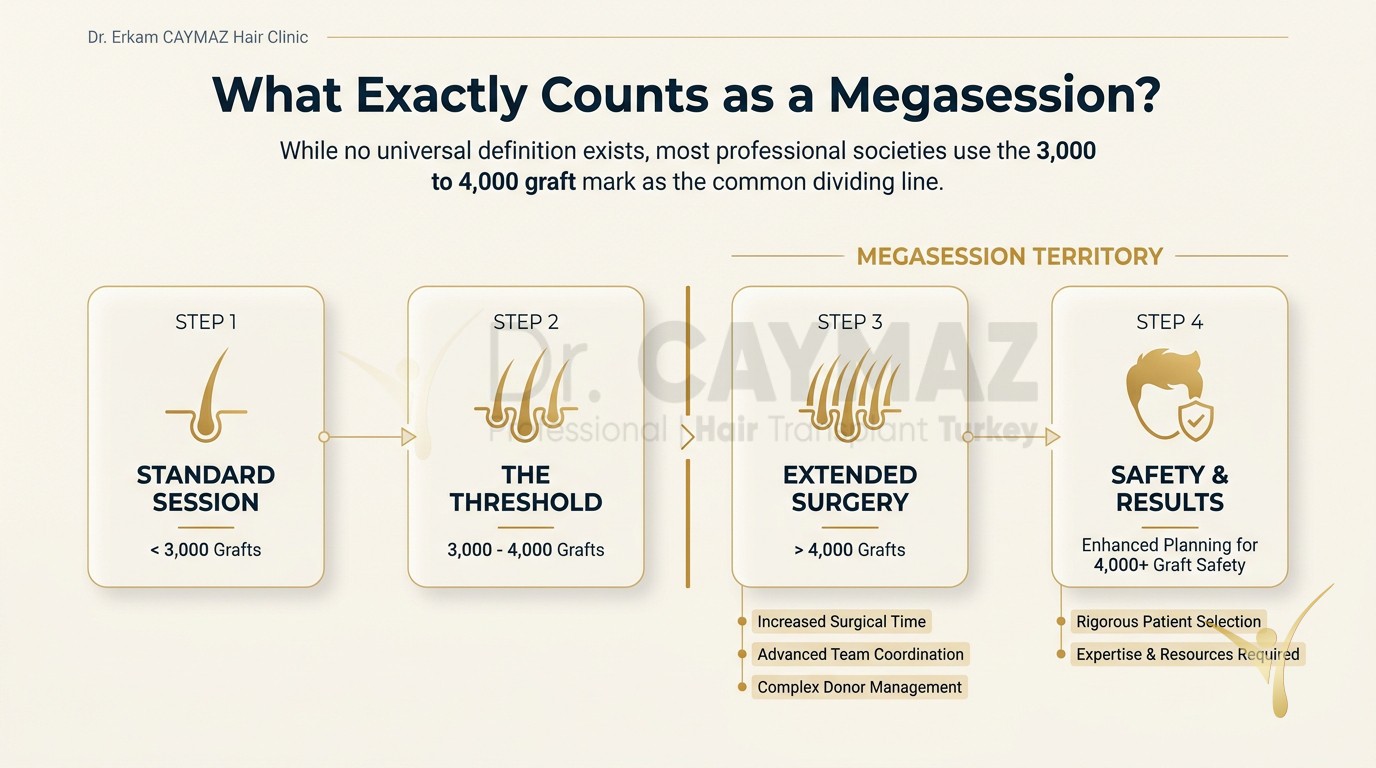
There's no universal definition locked into a textbook, but most hair restoration societies use the 3,000 to 4,000 graft mark as the dividing line. Below that range, the procedure is a standard session. Above it, the operation enters megasession territory, where surgical time, team coordination, and donor management all become more demanding. A typical Sapphire FUE session of 2,500 to 3,500 grafts already takes 6 to 8 hours. Push past 4,000 and you're looking at 8 to 10 hours of continuous work, sometimes longer.
The appeal is obvious: one flight, one recovery period, one round of post-op care. But the human scalp isn't a warehouse with unlimited inventory. The occipital donor strip, the band of DHT-resistant hair running between the ears, contains a finite number of follicular units, typically between 6,000 and 8,000 extractable grafts over a patient's lifetime. Pulling half of that supply in a single morning changes the math for every future procedure. Understanding donor area anatomy is the first step toward realistic expectations.
Why Does Donor Safety Limit Graft Count?
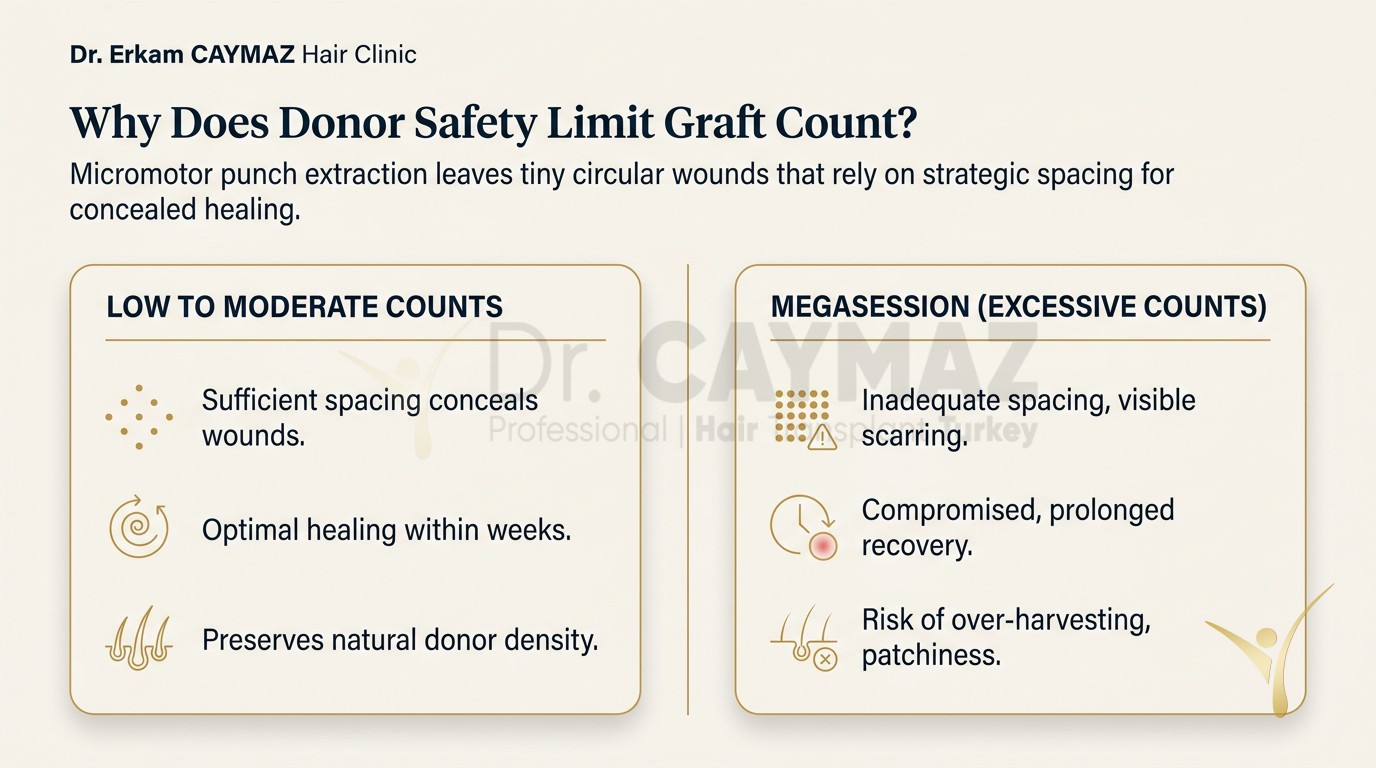
Every follicular unit extracted with a 0.8 to 0.9 mm micromotor punch leaves a tiny circular wound in the donor zone. At low to moderate counts, these micro-wounds are spaced far enough apart that surrounding hair conceals them within weeks. Extract too many in one session, though, and the spacing shrinks. The result is a condition called overharvesting: visible thinning, moth-eaten patches, or scarring across the back and sides of the head. Once the donor zone is depleted, no technique can restore it.
Donor density varies from person to person. A patient with 80 follicular units per cm² has more room than someone with 55 FU/cm². Scalp laxity, hair caliber, and the ratio of single-hair to multi-hair grafts all factor in. Dr. Caymaz evaluates these variables during the initial consultation, using magnified photography to map extractable zones before any graft number is quoted. Patients with weak or thin donor areas face tighter limits, and pushing past those limits for the sake of a single-session megasession is a trade-off that rarely favors the patient long term.
You can read a detailed breakdown of what happens when extraction exceeds safe thresholds in our discussion of overharvesting risks.
How Long Can Grafts Survive Outside the Body?

This is the variable most megasession advertisements ignore. Once a follicular unit is separated from its blood supply, a biological clock starts. Grafts stored in chilled saline or a holding solution like Hypothermosol remain viable for roughly 4 to 6 hours. Beyond that window, cellular metabolism slows to a point where survival rates begin to drop. Published data from the International Society of Hair Restoration Surgery (ISHRS) show measurable declines in graft take when out-of-body time exceeds 6 hours.
In a standard 3,000-graft session, the first grafts extracted might wait 3 to 4 hours before implantation. That's within the safe zone. Scale up to 5,000 or 6,000 grafts and the earliest-extracted follicles could be sitting on a tray for 7, 8, even 9 hours. No amount of chilled solution fully compensates for that delay. The math is simple: more grafts per session means longer out-of-body time for the first batch, and that directly threatens the survival rate you're paying for.
Skilled teams mitigate this by staggering extraction and implantation, a workflow design we'll cover below. But there's a physical ceiling to how much staggering can compress the timeline when a single patient needs thousands of incisions and thousands of placements in one day.
How Should a Surgical Team Be Designed for High Graft Counts?
Team structure is what separates a safe megasession from a risky one. In a surgeon-led VIP model, the division of labor follows a clear hierarchy. The surgeon handles consultation, hairline design, and recipient-site incisions, the steps that determine angle, depth, direction, and density. Expert surgical technicians perform extraction and implantation under the surgeon's direct supervision. An assisting nurse manages local anesthesia, also under supervision. This isn't a shortcut; it's how high-quality clinics maintain precision across 6 to 10 hours of continuous work.
The danger arises in high-volume "hair mill" clinics that run 5 to 10 operations per day. In those settings, a single doctor may bounce between rooms, spending 15 minutes on each patient's hairline before moving on. Technicians handle everything else unsupervised. Graft counts climb because speed, not safety, drives the schedule. You can review how team composition affects outcomes.
| Factor | Surgeon-Led VIP (1–2 ops/day) | High-Volume Mill (5–10 ops/day) |
|---|---|---|
| Surgeon involvement | Full-day: consultation, hairline, incisions, supervision | Brief visit per room; technician-driven |
| Extraction | Expert technicians, surgeon-supervised | Technicians, often unsupervised |
| Implantation | Dedicated implantation technicians, staggered batches | Same staff, sequential workflow |
| Graft out-of-body time | Minimized by staggered extraction/implantation | Often 6–9+ hours for early grafts |
| Max safe graft count | Case-dependent, typically up to ~4,500 | Advertised 5,000–7,000, safety variable |
| Donor assessment | Magnified mapping, conservative extraction | Aggressive extraction to hit promised number |
| Patients per day | 1–2 | 5–10+ |
At our clinic, Dr. Erkam Caymaz personally performs the consultation, planning, hairline design, and VIP incisions for every patient. With only 1 to 2 operations per day, the entire team stays focused on a single case for the full duration. That structure is what allows safe execution at higher graft counts when the donor zone supports it. You can see how this clinic structure differs from volume-driven models.
When Should a Megasession Be Split Into Two Sessions?
For patients classified as Norwood 4 or above, the recommendation at our clinic is clear: plan at least two sessions, spaced a minimum of 6 months apart. The reasoning is both biological and strategic.
Biologically, the donor zone needs time to heal. Each extraction site forms a tiny scar that contracts over 3 to 4 months. Extracting 5,000+ grafts before those scars mature risks overlapping wounds, increased transection rates on the second pass, and visible thinning that no hairstyle can hide. Six months gives the scalp time to recover, lets the surgeon reassess density, and allows the first session's transplanted hair to begin growing so the second session can fill remaining gaps with precision.
Strategically, splitting sessions protects your future. A 35-year-old Norwood 5 patient who burns through 5,500 grafts in one sitting may have almost nothing left for touch-ups at age 50 when native hair continues to thin. Two sessions of 3,000 to 3,500 grafts each, separated by at least half a year, distribute the donor load and leave a reserve. Our detailed discussion of why 7,000 grafts require two sessions walks through the arithmetic in full.
There's also a practical comfort factor. A 10-hour surgery is exhausting for the patient. Sitting motionless while local anesthesia is periodically refreshed, maintaining hydration, managing bathroom breaks: these aren't trivial concerns. Two 6-hour sessions are physically easier to tolerate than one marathon day.
Dr. Caymaz Insight
| I've seen too many patients arrive for revision work after another clinic plans a single-session ceiling of about 5,000–5,500 grafts when the donor allows in a single day. The recipient area might look acceptable, but the donor zone tells the real story: patchy, scarred, and depleted beyond repair. In my practice, I cap single-session counts based on what the individual donor can safely give, not what the patient requests. For Norwood 4 and above, I almost always recommend two sessions. The six-month wait feels long, but it's the difference between a result that lasts decades and one that creates a new problem. Planning is among the most critical steps in any transplant, and nowhere is that more true than in high-graft cases. |
How Do You Calculate Your Personal Graft Ceiling?
Your graft ceiling isn't a fixed number printed on a chart. It's a calculation that accounts for at least five variables: donor density (follicular units per cm²), scalp laxity, hair shaft diameter, the single-to-multi-hair graft ratio, and the total recipient area that needs coverage. A patient with fine, low-density donor hair and a Norwood 6 pattern might have a lifetime ceiling of 5,000 extractable grafts. Someone with thick, dense donor hair and a Norwood 3 pattern could safely yield 7,000 or more across two sessions.
The consultation phase is where these numbers get pinned down. Magnified scalp photography, density measurements, and an honest conversation about long-term hair loss progression all feed into the plan. Our graft estimation overview explains the formula in patient-friendly terms. The key point: any clinic that quotes you a graft number before examining your donor zone is guessing, and guessing at 4,000+ grafts can cause irreversible harm.
Patients with borderline donor reserves sometimes ask about body hair transplantation (BHT), using chest or beard hair to supplement scalp grafts. While technically possible, body hair has different growth cycles, caliber, and curl patterns. It's a backup option, not a primary strategy, and it doesn't change the fundamental ceiling imposed by your scalp donor zone. You can review donor density requirements for a deeper look at what constitutes a strong versus weak donor.
What Risks Increase as Graft Count Climbs?
Every surgical procedure carries risk. In a standard 2,500-graft FUE, those risks are well-managed and statistically low. As graft counts climb past 4,000, several risk factors amplify:
Transection rate. Transection means the punch cuts through a follicle instead of around it, destroying the graft. Fatigue increases transection rates. A technician who has been extracting for 8 straight hours will not perform identically to how they performed in hour 2. Published studies report transection rates of 3 to 7% in standard sessions; in prolonged megasessions without team rotation, that figure can climb above 10%.
Graft desiccation. Even with chilled saline, grafts left on trays too long begin to dry at the edges. Desiccation, the loss of moisture from exposed tissue, is one of the leading causes of poor graft survival. Keeping grafts submerged and rotating batches into the recipient area in stages is the primary defense.
Recipient-site trauma. Creating 4,000+ incision channels in the recipient scalp causes cumulative tissue swelling. Excessive swelling compresses blood vessels, reducing oxygen delivery to newly placed grafts. Epinephrine in the local anesthetic helps control bleeding, and firm gauze pressure manages hemostasis, but there's a threshold beyond which the tissue simply can't accommodate more channels without compromising the grafts already placed.
Post-operative side effects like swelling, numbness, and shock loss, the temporary shedding of existing native hair near the transplant zone, also tend to be more pronounced after high-graft sessions. You can review the full spectrum of potential side effects to understand what's normal versus what warrants concern.
Does Technique Choice Affect Megasession Safety?
Sapphire FUE is the default standard at our clinic and the surgeon's general preference for most cases, including higher-count sessions. The V-shaped sapphire blade used for recipient-site channels creates narrower, more precise incisions than steel, which reduces tissue trauma and promotes faster healing. In a megasession context, that precision matters more, not less, because the cumulative effect of thousands of channels amplifies any difference in blade quality.
DHI, which uses a Choi implanter pen to combine incision and placement into one step, is reserved for selected indications such as dense-packing into existing hair or small-area touch-ups. It isn't a premium upgrade over Sapphire FUE, and its per-graft speed is generally slower, making it less practical for sessions above 3,000 grafts. The technique is always decided during the planning phase based on WhatsApp or email photos, never switched on surgery day. For a side-by-side comparison, see our DHI versus Sapphire FUE breakdown.
The broader principle is that technique alone doesn't determine safety at high graft counts. A skilled team using Sapphire FUE with proper graft handling will outperform a less experienced team using any technique. As the saying goes in hair restoration: there's no good technique, only good surgeons and well-coordinated teams.
What Should You Ask Before Agreeing to a Megasession?
If a clinic proposes 4,000 or more grafts in a single day, you should ask pointed questions before signing anything. These aren't confrontational; they're the same questions any responsible surgeon would welcome.
"How many operations does the surgeon perform per day?" A surgeon running 5 to 10 cases daily cannot give each patient the attention a megasession demands. At our clinic, the answer is 1 to 2 VIP operations per day, roughly 15 patients per month. That volume allows full surgeon involvement from start to finish.
"What is my donor density, and how was it measured?" If the clinic can't show you a magnified density reading, the graft number they've quoted is a guess. Density should be measured in follicular units per cm², ideally at multiple points across the donor band.
"How will you manage graft out-of-body time?" The answer should involve staggered extraction and implantation, chilled holding solution, and a team large enough to keep the workflow moving without bottlenecks.
"What happens if you can't safely extract the promised number?" Ethical clinics stop when the donor zone signals it's had enough, even if that means falling 500 grafts short of the plan. Clinics that guarantee a fixed number regardless of intraoperative findings are prioritizing their marketing promise over your scalp health. Our donor-density balance discussion covers this decision-making process in detail.
A Realistic Timeline for High-Graft Patients
Patients who need 5,000 to 7,000 total grafts should plan for a two-session timeline. Here's what that typically looks like:
Month 0: First session, 3,000 to 4,000 grafts depending on donor capacity. Hairline and frontal zone are usually prioritized because they frame the face and deliver the most visible improvement. The procedure steps are identical to a standard session; only the graft count is higher.
Months 1 to 5: Recovery, shedding phase, and early regrowth from session one. Shock loss peaks around weeks 3 to 6, then new growth begins around month 4. During this period, the donor zone heals and density stabilizes.
Month 6 or later: Second session, targeting the crown, mid-scalp, or areas that need additional density. By now, the surgeon can see how session one is growing in and adjust the plan accordingly. The donor zone has had time to recover, and extraction can proceed from slightly different coordinates to avoid overlapping with first-session punch sites.
Month 12 to 18: Final results from both sessions are visible. Overall success rates for well-planned two-session cases run between 90 and 95%, with graft survival reaching up to 98% when handling and out-of-body time are optimized.
This timeline requires patience, but it protects the donor zone, maximizes graft survival, and gives the surgeon two opportunities to refine density and coverage. Patients who want to understand the full recovery arc can review our week-by-week recovery milestones.
The Bottom Line on Megasession Safety
A megasession hair transplant can be safe when the donor supports it, the team is structured correctly, and graft out-of-body time stays under 6 hours. But "can be safe" is not the same as "is always safe." The patients who get the best lifetime results are the ones who resist the urge to do everything in one day and instead trust a staged plan built around their individual anatomy.
If you're a Norwood 4 or above, two sessions of 3,000 to 4,000 grafts will almost always outperform a single session of 6,000. You'll keep more donor reserve for the future, your grafts will spend less time outside your body, and your surgical team won't be fighting fatigue in hour 9. The graft ceiling isn't a number you should try to hit. It's a number you should respect.
Sources & clinical references
FAQ
Most hair restoration professionals define a megasession as any procedure extracting 4,000 or more grafts in a single sitting. Some sources set the threshold at 3,000, but the clinical concerns around donor safety, graft out-of-body time, and team fatigue become most relevant above 4,000.
It depends entirely on the patient's donor density, scalp laxity, and the surgical team's capacity. For most patients, especially Norwood 4 and above, extracting 5,000 to about 5,000–5,500 grafts in a single session when the donor allows risks overharvesting the donor zone and extends graft out-of-body time beyond safe limits. Two sessions spaced at least 6 months apart are generally safer and produce better long-term results.
Once a follicular unit is removed from the scalp, it loses its blood supply. Grafts stored in chilled saline remain viable for roughly 4 to 6 hours. In a megasession, the first grafts extracted may sit on a tray for 7 to 9 hours before implantation, which measurably reduces their survival rate.
Overharvesting occurs when too many follicular units are extracted from the donor zone, leaving visible thinning, moth-eaten patches, or scarring. The donor area has a finite supply of grafts, typically 6,000 to 8,000 over a lifetime. A single megasession that takes 5,000+ grafts can deplete this reserve and leave no options for future procedures.
A well-structured megasession team includes the surgeon for consultation, hairline design, and recipient-site incisions, plus dedicated extraction technicians and separate implantation technicians working under the surgeon's supervision. An assisting nurse handles local anesthesia. This division of labor keeps graft out-of-body time short and reduces fatigue-related errors.
Dr. Caymaz performs high-graft sessions up to approximately 4,500 grafts when the patient's donor zone supports it. For patients needing 5,000 or more total grafts, he recommends splitting the work into two sessions at least 6 months apart to protect donor health and maximize graft survival.

Afro-American Hair Transplantation from Hair Upload
Afro-textured hair transplants need curved-follicle extraction, slower punch work, and donor-safe density planning…
Read More: Afro-American Hair Transplantation from Hair Upload
Hair Transplant Recovery Timeline: Week-by-Week Milestones
Hair transplant recovery follows predictable milestones: scabs clear in days 10–14, shock loss peaks in weeks 3–6, and…
Read More: Hair Transplant Recovery Timeline: Week-by-Week Milestones
Can Both Beard and Hair Transplantation Be Performed in the Same Session?
Beard and hair transplant can often be performed in the same FUE session when donor density supports both zones without…
Read More: Can Both Beard and Hair Transplantation Be Performed in the Same Session?
High Hemoglobin and Hematocrit Before Hair Transplant
Elevated hemoglobin or hematocrit values on pre-operative blood work don't automatically disqualify you from hair…
Read More: High Hemoglobin and Hematocrit Before Hair TransplantFrequently Asked Questions
Professional Hair Transplant Insights by Dr. Erkam Caymaz