


Quick Numbers
| Typical start | After early healing |
|---|---|
| Goal | Adjunct recovery support |
| Not a substitute | Core aftercare protocol |
| Review | Individual tolerance |
Key Takeaways
| Laser caps are adjunct tools, not graft anchors. |
| Start timing should follow clinic clearance. |
| Aftercare compliance matters more than devices. |
| Results vary by baseline biology. |
Key Takeaways
| Earliest Safe Window: 14–28 Days Post-Op. |
| Risk During Days 1–10: Graft Displacement. |
| LLLT Wavelength Range: 650–670 nm (Red Light). |
| FDA Clearance Scope: Androgenetic Alopecia Only. |
One of the most common questions patients ask within the first week after an FUE hair transplant is whether they can start using their laser cap right away. The reasoning makes sense on the surface: if low-level laser therapy (LLLT) stimulates hair follicles, wouldn't it help newly transplanted grafts grow faster? The short answer is no, not yet. During the first 10 to 14 days, each graft sits in a tiny incision channel that hasn't fully sealed. Any device that presses against the scalp, traps heat, or creates friction can shift those grafts before they anchor. Understanding the biology behind this waiting period, and knowing exactly when a laser cap becomes safe, will help you protect your investment without missing out on a tool that may benefit you later.
What Does a Laser Cap Actually Do to the Scalp?
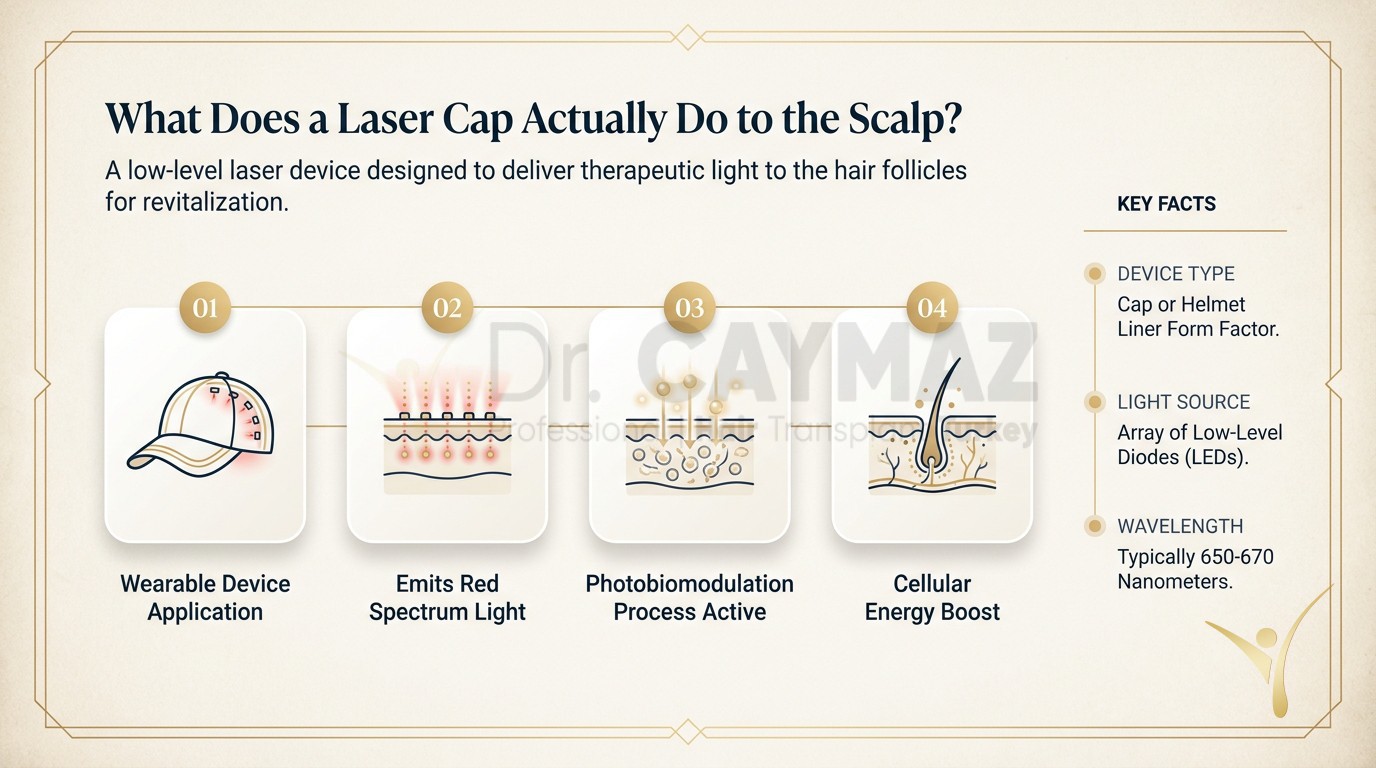
A laser cap is a wearable device, usually shaped like a baseball cap or helmet liner, that contains an array of low-level laser diodes or LEDs. These diodes emit light in the red spectrum, typically between 650 and 670 nanometers. The proposed mechanism is called photobiomodulation: photons of light are absorbed by cytochrome c oxidase in the mitochondria of hair follicle cells, which may increase adenosine triphosphate (ATP) production and promote cellular metabolism. In simpler terms, the light is thought to give follicle cells a small energy boost.
Several FDA-cleared laser caps exist on the market. It's worth understanding what that clearance actually means. The FDA has cleared certain LLLT devices specifically for the treatment of androgenetic alopecia, the genetic pattern of hair loss driven by dihydrotestosterone (DHT). This clearance does not extend to post-surgical wound healing, graft survival enhancement, or transplant recovery acceleration. The distinction matters because marketing language often blurs these boundaries, leaving patients to assume that a device good for hair loss must also be good for transplant recovery.
Published studies on LLLT for androgenetic alopecia show modest improvements in hair count. A 2014 randomized controlled trial reported an increase of roughly 17 hairs per cm² over 26 weeks in the treatment group compared to sham. That's a real but limited effect on existing miniaturized follicles. Transplanted grafts are a different biological scenario entirely.
Why Can't You Wear a Laser Cap Immediately After FUE?
| Phase | Focus |
|---|---|
| Week 0–2 | Protect grafts first |
| After clinic clearance | Consider adjunct LLLT |
| Month 3+ | Track with photos |

The first 10 days after FUE surgery represent the most vulnerable phase for transplanted grafts. Each follicular unit has been extracted from the donor area and placed into a recipient site incision that's roughly 0.6 to 1.0 mm in diameter. During the initial 48 to 72 hours, the graft is held in place primarily by the clotting mechanism, a tiny fibrin plug that forms around the base of the follicle. Over the next 5 to 7 days, early collagen fibers begin to anchor the graft more securely. Full vascular reconnection, where blood vessels grow into the transplanted tissue, takes approximately 7 to 10 days.
A laser cap introduces three specific risks during this window:
Physical contact and pressure. Even a lightweight cap rests against the scalp. In the recipient zone, where hundreds or thousands of grafts sit in shallow channels, downward pressure can dislodge grafts that haven't yet anchored. This is the same reason surgeons advise against wearing hats that press tightly on the transplanted area during the first week.
Friction during placement and removal is another concern. Sliding a cap on and off requires movement across the scalp surface. Scabs that form over each graft site can catch on fabric or device surfaces, pulling grafts out of position.
Thermal accumulation. While individual LLLT diodes produce minimal heat, a cap worn for 20 to 30 minutes creates a warm, enclosed environment. Elevated local temperature can increase swelling and inflammation in tissue that's already in an acute healing state. The scalp after FUE already experiences edema, and adding even mild thermal stress isn't clinically justified.
Dr. Caymaz Insight
| I treat laser caps as optional support after the wound-healing window, never as a replacement for washing discipline and sleep positioning in week one. |
When Is It Safe to Start Using a Laser Cap?

The timeline depends on individual healing, but most surgeons set the earliest starting point at 14 days post-operatively, with many preferring to wait until day 21 to 28. The milestones that need to be met before a laser cap is appropriate include:
- All scabs in the recipient area have shed naturally through the post-transplant washing protocol
- The skin surface appears smooth, with no open micro-wounds or crusting
- Normal hair washing is comfortable, without tenderness or bleeding
- Any post-operative swelling has fully resolved
If you still see scattered scabs at day 14, that's a signal to wait longer. Scabs indicate that the epithelial layer hasn't closed over the graft site, and placing a device on top of open tissue introduces infection risk on top of the mechanical concerns already discussed.
Some patients heal faster than others. Younger patients, non-smokers, and those who follow their aftercare instructions closely tend to reach the scab-free stage sooner. Patients with diabetes, those on blood thinners, or smokers may need an extra week or two.
Does LLLT Actually Improve Hair Transplant Results?
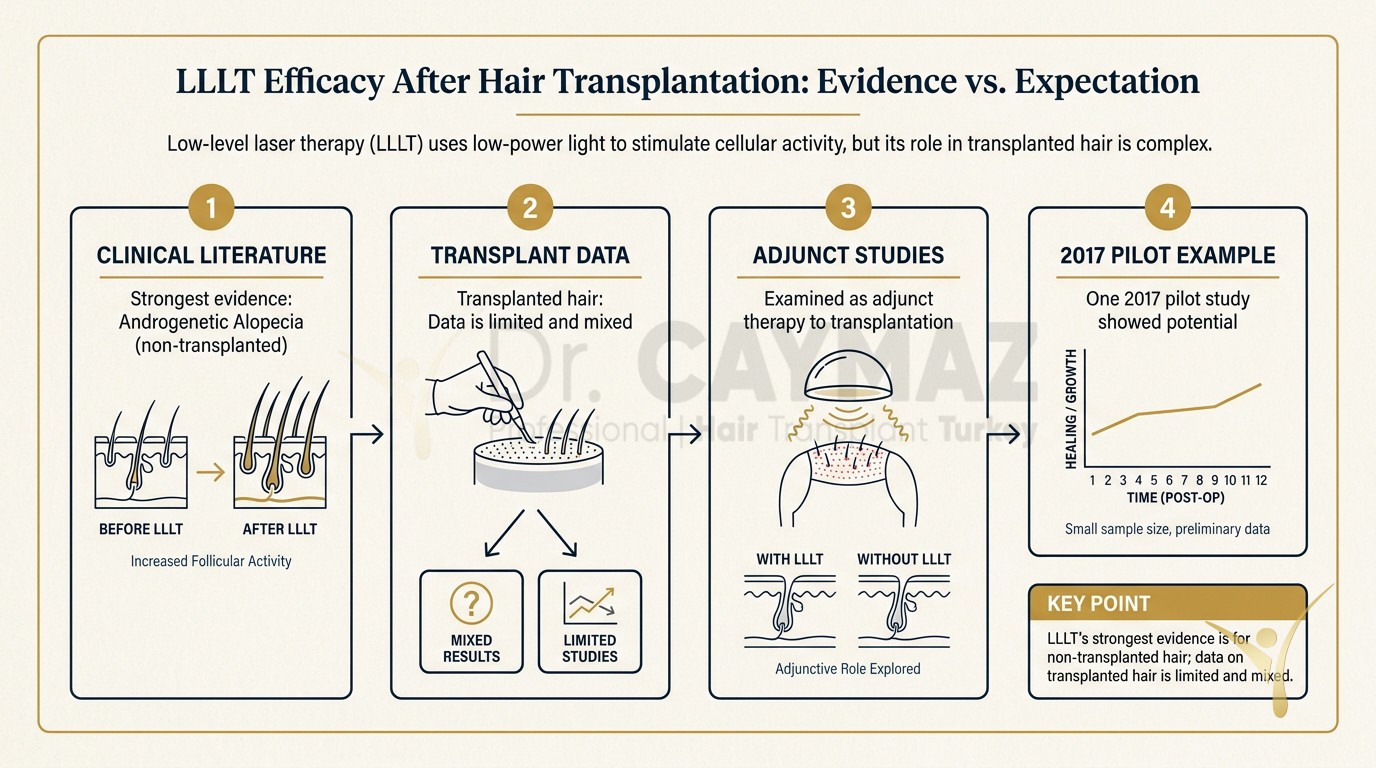
This is where patients need to separate evidence from expectation. The clinical literature on LLLT is strongest for androgenetic alopecia in non-transplanted scalps. For transplanted hair specifically, the data is limited and mixed.
A small number of studies have examined LLLT as an adjunct to hair transplantation. One 2017 pilot study suggested that LLLT applied starting at 24 hours post-transplant reduced erythema (redness) and may have shortened the shedding phase. However, the study had a small sample size, no long-term follow-up beyond 6 months, and hasn't been replicated in a large randomized trial. Another study from 2019 found no statistically significant difference in graft survival rates between LLLT and control groups at 12 months.
What we can say with reasonable confidence is that LLLT doesn't appear to harm transplanted grafts once healing is complete. It may offer a modest benefit in supporting the native (non-transplanted) hairs surrounding the transplant zone, particularly if those hairs are miniaturizing due to androgenetic alopecia. This is actually where a laser cap's value may lie for transplant patients: not in boosting the transplanted grafts themselves, but in helping preserve the existing hair around them.
Patients who are also using finasteride or minoxidil after their transplant may find that LLLT can be a complementary tool in their broader hair maintenance strategy. But it's a secondary tool, not a primary one.
What About Laser Caps Marketed Specifically for Post-Transplant Use?
Several companies now market laser caps with claims about "accelerating transplant recovery" or "boosting graft survival." These claims deserve scrutiny. As of 2024, no laser cap has received FDA clearance or approval specifically for improving hair transplant outcomes. The clearances that exist are for androgenetic alopecia treatment in non-surgical patients.
This doesn't mean the devices are fraudulent. It means the marketing has outpaced the evidence. A device cleared for pattern hair loss may indeed emit the correct wavelength and power density to stimulate follicle metabolism. But "stimulating follicle metabolism" in a stable, rooted follicle is a very different proposition from "improving survival of a freshly transplanted graft that hasn't yet established blood supply."
When evaluating any post-transplant product or device, ask two questions. First, is there a peer-reviewed, randomized controlled trial showing benefit specifically in transplant patients? Second, does my surgeon recommend it based on clinical experience with actual patient outcomes? If the answer to both is uncertain, the device falls into the "probably harmless once healed, but unproven for transplant-specific benefit" category.
How Should You Use a Laser Cap Once You're Cleared?
If your surgeon gives the green light, typically around weeks 3 to 4, here's what a reasonable protocol looks like. Most manufacturer guidelines suggest 20 to 30 minutes per session, three times per week. The cap should sit comfortably without pressing down hard on any area. If you feel pressure points, adjust the fit or use a model with a looser design.
Consistency matters more than intensity. Using the cap daily won't double the results. The photobiomodulation effect appears to follow a dose-response curve with diminishing returns, and some animal studies suggest that excessive light exposure can actually inhibit rather than promote cellular activity. Stick to the recommended schedule.
Don't expect visible changes from the laser cap alone within the first few months. The transplanted hairs will go through their own timeline: shock shedding around weeks 3 to 6, a dormant phase from months 2 to 4, and gradual regrowth starting around month 4 to 5. The laser cap won't accelerate this biological clock. What it may do, over 6 to 12 months of consistent use, is provide a small supportive effect on the native hairs in and around the transplanted zone.
Keep the device clean. Wipe the diode surface with a soft cloth before each use. A dirty cap pressed against a healing scalp is an invitation for bacterial buildup, even after the initial wound closure phase is complete.
Are There Better Alternatives During the Early Recovery Period?
If you're eager to support your grafts during the first two weeks, the most evidence-backed approach is simply following your surgeon's aftercare protocol precisely. That means gentle washing on the schedule provided, avoiding direct sun exposure, sleeping at the recommended elevation, and staying away from alcohol, smoking, and strenuous exercise.
Some clinics offer PRP (platelet-rich plasma) therapy as a post-transplant adjunct. PRP involves drawing a small amount of your blood, concentrating the platelets, and injecting the concentrate into the scalp. Unlike a laser cap, PRP doesn't require physical contact with the graft surface, as it's delivered via injection beneath the skin. Some studies suggest PRP may improve graft survival and reduce the duration of shock shedding, though the evidence base is still developing.
Topical minoxidil is another option some surgeons introduce after the initial healing phase, usually around week 2 to 4. Minoxidil is a vasodilator that increases blood flow to the scalp, and it has a stronger evidence base for hair growth than LLLT. Your surgeon will advise on the exact timing based on your healing progress.
The point is that a laser cap isn't the only, or even the strongest, tool available. It fits into a broader long-term hair care strategy that may include medication, PRP, proper nutrition, and scalp hygiene.
Common Mistakes Patients Make with Laser Caps After Surgery
Starting too early. This is the most frequent error. Patients read online forums where someone claims they used their cap on day 5 "with no problems." The absence of an obvious problem doesn't mean grafts weren't compromised. Graft displacement can be subtle, affecting density in ways that only become apparent months later when growth patterns emerge unevenly.
Treating the laser cap as a substitute for medication is another mistake. LLLT and finasteride or minoxidil work through completely different mechanisms. LLLT targets cellular energy production at the follicle level. Finasteride blocks the conversion of testosterone to DHT systemically. Minoxidil improves local blood flow. These aren't interchangeable, and dropping a proven medication in favor of a laser cap alone is likely to result in continued hair loss over time.
Expecting the cap to "save" a poorly executed transplant is unrealistic. If graft placement was too shallow, if the angle was wrong, or if the follicles were damaged during extraction, no amount of light therapy will fix those issues. The foundation of a good result is surgical technique, and everything else is supplementary.
Finally, some patients buy cheap, uncleared devices from overseas marketplaces. These products may not deliver the correct wavelength or power density, and some emit light outside the therapeutic range entirely. If you're going to invest in a laser cap, choose one that has genuine FDA clearance (not just "FDA registered," which is a much lower bar) and comes from a manufacturer that publishes its technical specifications.
Putting It All Together: Where Does a Laser Cap Fit?
A laser cap is a reasonable, low-risk addition to your post-transplant care once the initial healing phase is complete. It's not a first-line treatment. It's not a replacement for surgical skill, proper aftercare, or proven medications. And it's certainly not something to place on a scalp full of fresh, unanchored grafts.
The safest approach is straightforward. Protect your grafts completely during weeks 1 and 2. Confirm with your surgeon that your scalp has healed adequately before introducing any device. Begin laser cap sessions around weeks 3 to 4 if cleared, using the manufacturer's recommended protocol. Continue consistently for at least 6 months to give the therapy a fair trial. And always view the laser cap as one component of a multi-pronged strategy that includes medical therapy, good nutrition, and disciplined scalp care.
If you're unsure about your individual timeline, a quick photo sent to your surgeon's team can clarify whether your scalp is ready. That 30-second check is worth far more than any assumption based on a calendar date alone.
The first nights after surgery are when mechanical dislodgement risk is highest; sleep elevation and gentle washing matter more than expensive serums. Follow the written schedule even when crusts look unsightly. Deviating early can silently reduce yield. Step-by-step graft care is outlined in how to care for hair transplant grafts.
Recovery quality depends less on a single product than on consistent washing, sleep position, sun protection, and avoiding friction. Deviating from the written protocol is a common reason for crust retention or graft trauma. Keep a simple log of wash times and any symptoms to discuss at follow-up. Our aftercare checklist summarizes the non-negotiable steps.
Finasteride may protect non-transplanted native hair from continued miniaturization, improving long-term blend around grafts. It is not appropriate for every patient and requires medical supervision. Starting or stopping around surgery dates should be coordinated with your prescriber. Timing questions are addressed in finasteride after hair transplantation.
Sources & clinical references
FAQ
No. During the first 10 to 14 days after FUE, grafts are held in place only by a fragile fibrin clot and early collagen fibers. A laser cap creates pressure, friction, and mild heat against the scalp, all of which can dislodge grafts before they anchor. Most surgeons require a minimum wait of 14 days, with many preferring 21 to 28 days.
No laser cap has received FDA clearance specifically for improving hair transplant outcomes or accelerating graft healing. Existing FDA clearances apply only to the treatment of androgenetic alopecia (pattern hair loss) in non-surgical patients. Marketing claims about transplant recovery benefits are not supported by the device's regulatory status.
The earliest safe window is typically 14 days post-operatively, but only if all scabs have shed, the skin surface is smooth, and washing is comfortable. Many surgeons prefer to wait until days 21 to 28. Always confirm with your surgeon before starting any device-based therapy.
Current evidence does not show that LLLT accelerates the growth timeline of transplanted grafts. Transplanted follicles follow a biological cycle of shock shedding (weeks 3 to 6), dormancy (months 2 to 4), and gradual regrowth (starting around month 4 to 5). A laser cap may offer modest support to native, non-transplanted hairs in the surrounding area, but it won't speed up the transplanted hair's growth clock.
No. LLLT, finasteride, and minoxidil work through entirely different mechanisms. Finasteride blocks DHT production systemically, minoxidil improves local blood flow, and LLLT targets cellular energy production at the follicle level. Dropping a proven medication in favor of a laser cap alone is likely to result in continued hair loss over time. These therapies are complementary, not interchangeable.
Using a laser cap too early risks graft displacement, increased inflammation, and potential infection if the skin surface hasn't fully closed. Graft displacement may not be immediately obvious but can result in uneven density or poor growth patterns that only become visible months later during the regrowth phase.

Male Pattern Baldness Stages: Medication vs Surgery Thresholds
Male pattern baldness follows a predictable Norwood staging pattern. Early stages (Norwood 2–3) often respond well to…
Read More: Male Pattern Baldness Stages: Medication vs Surgery Thresholds
Balance Between Hair Transplantation Density Without Damaging the Donor Area
Patients often ask how many grafts they can receive in one session. The better question is how many grafts the donor…
Read More: Balance Between Hair Transplantation Density Without Damaging the Donor Area
Hairline Design: The Key to a Natural-Looking Hair Transplant
Frontal hair transplant planning separates believable results from “obvious transplant” under bathroom lighting. The…
Read More: Hairline Design: The Key to a Natural-Looking Hair Transplant
Hair Mill in Turkey: Avoiding Risky Clinics
A hair mill runs too many transplant cases with too little surgeon oversight. Warning signs include fixed graft quotes…
Read More: Hair Mill in Turkey: Avoiding Risky ClinicsFrequently Asked Questions
Professional Hair Transplant Insights by Dr. Erkam Caymaz