


Quick Numbers
| Micro-scab shedding | Days 10–14 post-op |
|---|---|
| Donor soreness peak | Days 2–3, resolves within 7 days |
| Recipient redness | Fades over 4–8 weeks |
| First visible growth | Months 3–4 |
| Final density | Month 10–12 |
Key Takeaways
| Micro-scabs are protective crusts around each graft site; picking them off risks dislodging grafts before they anchor. |
| Donor area discomfort is usually mild and manageable with standard analgesics, not narcotics. |
| The first clinic wash at our practice is on day 2 post-op, which begins the gentle scab-softening process. |
| Shock loss, a temporary shedding of transplanted and sometimes native hairs, peaks around weeks 3–6 and is not a sign of failure. |
| Graft survival rates can reach up to 98% when post-operative care instructions are followed carefully. |
Three days after your FUE procedure, you look in the mirror and see hundreds of tiny dark dots across the recipient area, a tender donor zone at the back of your head, and maybe some puffiness around your forehead. Is this normal? For the vast majority of patients, yes. Understanding what each of these signs means, and when each one resolves, is the single best way to reduce anxiety during FUE hair transplant recovery. This article walks through the specific tissue-level events that happen in the first two weeks and then across the following months, with a focus on two concerns patients ask about most: micro-scab behavior and donor area soreness.
What Are Micro-Scabs and Why Do They Form After FUE?

Each follicular unit extracted during FUE (follicular unit extraction) is placed into a tiny recipient channel made with a V-shaped sapphire blade. The blade creates a slit roughly 1.0–1.3 mm long, and the graft sits just below the skin surface. Within hours, blood plasma and platelets seal the opening. By 24–48 hours, that seal hardens into a small crust, the micro-scab.
These crusts aren't debris. They're biological dressings. Each one protects the graft underneath while the surrounding tissue forms new capillary connections, a process called neovascularization. Disturbing a scab before the graft has anchored, usually before day 7, can physically pull the follicle out of its channel. That's why the washing protocol matters so much in the first week.
Scab color varies. Fresh crusts look dark red or maroon. Over the next few days they dry to a brownish or yellowish tone. By days 10–14, most scabs have softened and fallen away during gentle washing. If a few stubborn ones remain at day 14, continued gentle soaking usually clears them by day 16–17. You can review the full post-transplant washing steps for the exact technique.
When Does the First Wash Happen and How Does It Help?
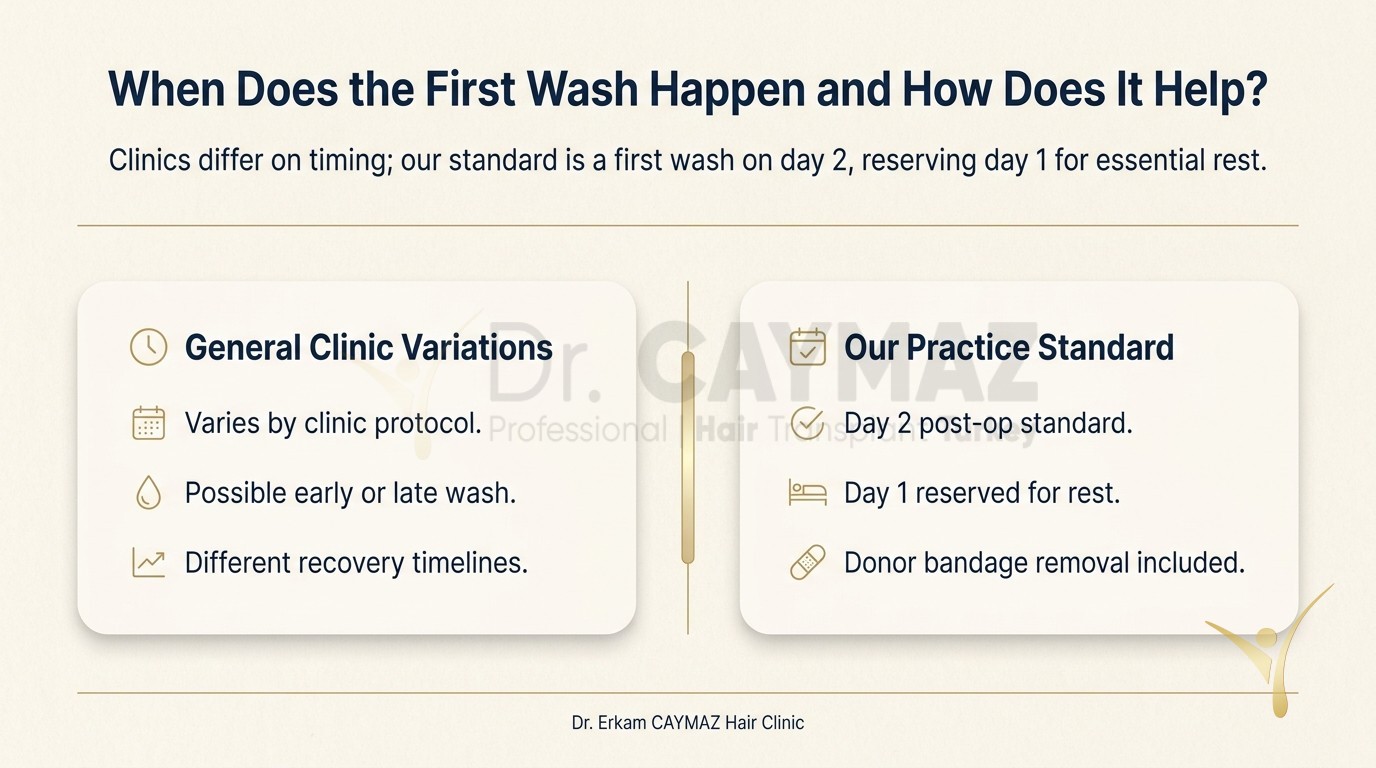
Clinics differ on first-wash timing. At our practice, the standard is a first clinic wash on day 2 post-op, with day 1 reserved for rest. So if your operation is on a Monday, you rest Tuesday, and your first wash is Wednesday. During this wash, the donor bandage is also removed. The recipient area is left uncovered from the moment you leave the operating room; only the donor site gets a bandage.
Some clinics perform the first wash on day 1. We haven't seen that cause problems, but we prefer day 2 because it gives the initial fibrin clot an extra 24 hours to stabilize. The wash itself uses a gentle medical lotion applied with an open palm, never fingertips or nails. Water pressure should be low. The goal isn't to remove scabs on day 2; it's to begin softening them gradually.
From day 2 onward, patients wash daily at home following the same technique. By about day 7–8, you can start applying slightly more pressure with your fingertips in a circular motion. This accelerates scab loosening without endangering grafts, because by that point the follicles have formed enough tissue attachment to resist gentle mechanical force. The full aftercare protocol covers each daily step in detail.
How Long Does Donor Area Soreness Last?

The donor zone, typically the occipital region between the ears, is where each graft was extracted using a micromotor punch 0.8–0.9 mm in diameter. Hundreds or thousands of these tiny cylindrical wounds are left behind. They don't require stitches; each one is small enough to close on its own through secondary intention healing.
Soreness peaks around days 2–3. Most patients describe it as a sunburn-like tightness rather than sharp pain. Standard over-the-counter analgesics, typically paracetamol or ibuprofen, are enough for the majority of cases. Narcotic painkillers are rarely needed. You can read about the medications used during and after surgery for a full list.
By day 5–7, most donor discomfort has resolved. Numbness or a mild tingling sensation can linger for 2–4 weeks in some patients because superficial sensory nerve branches in the scalp are temporarily disrupted during extraction. Full sensation returns as those nerves regenerate. The tiny extraction dots themselves heal with pinpoint scars that are virtually invisible once the surrounding donor hair grows back over them, usually within 2–3 weeks.
Patients sometimes worry about a "moth-eaten" look in the donor area. When extraction is performed conservatively, respecting safe donor density limits, the remaining hair conceals the extraction sites well. Overharvesting, taking too many grafts from a limited area, is the real risk. That's one reason Dr. Caymaz recommends at least two sessions spaced a minimum of 6 months apart for patients at Norwood 4 and above, rather than attempting a single mega-session of 5,000+ grafts. You can review donor area management in a separate article.
What Does the Recipient Area Look Like During Weeks 1–2?
The recipient zone goes through several visible changes in the first 14 days. Here's a day-by-day overview of what to expect:
| Timeframe | Appearance | What's Happening |
|---|---|---|
| Day 0 (surgery day) | Pinkish-red scalp, visible grafts, slight oozing | Grafts seated in channels; fibrin clot forming |
| Days 1–2 | Dark red crusts forming; mild swelling possible | Micro-scabs harden; first clinic wash on day 2 |
| Days 3–5 | Forehead swelling may peak (gravity pulls fluid down); scabs darken | Neovascularization begins; grafts anchoring |
| Days 6–8 | Swelling resolves; scabs turning brown/yellow | Gentle fingertip washing can start; grafts secure |
| Days 9–11 | Scabs loosening and shedding during washes | Underlying skin healing; redness still present |
| Days 12–14 | Most scabs gone; short transplanted hairs visible; pink/red skin | Epithelial closure nearly complete |
Forehead swelling deserves a note. It happens in roughly 30–40% of patients, especially those who received grafts in the frontal hairline. The swelling isn't at the graft sites themselves; it's caused by the tumescent fluid (saline with a local anesthetic) that was injected during surgery. Gravity pulls this fluid downward over 48–72 hours, sometimes reaching the brow or upper eyelids. It looks alarming but resolves on its own within 2–3 days. Sleeping with your head elevated at 45 degrees and applying a cold compress to the forehead (never directly on grafts) can reduce it.
Does Redness After FUE Mean Something Went Wrong?
Redness in the recipient area is a normal inflammatory response, not a complication. Each recipient channel is a controlled micro-wound, and the body sends blood flow to the area as part of healing. In fair-skinned patients, this redness can be quite noticeable for the first 3–4 weeks. In darker skin tones, it may appear as a slight darkening or purplish hue.
Most redness fades between weeks 4 and 8. By month 3, the vast majority of patients show no visible redness at normal conversational distance. A small percentage of patients, particularly those with very fair or reactive skin, may have faint pinkness that lingers until month 4–5. This is cosmetic, not pathological.
If redness is accompanied by increasing pain, warmth, pus, or fever after the first week, that's a different situation. Those signs could indicate infection, which is rare (under 1% in well-managed surgical environments) but requires prompt medical attention. Proper sterilization protocols during surgery and diligent aftercare minimize this risk substantially.
Dr. Caymaz Insight
| I tell every patient the same thing: the first two weeks test your patience, not your grafts. The scabs, the redness, the shedding that follows, these are all signs that your body is doing exactly what it should. The mistake I see most often is patients who pick at their scabs or skip washes because they're afraid of disturbing the grafts. By day 7, those grafts are anchored. Gentle, consistent washing is what gets the scabs off safely. I also want patients to understand that donor soreness is temporary and mild. In over 15 years of practice, I've rarely needed to prescribe anything stronger than a basic anti-inflammatory for post-op pain. |
What Is Shock Loss and When Should You Expect It?
Between weeks 2 and 6, many patients notice that the short transplanted hairs that survived the scab phase begin to fall out. This is shock loss, sometimes called shedding phase, and it's one of the most misunderstood parts of FUE hair transplant recovery. The hair shafts fall out, but the follicles remain alive beneath the skin. They've entered a resting phase (telogen) triggered by the trauma of extraction and reimplantation.
Shock loss affects transplanted hairs in roughly 80–90% of patients. In some cases, existing native hairs near the transplanted zone also shed temporarily. This native hair shock loss is less common but can be distressing because it makes the area look thinner than before surgery for a few weeks.
Both types of shock loss are temporary. Transplanted follicles re-enter the growth phase (anagen) starting around month 3. Native hairs that shed typically regrow within 2–4 months. If you're concerned about shock loss patterns, there's a detailed explanation of the mechanism available. The key clinical point: shock loss is not graft failure. It's a normal biological reset.
What Happens Between Months 3 and 12?
After the initial healing phase, FUE recovery shifts from wound management to growth monitoring. Here's what the timeline looks like:
Month 3: The first new hairs begin emerging. They're often thin and wispy, sometimes curly even if your natural hair is straight. This is normal. The follicle is producing a new shaft from scratch, and the initial output is finer than the mature hair will be.
Month 4–5: Growth becomes more visible. About 30–40% of transplanted follicles are now producing hair. The texture is still maturing. Some patients feel disappointed at this stage because density looks low. Patience is essential here.
Month 6–7: Roughly 50–60% of grafts are producing visible hair. Shaft diameter is increasing. Many patients start to see a meaningful cosmetic difference. This is often when friends or colleagues begin noticing the change.
Month 8–10: About 70–85% of final density is present. Hair texture normalizes. Curly early growth straightens out (or vice versa, matching your genetic pattern). The long-term hair care protocol becomes relevant at this stage for maintaining results.
Month 10–12: Final density is reached for most patients. Some slower-growing follicles may continue thickening until month 14–15, but the visual difference after month 12 is usually subtle. Overall success rates for well-performed FUE procedures sit at 90–95%, with graft survival rates reaching up to 98% when aftercare is followed properly.
Can Poor Recovery Cause an FUE Transplant to Fail?
Yes, but "failure" in this context usually means suboptimal density rather than zero growth. The most common recovery-related causes of poor results include:
Premature scab removal. Picking or scratching crusts before day 7 can physically extract grafts from their channels. Even after day 7, aggressive scrubbing can damage follicles that haven't fully vascularized.
Infection. Rare but possible. Signs include spreading redness, pus, and fever. Early antibiotic treatment usually resolves it, but delayed treatment can damage grafts in the affected area.
Sun exposure. Direct UV radiation on the healing recipient area in the first 4–6 weeks can cause hyperpigmentation and potentially impair follicle recovery. A loose hat is fine after day 10; direct sun is not.
Smoking and nicotine. Nicotine constricts blood vessels, reducing the oxygen supply that new grafts need for neovascularization. Studies show smokers have measurably lower graft survival. Patients should stop all nicotine products at least one week before and two weeks after surgery.
A detailed analysis of what can go wrong is available in the article on FUE transplant failure causes. The short version: most failures trace back to surgical technique or planning errors, not patient behavior. But patient compliance during recovery is the one variable you control, and it does matter.
How Should You Sleep, Exercise, and Return to Normal Life?
Sleep position matters for the first 7–10 nights. Sleeping on your back with your head elevated at roughly 45 degrees reduces swelling and prevents you from rubbing the recipient area against a pillow. A travel neck pillow can help keep your head centered. After day 10, most patients can return to their normal sleeping position.
Exercise restrictions follow a graduated timeline. Walking is fine from day 1. Light gym work (no heavy lifting, no bending over) can resume around day 10–14. Full-intensity weightlifting, running, and contact sports should wait until day 28–30. Swimming in pools, oceans, or lakes is off-limits for at least 4 weeks due to infection risk and chlorine irritation. The return-to-activity calendar provides a week-by-week breakdown.
Most patients return to desk work within 3–5 days. If your job involves physical labor, helmets, or dusty environments, plan for 10–14 days off. The scabs will still be visible during the first week, so some patients prefer to work from home until day 10 when the scalp looks less conspicuous.
Alcohol should be avoided for at least 72 hours post-op because it can increase bleeding tendency and interfere with medications. The side effects overview covers other temporary effects like itching, which typically starts around week 2–3 as the scalp heals and is a positive sign of tissue repair.
When Should You Contact Your Surgeon During Recovery?
Most post-operative symptoms are expected and self-limiting. But certain signs warrant a call to your clinic:
Persistent or worsening pain after day 5, especially if accompanied by warmth or swelling in a localized area. Fever above 38°C (100.4°F) at any point after surgery. Pus or foul-smelling discharge from either the donor or recipient area. Sudden heavy bleeding that doesn't stop with 10 minutes of firm gauze pressure. Severe itching with visible hives or rash, which could indicate an allergic reaction to a prescribed medication.
These situations are uncommon. In a surgeon-led practice with proper sterilization and conservative graft counts, complication rates remain very low. But knowing the warning signs gives you confidence to act quickly if something does seem off.
FUE hair transplant recovery is a process measured in months, not days. The first two weeks demand the most attention: protecting scabs, washing gently, managing donor soreness, and keeping the scalp clean. After that, the work shifts to patience. Growth is slow, uneven, and sometimes discouraging at month 2–3. By month 6, the picture changes. By month 12, you're looking at the final result. The grafts that survived the first 10 days are, in the vast majority of cases, permanent.
Sources
Sources & clinical references
FAQ
Micro-scabs typically form within 24–48 hours after surgery and shed naturally between days 10 and 14 through gentle daily washing. A few stubborn scabs may persist until day 16–17 but will come off with continued soaking and soft circular motions.
Most patients describe donor soreness as a mild sunburn-like tightness, not sharp pain. It peaks around days 2–3 and usually resolves within a week. Standard over-the-counter analgesics like paracetamol or ibuprofen are sufficient for the majority of patients.
Our standard is a first clinic wash on day 2 post-op, with day 1 reserved for rest. For example, if your surgery is on Monday, you rest Tuesday, and the first wash plus donor bandage removal happens on Wednesday. Some clinics wash on day 1, which we haven't seen cause problems, but we prefer the extra stabilization time.
No. Picking or scratching scabs before day 7 can physically pull grafts out of their channels before they've anchored. Even after day 7, only gentle fingertip pressure during washing should be used. The scabs will come off naturally with consistent daily washing.
Yes. This is called shock loss, and it affects roughly 80–90% of patients. The hair shafts fall out, but the follicles remain alive beneath the skin in a resting phase. New growth from these follicles typically begins around month 3–4.
Redness is a normal inflammatory response that fades gradually over 4–8 weeks. By month 3, most patients show no visible redness at conversational distance. Fair-skinned patients may notice faint pinkness until month 4–5, which is cosmetic and not a sign of complications.

Hair Mill in Turkey: Avoiding Risky Clinics
A hair mill runs too many transplant cases with too little surgeon oversight. Warning signs include fixed graft quotes…
Read More: Hair Mill in Turkey: Avoiding Risky Clinics
Hair Transplantation Technology: A Review of Recent Advances
Hair-transplant technology has evolved in tools, workflow precision, and planning support, but innovation claims should…
Read More: Hair Transplantation Technology: A Review of Recent Advances
Laser Cap After FUE Hair Transplant: Timing Guide
A laser cap should not be placed on the scalp during the first 10 to 14 days after FUE hair transplant surgery. Fresh…
Read More: Laser Cap After FUE Hair Transplant: Timing Guide
Planning for Hair Transplantation
Hair transplantation is not only about how many grafts can be extracted on surgery day. Long before channels are…
Read More: Planning for Hair TransplantationFrequently Asked Questions
Professional Hair Transplant Insights by Dr. Erkam Caymaz