


Quick Numbers
| Total procedure time | 6–8 hours (single day) |
|---|---|
| VIP operations per day | 1–2 patients maximum |
| Graft survival rate | Up to 98% |
| Extraction phase | 2–3 hours |
| Discharge | Same evening; donor bandage applied (removed at our day-2 post-op clinic wash) |
Key Takeaways
| The surgeon personally designs the hairline and creates recipient incisions before any graft is placed. |
| Extraction and implantation are performed by expert surgical technicians under direct surgeon supervision. |
| Local anesthesia keeps the procedure virtually painless; most patients watch films or nap between phases. |
| At our clinic, first wash and bandage removal are on day 2 post-op (day 1 is rest). Some centers wash on day 1; we have not seen problems, but day 2 fits our experience better. |
| Limiting the clinic to 1–2 operations per day protects graft quality and reduces out-of-body time for follicles. |
You've booked your date, arranged your flight, and now you're staring at the ceiling of your hotel room the night before surgery wondering: what exactly will tomorrow look like? Most patients searching for details about the FUE hair transplant procedure find either a vague three-step diagram or a 30-second promotional reel. Neither tells you how the day actually unfolds, hour by hour, from the moment you walk through the clinic door until you leave with a bandaged donor area and a set of aftercare instructions in your hand. This article fills that gap. It follows a single operation day in sequence, explains who does what and when, and flags the moments that matter most for graft survival.
What Happens Before You Sit in the Chair?
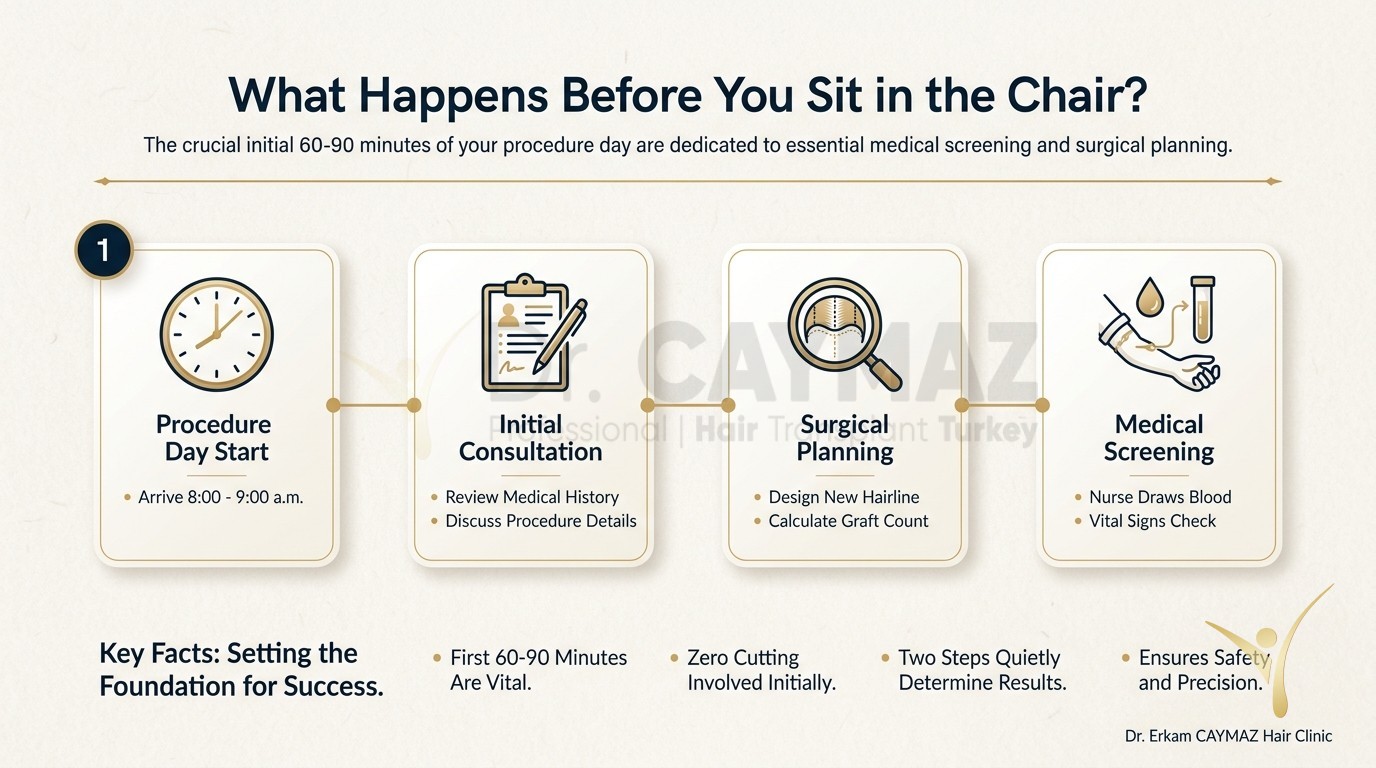
Your procedure day starts earlier than the surgery itself. Most clinics schedule arrival between 8:00 and 9:00 a.m. The first 60 to 90 minutes don't involve any cutting at all. They're devoted to medical screening and surgical planning, two steps that quietly determine everything that follows.
A nurse draws blood for a pre-operative panel, typically a complete blood count, coagulation markers, and screening for hepatitis B, hepatitis C, and HIV. Results come back within 30 to 45 minutes from an in-house or nearby lab. If your platelet count is low or your INR is elevated, the surgeon needs to know before the first punch touches your scalp. You can read more about the pre-op blood tests required before hair transplant in a separate guide.
While the lab processes your sample, you'll sit for a face-to-face consultation. The surgeon examines your donor density under magnification, confirms your Norwood classification, and reviews the graft count discussed during your initial consultation. This is also the moment to raise any last-minute questions about medications you've been taking. Aspirin, ibuprofen, and certain supplements thin the blood and should have been stopped at least seven days prior. If you haven't followed those
How Is the Hairline Designed on the Day of Surgery?
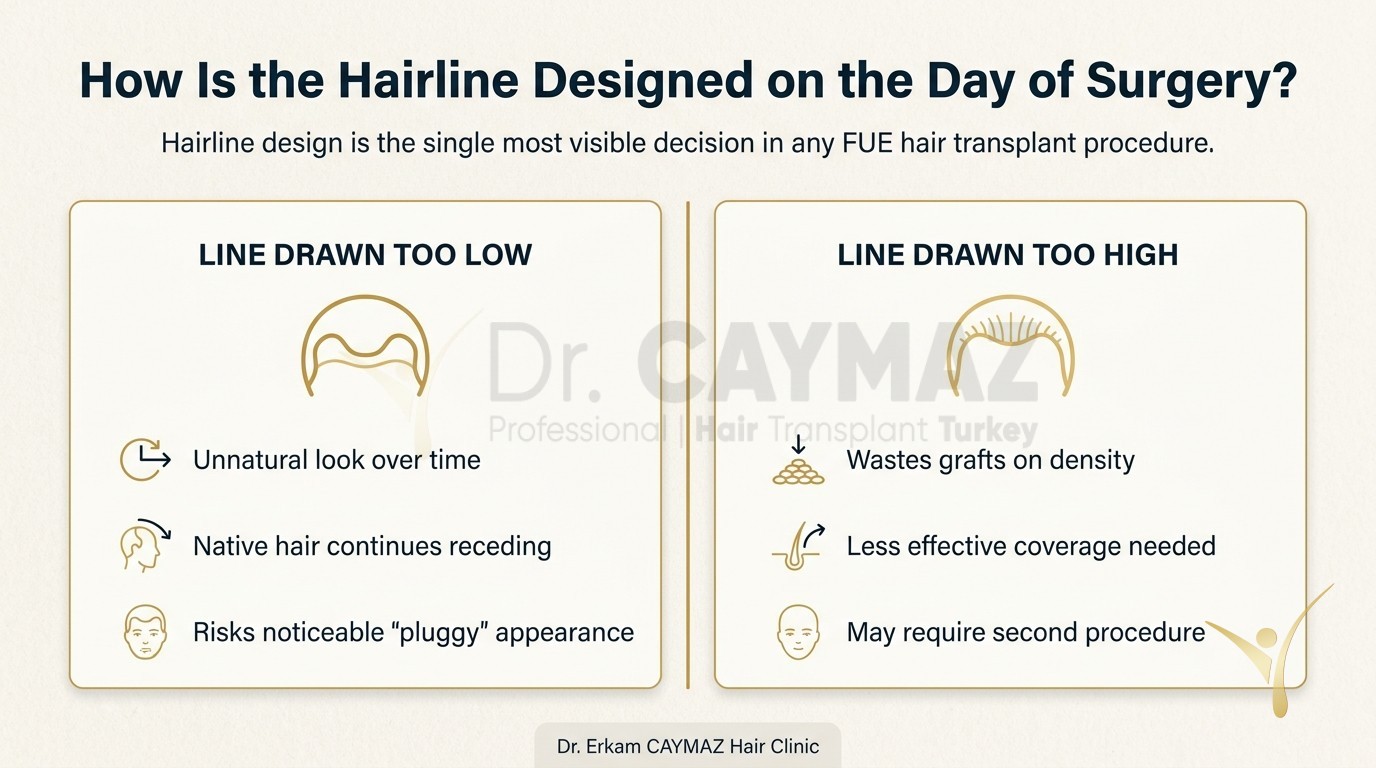
Hairline design is the single most visible decision in any FUE hair transplant procedure. A line drawn 1 cm too low can look unnatural within a decade as native hair continues to recede behind it. A line drawn too high wastes grafts on density the patient didn't need.
Dr. Erkam Caymaz performs this step personally, standing in front of the seated patient with a surgical marker. The process takes 15 to 25 minutes and involves several reference points: the highest crease of the frontalis muscle (the forehead wrinkle line), the midpupillary line, and the natural asymmetry of the patient's face. Single-hair grafts are reserved for the very front row to mimic the soft, irregular border of a natural hairline. Multi-follicular grafts, containing two to four hairs each, fill the area behind it for density.
The patient holds a mirror throughout. Adjustments happen in real time. Once both sides agree, the design is photographed from multiple angles. This photograph becomes the surgical map for the rest of the day. For a deeper look at the anatomy behind this step, see the discussion on frontal hairline design and the first 2 cm.
What Does Local Anesthesia Feel Like?
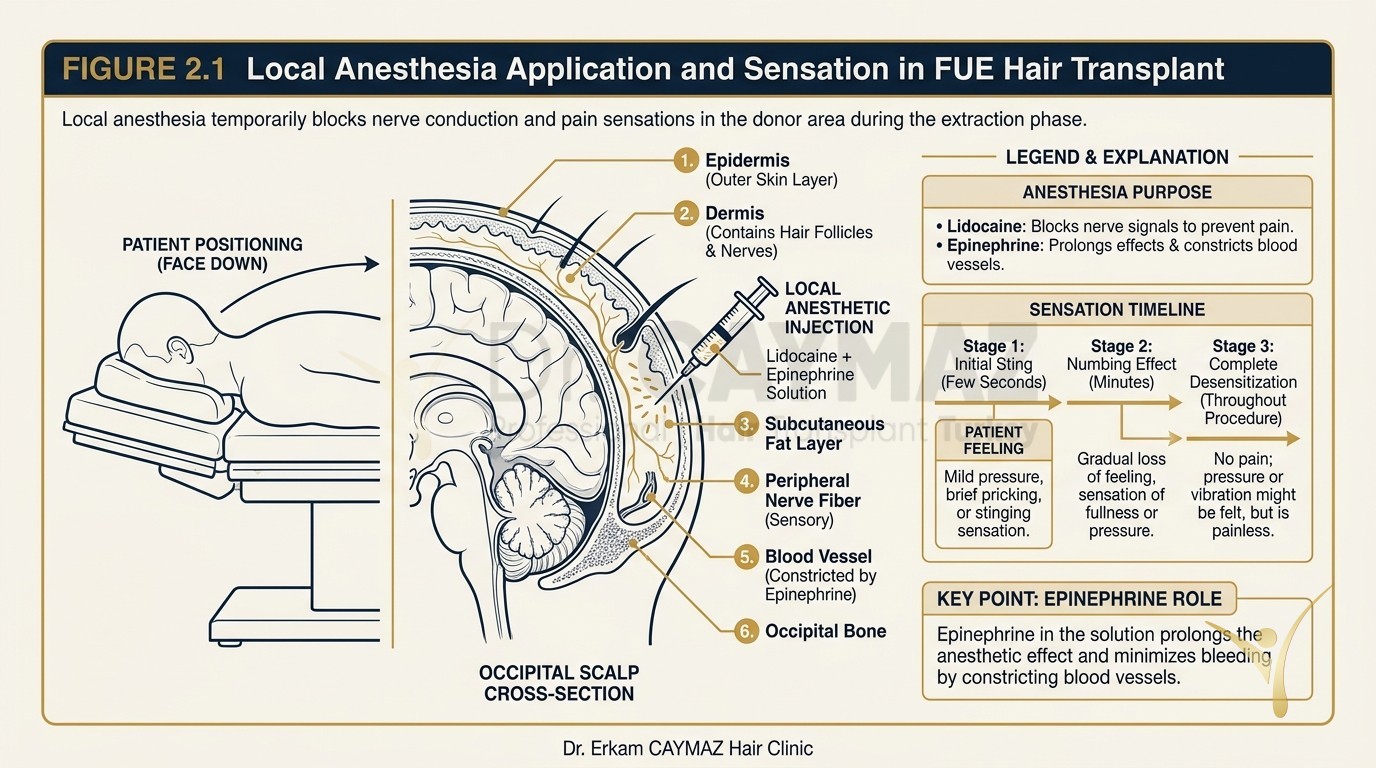
After the hairline is finalized, the patient lies face down on the operating table for donor-area anesthesia. A local anesthetic solution containing lidocaine and epinephrine is injected into the occipital scalp, the region between the ears at the back of the head. Epinephrine serves a dual purpose: it prolongs the numbing effect and constricts small blood vessels, reducing bleeding during extraction.
The initial needle pricks are the most uncomfortable part of the entire day. Most patients describe a stinging sensation that lasts 30 to 60 seconds per injection site. After two to three minutes, the area goes numb. Some clinics use a vibration device or nerve-block technique to blunt the sting further. Once anesthesia sets in, you shouldn't feel pain, only mild pressure or tugging as the micro-punches rotate.
If you're concerned about the anesthesia protocol and pain management, that topic has its own detailed page. The short version: the procedure is tolerable for the vast majority of patients, and supplemental doses are given whenever numbness begins to fade.
How Does the Extraction Phase Work?
Extraction is the phase most people picture when they hear "FUE." Follicular Unit Extraction means each graft is removed individually from the donor area using a cylindrical micro-punch, typically 0.7 to 0.9 mm in diameter. The punch scores around the follicular unit just below the skin surface, and the graft is then lifted out with fine-tipped forceps.
This phase usually lasts 2 to 3 hours depending on the total graft count. For a 3,000-graft session, an experienced team extracts roughly 15 to 20 grafts per minute. The extracted grafts are placed immediately into a chilled holding solution, often hypothermosol or a saline-based medium enriched with ATP, to keep cells viable while they wait for implantation.
Bleeding during extraction is managed with epinephrine in the local anesthetic and firm gauze pressure applied by the surgical team. Pacing the extraction, working in sections rather than rushing through the entire donor zone at once, also helps control oozing and protects graft integrity.
A critical point: extraction and implantation at our clinic are performed by expert surgical technicians under the direct supervision of the operating surgeon. The surgeon has already set the plan, designed the hairline, and will personally create the recipient incisions. But the repetitive manual work of punching and placing thousands of individual grafts is a team effort. This division of labor is standard in high-quality FUE clinics worldwide and is one reason the clinic limits itself to 1 to 2 VIP operations per day, roughly 15 patients per month, so the full team can focus on a single case at a time.
For patients with advanced hair loss classified as Norwood 4 or higher, the donor area can't safely yield 5,000 or 6,000 grafts in one sitting without risking overharvesting. In those cases, splitting the work into two sessions at least six months apart protects donor density and long-term aesthetics.
What Happens During the Lunch Break?
Most FUE procedures include a 30- to 45-minute break between extraction and implantation. You'll sit up, eat a light meal, drink water, and stretch your legs. This isn't just a courtesy. Lying face down for two to three hours can cause mild facial swelling due to gravity, and a short upright break helps fluid redistribute before the next phase begins.
During this pause, the surgical team counts and sorts the harvested grafts under magnification. Singles, doubles, triples, and occasional four-hair units are separated into labeled petri dishes. The count is recorded and compared against the pre-operative plan. If the surgeon planned 2,800 grafts and the team extracted 2,850, the extras provide a small buffer for any grafts that don't meet quality standards under the microscope.
The grafts remain in their chilled holding solution throughout the break. Out-of-body time, the interval between extraction and implantation, is a key variable in graft survival. Published data suggest that keeping this window under 4 to 6 hours preserves follicle viability above 95%. Limiting the clinic to one or two cases per day, rather than running five or more in parallel, directly shortens this window because the team isn't splitting attention across multiple patients.
Dr. Caymaz Insight
| I tell every patient the same thing: the hairline is my signature, and I won't delegate it. I draw it, I make the recipient incisions with sapphire blades, and I set the angle and depth for every channel in the frontal zone. My technicians are skilled professionals I've trained over years, and they handle extraction and placement under my direct supervision. This structure lets me focus on the decisions that shape the final aesthetic, the ones you'll see in the mirror every morning. Keeping our schedule to one or two VIP cases a day means I'm never rushing between rooms. That's not a marketing line; it's the only way I can guarantee the level of attention each scalp deserves. |
How Are Recipient Incisions and Implantation Performed?
After the break, the patient lies back with the face up. The surgeon now creates recipient-site incisions across the balding area using sapphire blades, ultra-fine tips made from synthetic sapphire crystal. These blades produce channels approximately 1.0 to 1.3 mm wide, matching the diameter of the grafts. Sapphire's smooth edge causes less tissue trauma than steel, which translates to reduced swelling and faster crust shedding in the first week.
Each incision is made at a specific angle, typically 30 to 45 degrees, and a specific direction that mirrors the patient's original hair growth pattern. In the frontal zone, hairs point forward and slightly lateral. At the crown, they spiral outward from a central whorl. Getting these angles wrong produces hair that sticks straight up or lies flat in the wrong direction, a flaw no amount of density can fix. The surgeon personally controls this step, a practice sometimes called The Architect Touch, because the incision map determines the final look more than any other single variable.
Once the channels are open, the surgical technicians begin implantation. Using fine-tipped forceps, they slide each graft into its designated channel. Single-hair grafts go into the hairline row. Multi-hair grafts fill the mid-scalp and vertex for density. This phase takes 2 to 3 hours for a typical 2,500- to 3,500-graft session. The team works methodically from front to back, and the surgeon checks progress at regular intervals.
You can find a broader overview of each surgical step on the hair transplant procedure steps page, but the key point for operation day is this: incision quality and graft-channel fit are what separate a natural result from a mediocre one.
| Phase | Approximate Duration | Who Performs It | Patient Position |
|---|---|---|---|
| Blood work and medical screening | 30–45 min | Surgical technicians | Seated |
| Consultation and hairline design | 30–45 min | Dr. Erkam Caymaz | Seated, holding mirror |
| Donor-area local anesthesia | 10–15 min | Surgical technicians, Dr. Caymaz–supervised | Face down |
| Graft extraction (FUE) | 2–3 hours | Surgical technicians, surgeon-supervised | Face down or lateral |
| Lunch break and graft sorting | 30–45 min | Patient rests; team sorts grafts | Seated / upright |
| Recipient-area anesthesia | 10–15 min | Surgical technicians, surgeon-supervised | Reclined, face up |
| Recipient-site incisions (sapphire) | 45–90 min | Dr. Erkam Caymaz (VIP, The Architect Touch™) | Reclined, face up |
| Graft implantation | 2–3 hours | Surgical technicians, surgeon-supervised | Reclined, face up |
| Post-op bandaging, discharge briefing, and hair-wash scheduling | 20–30 min | Doctor's assistant | Seated |
What Should You Expect at Discharge?
By late afternoon or early evening, the last graft is in place. The nurse applies a light bandage over the donor area at the back of the head. The recipient zone, where the new grafts sit, is left uncovered so nothing presses against the freshly placed follicles.
Before you leave, the team walks you through a printed aftercare sheet. Key instructions include:
- Sleep at a 45-degree angle for the first three nights to reduce forehead swelling.
- Don't touch, scratch, or rub the recipient area for at least 72 hours.
- Avoid alcohol for 48 hours and smoking for at least two weeks, both impair microcirculation to the grafts.
- At our clinic, plan the first wash on day 2 post-op (for example, Monday surgery → Tuesday rest → Wednesday first wash). The donor bandage is removed then. Some clinics wash on day 1 instead; we have not seen that cause problems, but we prefer day 2. Follow the first-wash protocol after surgery demonstrated by the nurse.
- Take any prescribed medications, typically an antibiotic, an anti-inflammatory, and a mild analgesic, exactly as directed.
Most patients feel surprisingly normal at discharge. The anesthesia hasn't fully worn off, so pain is minimal. A dull ache in the donor area usually peaks around 6 to 12 hours post-op and responds well to standard paracetamol. At our clinic, day 1 post-op is a rest day before the first wash. On day 2 post-op, you return for the first wash demonstration; the nurse removes the donor bandage, shows you how to apply saline spray, and gently foam the scalp without dislodging grafts (Monday surgery → Wednesday first wash). Some clinics schedule the first wash on day 1; that is not something we have seen cause problems, but we find day 2 gives the donor area a little more settling time.
Why Does Limiting Daily Cases Protect Your Grafts?
High-volume clinics, sometimes called "hair mills," may run 8 to 10 operations simultaneously in a single day. In that model, the surgeon's involvement per patient shrinks to minutes rather than hours. Technicians rotate between rooms. Grafts sit in holding solution longer because the implantation team is shared across cases.
The math is straightforward. If a follicular unit spends 6 hours outside the body instead of 3, cellular ATP reserves drop, and the percentage of grafts that successfully anchor and grow declines. Published literature places overall FUE success rates at 90 to 95% and graft survival up to 98% under optimal conditions. Those optimal conditions include short out-of-body time, careful handling, and a focused team, all of which are easier to achieve when the clinic schedules only 1 to 2 operations per day.
This is also why surgical planning matters so much. A well-planned session with a realistic graft count finishes within 6 to 8 hours. An overly ambitious session that tries to pack 5,000 or more grafts into a single sitting stretches past 10 hours, exhausts the team, and pushes the earliest-extracted grafts into dangerous territory for viability. You can explore the reasoning behind
What Does the First Week After Procedure Day Look Like?
The operation itself is only half the story. The first seven days determine whether those carefully placed grafts take root or fail.
Days 1 to 3: Mild swelling may develop across the forehead and around the eyes. This is gravity pulling the anesthetic fluid downward, not a sign of infection. Sleeping elevated and applying a cold compress to the forehead (never the grafts) helps. Tiny crusts form around each graft site. Don't pick them.
Days 4 to 7: You'll wash the scalp daily at home using the technique demonstrated at your first clinic wash (at our clinic, day 2 post-op, when the donor bandage is removed). Gentle circular motions with fingertips soften the crusts, which shed naturally by day 7 to 10. Most patients can return to desk work by day 3 or 4, though strenuous exercise should wait until at least day 14.
Between weeks 2 and 6, many patients experience shock loss, a temporary shedding of the transplanted hair shafts. The follicles themselves remain alive beneath the skin. New growth typically becomes visible around month 3 to 4, with final density reached between months 10 and 14. A full breakdown of this timeline is available on the recovery timeline milestones page.
Long-term care, including decisions about finasteride, minoxidil, or PRP maintenance, is discussed at a follow-up appointment once initial healing is confirmed. The aftercare protocol covers these topics in detail.
Can You Fly Home the Day After a FUE Procedure?
Yes. Many international patients fly home after our day-2 post-op clinic wash, once the donor bandage has been removed and the nurse has demonstrated home washing. You receive a travel kit with saline spray, a soft pillow for the headrest, and written instructions for washing at home. Short-haul flights 24 to 48 hours after surgery are common when they align with that first-wash visit.
Cabin pressure at cruising altitude doesn't affect graft survival. The main concern is accidental contact: bumping your head on the overhead bin or pressing the recipient area against the seat. A neck pillow keeps your head forward and away from the headrest. Avoid hats or beanies that press tightly against the grafts for the first 10 days. A loose, front-opening shirt is better than a pullover to avoid dragging fabric across the transplanted zone.
If your flight exceeds 5 hours, mild ankle swelling is normal. Walk the aisle periodically and stay hydrated. The grafts themselves are anchored within their channels by fibrin clot formation, which begins within minutes of placement and strengthens over the first 72 hours. By the time you board your flight after the first clinic wash, the grafts are already mechanically stable enough to withstand normal movement.
Sources
FAQ
A typical FUE session lasts 6 to 8 hours in a single day. This includes roughly 1 to 1.5 hours for blood work, consultation, and hairline design; 2 to 3 hours for graft extraction; a 30- to 45-minute lunch break; and 2 to 3 hours for recipient-site incisions and implantation. Discharge happens the same evening.
In VIP operations, Dr. Erkam Caymaz personally performs the consultation, hairline design, and recipient-site incisions (The Architect Touch™), which set angle, depth, and direction. Graft extraction and implantation are carried out by expert surgical technicians under his direct supervision. Local anesthesia for donor and recipient areas is administered by surgical technicians under Dr. Caymaz's supervision.
Local anesthesia numbs the scalp before any surgical work begins. The initial needle pricks cause a brief stinging sensation lasting 30 to 60 seconds per injection site. Once the anesthetic takes effect, most patients feel only mild pressure or tugging. Supplemental doses are given if numbness begins to fade during the procedure.
Limiting daily cases keeps graft out-of-body time short, ensures the full surgical team focuses on one patient at a time, and allows the surgeon to personally oversee every critical step. High-volume clinics running 8 to 10 cases simultaneously often compromise on these factors, which can reduce graft survival rates.
Some patients fly 24 to 48 hours after surgery, but at our clinic the priority is the day-2 post-op wash when the donor bandage is removed. Many fly after that visit. Use a neck pillow, avoid tight hats, and stay hydrated. Grafts are mechanically anchored by fibrin clot formation within the first 72 hours.
Shock loss is a temporary shedding of transplanted hair shafts that typically occurs between weeks 2 and 6 after surgery. The follicles remain alive beneath the skin. New visible growth usually begins around month 3 to 4, with final density reached between months 10 and 14.
For patients with advanced hair loss, such as Norwood 4 or higher, attempting to extract 5,000 or more grafts in a single session risks overharvesting the donor area. In these cases, the procedure is split into at least two sessions spaced a minimum of six months apart to protect donor density and long-term results.
On procedure day, the donor area is bandaged and the recipient zone stays uncovered. At our clinic, we schedule the first wash on day 2 post-op and remove the donor bandage then (for example, Monday surgery → Tuesday rest → Wednesday first wash). We treat day 1 as a rest day. Some clinics perform the first wash on day 1 instead; that is not something we have seen cause problems, but our preference and experience favor day 2. After the first clinic wash, wash daily at home with gentle fingertip circles. Crusts around graft sites shed naturally by day 7 to 10.
Overall FUE success rates range from 90 to 95%, while graft survival under optimal conditions can reach up to 98%. These are distinct metrics: success rate reflects the overall aesthetic outcome, while graft survival measures how many individual follicles take root and produce hair.
Sapphire blades produce smoother, narrower channels than traditional steel blades. This results in less tissue trauma, reduced post-operative swelling, and faster crust shedding. The precise channel size also improves the snug fit between graft and incision, supporting higher graft survival.

FUE vs FUT: Scars, Graft Numbers and Recovery Compared
FUE removes follicular units one by one and leaves small dot scars; FUT removes a strip of scalp and leaves one linear…
Read More: FUE vs FUT: Scars, Graft Numbers and Recovery Compared
What is Alopecia Areata?
Alopecia simply means hair loss, but alopecia areata is a specific autoimmune pattern: smooth bald patches that can…
Read More: What is Alopecia Areata?
Will I Need a Revision Surgery?
Revision may mean a planned second session after staged coverage goals on advanced Norwood patterns, or corrective work…
Read More: Will I Need a Revision Surgery?
Hair Transplant Cost in Turkey vs the UK: A 2026 Planning Guide
Turkey VIP packages typically run €5,000–€7,500 all-inclusive, while comparable private UK quotes often reach…
Read More: Hair Transplant Cost in Turkey vs the UK: A 2026 Planning GuideFrequently Asked Questions
Professional Hair Transplant Insights by Dr. Erkam Caymaz