


Quick Numbers
| Realistic DHI density | 35–50 grafts per cm² |
|---|---|
| Choi pen implantation speed | ~500–700 grafts per hour (team) |
| Ideal single-session DHI range | 1,500–3,000 grafts |
| Graft survival (well-executed DHI) | Up to 98% |
| Final density visible | 12–15 months post-op |
Key Takeaways
| DHI is best suited for hairline refinement, small-zone density boosts, and patients who need unshaved implantation. |
| Patients with large bald areas (Norwood 5+) usually get better coverage from Sapphire FUE, not DHI alone. |
| Promising "80–100 grafts per cm²" is a red flag; native scalp density averages only 60–80 follicular units per cm². |
| Dr. Caymaz personally designs the hairline and performs VIP incisions; expert technicians handle extraction and implantation under his supervision. |
| Donor health determines everything: overharvesting for a single mega-session can leave permanent scarring. |
A 34-year-old patient from London sends photos showing a receding hairline with thinning behind it. He's read that a DHI hair transplant in Turkey can pack grafts closer together than any other method. He wants 4,500 grafts placed exclusively with Choi pens, all in one day. Is that realistic? In many cases, the answer is no. DHI is a powerful technique, but it isn't the right fit for every scalp, every Norwood stage, or every graft count. Understanding who actually benefits from DHI, and what density numbers are honest, can save you from disappointment and protect your donor area for decades to come.
What exactly does DHI do differently from Sapphire FUE?
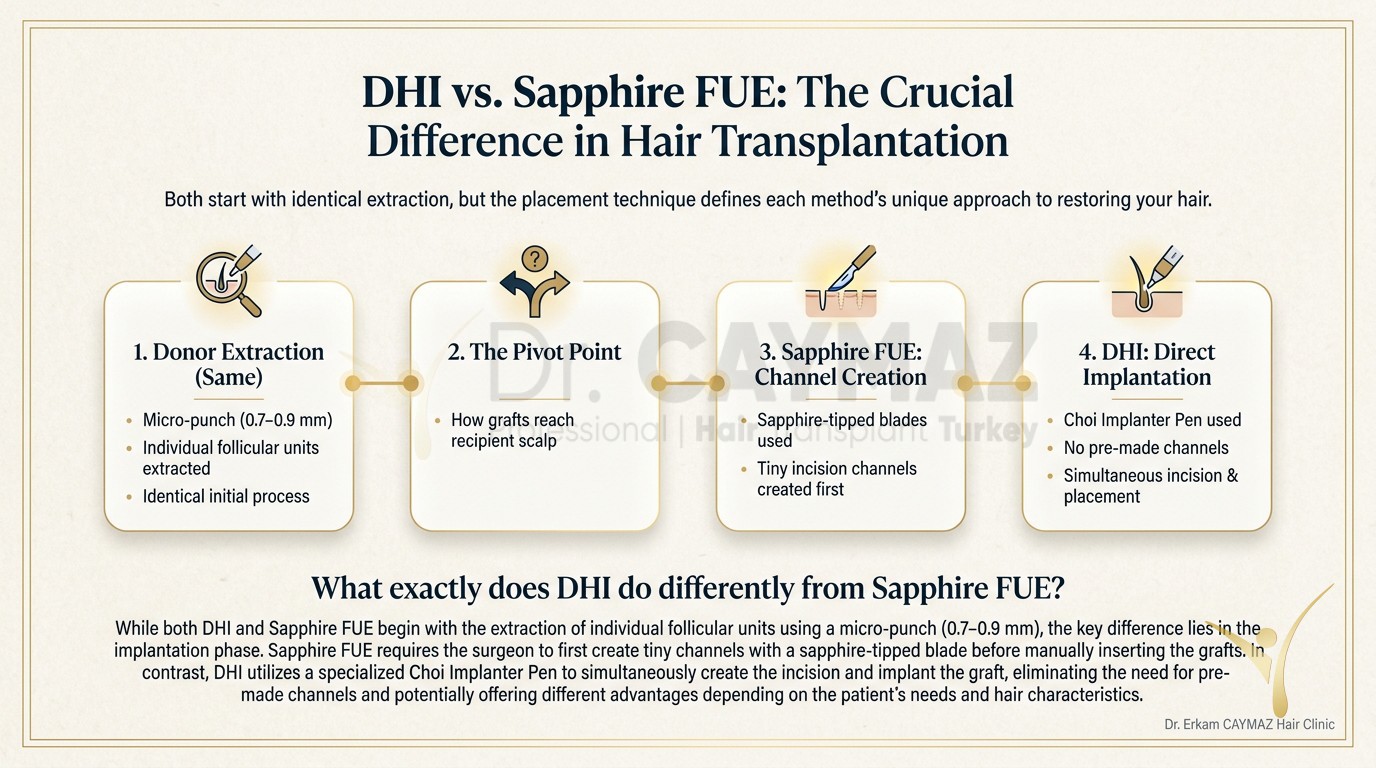
Both DHI and Sapphire FUE begin the same way: individual follicular units are extracted from the donor zone using a micro-punch, typically 0.7–0.9 mm in diameter. The difference is in how those grafts reach the recipient scalp. In Sapphire FUE, the surgeon first creates tiny incision channels with a sapphire-tipped blade, then the team implants grafts into those channels in a separate step. In DHI (Direct Hair Implantation), a hollow Choi implanter pen loads a single graft and simultaneously punctures the skin and deposits the follicle in one motion. There's no separate channel-creation phase.
This single-step placement gives DHI two clinical advantages. First, the graft spends less time outside the body, which can reduce desiccation. Second, the surgeon can implant between existing hairs without shaving the recipient area, because the pen tip is narrow enough to navigate around standing follicles. That's why DHI is often marketed as a "no-shave" or "unshaved" technique. But these advantages come with trade-offs: the procedure is slower per graft, and covering large bald zones with Choi pens alone extends operating time significantly. You can read a detailed comparison of FUE and DHI methods to see the mechanical differences side by side.
Which patients are the best candidates for DHI?
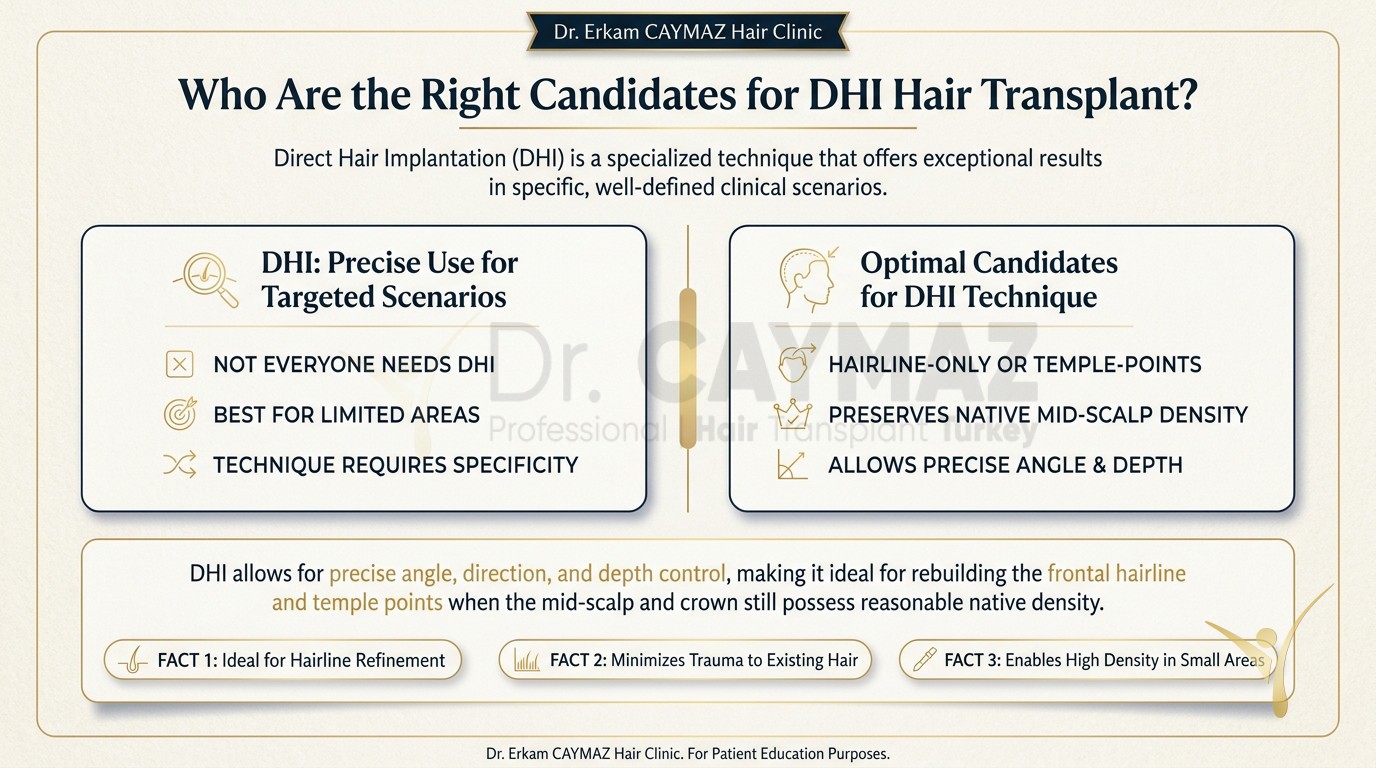
Not everyone who asks for DHI actually needs it. The technique shines in specific clinical scenarios. Here are the profiles that benefit most:
Hairline-only or temple-point cases. When the mid-scalp and crown still have reasonable native density and only the frontal hairline needs rebuilding, DHI allows precise angle and depth control graft by graft. Single-hair follicular units can be loaded into the Choi pen and placed at 10–15° acute angles, mimicking the way natural hairline hairs emerge almost flat against the skin. This level of control matters most in the first 1–2 cm of the hairline, where even a slight error in angle is visible. Dr. Caymaz designs every hairline personally, a step that determines whether the final result looks natural or "pluggy" regardless of technique.
Patients who can't shave the recipient zone. Professionals, public figures, or anyone who needs to return to work within days often prefer DHI because the existing hair camouflages the procedure. The team implants grafts between standing hairs, so there's no buzzed-down look. This is sometimes called the "long-hair" or "no-shave" approach. It works well for female hair transplant patients with diffuse thinning who want to keep their length.
Small-area density boosts. If a patient had a previous transplant and needs to fill in thin patches or add density to a zone that already has some growth, DHI lets the team work around existing grafts without damaging them. The Choi pen's narrow insertion point minimizes trauma to neighboring follicles.
Low-Norwood patients (Norwood 2–3). When total graft need is under 2,500, DHI can handle the entire case comfortably in a single session without excessive operating time. The procedure stays within a 5–7 hour window, which keeps graft viability high and patient fatigue low.
When is DHI not the right choice?
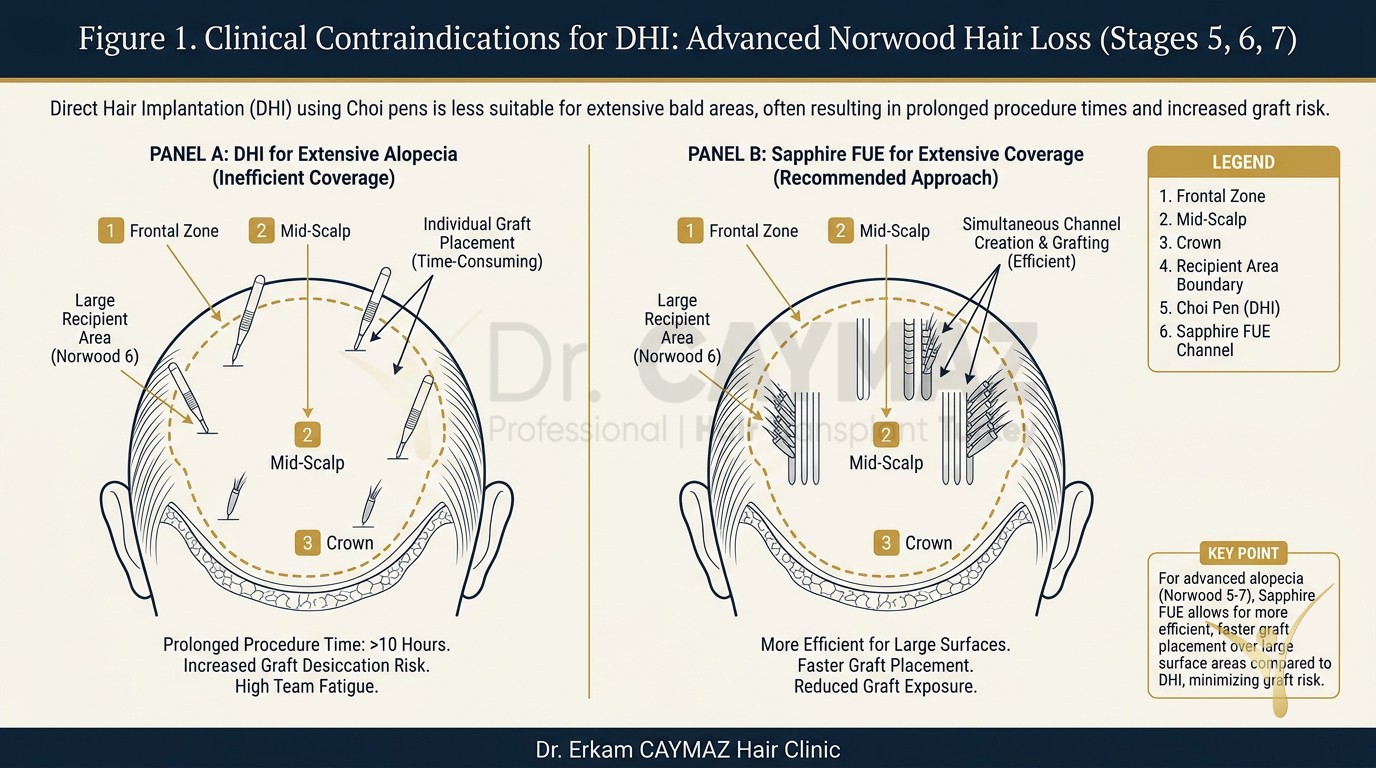
Patients with Norwood 5, 6, or 7 hair loss have large bald areas spanning the frontal zone, mid-scalp, and crown. Covering that surface with Choi pens alone would require extremely long operating times, sometimes exceeding 10 hours, which increases graft desiccation risk and team fatigue. For these cases, Sapphire FUE is typically the more efficient and safer choice. The pre-made sapphire channels allow a larger team to implant grafts simultaneously, cutting total procedure time.
There's also a graft-count ceiling. DHI works best in the 1,500–3,000 graft range per session. Once you push past 3,500 grafts with Choi pens, the extended time outside the body for later-extracted grafts can reduce survival rates. Clinics that promise 5,000+ DHI grafts in a single sitting are either stretching the truth about technique or compromising on graft care.
Patients with very tight, thick scalp skin can also present challenges for DHI. The Choi pen requires a certain tissue compliance to insert smoothly. A rigid scalp increases the force needed per insertion, which can damage the follicle bulb. In these cases, sapphire blade incisions followed by forceps implantation may be gentler on the grafts. A thorough pre-operative consultation with scalp laxity assessment helps determine which technique fits your anatomy.
What density can DHI realistically achieve?
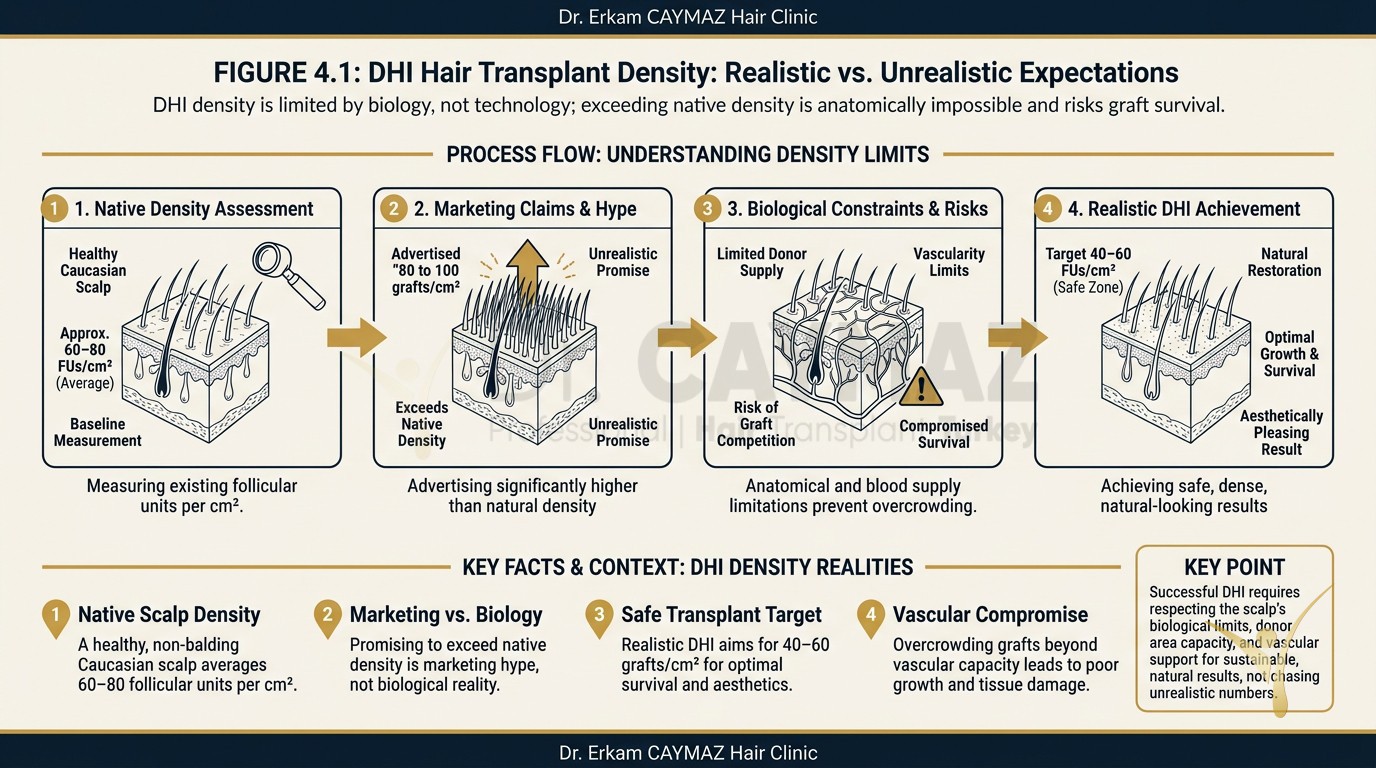
This is where marketing and biology collide. Some clinics advertise "80 to 100 grafts per cm²" with DHI. Let's put that in context. A healthy, non-balding Caucasian scalp has roughly 60–80 follicular units per cm² on average. Promising to exceed native density with transplanted hair isn't just unrealistic, it's anatomically impossible without compressing grafts so tightly that blood supply is compromised and survival drops.
A well-planned DHI procedure can achieve 35–50 grafts per cm² in the recipient zone. In the hairline's first centimeter, where single-hair grafts dominate, density may be slightly lower in graft count but visually effective because the fine, single hairs create a soft transition. Behind the hairline, multi-hair grafts (2–3 hairs each) are placed at 40–50 grafts per cm², which translates to roughly 80–150 hairs per cm², enough to create a convincing appearance of fullness. You can read more about minimum graft density per cm² to understand these numbers in clinical terms.
| Factor | DHI (Choi Pen) | Sapphire FUE |
|---|---|---|
| Best Norwood range | Norwood 2–3 (or targeted zones) | Norwood 2–6 (full coverage) |
| Ideal graft count per session | 1,500–3,000 | 2,000–4,500 |
| Realistic density achieved | 35–50 grafts/cm² | 40–55 grafts/cm² |
| Unshaved recipient possible? | Yes | Partial (less practical) |
| Procedure time (3,000 grafts) | 7–9 hours | 5–7 hours |
| Hairline angle precision | Excellent (pen-controlled) | Excellent (surgeon-controlled incisions) |
| Large-area coverage efficiency | Lower | Higher |
| Graft survival (overall) | Up to 98% | Up to 98% |
How does donor area health affect DHI candidacy?
Every graft placed with a Choi pen still has to come from somewhere, and that somewhere is your donor area, the band of DHT-resistant hair running from ear to ear across the back and sides of the scalp. A patient with fine hair, low donor density (under 60 FU/cm²), or a narrow safe donor zone simply doesn't have enough raw material for a high-density DHI session, no matter how skilled the team is.
This is why donor area evaluation is among the most critical steps in planning. Donor density is assessed with a dermatoscope during consultation, measuring follicular units per cm² and estimating total extractable grafts across the patient's lifetime, not just one session. For patients at Norwood 4 or above, we recommend splitting the work into at least two sessions spaced a minimum of six months apart. This protects the donor zone from
overharvesting, which can leave visible thinning or moth-eaten scarring in the back of the head.
A clinic that offers 5,000 or 6,000 grafts in a single DHI session should raise immediate concern. Even with Sapphire FUE, single-session counts above 4,500 push donor limits for most patients. With DHI's slower pace, the math simply doesn't add up without cutting corners on graft handling or extraction quality.
Dr. Caymaz Insight
| I choose DHI selectively, not as a default for every patient. When someone has a Norwood 2 or 3 with good donor density and wants a refined hairline without shaving, DHI is ideal. But when I see a Norwood 5 patient asking for full DHI coverage in one session, I have to be honest: Sapphire FUE will give better coverage with less risk to the donor. I personally design the hairline and perform the VIP incisions in every case. My technician team then handles extraction and implantation under my direct supervision. We limit our schedule to one or two VIP operations per day so that every graft gets the attention it deserves. Density promises above 50 grafts per cm² should make any patient skeptical, because biology has limits that no pen can override. |
Can DHI and Sapphire FUE be combined in one session?
Yes, and this is actually one of the smartest approaches for patients who fall between the ideal profiles. A hybrid session uses Sapphire FUE for the mid-scalp and crown, where larger surface areas need efficient coverage, and switches to DHI Choi pens for the hairline and temple points, where angle precision and no-shave capability matter most. This combination captures the strengths of both techniques without the time penalty of doing everything with Choi pens.
In practice, the extraction phase is identical for both. The difference is only in implantation. The surgical team can transition from sapphire-channel implantation to Choi pen implantation mid-procedure. This hybrid model is common in quality-focused clinics that tailor the technique to the anatomy rather than marketing a single brand name. If you're researching your options for a hair transplant in Turkey, ask whether the clinic offers technique customization or locks every patient into one method.
What red flags should you watch for when choosing a DHI clinic?
Turkey has hundreds of hair transplant clinics, and not all of them use DHI correctly. Here are concrete warning signs:
Density guarantees above 60 grafts per cm². As discussed, this exceeds native scalp density. Any clinic making this promise is either misunderstanding the metric or deliberately misleading you.
Single-session counts above 4,000 with DHI only. The procedure's slower pace makes this impractical without extending operating time to dangerous lengths or using multiple simultaneous Choi pens with undertrained staff. Graft survival drops when follicles sit in holding solution for 8+ hours.
No surgeon involvement in planning. If the consultation is handled entirely by a sales coordinator and you never speak with the operating physician before the day of surgery, that's a sign of a high-volume hair mill. Planning is among the most critical steps in any transplant, and it should involve the surgeon who will be in the operating room.
Identical plans for every patient. A clinic that quotes the same graft count and technique to everyone, regardless of Norwood stage, donor density, or hair caliber, isn't practicing personalized medicine. Your hairline design should reflect your facial proportions, age, and future loss trajectory, not a template.
What does recovery look like after a DHI procedure?
Recovery from DHI is broadly similar to Sapphire FUE, with a few nuances. Because the Choi pen creates smaller entry points than a sapphire blade, some patients report slightly less crusting in the recipient zone during the first week. Redness tends to fade within 7–10 days for most skin types. The donor area, where extraction occurred, heals identically regardless of implantation method, since the same micro-punch technique is used.
The first first wash after your procedure typically happens 48–72 hours after surgery. Gentle patting with lukewarm water and a prescribed lotion softens crusts without dislodging grafts. By day 10–14, most crusts have cleared.
Shock loss, the temporary shedding of transplanted hairs, usually begins around weeks 2–4 and resolves by month 3–4 as new growth cycles begin.
Full density from a DHI procedure takes 12–15 months to become visible. At month 6, roughly 50–60% of grafts are producing visible hair. By month 12, that figure climbs to 85–90%. The final 10–15% of maturation, including thickening of individual hair shafts, continues through month 15. Patients who follow their aftercare protocol closely, including avoiding direct sun, refraining from heavy exercise for 4 weeks, and using prescribed medications, tend to see the best outcomes.
How does cost factor into the DHI decision in Turkey?
DHI procedures generally cost more than standard Sapphire FUE because the Choi pens are single-use disposable instruments, the procedure takes longer, and the technique demands a higher skill level from the implantation team. In Turkey, the price difference between DHI and Sapphire FUE at a quality clinic typically ranges from 15–30% more for DHI. You can review current pricing and package details to see what's included in a VIP operation.
The cost difference is justified when DHI is clinically indicated, for example, in a no-shave hairline case or a small-area density enhancement. It's not justified when a clinic upsells DHI to every patient as a "premium" option without a clinical reason. If your case involves 3,500+ grafts across a large bald area, paying extra for DHI may actually give you a worse result than a well-executed Sapphire FUE, because the extended time increases graft vulnerability.
Overall success rates for hair transplantation, whether DHI or Sapphire FUE, range from 90–95% when performed by an experienced team with proper graft handling. Graft survival can reach up to 98% under optimal conditions. These numbers don't change based on technique alone; they depend on surgeon skill, team coordination, graft storage protocols, and patient compliance with aftercare.
Sources & clinical references
FAQ
Neither technique is universally better. DHI excels at hairline refinement, small-area density work, and no-shave implantation. Sapphire FUE is more efficient for covering large bald areas. The best choice depends on your Norwood stage, graft count, and whether you need unshaved implantation. Many quality clinics use both techniques in a single hybrid session.
DHI works best in the 1,500–3,000 graft range per session. Beyond 3,500 grafts, the extended procedure time increases the risk of graft desiccation and reduces survival rates. Clinics promising 5,000+ DHI grafts in a single sitting are likely compromising on graft care or misrepresenting the technique used.
A well-executed DHI procedure achieves 35–50 grafts per cm² in the recipient zone. Since each graft contains 1–3 hairs, this translates to roughly 70–150 hairs per cm², which creates a convincing appearance of fullness. Claims of 80–100 grafts per cm² exceed native scalp density and should be viewed with skepticism.
Yes, one of DHI's main advantages is the ability to implant grafts between existing hairs without shaving the recipient zone. The donor area still needs to be trimmed for extraction, but some clinics offer partial shaving techniques that can be hidden under longer hair. This makes DHI popular among women and professionals who can't take extended time off.
Patients with Norwood 5–7 hair loss, those needing more than 3,500 grafts, and individuals with very thick or tight scalp skin are generally better served by Sapphire FUE. The larger coverage area and higher graft count make Sapphire FUE more time-efficient and safer for the grafts in these scenarios.
Dr. Caymaz personally handles the consultation, surgical planning, hairline design, and VIP incisions for every patient. Extraction and implantation are performed by expert surgical technicians under his direct supervision. The clinic limits operations to 1–2 VIP cases per day to ensure focused attention on each patient.

Reading Hair Transplant Recovery Pictures Day by Day
Normal hair transplant recovery pictures show pink skin and small crusts for the first 10 to 14 days, shedding between…
Read More: Reading Hair Transplant Recovery Pictures Day by Day
What is the Success Rate of Hair Transplantation in Skin Diseases such as Eczema, Psoriasis, Liken Planus and Seborrheic Dermatitis?
Patients with eczema, psoriasis, lichen planus, or seborrheic dermatitis ask about hair transplant success rates. Skin…
Read More: What is the Success Rate of Hair Transplantation in Skin Diseases such as Eczema, Psoriasis, Liken Planus and Seborrheic Dermatitis?
Red Light Therapy After Hair Transplant: Timing and Protocols
Red light therapy (LLLT) at 630â670 nm wavelengths may support scalp healing and reduce inflammation after hair…
Read More: Red Light Therapy After Hair Transplant: Timing and Protocols
Minoxidil & Finasteride: Dosing, Side Effects & Results
Finasteride lowers DHT by blocking 5-alpha reductase; minoxidil supports follicle blood flow. Both can slow male…
Read More: Minoxidil & Finasteride: Dosing, Side Effects & ResultsHair Transplant in Turkey — Frequently Asked Questions
Expert Answers by Dr. Erkam Caymaz, Istanbul