


Quick Numbers
| Forehead Botox wait | 4, 6 weeks minimum after transplant |
|---|---|
| Mid-face filler wait | 3, 4 weeks minimum |
| Graft anchoring period | 7, 10 days for initial vascular lock-in |
| Post-Botox edema risk zone | Frontalis muscle to anterior hairline |
| Ideal safe window for any facial injectable | 3+ months post-transplant |
Key Takeaways
| Forehead Botox is the highest-risk injectable after a hair transplant because the frontalis muscle sits directly beneath the hairline graft zone. |
| Dermal fillers in the cheeks, nasolabial folds, or lips carry lower risk but should still be delayed at least 3 weeks to avoid systemic swelling that migrates upward. |
| Newly placed grafts don't have a mature blood supply for roughly 10 days, making them vulnerable to any pressure, edema, or manipulation in the surrounding tissue. |
| The safest approach is to schedule Botox or fillers either 2 weeks before a transplant or 3 months after, when graft survival is no longer at stake. |
A 38-year-old patient who had 3,200 grafts placed along the frontal hairline asked a question that comes up more often than most clinics acknowledge: "My Botox appointment is in two weeks. Do I need to cancel it?" The answer depends on exactly where the injections go, how recently the grafts were placed, and what type of injectable is involved. Botox and fillers after a hair transplant aren't permanently off-limits, but the timing window matters enormously. Getting it wrong can introduce swelling into the one area of your scalp where fragile, newly implanted follicles are still establishing a blood supply. This article covers the clinical reasoning behind safe wait times, the specific risks of forehead Botox versus mid-face fillers, and how to coordinate both procedures without compromising your hair transplant results.
Why Does Timing Matter for Injectables After a Transplant?

Every graft placed during a Sapphire FUE or DHI procedure sits inside a tiny recipient channel that's only about 0.8 to 1.2 mm deep. For the first 7 to 10 days, those grafts rely on a process called plasmatic imbibition, where surrounding tissue fluid nourishes the follicle before true capillary connections form. Any event that increases local edema, shifts tissue planes, or introduces external pressure to the scalp during this window can physically dislodge a graft or starve it of nutrients.
Botulinum toxin (Botox, Dysport, Xeomin) and hyaluronic acid fillers both cause localized swelling at the injection site. That swelling is usually mild and self-limiting in a patient who hasn't had surgery. But in a post-transplant patient, the scalp is already edematous from the tumescent anesthesia used during the operation. Stacking additional fluid retention on top of surgical edema creates a compounding effect. The forehead is especially vulnerable because gravity pulls fluid downward from the scalp, and Botox-related swelling pushes fluid upward from the brow. Those two forces meet right at the hairline, exactly where the most visible grafts sit.
Even after the initial 10-day anchoring phase, the grafts aren't fully secure. Neovascularization, the formation of new blood vessels feeding each follicle, continues for several weeks. Most surgeons consider the graft "safe" from mechanical displacement by day 14, but the surrounding tissue remains in an active healing state for 4 to 6 weeks. That's why the minimum wait for forehead Botox is measured in weeks, not days.
How Does Forehead Botox Specifically Threaten Hairline Grafts?

The frontalis muscle is the primary target for forehead Botox. It spans the entire width of the forehead and inserts into the skin just below the anterior hairline. When botulinum toxin is injected into this muscle, the needle punctures typically sit 1 to 2 cm above the brow. The toxin then diffuses outward from each injection point in a radius of roughly 1 to 1.5 cm over the following 24 to 72 hours.
That diffusion zone can overlap with the transplanted hairline. Even if the injector places the needle well below the grafted area, the protein spreads through tissue planes. In a scalp that's still healing, those tissue planes are more permeable than usual because of post-surgical inflammation. The result can be two problems at once: unwanted muscle relaxation near the graft zone, which alters the tension dynamics of the scalp skin, and localized edema that pools around the hairline grafts.
Patients who've had single-graft hairline placement are at the highest risk. Those single-hair grafts are the most delicate units in the entire transplant, and they sit in the shallowest channels. A wave of edema passing through the frontal scalp can push these grafts partially out of their channels before neovascularization has locked them in place.
Are Mid-Face and Lower-Face Fillers Safer Than Forehead Botox?
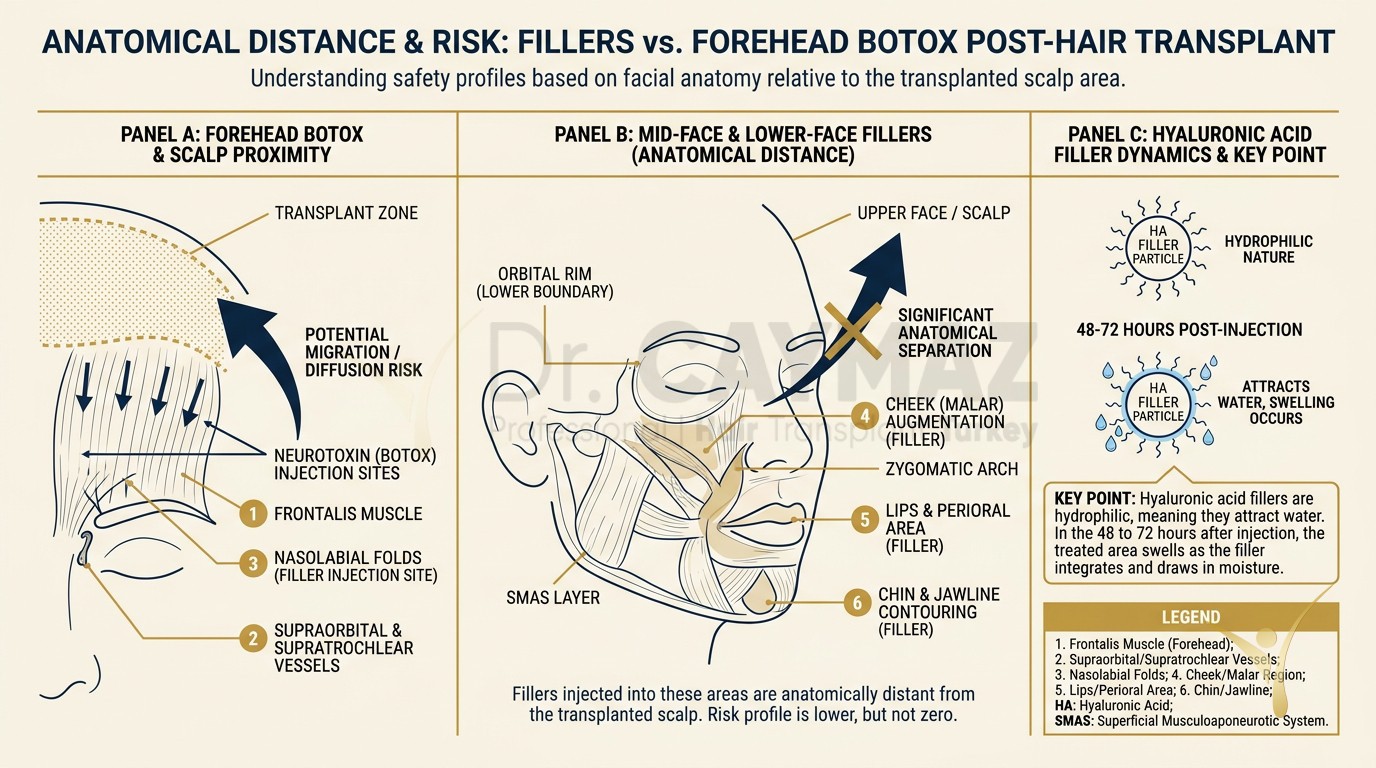
Fillers injected into the nasolabial folds, lips, chin, or cheeks are anatomically distant from the transplanted scalp. The risk profile is lower, but it isn't zero. Hyaluronic acid fillers are hydrophilic, meaning they attract water. In the 48 to 72 hours after injection, the treated area swells as the filler integrates and draws moisture from surrounding tissue. That swelling is usually confined to the injection site, but in a patient whose body is already managing post-surgical inflammation, systemic inflammatory mediators can amplify the response.
There's also a practical concern. Most filler appointments involve the patient lying flat or semi-reclined for 20 to 45 minutes. Lying flat increases blood flow to the head and can worsen post-transplant scalp edema, especially in the first two weeks. Patients who've recently had a transplant are typically advised to sleep at a 45-degree angle for the first 5 to 7 nights precisely because of this fluid dynamic. A filler appointment that requires a supine position during this period works against the aftercare protocol.
The practical guideline: mid-face and lower-face fillers can be considered as early as 3 weeks post-transplant if the scalp shows no residual swelling, all crusting has resolved, and the patient can remain upright during the procedure. The conservative recommendation is still to wait until the 6-week mark.
What About Botox in the Crow's Feet, Glabella, or Masseter?

Not all Botox targets are equal in terms of transplant risk. The glabella (the area between the eyebrows) is the second-highest concern after the frontalis because the corrugator and procerus muscles sit close to the frontal hairline. Diffusion from glabellar injections can reach the same zone as frontalis Botox, though the volume used is typically smaller (about 20 units versus 10 to 20 for the frontalis).
Crow's feet injections (lateral orbicularis oculi) pose minimal risk to scalp grafts. The injection sites are at the outer corners of the eyes, well away from the hairline and the temporal grafting zone. If a patient absolutely needs Botox during the post-transplant recovery period, crow's feet are the lowest-risk target. Even so, waiting at least 2 weeks is wise to avoid any systemic inflammatory overlap.
Masseter Botox, used for jawline slimming or TMJ relief, is injected into the lower jaw. It has essentially no direct anatomical connection to the scalp. The wait time here is driven more by the general principle of avoiding elective procedures while the body is healing from surgery. Two to three weeks is a reasonable minimum.
| Injectable Type | Target Area | Minimum Wait | Ideal Wait | Risk to Grafts |
|---|---|---|---|---|
| Botox | Frontalis (forehead lines) | 4, 6 weeks | 3 months | High |
| Botox | Glabella (frown lines) | 4, 6 weeks | 3 months | Moderate-High |
| Botox | Crow's feet | 2 weeks | 4 weeks | Low |
| Botox | Masseter (jaw) | 2, 3 weeks | 4 weeks | Very Low |
| HA Filler | Nasolabial folds | 3 weeks | 6 weeks | Low |
| HA Filler | Lips | 3 weeks | 6 weeks | Low |
| HA Filler | Temples | 4, 6 weeks | 3 months | Moderate |
| HA Filler | Under-eye (tear trough) | 4 weeks | 6 weeks | Low-Moderate |
Can You Get Botox or Fillers Before a Hair Transplant Instead?
This is often the smarter scheduling strategy. If you know your transplant date, getting your Botox or filler appointment 2 weeks before surgery avoids the entire post-operative conflict. By the time the transplant takes place, the initial swelling from the injectable has resolved, the product has settled into its final position, and there's no active inflammatory process competing with graft healing.
There's one exception. Temple fillers placed within 2 weeks of a transplant can be problematic if the surgeon plans to extract grafts from the temporal donor zone or place grafts in the temple points. The filler material alters the tissue density and can interfere with channel creation. If temple work is part of your transplant plan, discuss the filler placement with your surgeon beforehand.
Botox in the frontalis 2 weeks before surgery is generally fine. The muscle relaxation is already established, the swelling has passed, and the toxin won't interact with the surgical anesthesia. Some surgeons actually note that a relaxed frontalis makes the forehead skin slightly easier to work with during Sapphire FUE channel creation, though this isn't a reason to get Botox specifically for surgical purposes.
Dr. Caymaz Insight
| I tell my patients to think of the first 6 weeks after transplant as a period where the scalp has priority over every other cosmetic procedure. The grafts are alive but fragile, and anything that introduces unnecessary swelling to the forehead region is a gamble I don't want them to take. When patients ask about Botox specifically, I explain that the frontalis muscle is essentially the floor beneath their new hairline grafts. Injecting toxin into that floor while the grafts above it are still anchoring is poor timing, not a medical emergency, but an avoidable risk. My standard recommendation is simple: schedule your Botox 2 weeks before the transplant or wait 3 months after. That way, neither procedure compromises the other. |
What Happens If You Don't Wait Long Enough?
The consequences of premature Botox or fillers after a transplant range from mild to clinically significant. The most common issue is prolonged or worsened forehead edema. Normal post-transplant swelling peaks around day 3 to 5 and resolves by day 7 to 10. Adding Botox-related swelling on top of this can extend the edema phase to 2 weeks or longer, and the swelling can migrate down to the eyelids and bridge of the nose, causing significant discomfort and a puffy appearance that alarms patients.
The more serious risk is graft displacement. When tissue swells, it expands. That expansion can push grafts partially out of their channels, especially in the first 10 days when the grafts haven't formed vascular connections. A displaced graft doesn't necessarily die, but it may heal at an abnormal angle, producing a hair that grows in the wrong direction. In the hairline, where every single graft needs to point forward at a 10 to 15-degree angle, even a few misaligned hairs can look unnatural. Patients who are concerned about suboptimal transplant results should understand that premature cosmetic procedures are one preventable cause.
A third possibility is increased bruising. Both Botox and filler injections can cause bruising at the needle site. A post-transplant patient's scalp already has thousands of micro-wounds from graft extraction and placement. The body's clotting resources are actively engaged in scalp healing. Introducing additional needle trauma to the face diverts platelets and inflammatory cells away from the scalp, potentially slowing the healing of donor and recipient sites. This is the same reason patients are advised to avoid blood-thinning supplements during the transplant process.
Does PRP Therapy Change the Timeline?
Some patients receive PRP (platelet-rich plasma) therapy as part of their transplant protocol, either during the procedure or in the weeks following it. PRP involves drawing the patient's blood, concentrating the platelets, and injecting the concentrate into the scalp to support graft healing. The question arises: does PRP interact with Botox or fillers?
There's no direct pharmacological interaction between PRP and botulinum toxin or hyaluronic acid. They work through entirely different mechanisms. However, PRP sessions add another round of scalp injections that the body needs to recover from. If a patient has PRP at week 2 post-transplant and then gets forehead Botox at week 3, the cumulative needle trauma and inflammatory load becomes excessive. The scalp doesn't get a clean healing window.
The practical approach is to space all injectable procedures at least 2 weeks apart from each other. If your post-transplant PRP session is scheduled for week 4, don't book Botox until week 6 at the earliest. This gives each treatment its own recovery window and prevents overlapping inflammatory responses.
How Should You Coordinate Botox and Fillers with Long-Term Hair Care?
Once you're past the 3-month mark, Botox and fillers can be scheduled freely without concern for graft survival. By month 3, the transplanted follicles have established a mature blood supply, the recipient channels have fully closed, and the grafts are entering the early growth phase. Some will be in shock loss, which is a normal shedding phase that doesn't indicate graft failure.
For patients who get Botox every 3 to 4 months as part of their regular routine, the simplest scheduling approach is to align the transplant with the Botox cycle. Have your last pre-transplant Botox session 2 weeks before surgery. Skip the next scheduled session (which would fall during the recovery period). Resume Botox at the 3-month post-transplant mark, which conveniently coincides with when the previous dose would be wearing off anyway.
Long-term, there's no evidence that regular Botox use affects transplanted hair growth. Some early-stage research has actually explored whether botulinum toxin injected into the scalp itself could reduce tension on hair follicles and slow androgenetic alopecia, though this remains experimental. What we can say with confidence is that standard cosmetic Botox in the forehead, glabella, or crow's feet has no negative effect on established, fully healed grafts.
For ongoing scalp health, patients should continue their long-term hair care regimen regardless of their injectable schedule. These details belong in the surgical plan with your physician, not as a stand-alone marketing claim.
Minoxidil, finasteride, and mesotherapy sessions can all proceed on their normal timelines once the transplant surgeon gives clearance, typically at the 4 to 6-week follow-up. These details belong in the surgical plan with your physician, not as a stand-alone marketing claim.
The bottom line is straightforward. Botox and fillers after a hair transplant aren't dangerous in themselves. The risk is entirely about timing. Respect the healing window, coordinate your appointments with your transplant surgeon's guidance, and you can maintain both your facial aesthetics and your hair restoration results without compromise.
Sources
FAQ
You should wait a minimum of 4 to 6 weeks before receiving Botox in the forehead (frontalis muscle) after a hair transplant. The ideal wait time is 3 months. The frontalis muscle sits directly beneath the hairline graft zone, and botulinum toxin diffusion combined with post-surgical swelling can threaten graft anchoring during the early healing period.
Lip fillers are lower risk than forehead Botox because they're anatomically distant from the scalp. However, waiting at least 3 weeks is recommended. Hyaluronic acid fillers cause localized swelling that can add to the body's overall inflammatory load while the scalp is still healing. The filler appointment may also require lying flat, which can worsen post-transplant scalp edema.
No. Once your grafts are fully healed, typically by 3 months post-transplant, regular cosmetic Botox in the forehead, glabella, or crow's feet has no negative effect on transplanted hair growth. The concern is only about timing during the early healing phase when grafts are still anchoring and forming new blood vessel connections.
Getting Botox about 2 weeks before your transplant is often the smarter scheduling strategy. By surgery day, the initial swelling from the Botox has resolved and the product has settled. This avoids the entire post-operative conflict. If you've already had your transplant, wait at least 4 to 6 weeks for forehead Botox or 3 months for the safest approach.
Temple fillers require extra caution because the temporal zone may overlap with the donor extraction area or temple-point graft placement. Wait at least 4 to 6 weeks, and ideally 3 months. If temple fillers are part of your regular routine, discuss the placement with your transplant surgeon before scheduling, as the filler material can alter tissue density in areas relevant to the surgery.
There's no direct pharmacological interaction between PRP and botulinum toxin. However, both involve needle injections that trigger inflammatory responses. If you have a PRP session scheduled during your post-transplant recovery, space your Botox appointment at least 2 weeks after the PRP to avoid overlapping inflammatory loads on the body.

Hair Loss Treatments in Turkiye
Hair loss treatment in Turkiye should start with diagnosis, not package selection. Most patients need a staged decision…
Read More: Hair Loss Treatments in Turkiye
Balance Between Hair Transplantation Density Without Damaging the Donor Area
Patients often ask how many grafts they can receive in one session. The better question is how many grafts the donor…
Read More: Balance Between Hair Transplantation Density Without Damaging the Donor Area
What Is Body Hair Transplantation?
Body hair transplantation (BHT) moves follicles from beard, chest, or other sites to the scalp when the nape cannot…
Read More: What Is Body Hair Transplantation?
Liposuction Surgery
Liposuctions are usually performed on an outpatient basis. Before the actual procedure, the patient is informed about…
Read More: Liposuction SurgeryFrequently Asked Questions
Professional Hair Transplant Insights by Dr. Erkam Caymaz