


Quick Numbers
| Extraction punch size | 0.8-0.9 mm (FUE for both) |
|---|---|
| Sapphire slit width | About 1.0, 1.3 mm |
| Choi needle range | About 0.6, 1.0 mm |
| Graft survival (either method) | Up to 98% when handled well |
| VIP cases per day | 1, 2 patients maximum |
Key Takeaways
| There is no superior technique. A skilled surgeon and a matched plan drive the result. |
| Dr. Caymaz generally plans Sapphire FUE. DHI is not a default recommendation. |
| The method is chosen before surgery from WhatsApp or email photos, not changed in the operating room. |
| Both Sapphire FUE and DHI can produce strong, natural density when the case fits. |
| Hybrid Sapphire FUE plus DHI is used only when that mix was planned in advance. |
Patients often ask which is “better” in a DHI hair transplant vs FUE comparison. The honest answer is neither label wins on its own. Both methods can look excellent when planning, extraction, and placement are done well. At this clinic the usual plan is Sapphire FUE. Dr. Caymaz does not specially push DHI. When DHI appears in a plan, it is because remote photos and history support a specific indication, not because DHI is a premium upgrade.
One more clinic fact matters: the implantation method is set before you travel. Photos shared over WhatsApp or email drive that plan. On surgery day the team executes what was already agreed. The technique is not rewritten on the table.
Why Is the Implantation Method Chosen Before Surgery Day?
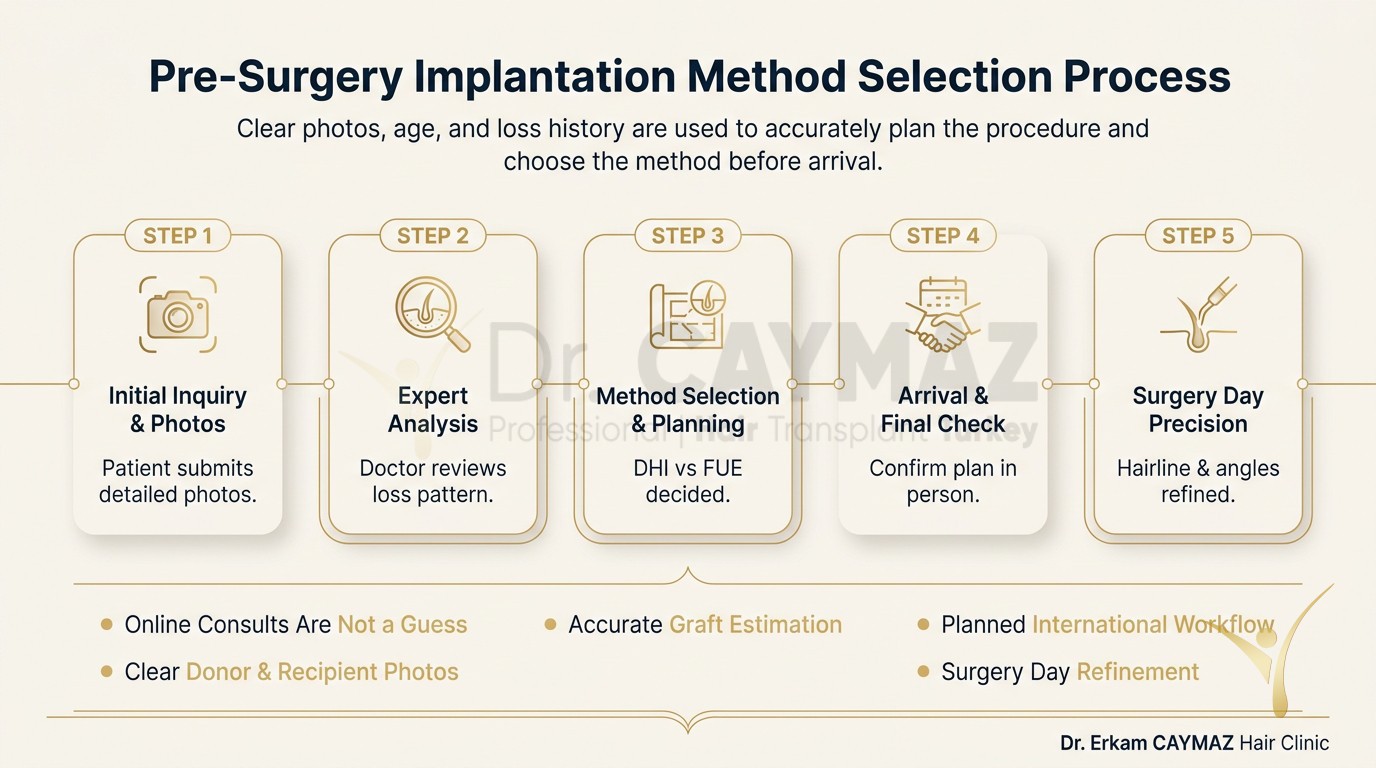
Online consults are not a guess. Clear photos of the donor strip, crown, hairline, and temples, plus your age and loss history, are enough to estimate graft need and choose an implantation workflow. That is how most international patients are planned here.
Surgery day still matters for hairline drawing, angle checks, and VIP recipient work under magnification. Those steps refine design and execution. They do not reopen a brand-new “FUE or DHI?” debate after anesthesia. If photos were incomplete, the clinic asks for better images before you fly, rather than improvising a method change in the OR.
You can see where implantation sits in the full workflow on the hair transplant procedure steps overview.
What Differs Between Sapphire FUE and DHI Implantation?
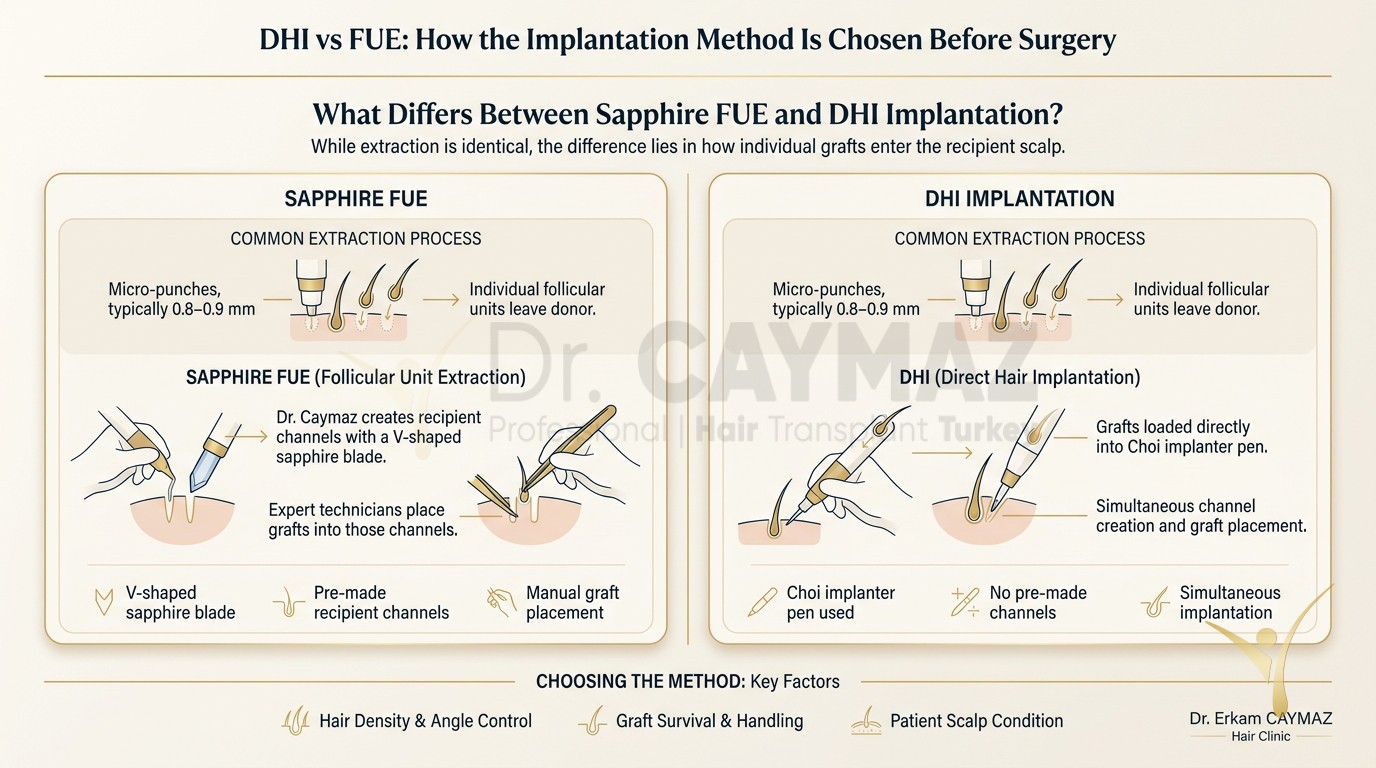
Extraction is the same family of work for both: individual follicular units leave the donor with micro-punches, canonically 0.8-0.9 mm. The difference is how grafts enter the recipient scalp.
In Sapphire FUE, the surgeon creates recipient channels with a V-shaped sapphire blade, then expert technicians place grafts into those channels under direct supervision. Incision design, depth, and direction stay under surgeon control. That is why Sapphire FUE is the clinic’s usual standard for broad coverage and clear density mapping. For instrument detail, see the Sapphire FUE technique.
In DHI (Direct Hair Implantation), a Choi implanter combines channel creation and placement in one motion. That helps when a plan must thread grafts through dense surviving native hair, or when a small, irregular target was already identified on photos. It is a tool choice for those maps, not a claim that DHI beats Sapphire FUE overall.
Neither method is universally superior. Matched planning beats marketing names. The pillar comparison on DHI vs Sapphire FUE keeps the same equal-outcomes rule.
When Might DHI Be Planned From Remote Photos?

DHI enters the written plan when photo review shows a clear indication, for example:
Dense native hair in a thinning zone. If mid-scalp photos still show many surviving follicles, a Choi workflow can reduce the chance of cutting those hairs with a full row of pre-made slits. That is planned from images, not announced as a surprise upgrade on the morning of surgery.
Small or irregular targets. Temple points, scar camouflage, or limited patches sometimes fit an implanter workflow better when the photos already show a tight geometry. Related small-zone work appears in topics such as eyebrow transplantation.
Selected tension or thin-skin notes from history and photos. When the remote file shows channels that will not hold well for a long batch-placement phase, the plan favors one-step implanter placement in that limited zone.
Limits and candidacy detail live in DHI indications and limits. If photos do not support those indications, the default here stays Sapphire FUE.
Why Does Sapphire FUE Remain the Usual Plan?
Most cases sent to the clinic need broad coverage, a clear density gradient, and efficient placement for larger graft counts. Sapphire FUE fits that pattern. Pre-made sapphire channels let the surgeon set the full architectural map before batch placement. For many Norwood patterns with open recipient skin, that is the cleaner clinical fit.
High graft counts also favor the Sapphire FUE workflow. Choi pens load one graft at a time. Past roughly 2,500, 3,000 grafts, reload time lengthens the day. Longer days can stress the last graft batches. Sapphire FUE batch placement usually keeps large sessions inside a practical 6, 8 hour window.
Advanced patterns and multi-session thinking appear in the Norwood 5, 6, 7 case studies. Those plans still start from remote photos and almost always center on Sapphire FUE unless a defined DHI indication is already visible.
Dr. Caymaz Insight
| I tell patients there is no magic acronym. A good Sapphire FUE case and a good DHI case both look natural when the plan fits the scalp. I generally prefer Sapphire FUE and I do not market DHI as a better technique. We lock the method from the photos you send on WhatsApp or email before you travel. On surgery day I design the hairline and run the VIP recipient work according to that plan. We do not change the implantation technique in the operating room. |
Can Both Techniques Appear in One Planned Session?
Yes, when the remote plan already says so. A hybrid session uses sapphire channels in a bare vertex and Choi placement in a frontal zone that still holds native hair. Extraction stays identical. Grafts are sorted by unit size. Singles still go to the hairline. The only difference is which planned recipient workflow each zone uses.
Hybrid work needs a team fluent in both placement styles. With only 1, 2 VIP operations per day, the clinic can keep that pace without rushing. Hybrid is never an OR-day surprise swap. If you want clinic context for that slow intake model, see about the clinic.
How Does Technique Choice Affect Recovery and Results?
Patients worry that choosing DHI or Sapphire FUE will rewrite their recovery. The differences are small next to shared biology.
| Factor | Sapphire FUE | DHI (Choi) |
|---|---|---|
| Recipient crusting | About 7, 12 days | About 7, 10 days |
| Edema risk | Moderate (days 2, 5) | Often similar; may be lower in tiny zones |
| Graft survival | Up to 98% when handled well | Up to 98% when handled well |
| Typical efficient graft range | Up to about 4,000, 4,500 | Often up to about 2,500, 3,000 |
| Best clinical fit | Broad bald areas, density map control | Selected native-hair or small-zone plans |
| First clinic wash | Day 2 post-op | Day 2 post-op |
| Final maturity | 12, 15 months | 12, 15 months |
Graft survival and final density track surgical quality, not the brand name on the tool. Growth still follows the same cycle: shedding, early sprouts around months 3, 6, maturity by 12, 15 months. The recovery timeline milestones apply either way.
Aftercare is the same path. The clinic standard is a first wash on day 2 post-op, with donor bandage removal at that visit. The first-wash protocol after surgery does not change because grafts arrived through a sapphire channel or a Choi needle.
What Should You Ask Before You Travel?
Useful questions focus on the plan you already received from photos, not on OR-day improvisation.
“Which method is in my written plan, and why?” You should hear a clear Sapphire FUE default, or a specific reason DHI or hybrid appears.
“Will you change the implantation technique on surgery day?” Here the answer is no. Design details are confirmed in person. The method itself stays as planned from remote photos.
“How does technique affect price?” Some clinics treat DHI as a surcharge brand. At this clinic, listed DHI packages sit below Sapphire FUE VIP bands, and technique follows clinical fit. See pricing and packages for current ranges.
“Who performs recipient work?” In VIP care, the operating surgeon handles hairline design and sapphire recipient channels (The Architect Touch™). Placement is done by expert technicians under his supervision. For planned DHI zones, implant work follows that same surgeon-led plan.
Does DHI vs FUE Change Donor Area Management?
No. Harvesting stays FUE with the same safe-zone rules and 0.8-0.9 mm punches whether grafts later enter sapphire channels or Choi pens. Donor spacing and punch choice are not rewritten by the implantation label. For larger patterns, multi-session planning still protects the donor area better than one oversized harvest.
Density without donor damage remains a higher-level rule than any tool brand. See density versus donor balance for that planning principle.
Red Flags: Technique Marketing That Isn't Clinical
DHI sold as “newer and better.” Choi implantation has been used for years. Calling it automatically superior without photo-based reasons is branding, not planning.
Day-of-surgery upsells. If a coordinator suddenly says you “need DHI” for an extra fee after you arrive, that is commercial pressure. A legitimate plan was already explained from your photos.
No surgeon ownership of the plan. The person responsible for VIP recipient design should own the Sapphire FUE vs DHI explanation before travel, not a script that changes at the door.
Tools serve the scalp map. A careful Sapphire FUE case will beat a rushed DHI case, and the reverse is also true. What you want is a surgeon who chose the method from your photos for clinical reasons, then stuck to that plan on surgery day.
Sources & clinical references
FAQ
No. There is no superior technique, only a well-matched plan and a skilled surgical team. Both Sapphire FUE and DHI can deliver natural density when extraction, incision design, and placement are done correctly. Graft survival can reach up to 98% with either method in experienced hands.
No. At Dr. Caymaz's clinic the technique is planned before you travel, using the photos you send by WhatsApp or email plus your history. Surgery day confirms the hairline design and execution details. The implantation method itself is not changed on the operating table.
No. Dr. Caymaz generally prefers Sapphire FUE for most cases. DHI may be planned when remote photos show a selected indication, such as dense native hair in a small recipient zone. Preferring Sapphire FUE is a clinical default, not a claim that DHI is inferior.
DHI may be planned when photo review shows dense surviving native hair that should be preserved, a small or irregular recipient target, or another indication where a Choi implanter fits better. Those decisions are made in advance from remote photos, not as a last-minute upgrade on surgery day.
At this clinic, DHI packages sit in a lower listed price band than Sapphire FUE VIP packages (€5,000–€6,000 vs €6,500–€7,500). Exact pricing still depends on graft count and case review. Technique is chosen for clinical fit, not as a premium upsell.
Recovery timelines are nearly the same. Crusting lasts about 7–12 days for both. The first clinic wash is on day 2 post-op regardless of method. Final maturity appears around 12–15 months for both techniques.
Yes, but only when that hybrid plan is set before surgery from the photo review. Extraction stays FUE with 0.8–0.9 mm punches. Different recipient zones may use sapphire channels or Choi implanters if that mix was planned in advance.
No. Grafts are harvested the same way for both methods: individual FUE punches from the safe donor zone. Implantation method does not change punch size or donor spacing rules.
You can ask about either method, but the plan should follow your photos and donor map. Insisting on a brand name without clinical fit can limit options. A clear explanation of why Sapphire FUE or DHI was chosen for your case is the right standard.
Dr. Caymaz sets the plan after reviewing your remote photos and medical history. On surgery day he designs the hairline and performs VIP recipient work according to that pre-agreed plan. The team does not switch techniques once you are in the operating room.

Psychological Processes Before and After Hair Transplantation
Hair transplantation has a psychological timeline as well as a surgical timeline. Anxiety often rises during early…
Read More: Psychological Processes Before and After Hair Transplantation
What Happens During a FUE Hair Transplant Day?
A FUE hair transplant procedure typically spans 6 to 8 hours in a single day. The morning begins with blood work, scalp…
Read More: What Happens During a FUE Hair Transplant Day?
Will I Feel Pain During Hair Transplantation?
Pain during hair transplantation is one of the first questions patients ask, and one of the most misunderstood. Modern…
Read More: Will I Feel Pain During Hair Transplantation?
Planning for Hair Transplantation
Hair transplantation is not only about how many grafts can be extracted on surgery day. Long before channels are…
Read More: Planning for Hair TransplantationDHI Hair Transplant — Frequently Asked Questions
Expert Answers by Dr. Erkam Caymaz, Istanbul