


Quick Numbers
| Typical lowering with surgery | About 1–3 cm |
|---|---|
| Surgery scar | Along the hairline |
| Transplant final result | 12–18 months |
| Gap between transplant sessions | At least 6 months |
| What we perform | Hair transplants only |
Key Takeaways
| Hairline lowering surgery removes a strip of forehead skin and moves the scalp forward. A hair transplant places new grafts below the existing hairline. |
| Surgery gives an immediate result in one operation but leaves a scar along the hairline and needs a flexible scalp. |
| A transplant leaves no forehead scar, can reshape the temples and suits progressive hair loss, but takes 12–18 months to mature. |
| Hairline lowering is mainly for a naturally high forehead without hair loss. Men with a receding hairline are usually better served by a transplant. |
| We perform hair transplants only. Forehead reduction is a plastic surgery procedure done by other specialists. |
A high forehead can be something you were born with or the result of a hairline that has moved back over the years. Either way, there are two ways to bring the hairline down: a surgical procedure that shortens the forehead, and a hair transplant that adds hair below the existing hairline. They work in completely different ways and suit different people.
We perform hair transplants, not forehead reduction. This comparison is meant to help you understand both options honestly, so you can tell which one fits your situation before you speak to a surgeon.
What is the difference between hairline lowering and a hair transplant?
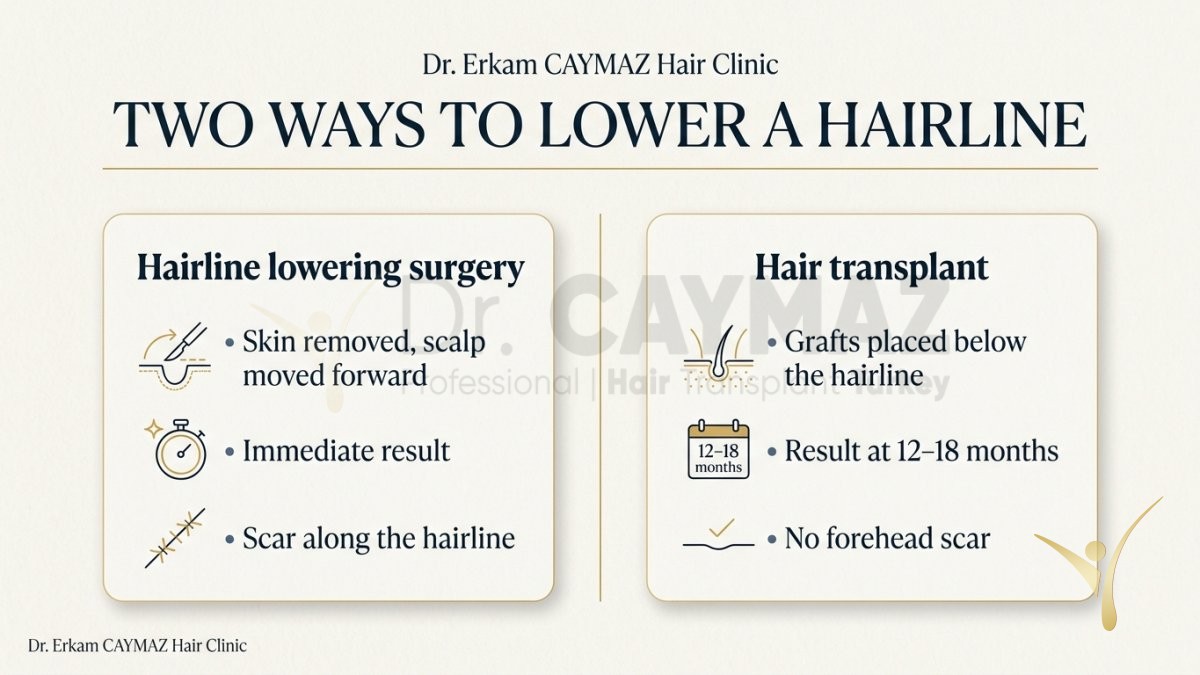
Hairline lowering surgery, also called forehead reduction, shortens the forehead itself. A strip of skin is removed just in front of the hairline, and the scalp behind it is loosened and moved forward. The hair you already have ends up lower on the forehead.
A hair transplant doesn't move the scalp. It takes follicular units from the donor area at the back of the head and places them in front of the current hairline, creating a new, lower hairline from your own hair. The forehead skin stays as it is.
So the first is a skin operation with an instant result, and the second is a hair-restoration procedure whose result grows in over the following year.
How does hairline lowering surgery work?
The procedure is performed by plastic or facial surgeons. An incision is made along the front of the hairline, usually in an irregular pattern that follows the natural edge of the hair. The surgeon removes the planned strip of forehead skin, frees the scalp so it can slide forward, and closes the wound. Many surgeons use a closure technique that allows hair to grow through the scar over time, which helps hide it.
How far the hairline can come down depends on how flexible the scalp is. In published series, the typical lowering is around 1 to 3 cm. A tight scalp limits the movement, and some patients need a tissue expander first to stretch the scalp.
The trade-offs are a permanent scar right at the front of the hairline, numbness on top of the head that often lasts for months, and the possibility of temporary hair shedding near the incision. The temple corners are also harder to change with this method.
How does a hair transplant lower the hairline?
With a transplant, the new hairline is drawn on the forehead before surgery. Dr. Caymaz designs it personally, using the facial proportions, the temple points and the natural direction of the hair as references. The front edge is built from single-hair grafts so that it looks soft rather than sharp. Our article on the anatomy of the frontal hairline explains these details.
The grafts are then implanted into the area below the old hairline. In our clinic, the channels are opened with sapphire blades, and the technicians implant the grafts under the surgeon's direct supervision. There's no incision on the forehead and no linear scar. The donor area at the back heals with small dot scars hidden in the hair.
The result isn't immediate. The transplanted hairs shed in the first weeks, new growth begins around the third month, and the final density takes 12 to 18 months. Lowering a large area at good density can need more grafts than one session should take, so some patients plan a second session at least six months later. More detail on the procedure is on our frontal hair transplant page.
Hairline lowering vs hair transplant at a glance
| Factor | Hairline lowering surgery | Hair transplant |
|---|---|---|
| How it works | Removes forehead skin and moves the scalp forward | Places grafts below the existing hairline |
| Result | Immediate, in one operation | Gradual, final at 12–18 months |
| Scar | Along the front of the hairline | Small dots in the donor area, none on the forehead |
| Temples | Hard to reshape | Can be reshaped and rounded |
| Progressive hair loss | Not suitable | Can be planned around |
| Main requirement | A flexible scalp | A good donor area |
| Performed by | Plastic or facial surgeons | Hair transplant surgeons (our clinic) |
Who is a good candidate for each?
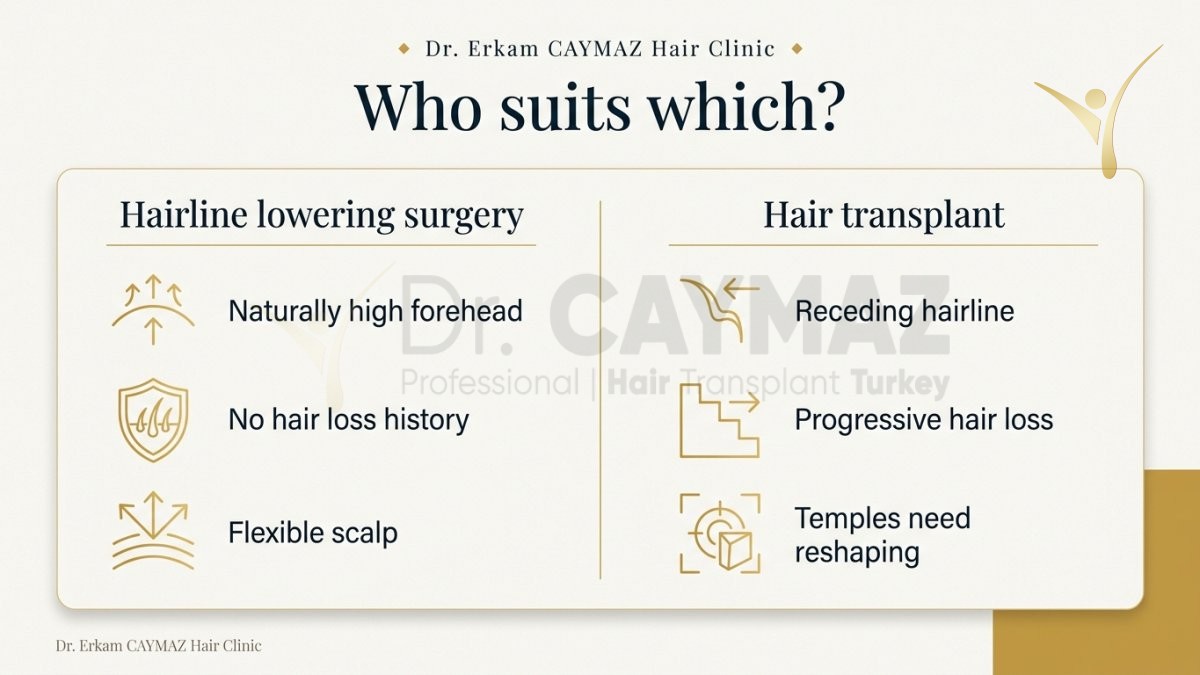
Hairline lowering surgery is usually considered for people with a naturally high forehead, a stable hairline with no history of pattern hair loss, dense hair at the front and a scalp that moves easily. Many of them are women who have always had a tall forehead and want it shorter in a single step.
A hair transplant suits a wider range of people. It works for a hairline that has receded, for temples that need reshaping, for a high forehead in someone whose scalp is too tight for surgery, and for anyone who doesn't want a scar at the front of the hairline. Women with a high forehead can be good candidates too, as our article on hair transplants for women's hairlines explains.
Some people combine both over time: forehead reduction first, then a small transplant to soften the scar line or refine the temples. That's a decision for the surgeons involved, based on each person's anatomy.
What about men with a receding hairline?
For most men, hairline lowering surgery is the wrong tool. Male pattern hair loss usually continues over the years. If the hairline is brought forward surgically and the hair behind it keeps thinning, the scar at the front can become visible and the hair can recede from the new edge.
A hair transplant can be planned around that progression. Transplanted hair comes from the donor area, which is naturally resistant to DHT, and the hairline can be designed at a height that will still look natural in ten or twenty years. Medication is often recommended alongside to protect the native hair. If you're at Norwood 4 or higher, plan for at least two sessions rather than one large one.
Dr. Caymaz Insight
| When someone asks me about forehead reduction, my first question is whether they're losing hair. If the forehead is high by nature and the hair is stable, a plastic surgeon may be the right person to see, and I tell patients that honestly. If there's any sign of pattern hair loss, I'd rather lower the hairline with grafts, because I can design it around the loss that's still coming. Either way, the new hairline has to suit the face for the next twenty years, not only the first few months. |
How do you choose between them?
Start with three questions. Is your forehead high by nature, or has the hairline moved back? Is there any pattern hair loss in you or your family? And would a scar at the front of the hairline bother you if your hair were ever cut short or pulled back?
If your forehead is naturally high, your hair is stable and you want an immediate change, it makes sense to consult a plastic surgeon about hairline lowering. If your hairline has receded, your temples need shaping or you'd rather avoid a forehead scar, a hair transplant is usually the better fit.
To find out what a transplant could do in your case, send clear photos of the front, top, crown and back of your head. Dr. Caymaz will review your hairline, your donor area and the number of grafts needed, and tell you honestly if surgery by another specialist would serve you better.
Scientific Sources
FAQ
Hairline lowering surgery shortens the forehead by removing a strip of skin and moving the scalp forward. A hair transplant leaves the forehead skin alone and places follicular units from the back of the head below the existing hairline to create a new, lower one.
It depends on how flexible the scalp is. In published series the typical lowering is around 1 to 3 cm. A tight scalp limits the movement, and some patients need a tissue expander first.
Yes, along the front of the hairline. Many surgeons use a closure that lets hair grow through the scar to help hide it, but the scar is permanent and can show if hair is cut short or pulled back.
Usually, yes. Male pattern hair loss tends to continue, and a surgically advanced hairline can recede again and expose the scar. A transplant uses DHT-resistant donor hair and can be designed around future loss, often alongside medication.
New growth starts around the third month and the final result takes 12 to 18 months. A large lowering at good density may need a second session at least six months after the first.
Yes. Women with a naturally high forehead can be good candidates for a transplant, especially if their scalp is too tight for surgery or they want to avoid a scar at the front of the hairline.
No. We perform hair transplants only. Forehead reduction is a plastic surgery procedure carried out by other specialists, and Dr. Caymaz will tell you honestly if that route would suit you better.

Donor Area Shock Loss After Hair Transplantation: Mechanisms, Risk Factors, and Management
Donor area shock loss is temporary shedding of native hairs in the harvest zone after FUE, usually visible within weeks…
Read More: Donor Area Shock Loss After Hair Transplantation: Mechanisms, Risk Factors, and Management
Tummy Tuck Surgery | Abdominoplasty
Abdominoplasty removes loose abdominal skin and may repair diastasis recti when diet and exercise cannot restore…
Read More: Tummy Tuck Surgery | Abdominoplasty
Afro-American Hair Transplantation from Hair Upload
Afro-textured hair transplants need curved-follicle extraction, slower punch work, and donor-safe density planning…
Read More: Afro-American Hair Transplantation from Hair Upload
Good Hair Transplant Candidates: Eligibility and Success Factors
Good Hair Transplant Candidates and What Must Be True Featured Snippet A good hair transplant candidate must have a…
Read More: Good Hair Transplant Candidates: Eligibility and Success FactorsHairline Design — Frequently Asked Questions
Expert Answers by Dr. Erkam Caymaz, Istanbul