Hair transplant scar repair cover

Quick Numbers

At-a-glance figures
Typical FUT strip scar15–20 cm long
Wait before repairAt least 9–12 months
Our extraction punch0.8–0.9 mm
Final result in the scar12–18 months
Second passSometimes needed

Key Takeaways

Key takeaways summary
A FUT strip scar can usually be softened by placing FUE grafts directly into the scar line, so it blends in with shorter hair.
Scar tissue has a weaker blood supply than normal scalp, so grafts grow less reliably there and some patients need a second pass.
FUE dot scars rarely need repair on their own. The real problem is an overharvested donor area with visible thin patches.
Every repair draws on the same limited donor supply, so the plan starts with an honest count of the healthy hair you have left.
The goal is a scar you can live with at your preferred hair length, not a scar that disappears.

Many of the patients who contact us about scars had their first surgery years ago. Some had a strip operation and now want to wear their hair short. Others had an FUE session elsewhere and noticed thin, patchy areas at the back of the head once the hair was clipped. In both cases the question is the same: can the scar be made less visible, and what will it cost in donor hair?

This guide explains the two kinds of donor scars, what a repair can and can't do, and how we plan one.

What scars does a hair transplant leave?
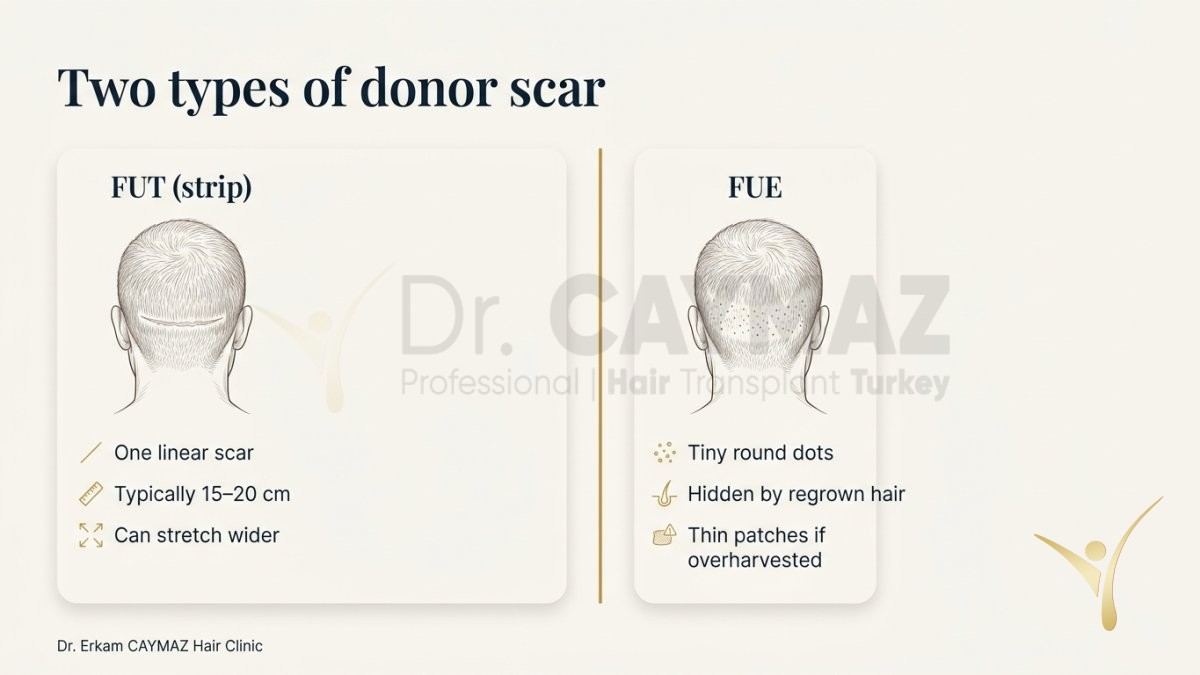
Infographic comparing donor scars: FUT leaves one linear scar, typically 15–20 cm, that can stretch wider; FUE leaves tiny round dots hidden by regrown hair, with thin patches only if overharvested
A strip scar is one line you can graft into; FUE dots only become a problem when too many grafts come from one zone.

Every hair transplant leaves some scarring where the grafts were taken. The type depends on the method used.

A FUT (strip) operation removes a long, thin strip of scalp from the back of the head and closes the wound with stitches. It leaves a single linear scar, typically about 15–20 cm long. When it heals well it's a fine line hidden by hair a couple of centimeters long. When the scalp was tight or the closure was under tension, it can stretch to several millimeters wide, and the hair along its edges may thin. You can read more about how the strip is taken on our FUT technique page.

An FUE operation takes grafts one by one with a small round punch. It leaves many tiny round scars spread between the remaining hairs. With a sensible number of grafts taken evenly, they're hard to see once the hair grows back. Problems appear when too many grafts come from one zone, which leaves the donor area looking thin or patchy.

Can hair be transplanted into a FUT scar?

Yes, in most cases. Grafts are taken with FUE from healthy donor hair and placed directly into the scar line, in the same direction as the surrounding hair. Once they grow, the hairs break up the straight edge of the scar, which is what makes it noticeable at short lengths.

A strip scar is narrow, so the number of grafts needed is usually modest: a few hundred rather than thousands, depending on its length and width. That matters, because every graft used for the scar is a graft that can't be used for the hairline or the crown later.

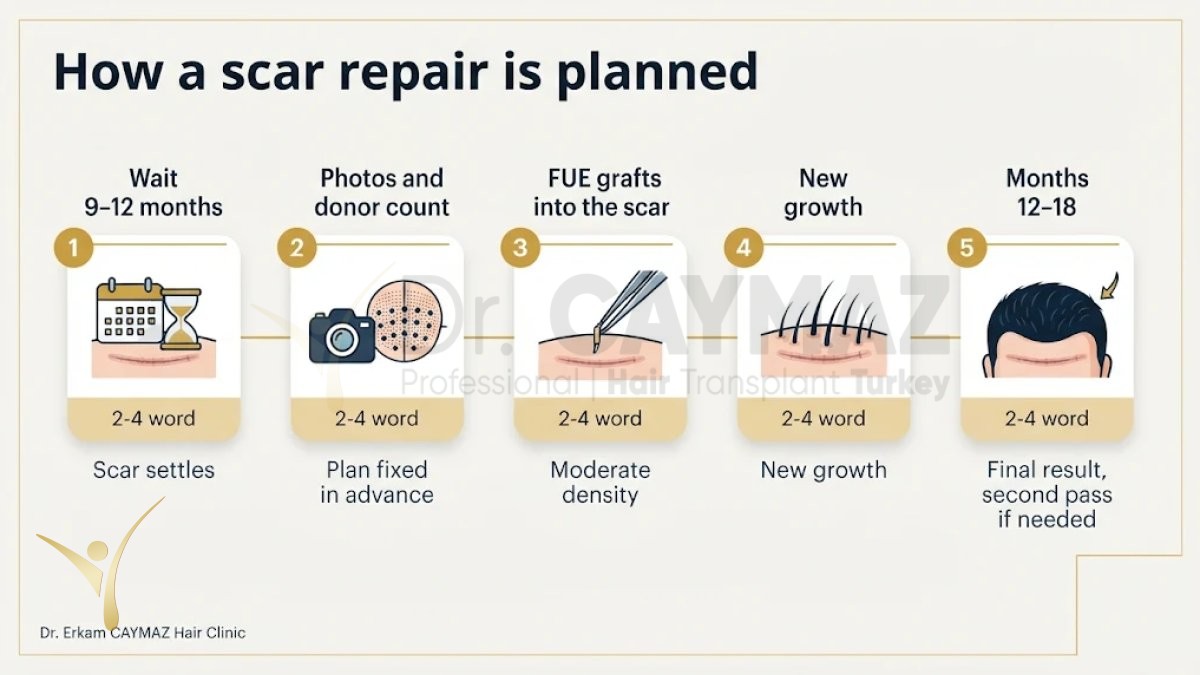
Timing is important. A strip scar keeps remodeling for months after surgery, so we wait at least 9–12 months after the original operation before planning a repair. Our article on revision surgery explains why waiting gives a clearer picture.

How well do grafts grow in scar tissue?

Less reliably than in normal scalp. Scar tissue is firmer and has fewer small blood vessels, and a newly placed graft depends on that blood supply to survive its first days. Studies on grafting into scars report good results in many patients, but growth is generally lower and more variable than in an untouched recipient area.

For that reason we place grafts at a moderate density in the scar instead of packing them tightly. Crowding a poorly supplied area tends to reduce growth further. If the first session leaves gaps, a second, smaller pass can be planned once the result is clear, at least six months later.

It's also why we're careful with promises. A well-planned repair usually turns an obvious line into one that's hard to notice with hair a few millimeters longer than a skin fade. It rarely makes the scar invisible on a shaved head.

Scar repair options compared

Common ways to make a donor scar less visible
OptionWhat it doesMain limitation
FUE grafts into the scarPuts growing hair into the scar line itselfLower growth in scar tissue; uses donor grafts
Scar revision surgeryCuts out a wide scar and closes it againCan widen again on a tight scalp; leaves a new scar
Scalp micropigmentationTattooed dots that imitate short hair stubbleFades over time; only works with very short hair
Keeping hair longerCovers the scar without any procedureLimits hairstyles; doesn't change the scar

In our clinic, repair means FUE grafting. Scar revision surgery and scalp micropigmentation are done by other specialists, and we mention them here so you can compare. Some patients combine approaches, for example grafting first and adding pigmentation later if they want to wear their hair very short.

What can be done about FUE dot scars and an overharvested donor?

Single FUE dot scars rarely need treatment. They're small, spread out and covered by hair of a normal length. What brings patients to us is overharvesting: too many grafts taken from a small zone, or taken unevenly, so the back of the head looks see-through or moth-eaten.

This is harder to fix than a strip scar, because the problem is missing donor hair, and the same donor area is the main source for any repair. The usual approach is to take a limited number of grafts from the denser zones that remain and spread them into the thinnest patches, so the density looks even again. When the scalp donor is badly depleted, beard or body hair can sometimes add grafts.

Before any harvesting we check that the patch isn't temporary hair loss. Thinning around the donor area in the first months after surgery can be donor shock loss, which often recovers on its own.

Dr. Caymaz Insight

Clinical perspective from Dr. Erkam Caymaz
When I look at a scar repair case, I'm looking at the donor area first and the scar second. A strip scar is usually the easier part. The difficult cases are patients who've lost too much donor hair to an earlier operation and still want a fuller hairline. Then we have to choose where the remaining grafts do the most good, and sometimes the honest answer is that the scar should wait. I'd rather tell a patient that now than spend grafts they'll need later.

How is a scar repair planned?

Timeline infographic of a scar repair: wait 9–12 months, photos and donor count, FUE grafts into the scar at moderate density, final result at 12–18 months with a second pass if needed
The plan is fixed from photos before the operation day, and the scar is judged again once the hair has fully grown.

Planning starts with photos. We ask for clear pictures of the back and sides of the head with the hair clipped short, plus the front, top and crown. From these we judge the scar's length and width, the density of the remaining donor hair and how much hair loss may still come.

Then comes the donor calculation. Earlier strip surgery and any previous FUE both reduce the hair available, and the scar has to compete with the hairline and crown for the same grafts. We don't overharvest to fix a donor problem, because that would only create a new one. If your earlier result also needs work at the front, our guide to correcting a failed transplant explains how we set priorities.

The technique and the number of grafts are agreed before the operation day, based on those photos. As with any of our operations, Dr. Caymaz reviews each case personally and designs the plan.

What does recovery look like?

Recovery is the same as after a standard FUE procedure. The tiny extraction sites heal within days, and most people return to desk work after about a week. The first wash is on day 2.

  • First 2 weeks: small crusts in the scar and donor area fall away.
  • Weeks 2 to 8: most transplanted hairs shed. This is normal; the follicles stay in the skin.
  • Around month 3: new hair starts to grow, often a little later in scar tissue.
  • Months 12 to 18: the final result, when we judge if a second pass would help.

Is a scar repair worth it?

For most people with a visible strip scar, yes. A few hundred grafts can make short haircuts possible again, and the procedure is gentle compared with the original strip surgery. It's less straightforward when the donor area is already thin, because each graft has to be spent carefully.

The best protection is still prevention. Choosing a clinic that plans conservatively, spreads extraction evenly and avoids mega-sessions keeps donor scars small from the start. If you already have a scar you'd like to improve, send us clear photos of your donor area and we'll tell you what a repair can realistically achieve.

Scientific sources

FAQ

Rarely. A repair aims to make the scar hard to notice at your preferred hair length, not to make it disappear. Grafts placed into a strip scar break up its straight edge, so it blends in with hair a few millimeters longer than a skin fade.

Yes. Grafts taken with FUE can be placed directly into a strip scar and usually grow, although less reliably than in normal scalp, because scar tissue has a weaker blood supply. Some patients need a second, smaller pass at least six months later.

Usually a few hundred rather than thousands, depending on the length and width of the scar. Because these grafts come from the same donor area as any future hairline or crown work, the plan always starts with a count of the healthy donor hair that remains.

At least 9 to 12 months after the original operation. A strip scar keeps remodeling for months, and grafting into a scar that has settled gives a more predictable result.

Single FUE dot scars rarely need repair because they are small and covered by normal hair. The harder problem is overharvesting, where too many grafts were taken from one zone. Then grafts from denser remaining zones are spread into the thin patches, and beard or body hair can sometimes help.

They do different things. Grafting puts growing hair into the scar, while scalp micropigmentation tattoos dots that imitate stubble and works best with very short hair. Some patients combine both. In our clinic, repair means FUE grafting; micropigmentation is done by other specialists.

It is the same as after a standard FUE procedure. Small crusts fall away within about two weeks, most transplanted hairs shed between weeks 2 and 8, new growth starts around month 3, often a little later in scar tissue, and the final result is judged at 12 to 18 months.

Frequently Asked Questions

Professional Hair Transplant Insights by Dr. Erkam Caymaz

Who is Dr. Erkam Caymaz and what are his medical credentials?
Dr. Erkam Caymaz is a hair restoration surgeon in Istanbul with 15+ years of clinical experience, 9,271+ patients and 5,184+ hair transplant procedures. He is certified by the American Academy of Aesthetic Medicine (AAAM) and is a member of FUE Europe and the World FUE Institute (WFI). He trained as a cardiovascular surgeon, and that background informs the precision and safety protocols applied in every VIP procedure at the clinic.
Which hair transplant techniques are offered at the clinic?
The clinic performs Sapphire FUE and DHI (Direct Hair Implantation) for scalp, beard, and eyebrow restoration. Sapphire FUE uses V-shaped sapphire blades to open recipient channels after micro-motor FUE extraction with a typical 0.8–0.9 mm punch. DHI uses a Choi implanter pen for direct graft placement. Technique choice depends on your clinical plan, not on one method being universally superior.
What is included in the all-inclusive hair transplant packages?
Packages include the hair transplant procedure, pre-operative blood tests, local anesthesia, post-operative medications, a specialized shampoo and foam care kit, VIP airport and clinic transfers, and three nights in a four- or five-star hotel. Structured post-operative follow-up includes scheduled photo check-ins and a 12-month clinical review. All-inclusive VIP packages typically range from €6,000–€8,000 depending on graft count (base €2–4 per graft). DHI packages are commonly €5,000–€6,000; Sapphire FUE €6,500–€8,000. Exact pricing is confirmed after consultation — see our hair transplant cost guide.
Is a hair transplant in Turkey safe, and what are the clinical standards?
Yes, when performed in an accredited facility under qualified surgical supervision. Procedures at our clinic follow European sterilization standards, appropriate single-use instruments, and documented infection-control protocols. Istanbul has become a major hub for hair restoration because experienced teams combine modern equipment with structured patient pathways.
Does the hair transplant procedure hurt?
The procedure is performed under local anesthesia, so the scalp is numbed before extraction and implantation. Most patients describe pressure rather than sharp pain during the session. Mild soreness for a few days afterward is normal and is managed with prescribed analgesics from your post-operative kit.
How long is the recovery period, and when can I return to work?
Many patients return to desk-based work within 5–7 days. Scabs in the donor and recipient areas are washed off at the 10th wash, on post-op day 11; mild redness can take a little longer to fade. Strenuous exercise, swimming, and saunas should wait until your team clears you, typically after the first couple of weeks.
What is shock loss, and is it normal after a hair transplant?
Shock loss is temporary shedding of transplanted hairs 2–4 weeks after surgery as follicles enter a resting phase. It is expected and does not mean the grafts have failed. New growth typically begins around months 3–4 as follicles re-enter the growth cycle.
When will I see the final results of my hair transplant?
Visible early growth often appears around months 3–4, with meaningful density gains by month 6. Final maturation and blending with native hair usually occur between 12 and 18 months. Timelines vary with graft count, hair characteristics, and adherence to aftercare.
Are hair transplant results permanent?
Hair from the safe donor zone (back and sides) is genetically more resistant to DHT, the hormone linked to androgenetic hair loss. Transplanted follicles that survive typically continue producing hair long term. We do not promise lifetime aesthetic outcomes; permanence reflects donor biology, not a guarantee certificate.
Why are hair transplants in Turkey more affordable than in the US or UK?
Lower operating costs, favorable exchange rates, and competitive clinical markets allow high-quality care at lower prices than in Western Europe or North America. Our transparent VIP packages (typically €6,000–€8,000 in total, depending on graft count) reflect full inclusions rather than hidden add-ons common abroad.
How does a hair transplant work?
Individual follicular units are harvested from the permanent donor area, usually the back of the scalp, processed under magnification, and implanted into thinning or bald recipient zones. Blood supply must re-establish for grafts to survive; proper channel angle, depth, and handling protect follicles during transfer.
Will my hair transplant results look natural?
Natural results depend on hairline design, graft distribution, angulation, and matching native hair direction. Dr. Caymaz plans each hairline individually rather than using a template pattern. Density is balanced with donor safety so the result looks age-appropriate, not pluggy.
How long does the hair transplant procedure take?
A typical session runs 6–8 hours under local anesthesia, often starting around 08:00–09:00 and finishing between 14:00 and 16:00. Duration depends on graft count, technique, and any combined areas such as beard work. You remain awake and can take short breaks.
How much does a hair transplant cost at your clinic?
All-inclusive VIP packages are typically €6,000–€8,000 in total: Sapphire FUE €6,500–€8,000, DHI €5,000–€6,000. The base cost is about €2–4 per graft, so the final figure depends on how many grafts you need (most single sessions are 2,500–4,500 grafts). Exact pricing is confirmed after photo review and consultation — see our hair transplant cost guide. Packages cover surgery, hotel, transfers, medications, and structured 12-month follow-up, not hidden clinic fees.
How many grafts do I need for a hair transplant?
Graft need depends on Norwood stage, crown involvement, desired density, and donor quality. Moderate hairline work may require 2,000–3,000 grafts; advanced patterns often need 3,500–5,500 or a staged two-session plan. We prioritize donor preservation over maximum single-session counts.
Will people notice that I had a hair transplant?
In the first 11–12 days, short hair, redness, and scabbing can be visible. After crusts shed and hair grows longer, results become discreet. A well-designed hairline and gradual density rarely attract attention once healing is complete.
When does transplanted hair start growing?
After shock loss, new shafts commonly emerge around months 3–4. Growth accelerates through months 6–9 and continues maturing to 12–18 months. Early hairs may be fine or curly before normalizing in texture.
Do you perform hair transplants for both men and women?
Yes. We treat male pattern baldness and selected female hair-loss patterns where a transplant is clinically appropriate. Women may require additional evaluation for diffuse thinning, traction alopecia, or hormonal contributors before surgery is recommended.
Is there a minimum or maximum age for a hair transplant?
There is no fixed legal age, but we prefer stable hair-loss patterns, often after the mid-20s for men. Young patients with rapidly progressing loss may benefit from medical therapy first. There is no upper age limit if health screening and donor quality are satisfactory.
How should I choose a hair transplant surgeon?
Evaluate surgical credentials, verifiable experience, before-and-after cases, sterilization standards, and who performs incisions versus graft placement. Avoid clinics that promise guaranteed density or lifetime outcome certificates. A surgeon-led VIP model with limited daily volume supports quality control.
Will transplanted hair match my existing hair?
Grafts come from your own donor hair, so color, caliber, and curl generally match native hair. Minor texture changes can occur temporarily during early regrowth. Beard or body donor hair may differ slightly and is used only when clinically indicated.
What is the difference between FUE and FUT?
FUE extracts individual follicular units with a micro punch, leaving scattered dot scars in the donor area. FUT removes a strip of scalp and closes the wound with a linear scar, then dissects grafts from the strip. We primarily perform FUE and Sapphire FUE; FUT is discussed only if donor characteristics favor it.
Who designs and opens the recipient channels?
In VIP operations, Dr. Caymaz personally plans the hairline and opens recipient incisions (channels). Graft extraction and implantation are performed by expert surgical technicians under his direct supervision, following the planned angles and density map.
How many days should I stay in Istanbul for a hair transplant?
Plan for three nights of accommodation included in standard packages, covering consultation, surgery day, and the first post-operative wash. Many patients arrive the day before surgery and depart 2–3 days after. Your coordinator confirms the exact schedule before travel.
When is it safe to fly home after a hair transplant?
Most patients fly home 2–3 days after the procedure once the first clinic wash and dressing check are completed. Cabin pressure is generally tolerated; we advise loose headwear and hydration. Long-haul flights are common and safe when post-operative instructions are followed.
Are pre-operative blood tests required?
Yes. Standard pre-op labs screen blood counts, clotting, and infections as appropriate for surgical safety. Tests are arranged through the clinic and included in package pricing. Results must be reviewed before anesthesia on surgery day.
Should I continue finasteride or minoxidil around surgery?
Do not stop prescribed medications without medical guidance. Finasteride and minoxidil may be continued in many cases, but timing around surgery day is individualized. Your coordinator will confirm what to pause or resume based on your history.
When can I return to the gym, swimming, or saunas?
Avoid heavy sweating, swimming pools, saunas, and strenuous lifting for about 2–3 weeks to protect grafts and donor healing. Light walking is encouraged early. Clearance for full gym activity is given at follow-up photo reviews.
How should I sleep during the first week after surgery?
Sleep with your head elevated on pillows to reduce swelling. Avoid rubbing the grafts against the pillow; a travel neck pillow can help. Side sleeping on the donor area is usually possible after a few nights if comfortable.
Can I wear a hat after a hair transplant?
A loose, clean hat may be worn after the first few days when advised by the clinic, avoiding friction on grafts. Tight caps and helmets should wait until healing progresses, typically 2–3 weeks or as directed.
What is the difference between graft count and hair count?
One graft (follicular unit) may contain 1–4 hairs, averaging about 2 hairs per graft in many donors. Clinics quote grafts; hair count is higher. A 3,000-graft session might yield 5,500–6,500 hairs depending on grouping.
Can beard or body hair be used as donor hair?
Beard and sometimes chest hair can supplement scalp donor when indicated for limited areas or specific characteristics. Beard donor is common for combined beard and scalp plans. Body hair has different growth cycles and is not a universal substitute for scalp follicles.
Will I need a second hair transplant session?
Patients with Norwood 4 or higher patterns often benefit from a planned second session spaced at least 6 months apart. A single session of 3,000–5,500 grafts may not restore full crown and hairline density safely. Donor limits guide realistic staging.
What is the difference between a revision and a density boost?
A revision addresses genuine corrective needs under clinic policy, such as poor growth in a defined zone, an uneven hairline, or scar camouflage. It is not a marketing substitute for adding coverage density. Planned second sessions for advanced baldness are separate clinical plans, not free density upgrades.
Is PRP recommended with FUE hair transplant?
PRP can support healing and early regrowth in selected cases as an adjunct, not a replacement for surgical technique. It is optional and discussed during consultation. Outcomes still depend on graft handling, channel design, and aftercare compliance.
Do you offer unshaven FUE for women?
Yes, unshaven or partially trimmed FUE techniques are available for suitable female patients who need discretion. Donor access must still allow safe extraction; very long hair may require strategic sectioning. Candidacy is confirmed after photo review.
Can I start with a remote photo consultation?
Yes. Submit scalp photos through our online analysis form for an initial graft estimate and candidacy screen. Remote review does not replace an in-person examination on arrival, but it streamlines planning and package confirmation before you book travel.
What is included and excluded in package pricing?
Included: surgery, anesthesia, blood tests, hotel (3 nights), VIP transfers, medications, shampoo and foam kit, and structured 12-month follow-up with photo check-ins. Excluded: international flights, personal expenses, optional add-ons such as extra PRP sessions, and companion costs unless arranged separately.
Which medications should I avoid before hair transplant surgery?
Stop alcohol and smoking at least one week before surgery. Blood thinners, high-dose aspirin, ibuprofen, and certain supplements (fish oil, ginkgo, high-dose vitamin E) should be paused as directed. Always disclose prescriptions during pre-op screening.
Should the crown or hairline be prioritized in one session?
In one session, the hairline and frontal triangle often receive priority because they frame the face and deliver the most visible impact. Crown coverage may be staged in a second session for advanced patterns to respect donor limits. Your plan is individualized during consultation.
What should I pack for my hair transplant trip to Istanbul?
Bring button-front shirts, comfortable loose clothing, a soft travel pillow, any daily prescriptions, and identification or travel documents. Avoid items that pull tightly over the head in the first week. The clinic provides most post-operative care products in your kit.
When can I color or style my hair after a transplant?
Hair coloring and chemical treatments should wait until grafts are fully anchored, usually after 4–6 weeks for gentle styling and longer for dyes or perms. Consult the clinic before salon treatments. Normal gentle washing follows the provided schedule from day 3 onward.
How do I choose between Sapphire FUE and DHI?
There is no universally superior technique; skilled execution matters more than the brand name. Dr. Caymaz generally prefers Sapphire FUE for many scalp cases; DHI suits selected indications such as certain density or unshaven needs. Your plan is based on clinical factors, not a one-size-fits-all winner.
What graft survival rate can I expect?
Overall clinical success is commonly in the 90–95% range when protocols are followed, with individual graft survival up to 98% in favorable conditions. These are population-level outcomes, not personal guarantees. Smoking, poor handling, or aftercare lapses can reduce survival.
Can a travel companion come with me to Istanbul?
Yes, companions are welcome and can stay in the same hotel room in most packages. They may wait in the lounge during surgery; the procedure is lengthy but does not require an attendant in the operating area. Coordinate rooming when booking.
Is sedation available during the hair transplant procedure?
Procedures are performed under local anesthesia; patients remain awake and communicative throughout. We do not offer IV sedation or general anesthesia for routine hair transplants because local anesthesia is sufficient and avoids unnecessary sedation risks for an elective outpatient procedure.
Can beard and scalp transplant be done on the same day?
Combined beard and scalp work can sometimes be completed in one day within safe graft limits and donor capacity. Total graft counts must stay within donor-safe ceilings, typically up to roughly 5,000–5,500 grafts in a single session when appropriate. Your surgeon confirms feasibility after donor assessment.
What are the rules for smoking and alcohol before and after surgery?
Stop alcohol and nicotine at least 7 days before surgery to support healing and graft survival. Smoking reduces blood flow and can lower survival rates; relapse after surgery also delays recovery. Moderate alcohol should remain avoided during early healing.
How does the online hair analysis form work?
Upload clear photos of your scalp from multiple angles with good lighting and dry hair. Our team estimates graft range, technique options, and package tier, then contacts you with next steps. The form is free and does not obligate you to book surgery.
What if growth looks uneven after several months?
Mild asymmetry can occur during intermediate growth phases before month 12. Photo check-ins during structured follow-up help distinguish normal maturation from areas needing evaluation. Persistent gaps after 12–18 months may be reviewed for revision eligibility under clinic policy, not automatic density adds.
What are touch-up grafts, and when are they used?
Touch-up grafts are small corrective sessions for localized deficiencies after maturation, distinct from a full second coverage session. They follow revision policy and medical necessity, not marketing promises of free extra density. Criteria are assessed at the 12-month review with photo documentation.
What travel documents do I need for a hair transplant trip to Turkey?
Most visitors need a valid passport; many nationalities qualify for an e-Visa or visa-free entry for tourism. Confirm requirements for your citizenship before booking flights. The clinic provides hotel confirmation letters upon request to support visa applications if needed.