


Quick Numbers
| Hairs per graft | 1–4 |
|---|---|
| New growth starts | Around month 3 |
| Final result | 12–18 months |
| Synthetic fiber implants | Banned in the US since the 1980s |
| What we use | Your own hair only |
Key Takeaways
| When people say "hair implants", they usually mean a hair transplant: moving your own hair follicles from the back of the head to thinning areas. |
| Synthetic hair implants are a different thing. Artificial fibers are stitched into the scalp, don't grow and need replacing. |
| A graft is a natural group of one to four hairs. The number of grafts, not hairs, is how transplants are planned and priced. |
| Transplanted hair grows like normal hair: it sheds in the first weeks, starts growing around month 3 and matures by 12–18 months. |
| The old "hair plugs" look came from large punch grafts. Modern techniques place individual follicular units. |
Search for "hair implants" and you'll find clinics, product ads and forum threads all using the same words for very different things. Some mean a hair transplant with your own hair. Some mean artificial fibers. Some still picture the doll-like "plugs" of the 1980s. If you're comparing clinics, it helps to know exactly what each term means.
This guide explains the words patients search for most, which of them describe the same procedure, and the one option we'd advise you to stay away from.
What does "hair implant" mean?
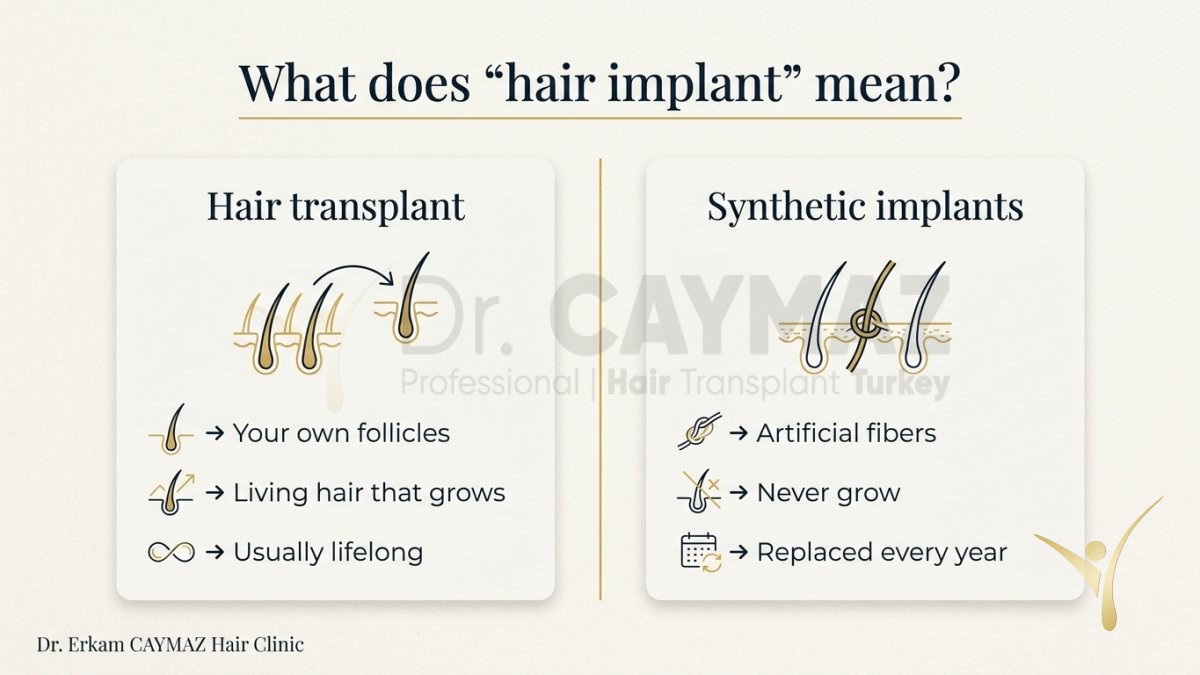
In everyday language, "hair implant" almost always means a hair transplant. Nothing artificial is implanted. Your own hair follicles are taken from the donor area at the back and sides of the head and moved to the areas that are thinning. Because donor hair is naturally resistant to DHT, the hormone behind pattern hair loss, it keeps growing in its new place.
The word "implant" sounds like a device, which is why it causes confusion. Surgeons use it in a narrower sense: implantation is the step in which each graft is placed into the scalp, for example with a DHI pen in the DHI technique. So a "hair implant" in a clinic's brochure is usually just a transplant described in plain words.
The exception is synthetic hair implants, where artificial fibers are placed into the scalp. They're covered in their own section below because they work and behave completely differently.
What are grafts and follicular units?
Hair doesn't grow as single strands spread evenly over the scalp. It grows in small natural groups of one to four hairs, called follicular units. When one of these units is moved during a transplant, it's called a graft.
That's why transplants are planned and priced in grafts, not hairs. A session of 3,000 grafts holds roughly two to three times as many hairs, because most grafts carry more than one hair. Single-hair grafts are kept for the very front of the hairline, where they look softest, and multi-hair grafts are placed behind them for density. Our article on how many hairs are in one graft explains the numbers in more detail.
In our clinic, grafts are extracted one by one with a fine punch about 0.8–0.9 mm across. This is the FUE method, explained on our FUE method page.
The terms at a glance
| Term | What it usually means | Your own hair? |
|---|---|---|
| Hair implant | A hair transplant, described in everyday words | Yes |
| Hair transplant | Moving follicles from the donor area to thinning areas | Yes |
| Graft | One follicular unit of 1–4 hairs, moved during surgery | Yes |
| Implantation | The step of placing each graft, for example with a DHI pen | Yes |
| Hair plugs | Old large punch grafts that gave a tufted look | Yes, outdated method |
| Synthetic hair implant | Artificial fibers stitched into the scalp | No |
What are synthetic hair implants?
Synthetic hair implants use man-made fibers, sometimes sold under brand names, that are knotted into the scalp with a needle. The appeal is obvious: there's no donor area to limit how much "hair" can be placed, and the result is visible the same day.
The drawbacks are serious. The body treats the fibers as foreign material, so inflammation, infection and scarring are common risks. The fibers don't grow, and they break and fall out over time, so a share of them has to be replaced every year for as long as you want to keep the result. Scarring from repeated rounds can also make a future hair transplant harder, because grafts grow less well in scarred skin. In the United States, the FDA has banned prosthetic hair fibers as implants since the 1980s.
We don't offer synthetic implants, and we don't recommend them. Every transplant in our clinic uses only your own hair.
Do hair implants grow?
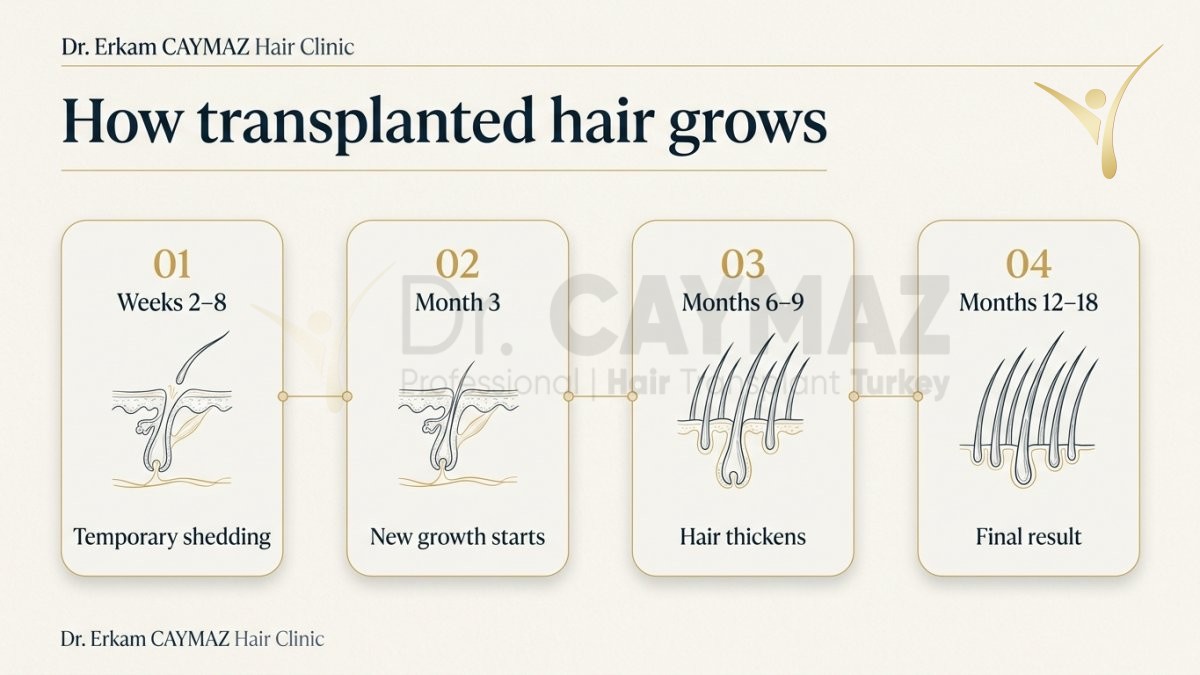
If "hair implants" means a transplant of your own hair, yes, they grow like normal hair, because each graft contains a living follicle. The growth follows a predictable pattern:
- Weeks 2 to 8: most transplanted hairs shed. This is normal and doesn't mean the grafts were lost; the follicles stay in place under the skin.
- Around month 3: new, fine hairs start to appear.
- Months 6 to 9: most of the hair has grown in and thickens.
- Months 12 to 18: the final result, with full thickness and texture.
Synthetic fibers, by contrast, never grow at all. For a closer look at how many grafts survive and why, see do all transplanted hairs grow.
Are hair implants permanent?
Transplanted hair comes from the donor area, where follicles are genetically resistant to the hormone that causes pattern hair loss. That's why it usually keeps growing for the rest of your life. In our clinic we describe graft survival as up to 98% and the overall success rate as 90–95%, because individual results always vary and no honest clinic promises 100%.
What isn't permanent is the native hair around the transplant. If your hair loss is still progressing, the surrounding hair can keep thinning, which is why medication is often recommended and why many patients at Norwood 4 or higher plan at least two sessions, spaced at least six months apart. Our article is a hair transplant permanent covers this in detail.
Dr. Caymaz Insight
| Many patients write to me asking for "hair implants", and almost all of them mean a transplant with their own hair. I always check, because a few have seen ads for synthetic fibers and expect an instant, unlimited result. I explain that artificial fibers don't grow, need replacing and can scar the scalp, which can make a real transplant harder later. Your own follicles are the only material that grows naturally and keeps growing, so that's the only material we use. |
What happened to "hair plugs"?
"Hair plugs" refers to an older technique in which round pieces of scalp, each holding many hairs, were moved in one block. The result often looked like rows of doll hair, which is the image many people still have of hair transplants.
Modern surgery moves individual follicular units instead, each one placed at the angle and direction of the surrounding hair. The front edge of the hairline is built from single-hair grafts so that it looks soft and natural. If you see the word "plugs" used today, it's usually a leftover term rather than a description of current practice.
What should you ask a clinic?
When a clinic offers "hair implants", a few questions make clear what you're actually buying:
- Is it my own hair? The answer should be yes. If any synthetic material is involved, walk away.
- How many grafts, not hairs? Graft counts are the honest way to compare offers.
- Which technique, and who does what? Ask who plans the hairline, who opens the channels and who places the grafts.
- How is my donor area protected? A good plan keeps enough donor hair in reserve for the future.
If you'd like a plan based on your own hair loss, send clear photos of the front, top, crown and back of your head. Dr. Caymaz reviews every case personally and will tell you how many grafts you need and what result is realistic.
Scientific Sources
FAQ
Usually, yes. When people say hair implants, they almost always mean a hair transplant, in which your own follicles are moved from the donor area at the back of the head to thinning areas. The exception is synthetic hair implants, which use artificial fibers.
Transplanted hair grows like normal hair because each graft holds a living follicle. Most transplanted hairs shed in weeks 2 to 8, new growth starts around month 3, and the final result takes 12 to 18 months. Synthetic fibers never grow.
Transplanted hair comes from DHT-resistant donor follicles and usually keeps growing for life. The native hair around it can keep thinning, so medication is often recommended and patients at Norwood 4 or higher usually plan at least two sessions.
Artificial fibers knotted into the scalp with a needle. They give an instant result but don't grow, break over time, need yearly replacement and carry risks of inflammation, infection and scarring. The US FDA has banned prosthetic hair fibers as implants since the 1980s.
A graft is one follicular unit, a natural group of one to four hairs, moved during a transplant. Transplants are planned and priced by graft count, and one graft holds on average more than one hair.
No. Hair plugs were large round punch grafts holding many hairs, which often looked like rows of doll hair. Modern surgery moves individual follicular units, with single-hair grafts at the front of the hairline for a natural look.
No. Every transplant in our clinic uses only the patient's own hair. We don't offer or recommend synthetic fiber implants.

Golden ratio: hairline creating during hair transplantation?
The hairline is the most visible part of a hair transplant. Patients often hear about the golden ratio, a mathematical…
Read More: Golden ratio: hairline creating during hair transplantation?
Psychological Processes Before and After Hair Transplantation
Hair transplantation has a psychological timeline as well as a surgical timeline. Anxiety often rises during early…
Read More: Psychological Processes Before and After Hair Transplantation
Hair Transplant Quote Checklist: Turkey vs USA Costs
Turkey VIP hair transplant packages typically run €5,000–€8,000 all-inclusive (Sapphire FUE) or €5,000–€6,000 (DHI)…
Read More: Hair Transplant Quote Checklist: Turkey vs USA Costs
Good Hair Transplant Candidates: Eligibility and Success Factors
Good Hair Transplant Candidates and What Must Be True Featured Snippet A good hair transplant candidate must have a…
Read More: Good Hair Transplant Candidates: Eligibility and Success FactorsFrequently Asked Questions
Professional Hair Transplant Insights by Dr. Erkam Caymaz