


Chiffres clés
| Plan global Norwood 7 | ~ 7 000 greffons (répartis sur plus de 2 sessions) |
|---|---|
| Gamme de packs EXCLUSIFS | 3 500 à 4 500 greffons par séance |
| Plafond mono-séance (notre clinique) | Jusqu'à 5 000 à 5 500 greffons lorsque la réserve du donneur le permet |
| Écart minimum entre les séances | 6 mois |
| Temps de greffe idéal hors du corps | < 4 heures |
| Survie du greffon (séance contrôlée) | Jusqu'à 98% |
Points clés à retenir
| Un patient qui a besoin d'environ 7 000 greffons pour une couverture complète est généralement Norwood 7; ce numéro décrit un plan de restauration total, et non un seul jour opérationnel. |
| 7 000 greffes ne peuvent pas être réalisées en toute sécurité en une seule séance ou sur deux jours consécutifs; le tissu du donneur a besoin de mois pour récupérer entre les récoltes. |
| Notre clinique n'effectue ni ne recommande des projets consécutifs tels que la moitié des greffes aujourd'hui et l'autre moitié demain. |
| Les cas avancés nécessitent au moins deux séances distinctes avec un intervalle minimum de six mois entre eux. |
| Chaque séance reste dans les limites de ce que le donneur peut fournir en toute sécurité, généralement 3 500 à 4 500 greffons sur les forfaits EXCLUSIFS et jusqu'à 5 500 greffons dans des cas sélectionnés de donneurs forts. |
Un patient qui a besoin d'environ 7 000 greffons pour une couverture significative de la racine des cheveux à la couronne, est généralement classé comme Norwood 7. Les cas Norwood 5 et 6 peuvent également nécessiter une stadification, mais ils nécessitent généralement moins de greffons au total. Le chiffre de sept mille greffes décrit un plan de restauration à vie, et non ce qui peut être extrait et implanté en toute sécurité en une journée opératoire. Une question de recherche courante suit : "Puis-je obtenir un 7000 greffes de cheveux en deux jours et en finir avec ça ? » Certaines cliniques annoncent exactement cela, répartissant une méga-extraction sur plusieurs jours opératoires consécutifs afin que le patient rentre chez lui le troisième jour. Ce n’est pas ainsi que nous planifions une restauration avancée. Le Dr Caymaz n'effectue ni ne recommande de méga-séances de jours consécutifs. Cet article explique pourquoi deux opérations distinctes à des mois d’intervalle, et non à deux jours de suite, protègent la santé du donneur et la survie du greffon.
Pourquoi un plan de 7 000 greffes signifie-t-il généralement Norwood 7 ?
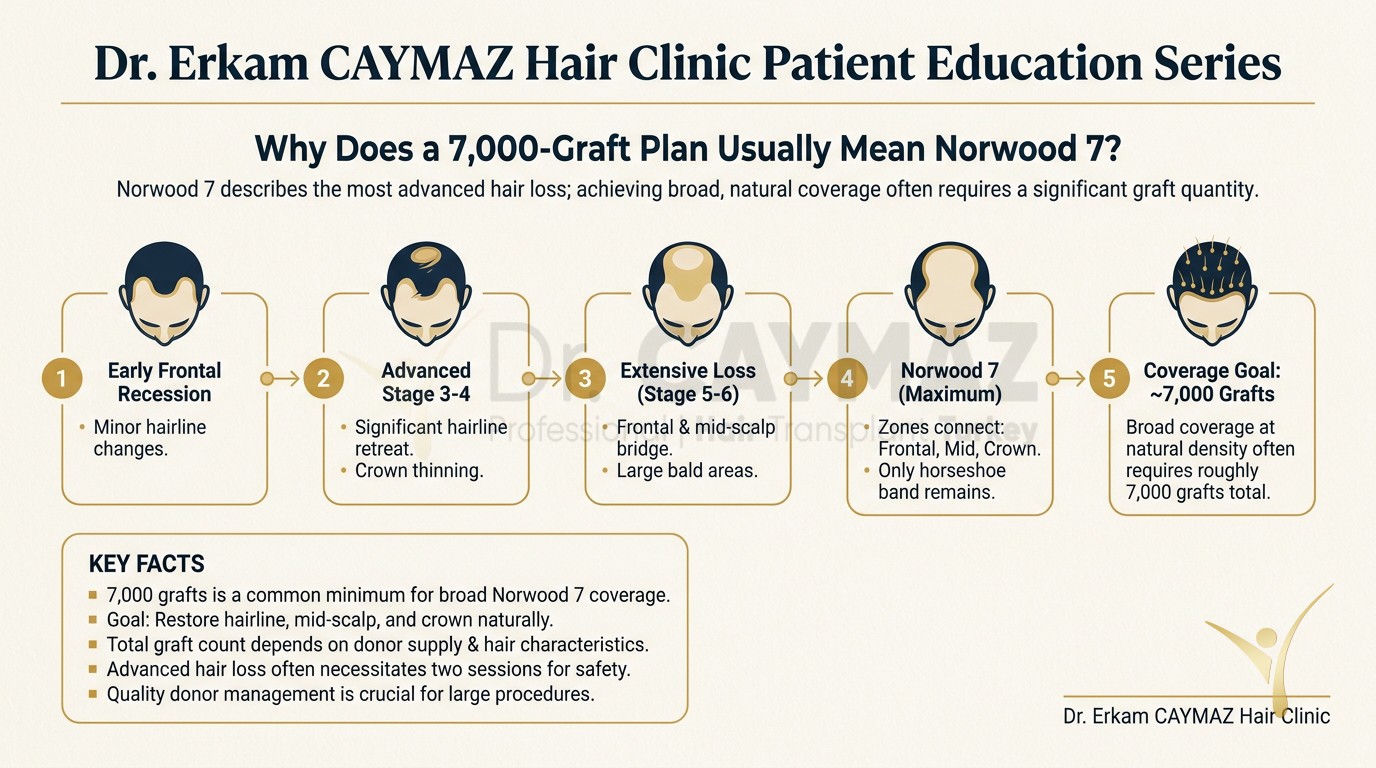
Norwood 7 décrit la perte de cheveux masculine la plus avancée : les zones frontales, médianes du cuir chevelu et de la couronne se connectent, ne laissant qu'une bande en fer à cheval de cheveux indigènes sur les côtés et à l'arrière. Les guides de planification citent souvent grossièrement 7 000 greffons au total minimum lorsque l’objectif est une large couverture à densité naturelle sur l’ensemble de ce modèle. Les étapes inférieures de Norwood nécessitent des totaux plus petits ; Norwood 5 peut cibler 5 000 greffons selon un plan par étapes, et Norwood 6 en atterrit souvent près de 6 000. Des exemples concrets apparaissent dans notre Études de cas Norwood 5, 6 et 7.
Le zone donatrice, la bande de cheveux résistants à la DHT située entre les oreilles, contient un réservoir limité. Dans le cuir chevelu d’un homme de race blanche en bonne santé, la densité des donneurs est en moyenne d’environ 65 à 80 unités folliculaires par centimètre carré. L’offre totale de donneurs sûrs varie généralement de 6 000 à 8 000 greffons au cours d’une vie, en fonction du laxisme du cuir chevelu, du calibre des cheveux et de la composition du greffon. Lorsqu'un chirurgien propose 7 000 greffons, la question n'est jamais « à quelle vitesse pouvons-nous les déplacer ? mais combien de séances le donneur peut supporter sans amincissement visible. Les calculs de greffe zone par zone sont détaillés dans notre guide sur de combien de greffons vous avez réellement besoin.
Qu'arrive-t-il à la zone donneuse lors d'une extraction de 7 000 greffons ?
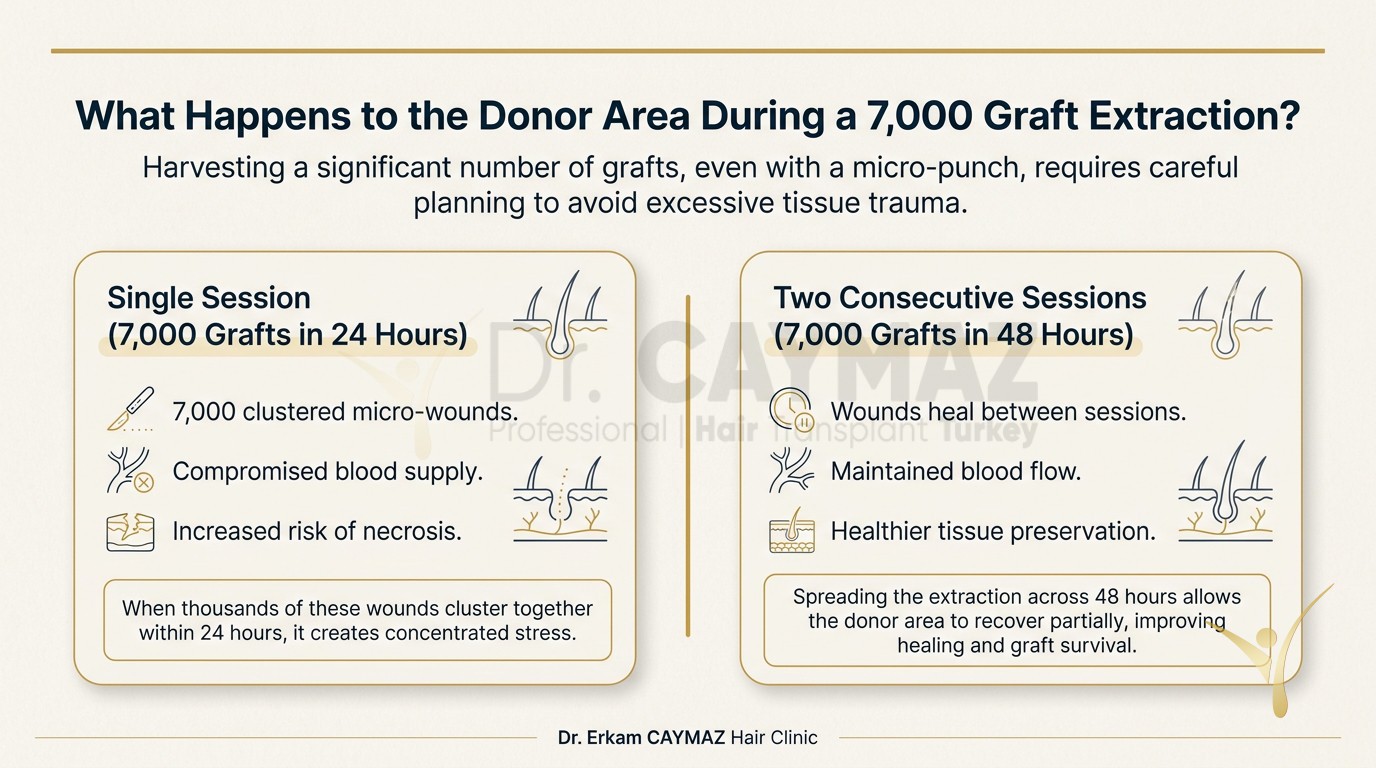
Retirer 7 000 greffons en une seule séance, ou sur deux jours consécutifs, signifie récolter la quasi-totalité de l’approvisionnement à vie en 48 heures. Même avec un poinçon de 0,8 mm, chaque site d'extraction laisse une micro-plaie qui a besoin d'un flux sanguin pour guérir. Lorsque des milliers de ces plaies se regroupent en 24 à 48 heures, les tissus qui les séparent peuvent perdre une perfusion adéquate. Le résultat est surexploitation de la zone donneuse, où l'arrière de la tête semble visiblement mince, rongé par les mites ou marqué. Vous pouvez en savoir plus sur surexploitation dans la greffe de cheveux et pourquoi c'est l'une des erreurs irréversibles les plus courantes dans le domaine.
Comparez cela avec une session unique contrôlée adaptée au donneur. De nombreux patients correspondent au Gamme de forfaits EXCLUSIFS de 3 500 à 4 500 greffons. Lorsque la densité et le laxisme sont forts, une séance à notre clinique peut atteindre jusqu'à 5 000 à 5 500 greffons après évaluation individuelle. Les sites d'extraction restent suffisamment espacés pour que les follicules environnants masquent le prélèvement, que l'approvisionnement en sang reste intact et qu'une deuxième séance puisse utiliser les réserves restantes une fois que les tissus ont complètement récupéré.
Pourquoi le temps de greffe hors du corps est-il si important ?
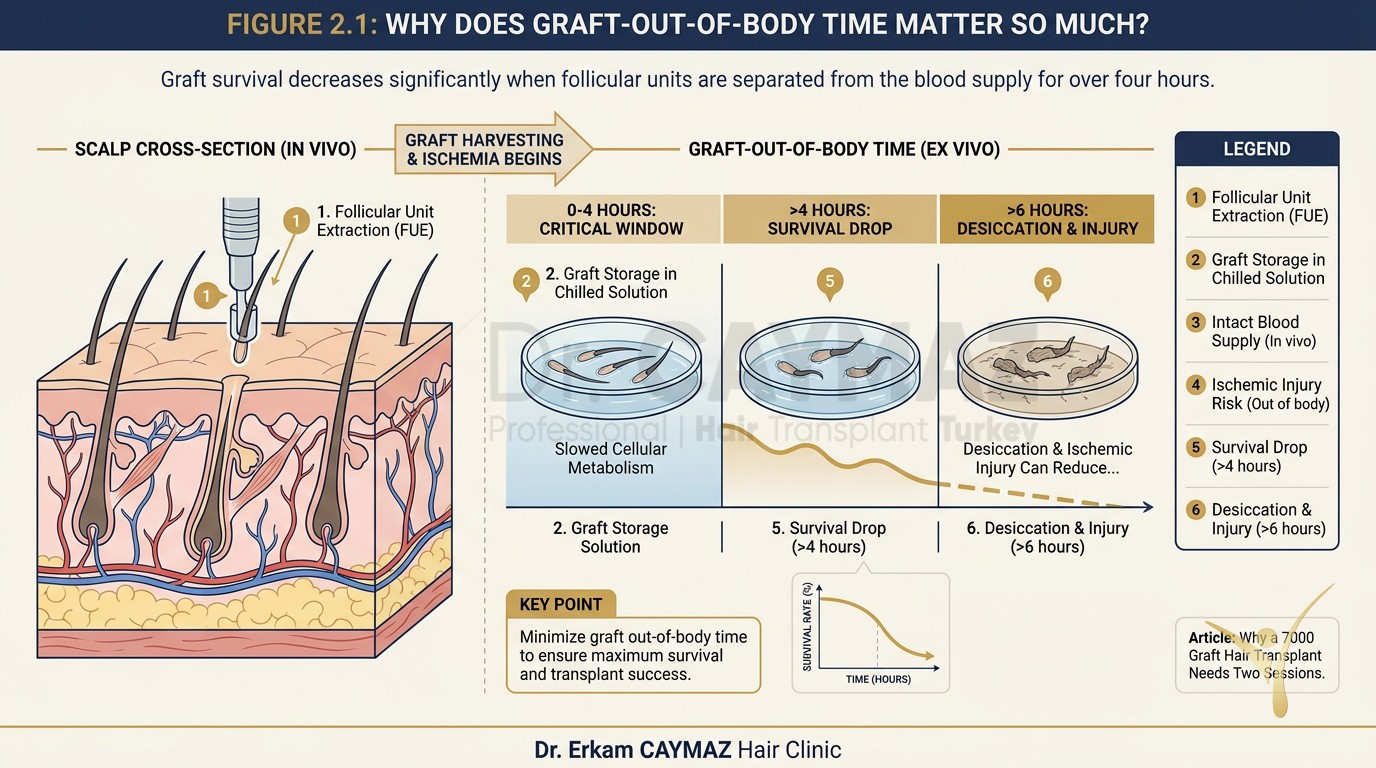
Chaque unité folliculaire retirée du cuir chevelu commence un compte à rebours. Une fois séparé de son apport sanguin, le greffon repose sur une solution de rétention réfrigérée pour ralentir le métabolisme cellulaire. Les données publiées montrent que la survie du greffon chute de manière mesurable lorsque le temps passé hors du corps dépasse quatre heures. Au-delà de six heures, la dessiccation et les lésions ischémiques peuvent réduire les taux de prise de 10 à 20 pour cent, voire plus.
Dans un marathon de 7 000 greffons, les premiers greffons extraits le matin peuvent rester en solution pendant huit, dix, voire douze heures avant l'implantation le deuxième jour. Certaines cliniques tentent de résoudre ce problème en effectuant simultanément l’extraction et l’implantation avec de grandes équipes tournantes. Cette approche divise l'attention du chirurgien et exige une coordination que peu d'équipes maintiennent pendant des journées consécutives de 10 heures sans erreurs liées à la fatigue.
Une seule séance bien rythmée maintient le dernier greffon dans cette fenêtre critique de quatre heures. Cela est vrai, que le plan prévoie 4 000 greffons dans un forfait EXCLUSIF ou jusqu'à 5 500 greffons dans le cas d'un donneur important. Le étapes de la procédure de greffe de cheveux sont conçus autour de cette horloge biologique, et non autour d’une promesse marketing d’un maximum de greffons par voyage.
En quoi deux jours consécutifs diffèrent-ils de deux sessions distinctes ?
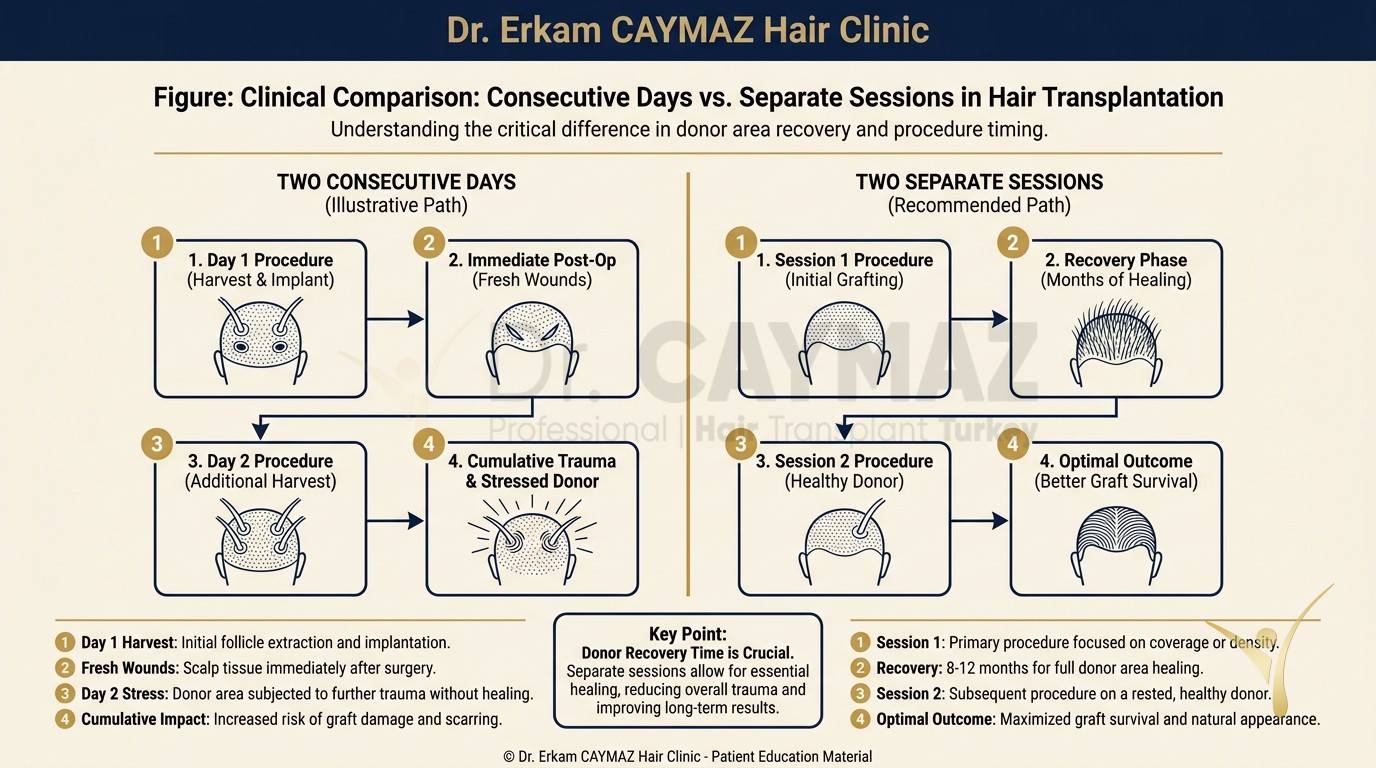
Cette distinction confond de nombreux patients. "Two days" and "two sessions" sound similar but are clinically very different. Deux jours consécutifs signifient toujours que le donneur n'a jamais plusieurs mois pour récupérer, et il est demandé au patient de tolérer une deuxième journée opératoire complète pendant que les plaies du jour 1 sont fraîches. Ce n’est pas la même chose que la session 1 d’aujourd’hui et la session 2 six mois ou plus plus tard.
| Facteur | Deux jours consécutifs | Deux séances (à plus de 6 mois d'intervalle) |
|---|---|---|
| Objectif total de greffe | ~7 000 en 48 heures | ~7 000 sur un plan par étapes |
| Temps de récupération du donneur | ~12 heures entre les jours | Minimum 6 mois entre les séances |
| Nombre de greffes par session | Souvent plus de 3 500 chaque jour (7 000 au total) | Généralement 3 500 à 5 500 par séance (en fonction du donateur) |
| Approvisionnement en sang du cuir chevelu | Toujours compromis par les blessures du premier jour | Restauré avant la session 2 |
| Politique du Dr Caymaz | Non effectué ou recommandé | Plan standard pour les totaux Norwood 7 |
| Potentiel de survie du greffon | Réduit le stress des tissus et les longs temps de maintien | Jusqu'à 98 % par session contrôlée |
| Apparition du donneur | Risque élevé d’amincissement visible | Modèle d'extraction progressif et masqué |
Lorsqu'un patient revient pour la séance 2 au moins six mois plus tard, le chirurgien peut évaluer comment le donneur a guéri, comment les premiers greffons se sont développés et si le plan initial correspond toujours au modèle du patient. Cette flexibilité n’existe pas lorsque les deux jours se déroulent dans la même semaine. Les cas avancés bénéficient d’un traitement structuré planifier une greffe de cheveux avant que le décompte des greffons ne soit finalisé.
Quels sont les risques d’une procédure de greffe de plus de 5 000 greffes en une seule séance ?
Au-delà des dommages causés aux donneurs et des temps d'attente prolongés, plusieurs risques aggravés apparaissent lorsque le nombre de greffons dépasse 5 000 en une journée opératoire.
Exposition prolongée à l'anesthésie. L'anesthésique local à l'épinéphrine engourdit le cuir chevelu et contrôle les saignements. Au cours d'une procédure d'une durée de 10 à 14 heures, le volume total de lidocaïne se rapproche de sa dose maximale sûre. Limites de dosage pour le médicaments administrés lors d'une opération de greffe de cheveux font partie du conseil préopératoire.
Fatigue de l'équipe. Même les techniciens chirurgicaux expérimentés perdent leur précision motrice après huit heures consécutives. Dans une greffe de cheveux, cela se traduit par des greffons écrasés, des incisions mal orientées et une profondeur incohérente.
Œdème du cuir chevelu et perte de choc. Un emballage dense sur une grande zone de réception peut déclencher perte de choc, chute temporaire des poils indigènes. Lire à propos chute de cheveux choc après transplantation si vous comparez les attentes de récupération entre une méga journée et deux séances par étapes.
Notre forfait EXCLUSIF couvre 3 500 à 4 500 greffons par séance. Lorsque la densité, le laxisme et la réserve des donneurs sont forts, une seule séance dans notre clinique peut atteindre jusqu'à 5 000 à 5 500 greffons après évaluation individuelle. Nous ne prévoyons pas 6 000 à 7 000 greffons en une seule séance ou sur plusieurs jours consécutifs. La notion de "le nombre maximum de greffons" est trompeur vaut la peine d’être compris avant de comparer les devis.
Combien de greffons peuvent être transplantés en toute sécurité en une journée ?
Il n’existe pas de numéro universel car chaque cuir chevelu est différent. La densité des donneurs, le calibre des cheveux, le laxisme du cuir chevelu et l’état de santé général influencent tous le plafond. Dans notre clinique, le cité La gamme EXCLUSIVE est de 3 500 à 4 500 greffons par séance. Dans les cas sélectionnés avec une solide réserve de donateurs, un Séance FUE Saphir peut atteindre jusqu'à 5 000 à 5 500 greffons lorsque le chirurgien confirme que le donneur peut le soutenir sans amincissement visible.
Pour un patient Norwood 7 qui a besoin d’environ 7 000 greffons au total, le calcul est simple, même avec un donneur important : La session 1 prend jusqu'à 5 500 greffons au maximum, et la session 2 couvre le reste après un intervalle de guérison minimum de six mois. Sept mille greffes ne peuvent toujours pas être réalisées en une seule séance ou sur deux jours consécutifs. Cette approche par étapes protège les réserves de donneurs, permet au chirurgien d'évaluer la croissance de la première séance avant de finaliser le deuxième plan et maintient chaque journée opératoire dans des limites physiologiques sûres.
Dr Caymaz Insight
| Lorsqu'un patient Norwood 7 a besoin d'environ 7 000 greffons, je ne prévois jamais « la moitié aujourd'hui, la moitié demain ». Je n’effectue ni ne recommande de méga-sessions consécutives. Nous répartissons les travaux en au moins deux opérations distinctes espacées d'un minimum de six mois. La séance 1 peut atteindre jusqu'à 5 500 greffons lorsque le donneur est fort, mais jamais 7 000 en un jour ou deux jours d'affilée. J'ai vu des patients arriver ailleurs après un marathon de 6 000 à 7 000 greffons de deux jours, et la zone donneuse raconte l'histoire : inégale, trop amincie, avec des cicatrices visibles qui limitent toute correction future. Lorsque je planifie une restauration avancée, je dessine personnellement la racine des cheveux, crée les incisions receveuses avec des lames en saphir et supervise l'extraction et l'implantation tout au long de chaque séance. Réaliser 7 000 greffons en 48 heures troque la densité à long terme contre une commodité à court terme. Le donateur est une ressource non renouvelable et je le traite ainsi. |
Que devriez-vous demander à une clinique qui propose 7 000 greffons en deux jours ?
Si une clinique propose une méga séance consécutive de deux jours, posez des questions pointues avant d'accepter.
« Est-ce que les deux jours auront lieu dans la même semaine, et combien de greffons par jour ? Si la réponse est des milliers d’extractions sur des jours consécutifs, le donneur ne bénéficie jamais des mois de récupération nécessaires entre les séances.
« Combien de chirurgiens et de techniciens travailleront sur moi simultanément ? » Les cliniques à volume élevé peuvent faire tourner plusieurs équipes. Compréhension le rôle de l'équipe dans la greffe de cheveux vous aide à évaluer si le modèle donne la priorité à la qualité ou au débit.
"Quel est le rôle du chirurgien lors de l'extraction et de l'implantation ?" Dans une configuration responsable, le chirurgien s'occupe de la consultation, de la conception de la racine des cheveux et des incisions tandis que des techniciens qualifiés extraient et placent les greffons sous supervision directe.
« Puis-je voir des photos de la zone donneuse, pas seulement du receveur ? » Une procédure bien exécutée laisse au donneur une apparence pleine et naturelle. Consultez des exemples dans notre galerie des résultats des patients.
Comment la planification par étapes protège-t-elle vos résultats à long terme ?
La chute des cheveux est progressive. Si tous les greffons de donneurs disponibles étaient utilisés en une seule méga-séance à 35 ans, il ne resterait peut-être plus rien pour faire face à une nouvelle récession à 45 ans. La planification par étapes crée une marge de sécurité. Entre les séances, un traitement médical au finastéride ou au minoxidil peut stabiliser les cheveux existants et potentiellement réduire les greffes nécessaires lors de la séance 2. Voir finastéride moa pour savoir comment ces médicaments fonctionnent.
La session 1 aborde généralement le tiers frontal et milieu du cuir chevelu, les zones qui encadrent le visage. Six à douze mois plus tard, une fois que ces greffons se sont développés et que le donneur a guéri, la session 2 aborde la couronne et les espaces restants au milieu du cuir chevelu. Tous les patients n’ont pas besoin de la séance 2 selon le calendrier initial ; les indicateurs pour une opération de suivi sont traités dans notre note sur quand une deuxième séance est appropriée.
Les patients internationaux peuvent planifier chaque séance comme un voyage distinct. Ce modèle coûte plus de temps de trajet qu’un marathon de deux jours, mais il préserve le capital des donateurs et la qualité de la greffe. Commencez par un consultation le plan correspond donc à votre étape Norwood et à votre réserve de donateurs.
Que disent les preuves sur les méga-sessions et la survie des greffes ?
La littérature évaluée par les pairs soutient systématiquement le principe selon lequel des durées opératoires plus courtes et un plus petit nombre de greffons par séance sont en corrélation avec des taux de survie plus élevés. Les greffes d'unités folliculaires conservées pendant plus de six heures présentent une repousse plus faible que celles implantées dans un délai de deux à quatre heures. À notre clinique, nous effectuons 1 à 2 opérations VIP par jour, environ 15 patients par mois, de sorte que chaque cas reçoit toute l'attention nécessaire sans la pression de la chaîne de montage.
Les séances contrôlées, avec une durée de greffe hors du corps inférieure à quatre heures, permettent d'obtenir systématiquement des taux de survie de jusqu'à 98%. Des séances marathon qui dépassent 5 500 greffons en un jour, ou répartir 7 000 sur deux jours consécutifs, introduisent des variables qu'aucune compétence ne peut pleinement compenser. Les mauvais résultats sont analysés dans pourquoi certaines greffes sont sous-performantes.
Un plan de deux séances est-il plus cher qu'un marathon de deux jours ?
Un plan en deux séances implique deux voyages et deux périodes de récupération. Certaines cliniques proposent des tarifs attractifs pour les méga-séances car elles traitent des volumes élevés de patients, parfois 5 à 10 opérations par jour, pour compenser les marges plus faibles par greffon.
Mais le calcul financier change si la méga-session produit des résultats sous-optimaux. La chirurgie de révision après un échec de transplantation coûte plus cher que la procédure initiale, tant financièrement qu’en capital du donateur. Un patient qui a perdu 20 % de 7 000 greffons en raison de temps de rétention prolongés a effectivement perdu 1 400 greffons qui ne pourront jamais être récupérés. Lorsque vous comparez le coût total de deux sessions bien exécutées à celui d’une méga session plus une révision potentielle, l’approche par étapes est presque toujours le meilleur investissement. Notre prix et détails du forfait devis par séance basé sur le nombre de greffons qui est sans danger pour votre donneur, et non sur un méga chiffre unique.
Sources et références cliniques
FAQ
Non. Le Dr Caymaz n’effectue ni ne recommande de méga-séances consécutives. L'extraction d'environ 7 000 greffons en 48 heures épuise les réserves de donneurs, prolonge le temps d'extraction du greffon hors du corps au-delà des limites de sécurité et ne permet pas des mois de récupération de tissus entre les récoltes. Les cas Norwood 7 nécessitent au moins deux séances distinctes avec un intervalle minimum de six mois.
Habituellement, oui. Un plan total d'environ 7 000 greffons pour une large couverture de la racine des cheveux à la couronne correspond généralement à la perte du motif Norwood 7. Les patients Norwood 5 et 6 ont souvent besoin de totaux plus petits, bien qu'ils puissent néanmoins nécessiter des séances en deux étapes.
Notre forfait EXCLUSIF couvre 3 500 à 4 500 greffons par séance. Lorsque la densité, le laxisme et la réserve de donneurs sont forts, une seule séance peut atteindre jusqu'à 5 000 à 5 500 greffons après évaluation individuelle. Nous ne prévoyons pas 6 000 à 7 000 greffons en une seule séance ou sur des jours consécutifs.
Un minimum de six mois est requis entre les sessions. Cet intervalle permet à la zone donneuse de guérir, rétablit l'approvisionnement en sang du cuir chevelu et donne aux greffons de la première séance le temps de commencer à se développer afin que le chirurgien puisse évaluer la couverture avant de planifier la séance 2. De nombreux chirurgiens préfèrent 10 à 12 mois avant une nouvelle récolte.
Les cliniques à volume élevé optimisent le confort et le débit des patients. Ils peuvent diriger plusieurs équipes de techniciens simultanément et traiter de nombreux patients par jour. Ce modèle augmente le risque de surexploitation des donneurs, de dessèchement du greffon et de qualité d'implantation incohérente par rapport à la planification VIP par étapes.
Non. Le Dr Caymaz n’effectue ni ne recommande le fractionnement des jours consécutifs pour les cas avancés. Lorsqu'environ 7 000 greffons sont nécessaires, il prévoit au moins deux opérations distinctes à des mois d'intervalle. La séance 1 peut atteindre jusqu'à 5 500 greffons lorsque le donneur est fort ; La session 2 couvre le reste.
Si les 7 000 greffons sont extraits en une seule séance ou sur deux jours consécutifs, l’amincissement visible du donneur présente un risque élevé. L'extraction par étapes sur deux séances espacées d'au moins six mois permet au chirurgien de répartir uniformément les sites de prélèvement et de préserver l'aspect naturel de la zone donneuse.
Le Dr Caymaz conçoit un plan de deux séances avec au moins six mois entre les procédures. La session 1 peut inclure jusqu'à 5 500 greffons lorsque la réserve du donneur le permet ; La session 2 aborde les objectifs de couverture restants. Il s'occupe personnellement de la consultation, de la conception de la racine des cheveux et des incisions du site receveur à l'aide de lames en saphir, tandis que son équipe de techniciens qualifiés effectue l'extraction et l'implantation sous sa supervision directe.

Un taux de réussite de 100 % est-il possible en greffe de cheveux ?
Les patients demandent si un Taux de réussite de greffe de cheveux de 100 % est possible. Réponse éthique : aucune…
Lire Plus: Un taux de réussite de 100 % est-il possible en greffe de cheveux ?
Greffe de cheveux sous sédation ou rester éveillé : à quoi s'attendre
Aucune sédation n’est nécessaire pour une greffe de cheveux. Dans notre clinique, chaque opération utilise uniquement…
Lire Plus: Greffe de cheveux sous sédation ou rester éveillé : à quoi s'attendre
Soins post-greffe de cheveux : conseils pour une récupération optimale
Les soins post-greffe protègent l’ancrage du greffon, la cicatrisation du cuir chevelu et l’apparence à long terme. On…
Lire Plus: Soins post-greffe de cheveux : conseils pour une récupération optimaleQuestions fréquemment posées
Conseils professionnels en greffe de cheveux par le Dr Erkam Caymaz