


Schnelle Zahlen
| Norwood 7 Gesamtplan | ~7.000 Transplantate (inszeniert in mehr als 2 Sitzungen) |
|---|---|
| EXKLUSIVES Paketsortiment | 3.500–4.500 Transplantate pro Sitzung |
| Einzelsitzungsdecke (unsere Klinik) | Bis zu 5.000–5.500 Transplantate, wenn die Spenderreserve dies zulässt |
| Mindestabstand zwischen den Sitzungen | 6 Monate |
| Ideale Transplantationszeit außerhalb des Körpers | < 4 Stunden |
| Überleben des Transplantats (kontrollierte Sitzung) | Bis zu 98 % |
Wichtige Erkenntnisse
| Normalerweise benötigt ein Patient etwa 7.000 Transplantate für eine vollständige Abdeckung Norwood 7; Diese Zahl beschreibt einen vollständigen Wiederherstellungsplan und nicht einen einzelnen Operationstag. |
| 7.000 Transplantationen können nicht sicher in einer Sitzung oder an zwei aufeinanderfolgenden Tagen durchgeführt werden; Spendergewebe braucht Monate, um sich zwischen den Ernten zu erholen. |
| Dr. Caymaz leistet keine Leistung oder empfiehlt aufeinanderfolgende Tagespläne, z. B. die Hälfte der Transplantate heute und die andere Hälfte morgen. |
| Fortgeschrittene Fälle erfordern mindestens zwei getrennte Sitzungen mit einem Abstand von mindestens sechs Monaten dazwischen. |
| Each session stays within what the donor can safely supply, typically 3,500–4,500 grafts on EXCLUSIVE packages and up to 5,500 grafts in selected strong-donor cases. |
A patient who needs roughly 7,000 grafts for meaningful coverage from the hairline to the crown is usually classified as Norwood 7. Norwood 5 and 6 cases may also need staging, but they typically require fewer grafts in total. The seven-thousand-graft figure describes a lifetime restoration plan, not what can safely be extracted and implanted in one operative day. A common search question follows: "Can I get a 7000 graft hair transplant in two days and be done with it?" Some clinics advertise exactly that, splitting a mega extraction across back-to-back operative days so the patient flies home on day three. That is not how we plan advanced restoration. Dr. Caymaz does not perform or recommend consecutive-day mega sessions. This article explains why two separate operations months apart, not two days in a row, protect donor health and graft survival.
Why Does a 7,000-Graft Plan Usually Mean Norwood 7?
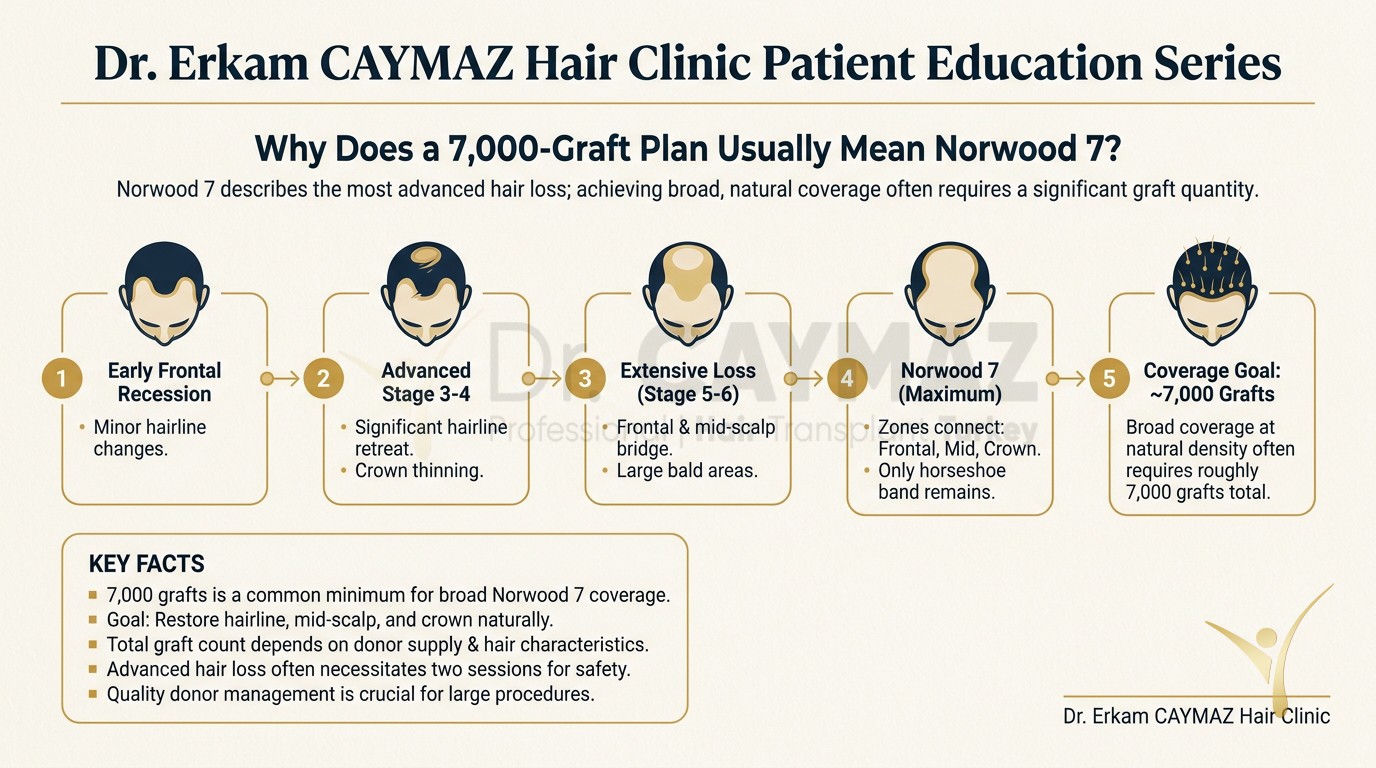
Norwood 7 describes the most advanced male pattern hair loss: the frontal, mid-scalp, and crown zones connect, leaving only a horseshoe band of native hair at the sides and back. Planning guides often cite roughly 7,000 grafts as a minimum total when the goal is broad coverage at natural density across that entire pattern. Lower Norwood stages need smaller totals; Norwood 5 might target 5,000 grafts over a staged plan, and Norwood 6 often lands near 6,000. Real-world examples appear in our Norwood 5, 6, and 7 case studies.
The donor area, the band of DHT-resistant hair between the ears, holds a finite reservoir. In a healthy Caucasian male scalp, donor density averages about 65 to 80 follicular units per square centimeter. The total safe donor supply typically ranges from 6,000 to 8,000 grafts over a lifetime, depending on scalp laxity, hair caliber, and graft composition. When a surgeon quotes 7,000 grafts, the question is never "how fast can we move them?" but how many sessions the donor can support without visible thinning. Zone-by-zone graft math is broken down in our guide on how many grafts you actually need.
What Happens to the Donor Area During a 7,000 Graft Extraction?
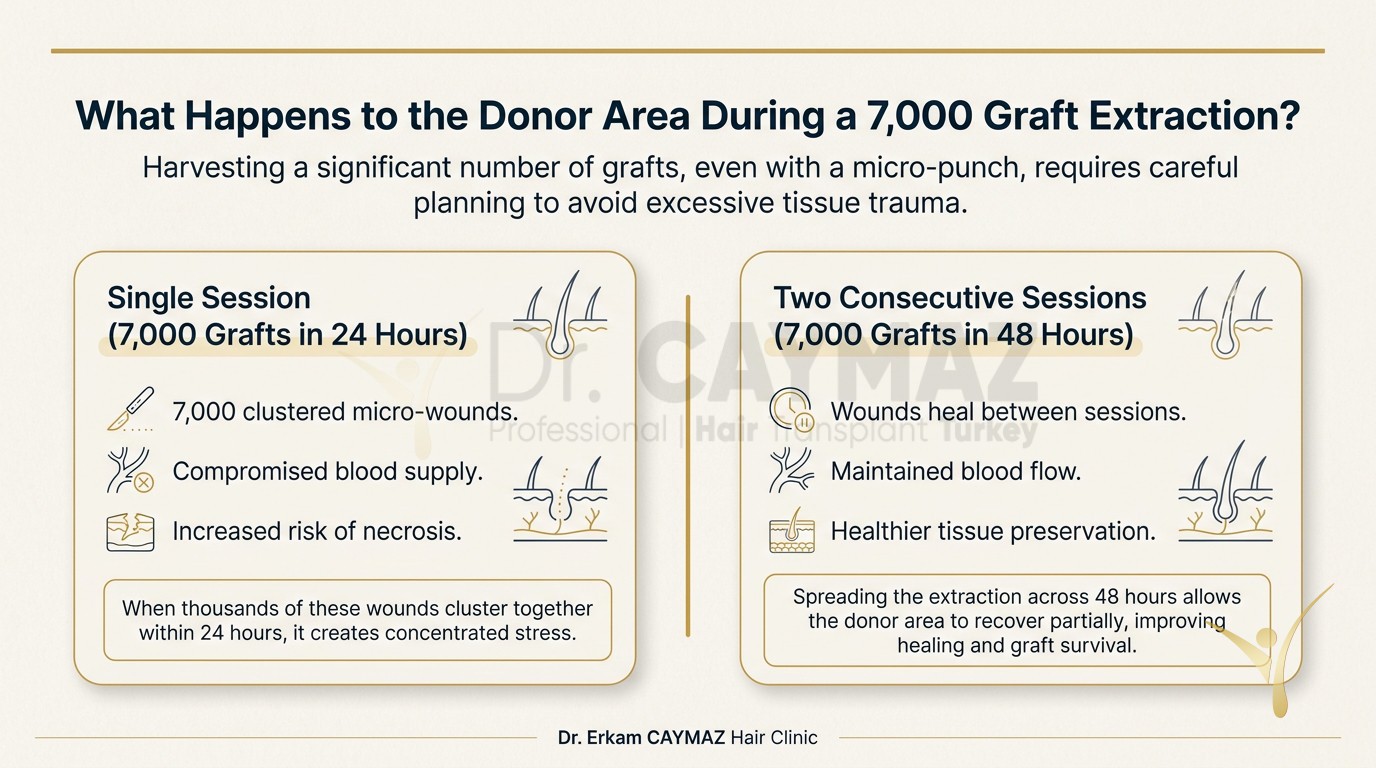
Removing 7,000 grafts in a single sitting, or across two consecutive days, means harvesting nearly the entire lifetime supply within 48 hours. Even with a 0.8 mm punch, each extraction site leaves a micro-wound that needs blood flow to heal. When thousands of these wounds cluster together within 24 to 48 hours, the tissue between them can lose adequate perfusion. The result is donor area overharvesting, where the back of the head looks visibly thin, moth-eaten, or scarred. You can read more about overharvesting in hair transplantation and why it is one of the most common irreversible mistakes in the field.
Contrast that with a controlled single session sized to the donor. Many patients fit the EXCLUSIVE package range of 3,500 to 4,500 grafts. When density and laxity are strong, one session at our clinic may reach up to 5,000 to 5,500 grafts after individual assessment. Extraction sites stay spaced enough that surrounding follicles mask the harvest, blood supply remains intact, and a second session can use remaining reserves once tissue has fully recovered.
Why Does Graft-Out-of-Body Time Matter So Much?
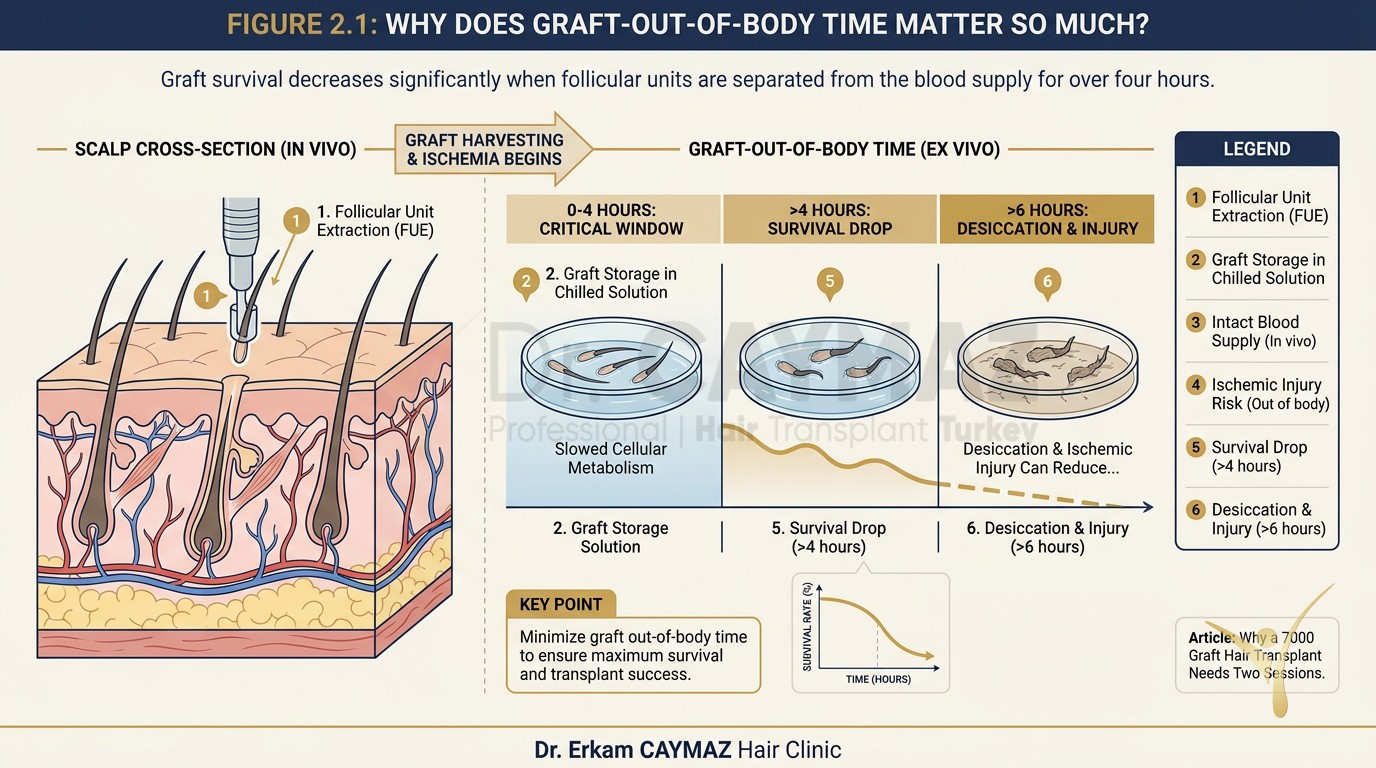
Every follicular unit removed from the scalp begins a countdown. Once separated from its blood supply, the graft relies on chilled holding solution to slow cellular metabolism. Published data show that graft survival drops measurably when out-of-body time exceeds four hours. Beyond six hours, desiccation and ischemic injury can reduce take rates by 10 to 20 percent or more.
In a 7,000 graft marathon, the first grafts extracted in the morning may sit in solution for eight, ten, even twelve hours before implantation on the second day. Some clinics try to solve this by running extraction and implantation simultaneously with large rotating teams. That approach divides the surgeon's attention and demands coordination that few teams sustain over consecutive 10-hour days without fatigue-related errors.
A well-paced single session keeps the last graft within that critical four-hour window. That is true whether the plan calls for 4,000 grafts on an EXCLUSIVE package or up to 5,500 grafts in a strong-donor case. The hair transplant procedure steps are designed around this biological clock, not around a marketing promise of maximum grafts per trip.
How Do Two Consecutive Days Differ from Two Separate Sessions?
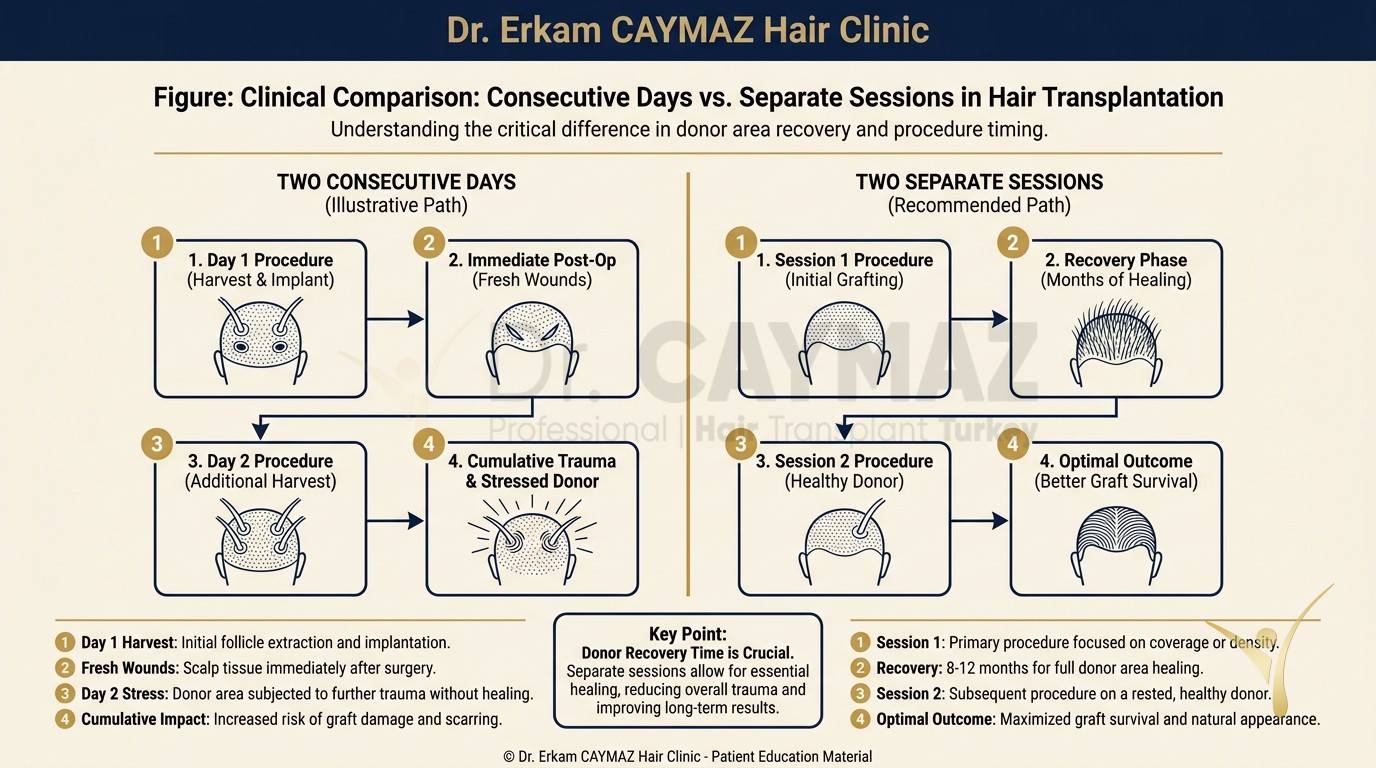
This distinction confuses many patients. "Two days" and "two sessions" sound similar but are clinically very different. Two consecutive days still mean the donor never gets months to recover, and the patient is asked to tolerate a second full operative day while Day 1 wounds are fresh. That is not the same as Session 1 today and Session 2 six or more months later.
| Factor | Two consecutive days | Two sessions (6+ months apart) |
|---|---|---|
| Total graft goal | ~7,000 in 48 hours | ~7,000 over a staged plan |
| Donor recovery time | ~12 hours between days | Minimum 6 months between sessions |
| Per-session graft count | Often 3,500+ each day (7,000 total) | Typically 3,500–5,500 per session (donor-dependent) |
| Scalp blood supply | Still compromised from Day 1 wounds | Restored before Session 2 |
| Dr. Caymaz policy | Not performed or recommended | Standard plan for Norwood 7 totals |
| Graft survival potential | Reduced by tissue stress and long hold times | Up to 98% per controlled session |
| Donor appearance | High risk of visible thinning | Gradual, masked extraction pattern |
When a patient returns for Session 2 at least six months later, the surgeon can evaluate how the donor healed, how the first grafts grew, and whether the original plan still fits the patient's pattern. That flexibility does not exist when both days happen in the same week. Advanced cases benefit from structured planning for hair transplantation before any graft count is finalized.
What Are the Risks of a Single-Session 5,000+ Graft Procedure?
Beyond donor damage and extended hold times, several compounding risks appear when graft counts climb past 5,000 in one operative day.
Prolonged anesthesia exposure. Lokalanästhetikum mit Adrenalin betäubt die Kopfhaut und stoppt Blutungen. Bei einem Eingriff, der 10 bis 14 Stunden dauert, nähert sich die Gesamtmenge an Lidocain der maximalen sicheren Dosis. Dosierungsgrenzen für die medications given during a hair transplant operation are part of pre-operative counseling.
Team fatigue. Even experienced surgical technicians lose fine motor precision after eight continuous hours. In a hair transplant, that translates to crushed grafts, misangled incisions, and inconsistent depth.
Scalp edema and shock loss. Dense packing over a large recipient area can trigger shock loss, temporary shedding of native hairs. Read about shock hair loss after transplantation if you are comparing recovery expectations between one mega day and two staged sessions.
Our EXCLUSIVE package covers 3,500 to 4,500 grafts per session. When donor density, laxity, and reserve are strong, a single session at our clinic may reach up to 5,000 to 5,500 grafts after individual assessment. We do not plan 6,000 to 7,000 grafts in one session or across consecutive days. The concept of "maximum grafts" being misleading is worth understanding before you compare quotes.
How Many Grafts Can Safely Be Transplanted in One Day?
There is no universal number because every scalp is different. Donor density, hair caliber, scalp laxity, and overall health all influence the ceiling. At our clinic, the quoted EXCLUSIVE range is 3,500 to 4,500 grafts per session. In selected cases with robust donor reserve, one Sapphire FUE session may reach up to 5,000 to 5,500 grafts when the surgeon confirms the donor can support it without visible thinning.
For a Norwood 7 patient who needs roughly 7,000 grafts total, the math is straightforward even with a strong donor: Session 1 takes up to 5,500 grafts at most, and Session 2 covers the remainder after a minimum six-month healing interval. Seven thousand grafts still cannot be completed in one session or across two consecutive days. This staged approach protects donor reserves, lets the surgeon assess first-session growth before finalizing the second plan, and keeps each operative day within safe physiological limits.
Dr. Caymaz Insight
| When a Norwood 7 patient needs roughly 7,000 grafts, I never plan "half today, half tomorrow." I do not perform or recommend back-to-back-day mega sessions. We split the work into at least two separate operations with a minimum of six months between them. Session 1 may reach up to 5,500 grafts when the donor is strong, but never 7,000 in one day or two days in a row. I have seen patients arrive after a two-day, 6,000 to 7,000 graft marathon elsewhere, and the donor area tells the story: patchy, over-thinned, with visible scarring that limits any future correction. When I plan advanced restoration, I personally draw the hairline, create the recipient incisions with sapphire blades, and supervise extraction and implantation throughout each session. Rushing 7,000 grafts into 48 hours trades long-term density for short-term convenience. The donor is a non-renewable resource, and I treat it that way. |
What Should You Ask a Clinic That Offers 7,000 Grafts in Two Days?
If a clinic proposes a back-to-back two-day mega session, ask pointed questions before agreeing.
"Will both days happen in the same week, and how many grafts per day?" If the answer is thousands of extractions on consecutive days, the donor never receives the months of recovery required between sessions.
"How many surgeons and technicians will be working on me simultaneously?" High-volume clinics may rotate multiple teams. Understanding the role of the team in hair transplantation helps you evaluate whether the model prioritizes quality or throughput.
"What is the surgeon's role during extraction and implantation?" In a responsible setup, the surgeon handles consultation, hairline design, and incisions while trained technicians extract and place grafts under direct supervision.
"Can I see donor-area photos, not just the recipient?" A well-executed procedure leaves the donor looking full and natural. Review examples in our patient results gallery.
How Does Staged Planning Protect Your Long-Term Results?
Hair loss is progressive. If all available donor grafts were used in a single mega session at age 35, there may be nothing left to address further recession at 45. Staged planning builds in a safety margin. Between sessions, medical therapy with finasteride or minoxidil can stabilize existing hair and potentially reduce the grafts needed in Session 2.
Session 1 typically addresses the frontal third and mid-scalp, the zones that frame the face. Six to twelve months later, once those grafts have grown and the donor has healed, Session 2 tackles the crown and any remaining mid-scalp gaps. Not every patient needs Session 2 on the original timeline; indicators for a follow-up operation are covered in our note on when a second session is appropriate.
International patients can schedule each session as a separate trip. That model costs more travel time than a two-day marathon, but it preserves donor capital and graft quality. Start with a consultation so the plan matches your Norwood stage and donor reserve.
What Does the Evidence Say About Mega Sessions and Graft Survival?
Peer-reviewed literature consistently supports the principle that shorter operative times and smaller graft counts per session correlate with higher survival rates. Follicular unit grafts stored for more than six hours show lower regrowth compared with those implanted within two to four hours. At our clinic, we perform 1 to 2 VIP operations per day, approximately 15 patients per month, so each case receives full attention without assembly-line pressure.
Controlled sessions, with graft-out-of-body time kept under four hours, consistently achieve survival rates of up to 98%. Marathon sessions that push past 5,500 grafts in one day, or split 7,000 across two consecutive days, introduce variables that no amount of skill can fully compensate for. Poor outcomes are analyzed in why some transplants underperform.
Is a Two-Session Plan More Expensive Than a Two-Day Marathon?
A two-session plan involves two trips and two recovery periods. Some clinics price mega sessions attractively because they process high patient volumes, sometimes 5 to 10 operations per day, to offset lower per-graft margins.
But the financial calculation changes if the mega session produces suboptimal results. Revision surgery after a failed transplant costs more than the original procedure, both financially and in donor capital. A patient who lost 20% of 7,000 grafts to extended hold times has effectively wasted 1,400 grafts that can never be recovered. When you compare the total cost of two well-executed sessions against one mega session plus a potential revision, the staged approach is almost always the better investment. Our pricing and package details quote per session based on the graft count that is safe for your donor, not a one-size-fits-all mega number.
Sources & clinical references
FAQ
Nein. Dr. Caymaz führt keine aufeinanderfolgenden Mega-Sitzungen durch und empfiehlt diese auch nicht. Die Entnahme von rund 7.000 Transplantaten innerhalb von 48 Stunden erschöpft den Spendervorrat, verlängert die Zeit, in der das Transplantat aus dem Körper gelangt, über sichere Grenzen hinaus und ermöglicht keine monatelange Gewebewiederherstellung zwischen den Entnahmen. Norwood 7-Fälle erfordern mindestens zwei separate Sitzungen mit einem Abstand von mindestens sechs Monaten.
Normalerweise ja. Ein Gesamtplan von etwa 7.000 Transplantaten für eine breite Abdeckung vom Haaransatz bis zum Scheitel entspricht typischerweise einem Norwood-7-Musterverlust. Bei Patienten mit Norwood 5 und 6 sind häufig geringere Gesamtbeträge erforderlich, möglicherweise sind aber dennoch zwei Sitzungen in mehreren Etappen erforderlich.
Unser EXKLUSIV-Paket umfasst 3.500 bis 4.500 Transplantationen pro Sitzung. Wenn die Spenderdichte, Laxität und Reserve hoch sind, kann eine einzelne Sitzung nach individueller Beurteilung bis zu 5.000 bis 5.500 Transplantate erreichen. Wir planen nicht 6.000 bis 7.000 Transplantationen in einer Sitzung oder an aufeinanderfolgenden Tagen.
Zwischen den Sitzungen müssen mindestens sechs Monate vergehen. Dieses Intervall ermöglicht die Heilung des Spenderbereichs, stellt die Blutversorgung der Kopfhaut wieder her und gibt den Transplantaten der ersten Sitzung Zeit, mit dem Wachstum zu beginnen, sodass der Chirurg die Abdeckung bewerten kann, bevor er Sitzung 2 plant. Viele Chirurgen bevorzugen 10 bis 12 Monate vor der erneuten Entnahme.
Kliniken mit hohem Durchsatz optimieren den Patientenkomfort und den Patientendurchsatz. Sie können mehrere Technikerteams gleichzeitig leiten und viele Patienten pro Tag behandeln. Dieses Modell erhöht im Vergleich zur stufenweisen VIP-Planung das Risiko einer Überernte des Spenders, einer Austrocknung des Transplantats und einer inkonsistenten Implantationsqualität.
Nein. Dr. Caymaz führt bei fortgeschrittenen Fällen keine Aufteilung auf aufeinanderfolgende Tage durch und empfiehlt diese auch nicht. Wenn etwa 7.000 Transplantate benötigt werden, plant er mindestens zwei separate Operationen im Abstand von Monaten. Sitzung 1 kann bis zu 5.500 Transplantate erreichen, wenn der Spender stark ist; Sitzung 2 deckt den Rest ab.

Cobblestone-Effekt nach der Haartransplantation: Ursachen und Korrektur
We want to say it is a really rare side effect (1/100.000 - 300.000). "Cobblestone" in hair transplantation refers to a…
Mehr erfahren: Cobblestone-Effekt nach der Haartransplantation: Ursachen und Korrektur
Rotlichttherapie nach Haartransplantation: Timing und Protokolle
Eine Rotlichttherapie (LLLT) mit Wellenlängen von 630–670 nm kann die Heilung der Kopfhaut unterstützen und…
Mehr erfahren: Rotlichttherapie nach Haartransplantation: Timing und Protokolle
Sehenswürdigkeiten in Istanbul während Ihrer Haartransplantation
Istanbul ist eine lebendige Geschichte mit Stadtmauern, Moscheen, Palästen, Museen und vielen historischen Orten. Sie…
Mehr erfahren: Sehenswürdigkeiten in Istanbul während Ihrer HaartransplantationHäufig gestellte Fragen
Fachliche Antworten zur Haartransplantation von Dr. Erkam Caymaz